Sunday, April 28, 2019

Out There: HIGH LIFE

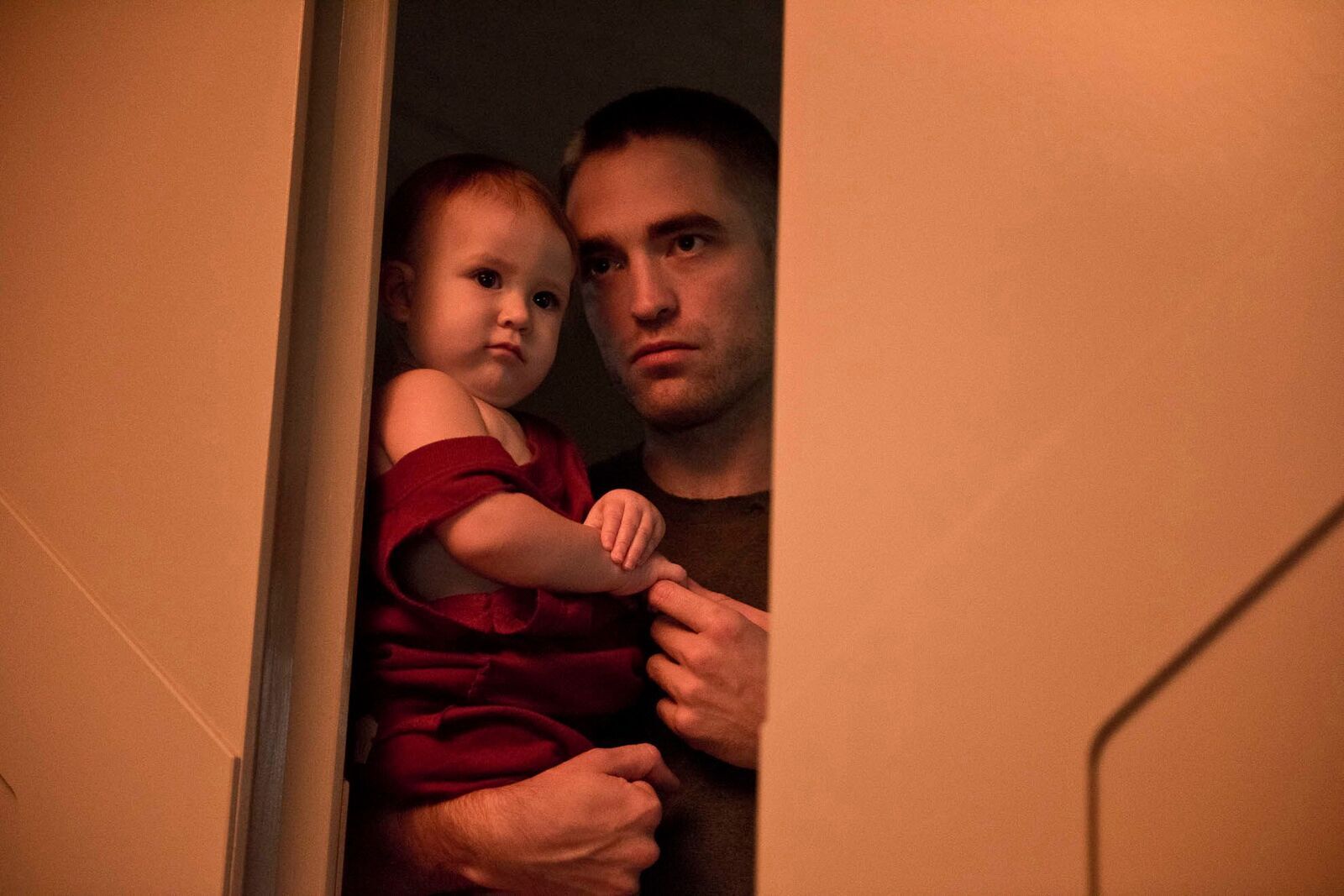
That’s cruelty, says the daughter (Jessie Ross). Her father (Robert Pattinson) replies, What do you know about cruelty? He’s lived it. We’ve seen, deep in his past, he’s perpetrated it: a dog dead in a stream; a child bleeding into the earth. We’ve seen he’s later been the victim of it: one on a crew of death-row prisoners sent into space on a suicide science mission, a one-way state-sponsored ticket to a black hole with a fertility related side-mission. This has been his life. From what we see, cruelty is all he’s known. His daughter, however, had known only him. He’s been to her a man of patience and kindness, tender and hushed, cultivating a bright young woman and a verdant garden alone. Of the initial con-air space flight, the man and child are all that’s left, all that's life. They survive, and yet the man, especially, as the girl is an infant for most of the film, carries with him the knowledge that they’re a dead-end, drifting in solitude and silence to a black hole with no hope of long-term planning or furthering their humanity. 

Because Claire Denis’ film is, in her typical style, hauntedly elliptical and vividly tactile, High Life accumulates hypnotic power from this scenario. She cuts between the isolation of man and child, and the steady decline of the mission that ultimately brought them to this loneliness. It can be sensual, even gross — a film of any and every fluid that can spring forth from the human body — yet within a sterile setting, with long clean corridors and crisp sci-fi suits and screens steadily splattered with the residue of its ensemble’s tensions. There’s a doctor (Juliette Binoche) who seems to be channeling penance for her infanticide past into an unethical attempt to force procreation amongst her fellow prisoners. There are men and women (Mia Goth, Andre Benjamin, Gloria Obianyo, Ewan Mitchell, Lars Eidinger) trying desperately to control their bodies to control their futures, to control their garden to control their environment, knowing that it might all be futile as they’re stuck with their urges in a box steadily shooting through the stars. It moves forward; they go nowhere. Silence can be overwhelming. Dissolves become decay. The film’s mood sits here—slow, upsetting, penetrating deep into the throbbing background hopelessness of it all, the fleshy needs and spiritual bankruptcy of its characters. Precariously balanced between new life and inevitable death, between hope and despair, between connection and separation, the movie ultimately builds to a breathtaking final sequence of shots—brilliantly simple, with a mesmeric and thematic power that lingers. It answers the questions raised about how to raise a new generation in the wake of our mistakes, and about whether it’s worth plunging forward into the unknown alongside them, with a startling clarity and beautiful ambiguity. There they go. Shall we follow?

Friday, April 26, 2019

Finale Countdown: AVENGERS: ENDGAME

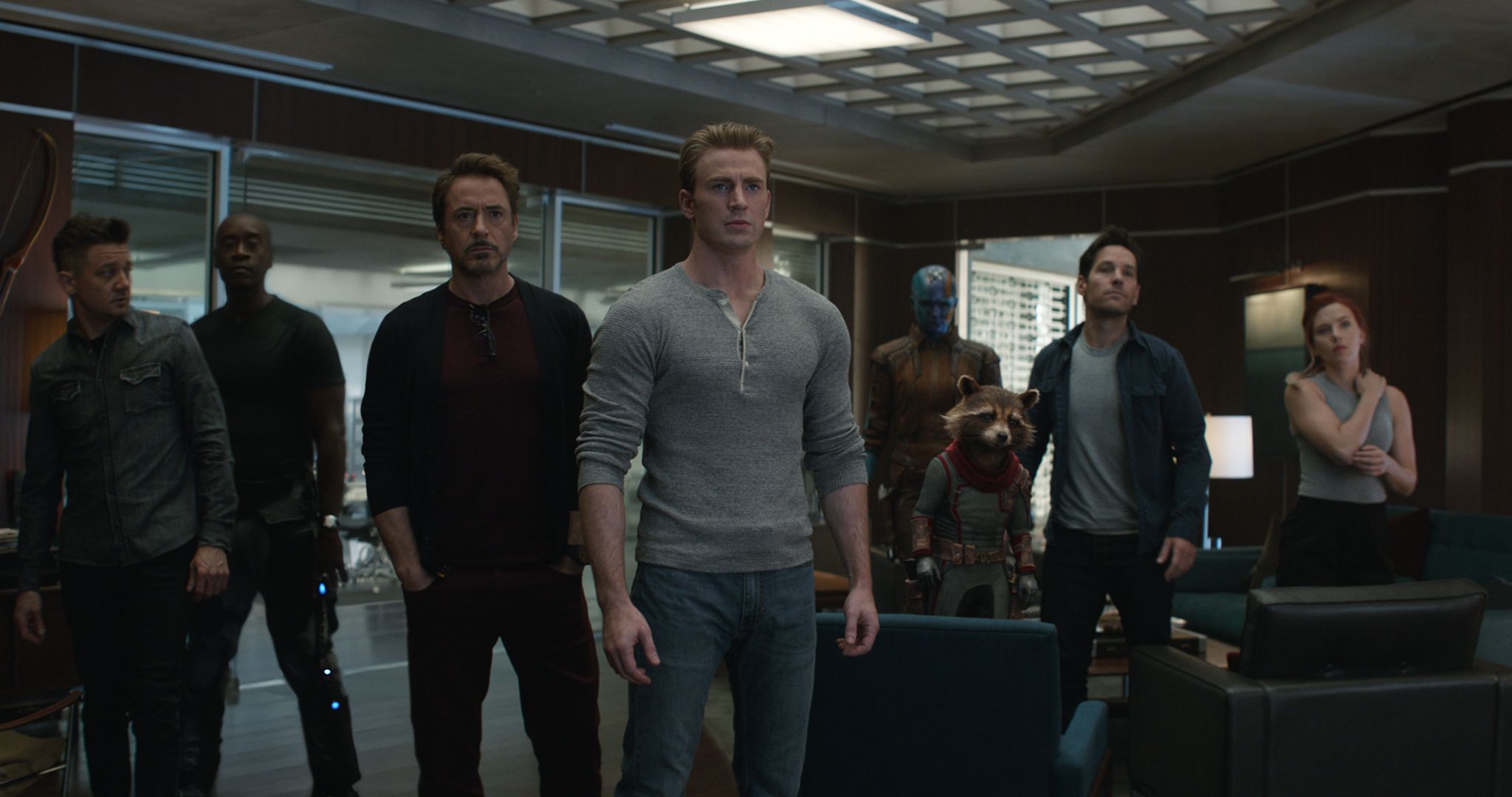
An endless cascade of encores and exposition, Avengers: Endgame is a thunderously melancholic machine most of the time, where the quips seem a little wan and the action visually slipperier yet more grandiosely apocalyptic. I suppose it's befitting a Universe that went through a culling last time, when purple baddie Thanos (CGI muscles and glob with the scowl and growl of Josh Brolin) snapped half the population to dust. This one's about the survivors trying to move on, while the remaining Avengers decide to live up to their name. It takes comic book leaps of disbelief as they do, eventually, after a long uneven buildup, and the movie's best moments are eruptions of satisfaction. Its worst are the sort of drooping anonymous action clutter and terse box-checking that so many of these devolve into. It also has a sloppy central sci-fi conceit that's basically successfully hand-waved in the moment, but makes less sense the more I think about it. Luckily, it is diverting, and, despite its runtime, provides very little to think deeply about later. The three-hour movie is stuffed with scenarios, a large-scale victory lap for an eleven-year project of culture-conquering moviemaking enshrining comic books as the prime fantasy of our time. We've gotten lost in them. Here we get to see every original main character (Downey, Evans, Hemsworth, Johansson, Renner, Ruffalo) and a host of cameos (which Marvel commands thou shalt not spoil), revisit settings and conflicts, and go down memory lane, even as we hurtle once more to an inevitable showdown with the forces of darkness. The difference is that this one doesn't tease an open ending. There is not even a post-credit scene. The thing is, for once, embracing, more often than not, a spirit of finality for the whole thrust of the franchise. Sure, it leaves itself plenty of heroes and story potential for the future, but it works as a big, satisfying climactic splash page in its fever-pitch, effects-heavy, character-clogged frames in battles royale. At its best, I found myself glad I sat through the whole twenty-movie project in order to feel the small nods to and charming echoes and reversals of situations past. At its worst, I found myself puzzling over its enormous smallness, its undeniable scope and ambition curtailed and constrained by the formula and flat style, even at this pseudo-endpoint. Literally dozens of stars are isolated in their mix-and-match green screen poses, personalities to bounce off each other, action figures for directors Russo brothers and the usual MCU scripters and producers to assemble at will. It doesn't quite gather the zing or zest that enlivened last year's surprisingly nimble and large Infinity War. Luckily, the familiar faces have enough charisma and the plot has enough forward momentum and how'll-they-wrap-this-up? curiosity to make it all a decent popcorn multiplex time. I left as stupefied and overstuffed and vaguely pleased as after a fast food feast.

Friday, April 5, 2019

He's Got the Power: SHAZAM!

Shazam! is just plain fun: a sweet and sentimental superhero movie that wears its metaphor lightly, but meaningfully. It’s built not out of sour self-importance or snarky quips, like so many clogging up our multiplexes and monopolizing our culture. Instead, director David F. Sandberg and screenwriters Henry Gayden and Darren Lemke root this DC fantasy in the kick kids get out of such stories, the way they’re both power trips and places in which misfits find belonging and makeshift families. It’s literalized here by making its hero an awkward, oft-runaway foster teen (Asher Angel), abandoned by his mother when he was very young and ever since desperate to find her. Instead, not long after the film begins, he finds himself drawn into an inter-dimensional portal where the ancient wizard Shazam (Djimon Hounsou) — dying, and therefore in need of a champion to channel his magic and continue his legacy of protecting the planet from spooky supernatural monsters — gifts him his powers. Say his name and — SHAZAM! — the boy becomes a man (Zachary Levi), muscled in a stereotypical red supersuit, cape and all, and with a gleaming dimpled grin and square jaw, practically a living superhero. His nerdy new foster brother (Jack Dylan Grazer) geeks out, vicariously living through his new superfriend. “What are your powers?!” he squeals. They proceed to test it out in a charming experimenting-with-newfound-abilities sequence that’s the best of its kind since Raimi’s first Spider-Man. The movie proceeds with a bounce in its step, since superpowers can, after all, be fun. The movie capably maneuvers between modes — a special effects charmer with ominous undercurrents in one moment, then flitting easily between family comedy and heartfelt family drama. It manages to feel both fantastical and grounded in the reality of a boy’s desires. They have a blast exploring his potential — jumping, punching columns, zooming around, shooting electricity from his hands. They’re simply two kids messing around, trying to determine how to fit this new normal into their daily lives and solve quotidian problems, even as we know a super-threat lurks on the horizon.

This all dovetails with their emotional needs, not just as adolescents craving acceptance and attention while trying to figure out how to maneuver in society, but as, in the case of our lead, a boy trying to find family after formative abandonment. The filmmakers have great fun playing with this idea visually, playing up the boy’s discomfort in his own skin as something exaggerated in the adult form, while the enthusiasm for the newfangled abilities bubbles out in immature goofiness. He likes that, for once, people seem to like him. Even if he’s outwardly confident, he still knows deep down he’s pretending to be something he’s not. As the movie develops toward the inevitable climactic confrontations with the glowering villain (Mark Strong) — a grown-up version of the teen’s problems with family and connection, an evil reflection of a possible future — it never loses its charm, perched between the soft-spoken recessive teen and the outdoor-voice chest-puffing bravado of his other self. Of course he must rise to the occasion, and the movie is the rare superhero movie to grow better as it goes along, gathering up rooting interest and character detail that doesn’t evaporate into CG clouds, but extends through the whiz-bang, zip-zoom action. In fact, it grows and complicates, rooting its conflict in character, while knowing that the origin story tropes and superhero formula, done well, provide their own comforting familiarity. The movie is modestly scaled, but exciting, and lovingly emotional, even when fighting globs of computerized monster effects. It’s because its focus on family, and on close personal relationships between recognizably human individuals who have hopes and dreams and warm conversations in cozy homes, that the stakes feel so real. I even got a little misty eyed at a key moment of surprising family unity near the end. This hero doesn’t have to learn how to save the world. He just has to save his world.

Thursday, March 28, 2019

Big Ears: DUMBO

Tim Burton’s live-action remake of Disney’s Dumbo does a disservice to every part of that phrase. It’s a Tim Burton film with a fraction of the visual whimsy and comedic timing, and with only the most pro-forma of his pet misunderstood-misfit thematic concerns. It’s a remake of a Disney classic that takes a simple parable of an awkward elephant learning to fly and makes it about a struggling troupe of circus misfits — looking for all the world like sad, boring performers cut from The Greatest Showman — that somehow manages to lose track of Dumbo himself for long stretches of time. I spent the first moments of the film straining to like it. I was charmed by Danny DeVito’s ringmaster; he plays it as a disheveled conman who’d love to go legit if only he could afford it. (He also sings “Casey Junior” under his breath as he stumbles back to his bunk. That’s cute.) I liked Colin Farrell as a freshly one-armed WWI veteran returning to his old stomping grounds to reunite with his precocious backstage kids (the adorable — and Burton-eyed — little Nico Parker and Finley Hobbins) and piece their family back together. It’s a fine echo of what little baby CG Dumbo is about to go through. But to find “Baby Mine” didn’t quite cue the waterworks for me was a first warning sign. After the promising opening, the plot set in motion here all happens too easily, tromping from expected beat to expected beat as Ehren Kruger’s screenplay goes into the most basic family film beats of easy believe-in-yourself symbolism and repetitive crisis-resolution shaping in every scene. Only Burton’s valiant visual attempts to spark life — fine Colleen Atwood costuming filigree; Busby Berkeley circus choreography; a striking bubbly Pink Elephant sequence; an Art Deco amusement park that often looks more Tomorrowland than the film’s ostensible 1919 period setting — briefly keep the film from just laying there dead on screen. The eventual conflict involves the scrappy circus facing a takeover from a fancy entertainment industry huckster (a game enough Michael Keaton who nonetheless doesn’t have a chance to cut loose). The guy is bent on taking over and commodifying anything he can, growing through expansion and losing the heart of the family entertainment biz in the process. Thus the only truly interesting part of this whiff of a picture is that Disney somehow allowed the movie to have a greedy Walt Disney type as a heartless showbiz businessman villain and stage a triumphant fiery finale in which a proto-Disneyland goes up in smoke. 

Saturday, March 23, 2019

Mirror Mirror: US

Get Out was a brilliant directorial debut for writer/performer Jordan Peele, moving behind the camera after a great career in sketch comedy. It was an engaging entertainment: a horror movie with a deep sociopolitical engagement that was somehow both the driver of its premise and its source of laughs that catch in the throat. It was deadly serious, but worn lightly, with every setup pleasingly paid off. Now here’s Peele’s follow-up: Us. Unlike his first feature, this fright show is tantalizingly unresolved, dramatically ambiguous where the other was crystal clear, and with a slowly developing thematic conceit where the other proceeded plainly declaiming its theses. But that doesn’t mean the plot is a puzzle to be solved. The exact point its high concept can no longer be explained is the very point the movie leaps into the purely metaphoric as a troubled and unsettled vision of both the dark reflections of ourselves we can no longer ignore lurking underneath our society, and of the depraved deprivation that makes comfortable upper- and middle-class lives possible. The puncturing of those boundaries is the point: how unsettling, frightening, and destabilizing it is to confront this darkness when it can no longer be ignored. 

We start in 1986, where a little girl wanders away from her parents at a Santa Cruz boardwalk, moseys into a funhouse that suffers a power outage and, stumbling in the dark, meets another little girl who looks exactly like her. Cutting on this moment of bewildered fright, Peele takes us — after a mesmerizingly simple opening credits sequence — to the present day, where this distant childhood trauma exists in the grown woman (Lupita Nyong’o) only as a faded dark cloud. It’s kicked up by her vacationing family — sweet dope husband (Winston Duke), teen daughter (Shahadi Wright Joseph), young son (Evan Alex) — heading to a Santa Cruz beach house. The place carries ominous associations for her, especially as her loved ones convince her to meet friends (a hilariously sniping shallow family played by Elisabeth Moss, Tim Heidecker, and Cali and Noelle Sheldon) at the very beach and boardwalk that was the site of her doppelgänger sighting. Eventually her unease that underpins the warmly funny familial hangout scenes is proven correct when, that night, a family of doppelgängers stand silent, dramatically backlit, at the end of their driveway. (At this point, our four leads develop remarkable, distinctive doubled performances, as gifted and eerie and convincing as you’re ever likely to see.) As the movie slinks into scary home-invasion, slasher-film machinations expertly, chilling staged, these mysterious characters — looking malnourished and eerily unkempt, clad in red jumpsuits and wielding sharp scissors — move with precise, eerie, controlled movements. They communicate with guttural howls. It put me in mind of the 1896 Paul Laurence Dunbar poem "We Wear the Mask": "This debt we pay to human guile;/With torn and bleeding hearts we smile,/And mouth with myriad subtleties."

The frightening, violent doubles reflect their better selves as if in a funhouse mirror. This is what our main characters would be if their comfortable lives were instead ones of neglect and pain; they've come to take their place. It’s scary stuff, potent to find the seemingly unstoppable forces of your destruction look just like you. Peele escalates the tension with an expert eye and razor-sharp script, becoming a litany of suspense and violence (a shame it’s a stretch to say it’s nearly a jeremiad to Get Out’s parable?) that plays off the character dynamics we so thoroughly learn and enjoy in the opening setup. (This is also the welcome wellspring of perfectly timed and executed comic relief.) The payoff is to deepen the characters through action as the film grows complicated, not through twists, although it has a few, but through challenging our assumptions and double-knotting the thematic concerns until it reflects a host of destabilizing questions. To discuss further the implications of its startling, evocative, resonant images would be to spoil the surprise and the fun. Let me just say this is an enormously entertaining, precisely controlled film. It builds, one expertly crafted sequence after another with nary a wasted image or line, until it becomes a complicated, richly developed, long-lingering jolt. At what cost do we survive? What will we do to get it? And what does it mean for us to deserve that survival? It leaves us with an expansive, haunting final image not unlike Dunbar's poem drew to a close saying, "We sing, but oh the clay is vile/Beneath our feet, and long the mile;/But let the world dream otherwise..."

Tuesday, March 19, 2019

Begin Again: NANCY DREW AND THE HIDDEN STAIRCASE

If a movie is released and no one notices was it even there? To take a detour for a moment: Too often the broad popular online film discourse is just film nerds talking to each other about film nerd movies. Who needs their umpteenth Marvel ranking or trailer analysis or an ending “finally EXPLAINED!!”? (Whatever that means.) They make the old “all thumbs” Film Comment argument about At the Movies look quaint, considering the new normal of hyperbolically aggregated press releases and bubbly ahistorical popcorn chatter makes At the Movies look like Film Comment in comparison. All this is just to say hardly anyone in film circles will tell you Warner Brothers' latest attempt to do something with the rights to Nancy Drew happened at all, or even that it's not bad for what it is: slight, cute, pleasant, girl power sleuthing. The exceedingly mild and unassuming Nancy Drew and the Hidden Staircase — so unassuming the studio itself barely seems to have noticed it turned up last weekend — is a modern reworking of Carolyn Keene’s long-running, occasionally-updated Depression-era teen detective books. Now that mostly means adding cell phones. This new version is a brightly lit, simply staged little movie following Nancy and her father moving from Chicago to a small town where her big city social justice spirit can do some good, and eventually leads to her exposing a Scooby Doo-level trick being played on a sweet old lady (Linda Lavin). Nancy is introduced skateboarding down Main Street to a bubblegum pop song, before getting asked by a new friend for help getting back at a bully. Revenge? No, “restorative justice,” Nancy says with giddy righteousness only a relatively carefree 16-year-old could muster. She's charming. A sweet rule-breaker in pursuit of truth and justice, it’d be hard not to hope she’ll succeed at whatever she puts her mind to, and even harder to think she won’t. She’s played by Sophia Lillis (the best part of the boring It movie lots liked a couple years ago) as a totally normal clever teen, using her smarts and her likable low-key charm to make friends and disentangle small-town conspiracies. Director Katt Shea (The Rage: Carrie 2) and screenwriters Nina Fiore and John Herrera (The Handmaid’s Tale) take a break from their usual heavier adult-oriented genre fare for a simple, clean-cut, clear-minded, easy narrative. As Nancy is drawn into solving the old lady’s plight, it is resolved at just the right level of complexity and speed for its intended audience — its the sort of thing you’d hope would be seen by elementary aged kids and their grandmas. There’s just enough soft-spoken kid-friendly personality to make the characters almost lifelike. And the movie is just engaging and chipper enough to fit comfortably alongside its closest competitors: the better Disney Channel Original Movies. It does basically what it says on the tin, whether anyone noticed or not. I'd rather have a sequel to this than Branagh's Poirot.

Sunday, March 17, 2019

Road to Nowhere: TRANSIT

Christian Petzold’s Transit is a story of refugees fleeing fascist forces that are taking over Europe. A German man (Franz Rogowski) sneaks out of Paris just ahead of a crackdown of some kind. He’s headed to Marseille, where he’ll wait for papers he'll need to flee somewhere safer — maybe Mexico, or America — or, failing that, he'll hike over the mountains. In this port city, he’s mistaken for a dissident writer whose immigration paperwork has already been completed. While he waits for his ship to come in, he’s surrounded by others stuck in the red tape — long lines, jumbled belongings, fraying relationships, dwindling resources. He sees the same faces again and again — a woman left stranded with two enormous dogs; a conductor; a doctor; a bartender; a soccer-loving boy and his deaf-mute mother; and a woman (Paula Beer) awaiting the arrival of her husband, a writer who promised their paperwork would be waiting for them. Pulling setup and incident from Anna Segher’s 1944 novel, Petzold’s film of people waiting in hope of exit visas could easily have fallen into a Casablanca riff, plumbing the familiar tropes of World War II fiction for its impact, much like his last film, the heartrending straight-faced melodrama Phoenix, used a rubble-strewn post-war 40’s landscape for its wickedly clever emotional twists. (Maybe Soderbergh in The Good German mode would’ve done Transit that way.) Instead, Petzold moves the book’s narrative essentially unchanged into something like present day, or maybe very near future, France. The image of modern cars and contemporary clothing, of current cruise ships, of militarized police, creates a haunting frisson of disjunction. If we saw this story, an episodic collection of displacement and strife slowly escalated through mistaken identity and competing loyalties, in vintage costume and historical affect, it’d be easier to contain in a safely time-stamped box. Here the danger, the quotidian responses to geopolitical strife, is both inextricable from the premise and a constant background given. It’s familiar and strange; it has happened before and can happen again — fascists marching in the streets. And yet Petzold hardly foregrounds this. He coaches his cast to give inscrutably troubled performances, portraying people hesitant and stumbling towards possibilities that may never come to fruition. It becomes a film of waiting, of people caught between where they’re going and where they’ve been, making connections to soothe their conscience or merely grasping at the last vital strands of humanity and compassion before the world forecloses their opportunities. Their lives have been smashed apart. They feel they just have to get on a boat and away from their broken homelands to start whole again. Would that it were so simple.