Showing posts with label Christopher McQuarrie. Show all posts

Friday, May 23, 2025

End Times:
MISSION: IMPOSSIBLE - THE FINAL RECKONING

There’s something genuinely apocalyptic in Mission: Impossible — The Final Reckoning. It sure does feel like an ending. The plot finds a rogue artificial intelligence wants to extinguish humanity. We’re told it has invaded the controls of half the nuclear weapons in the world and stokes geopolitical tensions with misinformation and deep fakes—all ways of hoping those missiles will drop one way or another. Though we really only learn that from blinking screens, since the tension is all on our ensemble’s faces. The score rumbles darkly, the camera tilts and looms, and every ridiculous turn of tension brings with it a somber sense that a fan favorite character will die. (Some do.) The previous entry, Dead Reckoning Part 1, had hugely enjoyable pleasures. It’s ebullient and energizing despite its weight and melancholy, a three-hour action extravaganza that, like all the best of this series, rockets through one sensational sequence after another. It was wholly satisfying and even complete in its way, though it leaves off on a literal cliffhanger. The first hour or so of The Final Reckoning is atypically tedious setting it all up to be a grand finale, regrouping and reorienting an audience it doesn’t have faith will remember, or even have seen, its immediate predecessor. We get several flashbacks to previous movies, some played multiple times, in this stretch, and endless exposition that shifts the characterization of a few characters and reassembles the team for a new last-ditch mission with those world-ending stakes. In this hour I found myself befuddled that it’s all gone so wrong.

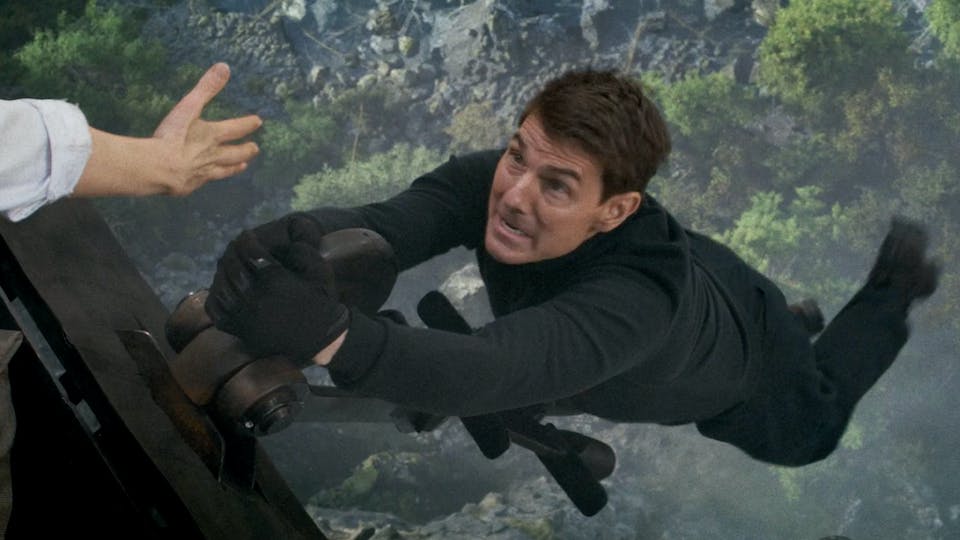
Writer-director Christopher McQuarrie’s work in this series is usually so joyfully clockwork precise, a delightful dance of complications and stunts that escalate well and resolve brilliantly. This one’s tedious and ponderous at first, endlessly explanatory, and laboring under the weight of retcons and loose threads. For a series that’s often been dinged as difficult to follow—I wouldn’t agree, until maybe now—this one doubles down on inscrutability and referentiality. They’re the same impulses that hold back Deathly Hallows Part 2 and Endgame and Rise of Skywalker and most other attempts to coast a lumbering franchise narrative to something like a finale from being fully satisfying. Mission: Impossible has the good sense to have a mission, though. Once Tom Cruise’s Ethan Hunt is back in the field, the movie steadily picks up momentum and builds to a truly ecstatic sequence of cross-cutting between various team members pulling off their own impossibilities—hanging off planes, cutting wires on a bomb with a countdown clock, waiting to flip a switch in a split second. Because it builds up such a head of steam on its commitment to feeling like the world truly hangs in the balance, the release of the climax is satisfying enough. It hits that classic sense of teamwork and underdogs and long odds and preposterous close calls and real death-defying stunts. I'll miss it.

Friday, July 21, 2023

Accept It:
MISSION: IMPOSSIBLE — DEAD RECKONING PART ONE

I tend to love when a long-running franchise finds its melancholy, and Mission: Impossible — Dead Reckoning Part One is no exception. The Tom Cruise action series has been reliably exciting, allowing his star persona to hone and sharpen along with his super-spy Ethan Hunt. They’ve fused as a man of singular focus and determination, willing to throw himself—literally his whole body—into pulling off incredible stunts. Hunt does it to save the world. Cruise does it to save the big screen blockbuster. Well done, both. The last few Missions Impossible, under the guidance of writer-director Christopher McQuarrie, have been sharply cobbled together with an excellent sense of escalating stakes, clever crescendos of momentum, and suitably coherent spectacular action—always with a sense of peril from a convincing over-the-top realism. These are top tier entertainments. The great success of Dead Reckoning Part One is that it doesn’t lose those attributes, and, in fact, by stretching out over three hours of rising action (this is only the first of a promised two-parter, after all) allows it to grow more complicated, and more emotionally engaged. The story is another MacGuffin hunt—two halves of a key that’ll unlock a missing server that holds the brains of a rogue military-grade artificial intelligence—but by pacing itself, it allows for that sadness to creep in. McQuarrie and Cruise have made Hunt a man driven by a desire to avoid loss—not just global, but personal—and here’s a movie that doubles and triples and quadruples down on that prospect.

It considers the effects of being a man for whom the impossible is pulled off in wild stunts of teamwork and the effects such constant danger and close calls have on himself and his only friends—those who work with him. Cruise has always played characters who think they can outrun the gravity of a situation’s reality. (Look no further than Top Gun: Maverick, in which that urge is proven correct.) Impossible has always been a series playing with the potential to flail in the face of danger—remember him dangling over the alarmed floor in the first one. This latest Mission runs toward and with that gravity. Its melancholy is a fine new flavoring that finally taps a rich vein at which the previous pictures have merely glinted. But this is still, as one might expect from these pictures, a rip-roaring adventure with some of the best action thrills anywhere, photographed cleanly and clearly, edited with energy and style, and keeping every aspect in vivid focus without losing the thread. Each sequence—from a sandstorm firefight to airport sleuthing, a car chase through Rome, and combat on a runway train that builds to Buster Keaton levels of astonishing chain reactions—are cleverly stacked with multiple variables, complications, and suspense elements—pursuers, ticking bombs, causes and effects—that make for delightfully complicated thrills.

For however heavy the undertow, the movie stays light on its feet, playful, and propulsive. The action is staged for impact of objects in dizzying motion that balance on a mix of danger and delight. Picture a tiny car tumbling down a massive stone staircase, causing its handcuffed passenger and driver to switch places, all while a massive Hummer smashes down after them. And yet it’s that underlying sadness that lets such giddiness play against a somber backbeat that finds these characters in an almost existential crisis when confronting their latest foe. (No wonder there’s no conclusion.) When a charming new character (Hayley Atwell) is given the choice to join the team for this mission, it’s presented with a somber touch. She needs to know the consequences. This earned level of sadness gives the hugely entertaining movie a genuine whiff of finality. In these endless franchise plays crowding our multiplexes, a few are starting to find satisfying stakes can be found by intimating an actual end is looming. All the pleasures of the momentum machine herein feel all the more weighted toward danger, and make the complications all the more delightfully compounded.

Monday, August 3, 2015

Choose to Accept It: MISSION:IMPOSSIBLE-ROGUE NATION


An efficient and engaging thrill machine, Mission: Impossible – Rogue Nation is further proof Tom Cruise’s signature franchise is one of the most consistently high-quality adventure series we’ve ever had. It accomplishes this by delivering strongly on a set of appealing and entertaining recurring excitements – vertiginous stunts, complicated heists, amusing spy gadgets, convincing masks, and dastardly double crosses. But no matter how cleverly the filmmakers deploy these elements, the glue holding them together is Cruise himself, racing along with hard-charging star charisma born out of hard-working determination motoring a constant forward momentum. Much has been made about his running, in which he appears to throw every ounce of his being into a hurtling mad dash across the frame. If anyone could accomplish the impossible, it would be his Ethan Hunt.

With appealing action and a megawatt star, the franchise has an ability to allow each director to play to his strengths. The result is a series of five films with a welcome familiarity in its recombination of its best parts, and yet never grows too repetitive. Each entry has its own flavor. De Palma first brought complicated pulp, then Woo had swooning balletic action, Abrams injected throat-grabbing emotional stakes, and Bird performed a juggling act of buoyant one-thing-after-another action. Now writer-director Christopher McQuarrie has the reigns, steering an endlessly enjoyable action movie into his twisty construction and clever control. He brings the mystery and the weighty violence of his last film, Jack Reacher (an underrated Cruise vehicle), and the shifting allegiances and slow realizations of his first script, The Usual Suspects.

Once more, the milieu of Ethan Hunt and the agents of the secret Impossible Missions Force is familiar, but the tone has something new. Unlike madcap MacGuffin chases of the last few entries, Rogue Nation plunges us into spy movie mechanics, with shady dealings and uneasy alliances. In D.C., the new head of the CIA (Alec Baldwin) talks a confidential Senate hearing into dissolving the IMF, using the near-miss missile and smoldering Kremlin from Ghost Protocol as his evidence. This leaves familiar faces (Jeremy Renner, Simon Pegg, Ving Rhames) behind desks, while Hunt (Tom Cruise) disobeys orders by staying in the field. He finds himself in hiding, trying to track down The Syndicate, a terrorist organization only he seems to know about. Connecting isolated tragedies with a conspiratorial mind, he seems crazy to the CIA, who are desperate to hunt him down and take him in.

But because an early scene sees an unknown bespectacled Brit (Sean Harris) gun down an IMF agent and attempt to kill Hunt, who barely escapes thanks to a mysterious woman (Rebecca Ferguson) and her helpful punches, it’s easy to see he’s right. So he’s on a globetrotting chase away from the CIA while attempting to track down proof of the group to clear his name, and then take them down and save the world. McQuarrie keeps things ambiguous. What is The Syndicate? Who is the Brit and the woman? What’s the IMF’s role? All is answered in sensationally staged setpieces pleasingly varied and orchestrated. Instead of the usual action beats strung along by rote connective tissue, they grow thrillingly out of an involving set of mysteries and complications. It never overwhelms or exhausts, maintaining consistently pleasing tension and thrills.

Rogue Nation is structured as a nesting doll of action, each setpiece a more compact, concentrated, and intricately designed moment than the last. It starts with big, grinning, highflying stunts, before narrowing through heists and car chases to close on bruising one-on-one combat. The movie moves quickly, enjoying a good one-liner or a perfectly timed look of skepticism just as much as it does putting Cruise on the side of a plane during takeoff, tossing him down an artificial waterfall, throwing him through a plate-glass window, and rolling his car end over end. The action is satisfying, bright, clear images (from cinematographer Robert Elswit) whipped up with crisp cross-cutting and elegant design. A gorgeously designed sequence set around an opera house backstage and on catwalks during a performance is one of the series’ best, with other highlights here including a high-velocity motorcycle chase down a desert highway, a trembling time-bomb bluff, and shootouts and knife fights kept PG-13 despite teeth-rattling sound effects.

McQuarrie stages these thrilling moments with the oomph of impact and the elegance of clockwork construction. But he never loses sight of the human-level interpersonal drivers behind the chaos. This allows Tom Cruise’s intense determination and eager motion to take appealing center stage while the terrific ensemble is allowed to be simultaneously essential team members and great comic relief, fun without diluting seriousness. (Best may be Baldwin, as a serious obstacle cut with a bit of Jack Donaghy bluster.) Meanwhile, Ferguson is great new character, complicated and an unknowable variable. Is she a foil, prey, a secret help, or a manipulative mastermind? It’s fun guessing, but even better is the realization she’s Hunt’s equal (or better, in some ways). If she’s an ally, they’re in luck. But if she’s out to destroy them, she just might win.

Running an unbelievably brisk 131 minutes, Rogue Nation is stuffed with excitement manipulated efficiently. McQuarrie and his team get just about everything possible out of each action sequence without overstaying their welcome. There’s no need to have a perfunctory car chase when it can drive the plot forward while adding participants and obstacles cleverly colliding and careening throughout. Each setpiece is wrung for all its worth, but stops where it can still leave the audience begging for more, as the characters regroup for their next move. McQuarrie understands the appeal of a blockbuster action movie at its best, marrying a fine ensemble with elaborate special effects in a tightly plotted machine delivering everything you’d want and a little more, too. The Lalo Schifrin theme has become big-budget action cinema’s most reliable sound. You can lean back sure that whatever happens next will be hugely enjoyable.

Sunday, June 8, 2014

Instant Replay: EDGE OF TOMORROW


Edge of Tomorrow is an action movie with an irresistible sci-fi hook. It’s the near future and humans are fighting a war against aggressive alien invaders. The creatures are fast, brutal, and seemingly unstoppable. Europe has fallen, occupied by the spindly, insidious beasties. The forces of Earth are mobilizing for a last-ditch effort to beat back the extraterrestrial beings before it’s too late. This is all laid out for us in one of those rapid-fire news footage montages that feature real anchors delivering this fictional news with grave sincerity. One of the army’s top public relations men (Tom Cruise) is asked to chronicle the impending attack. When he’s told it’s not a request, but an order, he tires to run. He’s branded a coward and a deserter. His punishment: a spot on the front lines. It’s there that he experiences first hand the carnage of the conflict. He’s killed in action and is surprised to wake up the day before. He’s caught in a time loop.

The rest of the movie features Cruise’s fearful, inexperienced soldier gaining strength and smarts by reliving the battle over and over and over. He repeats the day, getting a better grasp on the situational tactics and big picture with each replay. He’s like a gamer getting better and better each time through a level. The invasion is a chaotic sci-fi version of the D-Day invasion of Normandy. Humans wear mechanized battle suits as they land on the beach, firing off into the distance at an unseen enemy as they trudge forward. The aliens burrow under the sand, then burst forward grasping, blasting, chomping. They are biomechanical, multi-tentacle beasts that look truly otherworldly, incomprehensibly strange and self-evidently dangerous. It seems mankind’s only chance is the trial-and-error suddenly available to this one man. Again and again he dies only to be born again, ready to fight the same fight once more, but this time with a slightly better idea of what he’s in for.

Cruise is a perfect actor for this kind of role. He not only has the sympathetic hard-charging action hero role down to a science, he makes it look new each time. As a movie star who has lived through action movie carnage that’d kill a real person dozens of times over throughout his career, it’s a shock to see him die, let alone in a context that’s quickly edited for an almost comic effect at times. At one point, there’s a training montage of sorts in which he’s killed with every edit. He’s shot, stabbed, exploded, run over, squashed, chopped, and otherwise destroyed, but still he bounces up again, waking on the day before. Here his professionalism and determination grow steely through a sense of discovery that’s fun and tense. A lesser actor might let the whole project grow repetitive or wearing, but Cruise charges forward, all energy and willpower.

He meets one person who believes him, a tough soldier (Emily Blunt) who once got caught in a time loop herself a few battles back. She immediately recognizes the symptoms in him and agrees to help him. Too bad he has to reintroduce himself every day after his every death. He gets her up to speed and they set out to plan their attack like two kids who’ve lost each time through a multiplayer level and are sure this is the time they have enough information to win. They look at their blueprints and diagrams like it’s a strategy guide.

The screenplay by Christopher McQuarrie, Jez Butterworth and John-Henry Butterworth, from the novel All You Need is Kill by Hiroshi Sakurazaka, constantly resets. Each repetition brings with it a new understanding of what needs to be done, or at least a reframing of what approaches won’t work. It’s cleverly plotted, if thinly developed. There’s not a lot to it, but what’s there is competently told. It’s all forward momentum, with the reason for the time loop tied inextricably to the way to win the war. It’s tightly wound and briskly told, no time spent on treacly backstory for our main duo, defining side-characters (played by good character actors like Brendan Gleeson and Bill Paxton) beyond their mere presences, or providing humanizing families back home. It’s lean and straight to the point.

Director Doug Liman, who, with the likes of The Bourne Identity and Mr. and Mrs. Smith, is no stranger to staging fun action scenes, gets to riff on one setpiece in a variety of ways. He moves through the hectic, gray, and muddy alien D-Day sequence multiple times from an assortment of angles. Cinematographer Dion Beebe finds fluid and exciting images that are cut together by editor James Herbert in a propulsive pace. It’s not a great action scene – it’s indistinct and often incomprehensible in its fog of war – but the variations develop smartly. I didn't feel it in my gut, but my head enjoyed the ride.

We get a little farther with some repetitions, and as the movie progresses we jump into the action at later and later points. We know Cruise and Blunt can fight their way so far. They’ve done it hundreds of times. No need to repeat every beat of the action when we can skip to right where they left off. The action is digitally enhanced rattling and battling with characters able to leap and shoot, running and gunning. Aliens flip and scuttle about, popping up and spinning around in a dance of death with the humans who slowly learn to anticipate their moves.

The movie makes smart use of its time travel mechanics. Like Bill Murray in Groundhog Day, Cruise takes advantage of his ability to predict behaviors simply because he’s quite literally been there, done that. There’s some wit in his knowledge of a multitude of possible events for any given scenario. At one point late in the movie, Blunt says, “What now?” Cruise responds, “I don’t know. We’ve never made it this far before.” Like most time travel movies, push a little and it doesn’t quite add up. But Edge of Tomorrow moves so unrelentingly quickly, features a pair of solid star performances, and features a plot-heavy script a tad smarter than you’d think. It’s a fine popcorn entertainment.

Saturday, March 2, 2013

Hill of Beans: JACK THE GIANT SLAYER


When it comes to recontextualizing an old tale as a modern would-be blockbuster, Bryan Singer’s Jack the Giant Slayer is way better than Hansel & Gretel: Witch Hunters, but doesn’t even come close to the entertainment value of Snow White and the Huntsman. I suppose that’s the very definition of middling. I may not have liked it much, but it’s certainly not worth disliking, not when it’s so colorful and good natured, a kind of square, clear-eyed spectacle, a red-blooded adventure that wouldn’t have looked too out of place in the 50s with Harryhausen animation instead of blandly intricate CGI fakery. In this new telling, the story of Jack, the farm boy who trades his horse for magic beans which then grow into a beanstalk that leads to a land of giants, is the basic seed of story which sprouts into a typical hero’s journey complete with damsel so hopelessly distressed and a terribly modern extended action climax that drones on and on through noisy digital destruction.

But before it gets there, it starts simply, with a nicely crosscut sequence of a little boy in a farmhouse and a little girl in a castle, each being read a legend of giants and the king who forged a crown out of a melted giant’s heart to order them back to their realm high in the sky. The boy grows up to be Jack (Nicholas Hoult). The girl grows up to be the princess (Eleanor Tomlinson). She, through a series of events I shan’t relay here, ends up stuck at the top of the beanstalk when it smashes up through Jack’s small house. The king (Ian McShane) orders his best knight (Ewan McGregor) up the stalk with a team of men with the mission to save the princess at all costs. Among the group are the girl’s clearly villainous betrothed (Stanley Tucci, who doesn’t twirl his mustache, but might as well) and Jack, who has taken a liking to the girl and wants to impress her by joining the rescue party. He also feels a little responsible. After all, he’s the one who lost track of the bean that started the whole mess.

At the top of the beanstalk there be giants, of course. The giants’ world is a playground for standard adventure beats, with the men scurrying to and fro through setpieces that play with scale in all the ways you’d expect. There’s a smattering of silly visual moments – I especially liked one involving pigs in a giant’s oven – and a handful of fine action beats. The problem that Singer and his screenwriters Darren Lemke, Christopher McQuarrie, and Dan Studney don’t quite get around to solving – until the charming, unexpected epilogue, that is – is how to overcome the feeling that we’ve been here before. If not literally here, then we’ve at least been in the neighborhood. The characters never rise to the level of even fully inhabited, memorable one-dimensional types. The plot never shakes off the feeling that it’s all just a thin fable that’s been blown all out of proportion and along with it, the tone’s gone all misshapen too. It’s at once oversized and modest, an odd combination for something so ostentatiously expensive, dripping with state-of-the-art effects that are what they are. The stalk vines its way into the sky with a convincing slither, the giants stomp with motion captured weightless weightiness, and the humans more or less convincingly occupy the same spaces as all of the above.

As the movie marches forward, with the humans and giants scrambling about in the forest in the sky and back on the ground the kingdom’s citizenry assemble a sort of Ace in the Hole carnival atmosphere around the stalk’s base, the tone grows into what, if I’m feeling charitable, I’d call relaxed, or, if I’m not, I’d call half baked. Still, it allows some of the performers to really pop. I enjoyed McGregor’s smirking swashbuckling and his delight playing his character’s personality as somewhere between a flip Obi-Wan Kenobi and an excessively dashing Errol Flynn. His answer “Not just yet,” to the question “Are we dead?” is one of the movie’s most memorable moments, as is his laughter in a later scene as he watches a giant get repeatedly stung by bees. In a movie with bounteous visual trickery, he’s the best effect. Everything else, from the bland leading roles to the broadly sketched supporting roles and all the borrowed fantasy frippery in between, is so much sleepiness that’s so close to being fun that it’s all the more disappointing for falling short.

Saturday, December 22, 2012

More Than a Name: JACK REACHER


There’s a scene in the middle of Jack Reacher in which the man himself (Tom Cruise), a former military investigator now poking around in the aftermath of a seemingly random shooting, finds himself confronted by two toughs ready to clobber him over the head. Reacher falls back in a confined space and his attackers, inexperienced and overeager, swing wildly. Reacher moves precisely and quickly, giving his attackers just enough room to inadvertently beat each other up, leaving him free to continue his investigation. This is a fun scene, well choreographed and a nice blend of danger mixed with a small amount of humor. But it is also a good enough metaphor for the film itself and the way it goes about working. It’s hardly original material, but it’s well written, quick-witted (at times) and precise, ready to lean back and let the plotting fall into place with good instincts. It’s a fine thriller, crisp, quickly paced, and with a smartly plotted mystery.

It starts with a terrifying act of violence. A sniper shoots into a crowd, seemingly at random, resulting in five deaths. The man the police take into custody does not speak when interrogated. He scrawls on a piece of paper a simple directive: Get Jack Reacher. They don’t have to look very far. He’s already on his way. What’s his connection to the accused? It’s all a tad more complicated than I need to get into here. Let’s just say that Reacher agrees to help the defense attorney (Rosamund Pike) investigate the case, while navigating the evidence provided by a perceptive detective (David Oyelowo) and the District Attorney (Richard Jenkins). How this seemingly open and shut case soon involves tails and goons (Jai Courtney and Vladimir Sizov), hired toughs (Josh Helman and Michael Raymond-James), an in-over-her-head girl (Alexia Fast), and a shadowy, mostly fingerless man played by the beloved German filmmaker Werner Herzog is complexity that eventually gives way to a grim, pulpy simplicity.

What holds the film steady on its course is the constant focus of Jack Reacher. As played by Cruise, the man’s a steady rock, a determined investigator who lives off the grid and shows up to help here out of a sense of duty. He’s no-nonsense, but with some terse quips here and there that are welcome wry one-liners. This character’s already appeared in a popular and ongoing series of novels by Lee Child from which I’ve meant to read one or two for a while now. Here Christopher McQuarrie, a fine screenwriter in his second directorial outing, gives the whole production the kind of easy familiarity and relentless steady momentum that drives us inevitably forward through the tangles of mystery, inevitable precisely because of the character at the center. Reacher feels like a character who enters fully formed. We know that he will get to the bottom of the mystery precisely because he’s so determined, part Shane, part Dirty Harry, a man who’s no (or rather, rarely a) loose cannon vigilante, but a man looking for justice with comprehensive training to back up his professed skills.

Cop and lawyer procedurals have told similar stories, investigating shocking crimes that aren’t as simple as they seem thousands of times over, an hour at a time, on TVs worldwide. What’s better here is the weight given to violence, a proper sorrow and horror. The opening shootings are scary enough (especially haunting in light of the many real life random massacres we’ve seen this year), but as we return to the event as the characters try to learn more, we’re given a montage that reveals who the victims were, examining their humanity with unexpected depth. Later on in the film, when a likable side character is suddenly murdered, it’s a sharp pain of a moment, unexpectedly fast and upsetting. How often do mysteries treat the deaths involved as mere plot point? Here, they’re felt more deeply than usual, which gives a heft to the unraveling mystery it might not otherwise have.

McQuarrie has made a fine example of slick popcorn filmmaking that’s serious about its entertainment. It doesn’t shortchange its subject by cheapening it. Instead, he allows the horror of the inciting incident to inform the intensity with which the audience is able to root for Reacher to untangle the motivations and conspiracies behind it. The movie embraces genre tropes a bit too much in the climax with what was an enjoyable investigation taking a turn into a standard action movie showdown, but McQuarrie never loses his refreshingly steady eye for framing the events on screen. This is a solid, well-built example of Hollywood craftsmanship that serves up some unsettling material and then brings in a movie star hero written with the right set of smarts to settle things back down again.


Friday, March 25, 2011

Quick Look: THE TOURIST

Glamour should rarely be the sole purpose of a film, but in the case of The Tourist it’s very nearly enough. This is a laid back comic thriller with beautiful people in beautiful places. There’s Angelina Jolie as some kind of stylish criminal and Johnny Depp as a seemingly bumbling everyman. (There are also some nice supporting roles for the likes of Paul Bettany and Timothy Dalton). Together they become entangled, perhaps purposefully so, in all kinds of international espionage that takes place against the backdrop of stunning European scenery starting in Paris and ending up in Venice. Following up his heavy 2006 Oscar winning Stasi thriller The Lives of Others, Florian Henckel von Donnersmarck capably directs with light professionalism. He’s a solid craftsman who should direct more often, if only for the pleasure of seeing his lengthy credit stretch out across the entire wide screen. The Tourist is all fizz, but it’s prime fizz. The screenplay by von Donnersmarck, Christopher McQuarrie, and Julian Fellowes, Oscar winners all, is a bit of a prestige-hued mess, but it’s on the whole a delightful throwback, perhaps even homage, to the lighter side of Hitchcock. I was reminded not entirely unfavorably of To Catch a Thief, a similarly enjoyably thin exercise in style, star power and glamour. When The Tourist arrived last December, it was generally derided by critics and considered a flop domestically (though it’s been quite the hit in international markets), but now it’s easier to see that all the fuss was misguided. This is not, by any means, a great movie, but it has enough diverting pleasure to entertain. It’s a classy popcorn star vehicle with plenty of beauty and surface contentment. The last shot is a nice Freudian sight gag served up with a line that could be seen, with a wink and a shrug, as the film’s summation of its own quality: “It’ll do.”