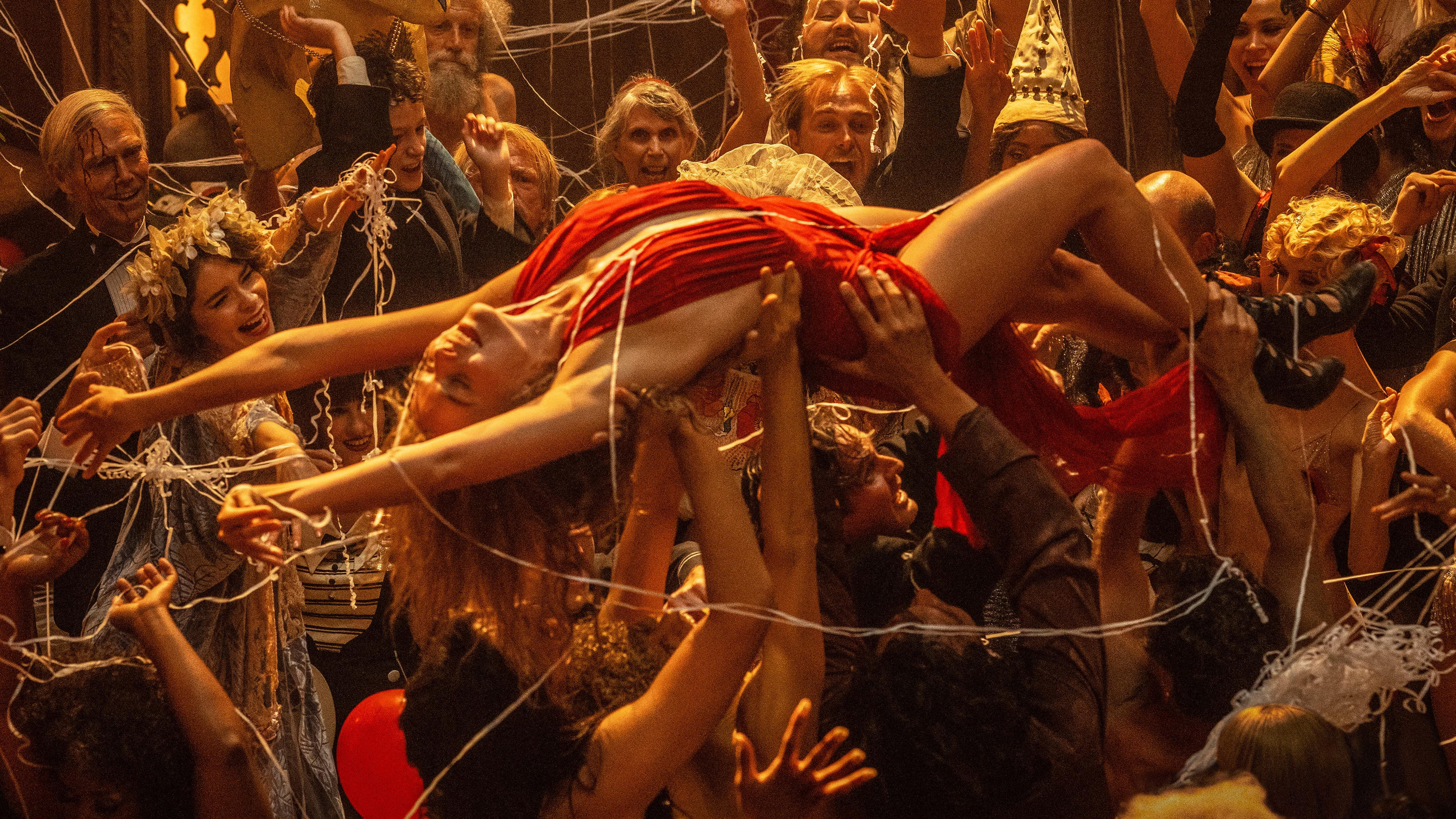
Damien Chazelle’s approach to Hollywood history in Babylon is right there in the title. He’s clearly winking toward Kenneth Anger’s gossipy book Hollywood Babylon, known for salacious rumor-mongering that cemented all manner of misinformation and falsehoods in certain corners of cinephilic imagination. Chazelle, like Anger, is interested more in the shock value, in the hurtling sensations of exposition and exhibition, than in getting the detail right. In this new three-hour epic of depraved farce and nihilistic sentimentality, Chazelle is piling on the excrement of scandal and sensationalism. It opens in the late 1920s, with an elephant pushed up a hill by a lowly assistant at the request of his hitherto unseen studio boss. We get an extreme close up of the frightened animal loosening its bowels. The sound design goes all in on the wet plops as enormous turds rain down onto the poor man below. Hollywood, the movie says in this opening sequence, is a lot of wading through muck to get to the top. It’s also, as we see in the next scene, with cavorting partiers engaging in kinky sex and snorting drugs and wailing to cool jazz trumpets, about having such a wild time it’s a wonder the movies ever get made at all. By the time the elephant literally crashes the party, distracting the revelers from the dead woman carried out the back door, it’s clear this is a movie about how sordid Hollywood can be. But Chazelle’s style, in its amped-up whip-pans and pretty people and pounding score and opulent period design and constantly forward-chugging montage, is so intoxicated with the slick surface pleasures of the movies that it practically says any human destruction or scatological peril in the cause of such spectacle is worth it.
This confusion results from a simplistic story—Singin’ in the Rain without the jokes—spread out over a long, rambling episodic structure—Boogie Nights’ plotting without the well-worn melancholy. The actors almost pull it off anyway. Amid a sprawling ensemble, Brad Pitt plays a Don Lockwood type floating along as a silent idol, drunkenly stumbling around behind the scenes until his cue when lights and camera assemble a perfect take where his eyes smolder and visage cuts through the chaos. Margot Robbie is a fresh-off-the-bus nobody who wiggles and winks her way to sexpot status as a silent comedienne. They’re connected by love and business to a striving Mexican immigrant (Diego Calva) who wants to work his way up to studio executive someday. The stars are burdened with tabloid melodrama lives, and that ends up taking their careers on the ups and downs you’d expect. Ultimately, the only smart characters opt out entirely. (Although, as also the only characters of color, they don’t always take that option by choice.) The others meet nasty ends of one sort or another.
Chazelle views the struggle of old Hollywood from the 20s through the 50s with a grand sweep and cynical eye. He clearly loves the movies—he’s an obvious case of millennial Turner Classic Movies and Karina Longworth love—and his film drinks in a period look, though it sloshes anachronistically from time to time. He also thinks he’s being clever re-staging some Singin’ gags—an extended bit with a talkie’s mic problems, for instance—but in a more protracted, profane way that’s lesser than the original. It’s all a mad jumble—loud and flashy and propulsive, but also thin and trite and tiring. That’s the strange paradox of the project. It’s at once a watchable display of pyrotechnic filmmaking, and a wearisome confusion. Chazelle’s as strong a talent as we’ve had debut in the last decade, as demonstrated in the false glamor of La La Land, the elegiacally technical First Man, and the hard-charging percussive Whiplash (still his best). Here he stages inventive and breathless sequences of excess—parties out of control, sojourns into boozy despair and snakebitten foolhardiness, and behind-the-scenes farce whipped up like Noises Off strung out and tweaked up. He has Movie Stars swanning about with broad vaudeville-by-way-of-Cassavetes performances in striking garb in enormous sets and flashy lights, all set to a booming, driving, jazzy score from his usual composer Justin Hurwitz (easily his best work). It’s all very capital-M Movie in a glitzy show-off display of technique. But his imagination behind the camera outpaces the writing, which dwindles off into the blank-headed pastiche of better pictures before circling the drain.
This confused push-pull is never more evident than the film’s ending. The final stretch—in which a gangster pitching a movie (a goofily committed cameo from a recognizable actor) takes an exec to a near-literal hell, conflating a trite addiction drama’s beats with the showbiz milieu as if moviemaking itself is a drug—finds its rock bottom in a literal geek show in improbably dank quarters. Then it pivots to a future reverie in which a character, years after surviving with his sanity by leaving the business entirely, goes to see the classic movie that the movie’s been aping all along, and, as he weeps at the wonder of it all, Chazelle’s film drifts into an ecstatic montage of “Hooray for Hollywood” proportions like Chuck Workman broke into the editing bay with one of his Oscar tributes. As the score works itself into a clanging frenzy, we see quick flashes of everything from Un Chien Andalou to Avatar. All the pain and abuse and bodily fluids behind the scenes, all the bodies ground up to feed the machine, all the contortions asked for the genius of the system, lead to this. (Somehow, heartbreak feels good in a place like this?) The movie’s exaggerations and excesses add up to nothing but an argument that we might hate the process, but the final products can be transcendent magic. I suppose it’s fitting that this movie feels the same. I disliked a lot of it, and wouldn’t mind seeing it again.
Showing posts with label Damien Chazelle. Show all posts
Monday, January 30, 2023
Monday, January 9, 2017
Song and Dance, Man: LA LA LAND
I saw La
La Land a few weeks ago and, though fun, the more I’ve thought about it the less I’ve
thought of it. There’s much to admire about its shaggy fastidiousness bringing
the movie musical to an aw-shucks shuffle and mumble aesthetic bursting with
glitter at the margins. Writer-director Damien Chazelle glides the Steadicam
with dancers great and small, dialing up the colors in the smooth
cinematography to just shy of Technicolor vibrancy. The songs don’t exactly
burst forth in memorable wit or hummable melody, but noodle around with a
passive aggressive earworm tendency to quietly wrap a measure or two around the
back of the brain. There’s something appealing about sitting in the theater
watching it unspool, but little to stick with you beyond the feeling of having
seen something largely pleasant, a mostly empty exercise in style and
self-satisfaction. But that's not so bad, considering.
It begins with one of the most exuberant curtain raisers in
recent memory, pure joy as a traffic jam erupts in dance, buoyant and colorful
gestures totally swept up in moving to the beat. The movie ends with an even
better sequence: one of the loveliest sustained passages in any movie I’ve seen
lately. I held my breath as the film steps into a poignant, melancholy,
graceful dream ballet about fleeting moments, about love and loss and the
fantasy of what might have been. In between the film isn’t quite as enchanting
and transporting, but it’s really trying, you know? Chazelle has traded in cachet
gained from the gruff, buzzy, and percussive Oscar-winning drama Whiplash for the chance to make an
original movie musical. We don’t get too many of those anymore, let alone
evocations of a Jacques Demy style peppered with allusions to MGM’s Freed unit
fare all nestled in a quipping romantic comedy (another genre that’s fallen
fallow of late).
Like his earlier film it’s an exploration of artists pushing
their talents to the limit, unsure whether their passion is enough to get them
to the level of success necessary to make a living, let alone becoming a Great.
But instead of that film’s dark central relationship – a jockeying for power
between a domineering professor and an aggressively ambitious student – this
film is a fuzzy and light romance, as charming as can be while still
maintaining a simmering striving sadness underneath. This film’s central couple
is a pair of dreamers trotting through a fantasy Los Angeles. She wants to be
an actress like her studio-era idols. A huge Golden Age Hollywood poster covers
one wall of her tiny bedroom in a cramped apartment shared with three other
girls, a place to crash between auditions and barista shifts at the Warner
Bros. lot. He wants to run a jazz club. In the meantime he’s obsessively
hording artifacts from when jazz was king and piecing together savings from
small time gigs playing background noise piano in restaurants or New Wave cover
bands at shallow parties.
She is Emma Stone. He is Ryan Gosling. They turn up the
movie star charm and crackling chemistry as they perform the expected rom-com
moves, starting out prickly, jabbing at each other with glowing conversational
daggers. They don’t like each other, each quick with an insult. But they dance
so swimmingly in sync, a soft shuffle of steps, a sudden graceful motion, a
swooping flourish. In true Astaire and Rogers fashion (in spirit, but
definitely not in skill) feet tell the real story of feelings. We know they’re
meant to be, and soon they’re giving it a go. Their only problem is being young
in 2016, a time in which it’s awfully hard to make jazz pianist or glamorous
star a career goal. (Not that it was ever easy to succeed in those professions,
but it sure was a lot smoother when there was popular demand.) This makes La La Land, a self-consciously colorful
and charmingly artificial romantic musical, a bittersweet tale of people who
just weren’t made for these times. They bond over artistic passions – he
explaining jazz, she taking a backlot tour – and fall in love, before the
demands of selling-out start them on separate paths.
Chazelle makes use of his leads’ appealing banter and
expressive moves, turning this into a slight two-hander. No time to flesh out
others, it is a duet for young talent with enough experience to shoulder the
demands of the roles and smooth-enough faces to play striving ingénues and
ambitious self-starters. They are figures conjured for genre play, the types
we’d expect to find in a movie like this, their movements and behavior dictated
by the way a dress should ruffle, the way glitter should float on a puff of
breeze, the way a hop-skip-slide should gleam under a lamppost at night. It’s
all rather sweet, but narrow. Their pursuit of success (and each other) is the
movie’s exclusive interest, crowding an ace supporting cast (fleeting glimpses
of Rosemarie DeWitt, J.K Simmons, Finn Wittrock, and others) out of the chance
to strut their stuff. And in the end, even their relationship is lopsided – far
more interested in his jazz than her acting – and remains vague on their actual
progress to career destinations.
The central question for the characters is whether or not
they’ll be true to their artistic ambitions – he likes real jazz; she prefers serious
roles – or give in to temptation. And maybe choosing one means losing the
other, or each other. That their potential sell-out moves – a gig playing fun
popular music with a John Legend type (played by the man himself); a role on a
series described as Dangerous Minds meets
The OC – sound at least as, if not
more, fun than their dream art maybe muddies the movie’s point. Gorgeous
widescreen colors stretch across the screen, and the film’s protagonists’
swooning, naïve worship of modes of artistic expression fallen from peak
popularity (clinging to an ideal that keeps their prospects slim and dusty
instead of embracing the actual mess of creating art) is mirrored in the fussy
(and sometimes fusty) evocation of genre gone by. I was frustrated by all this
inconsistency, but then there’s that final dreamy conclusion that practically
lifted me out of my seat. And, hey, it was worth hanging in there after all.
Any movie with two great scenes bookending a technically accomplished (if
hollow) middle can’t be all bad.
Friday, March 11, 2016
A Room with a Clue: 10 CLOVERFIELD LANE
John Carpenter initially thought his classic horror film Halloween could become a series of
otherwise unconnected horror stories set around the eponymous holiday. Alas,
Michael Myers proved too popular, and the one time that long-running property
tried out the stand-alone idea (Halloween
III: Season of the Witch) didn’t work out well enough to try again. But if
you’ve been hoping someone else would take that great idea for a unique spin on
franchise filmmaking and try it out, you’re in luck. J.J. Abrams and his
production company Bad Robot have sprung a surprise on us. With the title of
Matt Reeves’ great 2008 found-footage monster movie Cloverfield in its name, 10
Cloverfield Lane is a stand-alone thriller only similar in that it’s built
around a small-scale high-concept executed with simple and engaging plotting.
If the Cloverfield brand will
continue and become synonymous with cheap, resourceful, and entertaining sci-fi
tinged tension, then, based on the evidence at hand, count me in.
The setup is this. A woman (Mary Elizabeth Winstead) crashes
her car in the middle of nowhere and wakes up chained to a makeshift hospital
bed in what appears to be an empty anonymous basement (and with no reception,
naturally). Soon an imposing older man (John Goodman) walks in. He’s her captor
and self-appointed caretaker, intimidating and odd even before he informs her
that he’s also her savior. You see, they’re in his doomsday bunker. He claims
to have snatched her from the wreckage of her accident and allowed her to stay
with him, locked away from a world that has fallen into radioactive or
biological warfare, or maybe both. She’s not so sure he’s right, and even when
the bunker’s other occupant, a nice young man (John Gallagher Jr.),
corroborates the story, she’s still not so sure what’s going on. The good thing
is the audience doesn’t know either. What follows is a measured mind game as
the woman attempts to discover the truthfulness of her situation. Best-case
scenario: a madman prepper has kidnapped her. Worst-case scenario: it really is
the end of the world.
With a hook so intriguing, and a three-person cast of
uniform excellence, the movie would be foolish to let all that go to waste. In
its tiny setting, impeccably set-designed with rows of nonperishable food
items, incongruously homey placemats and knickknacks, and bookcases overflowing
with Tom Clancy novels (a low-key funny touch), the three characters maneuver
around each other, pressing advantages, keeping secrets, and jockeying for
power. Can we trust anyone? What are their motives? And what’s really outside?
The answers are slyly and slowly teased out by screenwriters Josh Campbell and
Matthew Stuecken, relative newcomers, with Damien Chazelle, an Oscar nominee
for Whiplash, although this is closer
in tone to his script for the pianist-held-hostage-mid-concert thriller Grand Piano. Director Dan Trachtenberg
makes a slick, competent debut – a fan film based on
the video game Portal was the most prominent item on his résumé
before this – by letting his craft play subtly while trusting the writing, the
mystery, and the cast to carry the picture.
A reasonably clever claustrophobic thriller – it’s
practically an inadvertent B-movie echo of Room
– 10 Cloverfield Lane takes its
time, bit by bit building the setups for a string of payoffs. It earns this
patience by sticking so closely to a sympathetic performance by Winstead. We
don’t know much about the character and don’t learn much more, but she brings
such an innately appealing presence, warm and capable, smart and scared, that
it’d be difficult not to care about her suffering. Add to that a sweetly odd
Gallagher Jr. and a simmering, unpredictable Goodman (a convincing, human-scale monster) you’re looking at a trio
of fine actors who build a fine, prickly atmosphere on which Trachtenberg can hang the film’s deliberate escalation of unease and suspense. It’s a sturdy
guessing game making for an entertaining 95 minutes or so, deflating only in
its disappointing conclusion, which goes about 10 minutes further, explaining
away ambiguities with overly literal and predictable action, effects, and unsatisfying
late breaking twists. Even so, for a modest feature of chills and thrills, it’s
a passably good time.
Friday, November 14, 2014
Beat! Beat! Drums! WHIPLASH
Whiplash is set in
the academic music world, following a 19-year-old who has a goal of being a
famous jazz drummer. He’s studying at a prestigious New York City music school
where he’s friendless and depressed, spending most of his free time holed up in
a practice room, drumming his heart out. In order to move towards his ultimate
idea of success – work in a jazz band that’ll win him the accolades and respect
he desires – he must first go through a bullying tyrant of a teacher, a noted
conductor responsible for the college’s premiere jazz ensemble. And so, though
the film is set in the world of jazz, the film is not about jazz. It’s about an
emotionally abusive relationship, as the student eager to please is drawn into
a world of overwhelming anxiety by an overbearing, impossible to please
teacher.
As Mr. Fletcher, the teacher in question, beloved character
actor J.K. Simmons, most recently known to audiences as the loving father in Juno and the scene-stealing J. Jonah
Jameson in Raimi’s Spider-Mans, is a
domineering, hectoring, frightening schoolroom authority figure. He’s scary. It’s
also the kind of supporting performance that bends the rest of the film into
its orbit. He has forceful, explosive anger and intensely steady confidence,
intimidating in its immovable presence. He stalks the room in tight black
shirts that accentuate his powerful arms and gleaming bald head. He demands
nothing short of perfection, as a prestigious music expert would, but goes
about it by running cruel practice sessions. He puts students on the spot,
brusquely dismissing their worth. He can be warm one minute, cutting and bruising
the next. He’s quick with a homophobic slur, a belittling comment, ready to use
personal information about a student as a knife to stick in and twist, all in
the name of making better musicians.
Simmons’ Fletcher towers over every scene. Characters
respect and fear him in equal measure. When he turns his stare towards the
camera, I couldn’t help but get a little nervous myself. Writer-director Damien
Chazelle, in only his second feature, shows great sense of blocking by keeping
the man tall and looming in the frame. Our lead, the driven student (Miles
Teller), sits behind a drum kit, low in the frame, separated from the others.
On the first day of practice, he cries. Later, he exerts so much intense effort
his hands split open, blood pooling on the sticks and drums, sweat falling on
the cymbals as he plays through the pain, his teacher demanding more and more. Late
in the film, Fletcher is asked if it’s possible to go too far. His answer is
simple. “No.”
Chazelle effectively narrows the film’s focus to this core
student/mentor relationship, charting the perfect storm that arises between
Teller’s desire to the be the best at all cost, and Simmons’ readiness to push
students as far as he can at all cost. That’s a lot of costs. Teller, in a less
showy but no less nuanced role that gains most of its power from the
determination in his eyes and in the silent strain growing there, throws
himself into his drumming. He’s feeling pressure from all sides, like a
cartoonishly dismissive extended family who think his music’s nice, but his
cousins’ football is impressive. He
shuts out good elements of his life – a wonderfully supportive and loving
father (Paul Resier) and a cute potential love interest (Melissa Benoist) – to
focus on pounding out paradiddle after paradiddle until he’s perfect.
The film becomes a series of anxiety attacks as a student
who feels he can’t catch a break gets pushed to the breaking point by a teacher
unwilling to waver from his intensity. The young man, earnest and serious about
his musical ambitions, comparing himself to Buddy Rich and Charlie Parker,
arrives at a point where he knows his teacher is an unfair, manipulative, and
psychologically assaultive bully, almost impossible to please. Even if he did,
the approval won’t last long. And yet he wants to please the authority figure
still. He’s told it’s the path to success, and is determined to get there.
These performances sell the relationship’s tricky nature, as the actors find
the humanity and the danger in their methods and madness.
Chazelle places this core emotionally abusive power dynamic over
a formula setup, transposing a music school drama onto a sports movie structure
as the ensemble prepares to perform for higher and higher stakes competitions.
Practices and performances alike are filmed in whip pans and cut together with percussive
editing, driving the skill and suspense of the drumming to greater heights. But
what starts as formula ends up with psychologically weighted drum solos
somewhere unexpected and gripping. Whiplash is so committed to following its
characters’ drives that it arrives at a perfectly logical but wholly surprising
conclusion. We watch two driven and uncompromising men pushing themselves for
control over the situation, over a relationship that’s unhealthy and yet potentially
might bring about beautiful music.
Subscribe to:
Posts (Atom)


