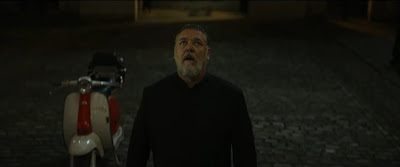
It’s Russell Crowe who makes The Pope’s Exorcist reasonably compelling. He grounds the movie’s well-crafted tropes and cliches in the exact right combination of pathos and panache for this flimsy pulp fun. He’s made the movie star pivot from headlining heavyweight to ace character actor better than just about anybody his generation. He’s been just as good this past decade playing mythological fathers (Man of Steel) and rumpled detectives (The Nice Guys) and road rage villains (Unhinged) as he was anchoring historical epics (Gladiator), biopics (A Beautiful Mind), and true story thrillers (The Insider) during his initial stardom. When he rides into this movie, perching his stocky frame in full billowing Catholic priest regalia on a little Vespa, and rumbling into each scene like he's a combination of Wallace Beery and Donald Pleasence, you just know you’ll be in good hands. He’s playing, as the title suggests, the Vatican’s top exorcist who reports directly to the Pope. If you hope he’ll at some point say “Take it up with my boss,” you’ll be rewarded pretty quickly. The movie falls into the standard pattern of stories in this sub-genre. It introduces a sympathetic family with a harried widow (Alex Essoe), her surly teenage daughter (Laurel Marsden), and innocent little boy (Peter DeSouza-Feighoney) who’s about to be possessed by a demon. Soon enough it all goes wrong for them. The church gets called to help, so the Pope (Franco Nero) sends Crowe to work stalking around a haunted abbey that’s literally hiding devilish secrets in its basement.
He’s earnest in his prayer warrior business and a personable presence alternating between disarmingly amiable humor and gravely serious pronouncements. He’s a source of tough love, takes no guff from the Vatican bureaucracy, and bravely toodles around on that Vespa without looking silly. It’s his presence that holds together these elements, and stays steady amidst the usual production design of a Catholic thriller. (Surely the denomination’s great contribution to the horror genre is the surplus of great costumes and symbolic accoutrements to haul out for added value.) The wind machines kick up, the lights flicker, the furniture bounces around, and the boy is slathered in grey makeup and speaks vulgar threats with the voice of Ralph Ineson. If you recall director Julius Avery’s World War II thriller Overlord’s Nazi monsters getting blown away in gory spasms or his Stallone-starring retired-superhero picture Samaritan’s walloping sledgehammer hits, you might not be surprised by the extra bloody flourishes by the end. It’s competently and sturdily handled right through the ending, including a wink for a potential sequel—heck, franchise—concept that isn’t a bad idea at all. Watching Crowe stand solid and unwaveringly committed in the center of this is quite fun. I’d do it again if he would.
Showing posts with label Franco Nero. Show all posts
Saturday, April 15, 2023
Thursday, December 27, 2012
Off the Chain: DJANGO UNCHAINED
Deeply uncomfortable and scarily cathartic, Django Unchained is Quentin Tarantino’s
first true Western, finding inspiration from 70’s spaghetti and blaxploitation
Westerns for a racially charged fantasy of bloody vengeance. The plot, set in
the antebellum Deep South, concerns a hardened slave named Django (Jamie Foxx,
steely cool) who is freed by the unassumingly dangerous German expatriate Dr.
Schultz (Christoph Waltz), a bounty hunter, in order to assist in hunting down
wanted slavers. The hunter doesn’t know their faces, but figures that the slave
will identify them, seeing as they are the ones who sold Django and his wife
(Kerry Washington, damsel distressed) to separate plantations. In exchange for
the help, Schultz promises Django not only his freedom, but an opportunity for
revenge and reunion as well. This is a film with many scenes of chains and
whips inflicted upon stripped, sweaty, beaten bodies. It summons up ugly
history to gorily dismantle the shameful institution (if only in
some small, personal way) with a force history does not allow.
As one practiced in genre synthesis, Tarantino makes clear
his aesthetic influences while recapitulating and recombining until he finds
and elevates core attractions of his favorite genres. Here, he makes simple
Western mythology out of volatile parts and unexpected juxtapositions. There’s
a hint of his mindset of insatiable cultural appropriation in shots of snowy
Sergio Corbucci fields; later, we follow a chain of slaves right out of Richard Fleischer's Mandingo. Drawing upon Western tropes by
digging into less well-known (or downright disreputable) subgenres, Tarantino
uses his film to reveal heroism and nobility in people usually kept off screen.
How often, after all, did John Wayne films even seriously acknowledge slavery,
a crucial economic engine and political hot button of the very era in which many
of his cowboy epics were set? (Or Clint Eastwood. Or Franco Nero. Or, or, or.)
Here, the black man is the hero, freed to exact his revenge, patiently working
with a foreigner to set a trap for slimy slavers and steal back his bride.
That’s undeniably thrilling. But Tarantino’s approach can be
awfully troubling as well. Though necessary, perhaps, the scenes of slavery and
brutality sit awkwardly in such a pulpy setting. And yet there’s such a moral
force behind it all. Why shouldn’t we get a kick out of seeing a slave determined
to wage a one-man revolt through those determined to dehumanize him? Along the
way we meet all manner of folk who are both imbued with Tarantino’s love of
colloquial verbiage and an easy despicability. There are plantation owners (Don
Johnson), vicious slavers (M. C. Gainey), cruel enforcers (Walton Goggins), and
colluding slaves (Samuel L. Jackson in an altogether unexpected and especially
tricky opaquely complex role). These characters are dancing around the edges of
the plot, which ultimately turns its attention on one particularly
charismatically nasty slave owner by the name of Calvin Candie who is played in
a nice bit of unexpected casting by Leonardo DiCaprio. Calvin owns a large,
notorious plantation called Candieland (get it?) that he proudly uses as a base
for making money off of his slaves through prostitution and death matches.
DiCaprio is clearly having fun (which, come to think of it, is a problem) and
makes for a scary funny foil.
What’s disappointing is that the characters (especially the
supporting ones) are thinner and the genre play is simpler and more
surface-level than the usual Tarantino effort. His sure ear for dialogue turns
tinny time and again, with some more overtly comedic set pieces galumphing
embarrassingly. A scene in which Ku Klux Klan members avant la lettre argue about the size and spacing of eyeholes in
their white hoods is just plain off tonally. Where he usually wields broad
material in great crowd-pleasing gasps that don’t cheat fine thematic points
and nuanced characterization, here he just has the brusque sensations. However
painterly and powerful is an image of a pure white cotton field suddenly
spotted with red blood, this is a film in which the human body has exploding
baggies of red syrup inside and in which only simple catharsis and horror comes
out with the gobs of viscera splattered about. (Though if anyone voices
complaint about Tarantino’s approach to violence, let it be said that at least he
modulates tone exceedingly well in its portrayal. Violence to slaves is gruesome;
violence to slavers is a release.) Unlike his last film, Inglourious Basterds, which told an alternate-history World War II
story through perfectly written scenes working on many levels at once, this
historical genre picture is fairly one-note. I was occasionally entertained and
delighted by the usual pleasures of the genre and certainly unsettled by the
intensity of the slavery aspects of the plot, but was disappointed in the lack
of deeper engagement or coherent commitment to genre subversion.
And then, there came a time when I found myself glad I
hadn’t written the film off as mere uneven entertainment and provocation. There’s
a sequence near the end of the picture that’s pure Tarantino, a long sizzle of
suspense in which violence and surprise lie ticking, explosion fully possible
at any moment. The suspense comes not just from a dangerous situation, but from
the dangerous situation that’s almost, but not quite, occurring, existing as
mere possibility that is deeply imbedded within character and plot in such a
way that the audience knows deep down that this scene will not end with the
same number of living characters that there were at its start. This is the kind
of smart, writerly standoff that Tarantino does best and has within it an
excitement and layered dexterity that I found missing in the rest of the film. Django Unchained frees itself from a
bumpy buildup to go out with a (strangely doubled) flourish of flashy, almost
frightfully effective and satisfying violence that just about justifies the film's existence and christens Foxx's Django a true new Western hero. Still, as good as
it can be and as rousing some of the finale is, I’d have liked to see a
sharper, deeper film that could have put to better use the unstable dynamite of
its plot elements instead of relying on easy outrage and surface cool.
Wednesday, June 29, 2011
Downshift: CARS 2
It is a testament to Pixar’s consistent level of excellence that their Cars 2, a movie I more or less enjoyed watching, feels like a disappointment. It’s a movie that’s fast, colorful, frenetic, and funny, but gone is the deeper feeling we’ve come to expect of productions from this company. This is all surface level whiz-bang silliness, highly watchable and fairly entertaining but also Pixar’s worst effort thus far.
It’s all in what you compare it to, I suppose. After an impressive string of masterworks (Toy Story, Finding Nemo, The Incredibles, Ratatouille, WALL-E, and Up among them), broken only by some relatively weaker entries that were merely pretty great (A Bug’s Life, Cars), Pixar has built a reputation for consummate craftsmanship, movies that entertain with great flair and originality while also managing to emote with a precision built on surprising grace and beauty. They’re gorgeously animated and layered films with heavy emotional content – a post-apocalyptic romance, a widower fighting the march of time, abandonment – handled tactfully and powerfully.
The first Cars wasn’t one of Pixar’s crowning achievements but it sure was fun. It takes place in a world much like our own but instead of a human populace there are fleets of vehicles with wide eyes staring out of clear windshields and bumpers twisting about like lips. It’s odd and off-putting at first, but in motion and in an involving plot, it all seems so natural. When I pushed toy cars across my childhood bedroom did I ever imagine people inside them? I don’t think so. For all I know, the cars themselves were racing each other all on their own. Cars has an egotistical racecar Lightning McQueen (Owen Wilson) zoom into Radiator Springs, a crumbling small town, and discover the slower pleasures of roadside Americana. It’s a movie about nostalgia versus modernity that comes down on the side of progress while still arguing for embracing what got us there.
Cars 2 has no deeper ambitions. If anything, it works to refute the stop-and-smell-the-roses relaxed pace of its predecessor. This film is proudly childish as it slams cars around in zippy action sequences driven by a silly round-the-world spy story. Surprisingly satisfying in its dizzying tangles of plot, events are kicked off by British secret agent car Finn McMissile (Michael Caine) dangerously and daringly discovering something of grave import aboard a menacing oil rig in the middle of the ocean. Soon enough, we learn that an eccentric billionaire (Eddie Izzard) has decided to promote his new alternative fuel by throwing a World Grand Prix, inviting the best racers from around the world. The race is on, which gets Lightning McQueen and his best friend, hick tow-truck Mater (Larry the Cable Guy), out of town and circling the globe.
Stops in Japan, France, Italy, and England provide the backbone of the plot, which is mostly an excuse for a diversity of deeply detailed backgrounds. Japan’s Tokyo is rendered as a world of little Hondas zipping around a bustling neon metropolis. A coastal village in Italy is a lush town where a little car speaks with the big voice of legendary Italian actor Franco Nero (!) and the boats in the harbor sit there pleasantly bobbing and blinking. In Paris, Notre Dame is encrusted with winged cars for saints and gargoyles, while in London the royal car family rolls up with their Land Rover bodyguards. It’s so very weird. Unlike the first film, during which I found myself unquestioningly accepting vehicular anthropomorphism, this time around I found myself wondering how cars managed to do just about anything, from building cathedrals to writing with pencils. And why would cars have to go through a metal detector in an airport? It’s a tribute to the nutty mise en scène, the total commitment to a truly strange concept, that endless unanswerable questions encroach every shot from all angles.
At each stop on the world tour, antics and action are around every corner. McQueen deals with his competition, like a hotshot Italian racecar (with a zooming, motor-mouth patter from a crazed and goofy John Turturro) in what ultimately becomes a glorified subplot. Meanwhile, in the main plot McMissile and his curvy assistant Holley Shiftwell (Emily Mortimer) mistake sweet, dumb Mater for a fellow spy. The plot’s strictly pro forma, not much more or less than an adequate Bond picture when you get down too it, though I liked the evil cabal made up of, well, I guess I won’t spoil it, but the makes and models of the villains are a fun concept. As the story zooms along, the spies take precedence over the racers.
Mater, with his deep accent and unfortunate misunderstandings, gets increasingly wearing the more the film gets tied to his character and sidelines the infinitely more charming McQueen for far too long. Good in small doses, like his moments of comic relief in the first Cars, Mater is overused here. As much fun as the detail and speed of the humor, the action, and the locations are, less enjoyable are the few attempts to make it all mean something. We’re supposed to laugh at Mater and feel bad about it too. There’s a Life Lesson here, but it feels forced and unconvincing. Nevertheless, Cars 2 has a fast pace and it goes down smoothly. It’s a pleasant diversion. Lots of gags hit their marks, though countless others miss entirely, and the gun-toting, bomb-throwing cars make for unlikely, but often awfully satisfying, action heroes.
After churning out so many outstanding movies it’s a shame to see that here Pixar has slipped in overall quality, but it’s clear from what’s seen on screen that it’s not for lack of trying. It’s incredibly detailed animation with meticulous sound design and mostly fantastic voice work; in typical Pixar fashion it looks and sounds absolutely wonderful. It’s light, inconsequential fun. It feels somewhat difficult to criticize Pixar’s team for trying something different, using their technical skills for something less meaningful. If it seems like I’m holding Pixar to a higher standard than I would any other animated company, it’s only because they’ve conditioned me to expect so much more than they offer here. And yet Cars 2 feels very much like exactly the kind of movie that they wanted to make, a broad, silly, punny, busy kids’ movie. I simply had a passably fun time, is that so bad? In this case, it almost feels that way.
Subscribe to:
Posts (Atom)