Showing posts with label Jamie Dornan. Show all posts

Sunday, September 17, 2023

Dark and Stormy Fright: A HAUNTING IN VENICE

It’s fitting that such a theatrical ham of an actor as Kenneth Branagh, so good at making full course meals out of others’ words, would be drawn, as director, to inhabit others’ works. His directorial career is full of echoes and inhabitations both literary (Shakespeare, Shelley) and filmic (Hitchcock, Lean). This doesn’t always lead to a good movie, but he’s a man of ostentatious Good Taste in a jolly old English way as befits a graduate (and current president) of London’s Royal Academy of Dramatic Art. His latest work as filmmaker, A Haunting in Venice, is his third turn with an Agatha Christie novel, returning as director and star in the role of famous detective Hercule Poirot. It is the best of these three—after Murder on the Orient Express’s airless exercises and over-gilded energy, and Death on the Nile’s expansive melodrama and bitter undercurrent. Compared to those, it has the smallest ensemble (Tina Fey, Michelle Yeoh, Kelly Reilly, and a two-man Belfast reunion). But such spareness successfully builds on this series’ best assets: a sense of world-weary cynicism held back by a relentless cold detective logic that makes even the darkest edges and dreary deaths solvable with a sharp mind and steady investigation.

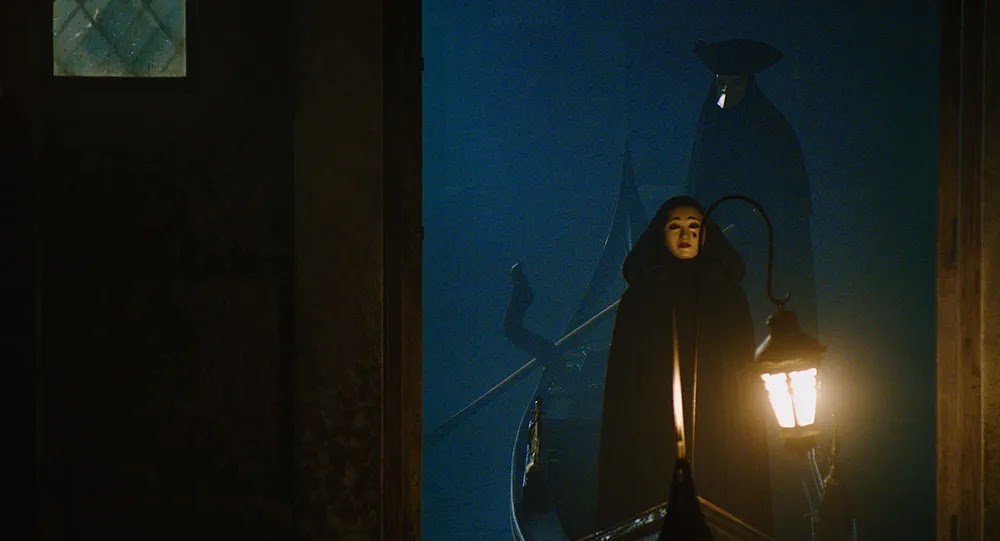
This one’s literally dripping in atmosphere. The setting is a damp Venetian palazzo on a dark and stormy night, the wind battering the windows, waves crashing into the walls, lights flickering, faucets dripping, interiors clammy and steps slippery. He films it like Welles might, in intense canted closeups reminiscent of Mr. Arkadin and snaky shadows like Touch of Evil. (To keep what Leonard Maltin might call the “Wellesian tomfoolery” going, a cut to a shrieking bird has to be a nod to Kane, and an early shot of a dramatic iron-gated gondola garage and a masked and robed figure is reminiscent of the only extant scene of Welles’ abandoned attempt at Merchant of Venice.) These surface pleasures are fun and potentially shallow, but Branagh finds plenty of percolating character beats and sneaky suspense to keep interest boiling with pop depths somberly intimated. In this locked-room mystery, Branagh is cranking up the spookiness and the sadness in equal measure, letting a blurry, bleary, midnight mood creep around corners and lurk in shadows.

As always in these stories, the murderer is in plain sight, and the cast of recognizable names stumble about in fear and suspicion, driven backwards into their frazzled psyches and paranoia as they try to survive the night. Christie’s sense of social status and class concerns takes a backseat to the tightening tensions and grief-stricken group. They were gathered for a seance: a mother who lost her daughter, a father damaged by war, a young son grappling with his father’s illness. (The seance itself is a fine, formulaic balance between sinister silence and sudden smashes.) Now they’re waiting out the storm while Poirot and his mustache must ask them enough questions to figure out the ghost of a clue. They’re as haunted by death and mystery as the film is by its influences—and its somehow a pleasing combination. For all the plot’s twists and turns, biggest surprise for me, though, was discovering that I’ve grown quite fond of Branagh’s broad take on Poirot with his puffed-up eccentricities and earnest melancholy. Beneath the starched facial hair and chewy accent there’s a real character there.

Monday, November 29, 2021

Boyhood: BELFAST and PROCESSION

In Belfast, Kenneth Branagh returns to the time and place of his younger days for a movie based on some boyhood impressions. And that’s what we get: impressions, fragments, glimpses, scenes warmly bathed in childlike innocence against the backdrop of sectarian strife that sets his parents’ minds toward leaving home and moving somewhere new. The movie is set in this obvious state of reminiscence, as the movie starts in clinical digital color and slowly fades to shiny black and white. He remembers some discussions of Catholics against Protestants and some cultural friction between Ireland and Britain. But above all else he remembers a cozy feeling of being surrounded by loving family. The movie finds the boy (Jude Hill) tromping around their working-class neighborhood, never more than out of earshot of his dear mother (Caitriona Balfe) calling him for dinner. He adores his father (Jamie Dornan), too, though the man is often away at work. He generally gets along with his moodier older brother (Lewis McAskie). He interacts with a swirl of cousins who’re always scampering about. He looks up to his grandfather (CiarĂ¡n Hinds) and grins at his grandmother (Judi Dench), two sweet old folks who give him lovely advice and good food. (His grandmother also takes him to see a play, reflected in full color in their eyes, a poignant moment from a director best known for his passionate Shakespearean adaptations.) Why, it’s just too bad that The Troubles had to mess with their perfect little world.

As the movie bumps along episodically, scenes don’t always feel complete or follow logically. It lingers in some moments and elides others, seemingly for no rhyme nor reason. It skips ahead, shifts to montage, or dawdles in minutiae. The result is, a handful of riots aside, a mild-mannered movie, gentle, soft, slight, and a little scattered. However, that feels true to its aims—not capturing a story so much as a collection of childhood memories, details, moments, conflicts, relationships, people. The sociopolitical implications are firmly background color and plot mechanic, while many supporting characters who appear and disappear sometimes at random remain at the level of surface impressions. Isn’t that just the way it is with a jumbled child’s-eye view of one’s own past? It may not build in scope or arrive at important revelation, but it’s ultimately a sweet movie about how much a grown man remembers being a little boy who loved his family with all his heart. No wonder he remembers them in gleaming black and white artifice, where his grandparents are wrinkled wisdom personified, and his father and mother are youthful and beautiful, singing and dancing, trying to do right by their little boy even as their world falls apart behind them.

Boyhood memories are much more fraught in Robert Greene’s Procession. His career as a documentarian has been concerned with performance as a way of processing reality. His Fake It So Real was about pro wrestling, while Actress and Kate Plays Christine dig deep into a performer’s process of building a role, and his Bisbee 17 had a small Arizona town reenact a 100-year-old massacre. (His work as an editor on sharply-written fictional character studies by Alex Ross Perry further bolsters his filmmaking’s psychological acuity.) His new film takes those ideas further into harrowing territory. In it, he collaborates with a group of men who have spoken about their past abuse by Catholic priests. Their stories are decades old now, but the pain is still fresh. Greene, working with a drama therapist and a lawyer, invites these men to script scenes that explore this element of their past. The documentary, then, is about filmmaking: writing, casting, location scouting. Yet every step is a journey into their pain. The men have long brainstorming sessions that double as a support group; they open up in heartbreaking ways, plumb the depths of their anger and betrayal, and share in the camaraderie and openness that only fellow survivors of such unimaginable violation can. The project gives them a way to orient their sharing toward a positive outcome. To share their stories, they think, is one more undeniable way to make a case for themselves and to give light and hope to others struggling with this burden. They talk of various court cases and legal wrangling with the Catholic Church, which, in each man’s case, has elements, if not entire claims, obfuscated, criticized, dragged out, downplayed, or ignored. Together they might be able to make art an act of grace, memory and truth an act of justice—grace and justice being two things Church officials seem slow to grant, or are unable to provide to these victims’ satisfaction.

We see the making of the men’s short films and the eventual final products—by turns testimony, nightmare, condemnation, explanation, reanimation, and act of self-forgiveness and letting go. They’ve explored their traumas, gone hunting for ways to represent the after-effects, literally retracing their steps in some cases. It’s difficult. But Greene films this so tenderly, and so plainly. He draws out their creative sides and, with professional assistance, makes art as a form of therapy. To do so, Greene doesn’t flinch from the heavy details; nor do the men hold back, though at times they pull away in self-preservation as they pick at emotional wounds that linger. A potentially upsetting variable, and yet so lovely in its act of protection and care, is the casting of a tween actor to play their stand-in. The scenes they’ve written have no explicit abuse in them, dealing more in implication, but are frank about the relational, spiritual, and emotional abuse that deviant priests inflicted upon them. (Some of the men even agree to play an abuser in these scenes, an obviously challenging prospect.) The young actor, surrounded by supportive parents and a generous crew, approaches the task with respect and care. The men bolster him, too, though all involved feel the seriousness on set. On the last day, the boy shakes the hand of a shaken older man and says in total sincerity: “I tried my best to tell your story.” That’s a powerful moment, and image—the present willing to attempt a healing of the past through the power of witness. The film finds its subjects excavating and exorcising their tragic pasts. It’s an unfailing honest and perceptive work. And it feels like nothing less than a personal reckoning that reverberates outwards and upwards towards a potential healing breakthrough.

Saturday, February 13, 2021

Florida, Man: BARB & STAR GO TO VISTA DEL MAR

Barb & Star Go to Vista Del Mar is silly. Just plain silly. They don’t make them this loopy and loony and freewheeling good vibes nonsensical every day. It stars Kristen Wiig and Annie Mumolo, co-writers, too, reuniting ten years after their hilarious Bridesmaids. That movie was a hilarious escalation of comedic scenarios in a conventional character-based way, a look at women’s friendships in a pressure-cooker of milestones. This one is more like an all-human Muppet movie with Austin Powers energy seeping in around the edges. It’s flat-out absurd in every second. Yet, it’s still about women, about best friends navigating aging and life changes. Barb and Star are melodiously accented Nebraskans fired from their jobs at a chain furniture store who decide to shake things up with a trip to a middle-aged paradise resort on the Florida coast. There they both fall in lust with a strapping secret agent (Jamie Dornan) who happens to be working for an underwater supervillain (Wiig in pasty pale makeup and a tragic hairdo) plotting to attack the local shrimp-based beauty pageant with killer mosquitos. So that’s going on, but really it’s just as much about: getting blackout drunk and dancing to a club remix of “My Heart Will Go On,” buying tacky seashell bracelets that are a little too sharp, sneaking out a window onto a pool raft and drifting past your friend practicing her calligraphy on the porch. Wacky developments, goofy voices, random asides, and daffy design abounds, with time for both funny background signs (a dumpy motel advertises “Some TVs”) and colorful dance sequences. (Dornan, freed from Fifty Shades, cuts loose with a ballad he addresses to some random seagulls, the highlight of the picture.) This jumble of nonsense is carried along simply by the strength of the fun the performers themselves seem to be having, a sense of wanting to keep the good times rolling just because everyone involved can effectively communicate just how enjoyable they find their own nonsense. It plays like one of those sui generis oddities — a Hot Rod, or Cabin Boy, or Romy and Michele’s High School Reunion — where comedic voices are given free reign to just do whatever. If you can get even a little bit on the wavelength it’s mostly a blast, even as it starts to wear a little thin in the back half. Wiig and Mumolo are confident enough in their own sense of humor to pull it off.

Saturday, February 11, 2017

Shadier: FIFTY SHADES DARKER


The ending of Fifty Shades of Grey really made the picture. Before a finale in which meek Anastasia Steele (Dakota Johnson) firmly turns down the imposing and domineering Christian Grey (Jamie Dornan), the movie had been a modestly enjoyable adult drama, a sort of half-sexy, half-preposterous interlude between pretty young people engaging in teasingly revealed sexual exploration between bouts of bland business speak and low-boil rom-com flirting. Ah, but in its final moments it turned what had been a lopsided power dynamic – rich sadist gets off hurting a sweet underling who likes it, but only up to a point – into a loaded denial. He pleads with her to stay. She, having finally realized he liked hurting her more than she liked it and more than her willingness to play along could withstand, says a firm, simple, strong, “No.” It’s the last thing we hear as the elevator doors close on the final cut to black. Because Johnson had been such a fun performer, equally enthusiastic and full of personality in bedroom scenes and barroom conversations alike, she almost single-handedly kept the movie from tipping over into prurient giggling or exploitative leering, especially with Dornan’s dour wooden display at her side. This final assertion of her control over the situation lent the movie a nice, contained little arc the sequels were bound to trample.

As Fifty Shades Darker begins, Anastasia continues to rebuff Christian’s creepily insistent attempts to get his way back into her life. Alas, as following the dictates of the garbage book that inspired this whole thing demands, she must allow this to happen. If the first film was ultimately about a young woman trying out a relationship with a cold, distant, persnickety man just to see if she could make it work, the second is about that same woman getting pulled back into the relationship just because. If these stories are theoretically about true love, and I suspect that’s the ending we’re angling towards in next year’s supposed finale, it has done a poor job showing it. This installment, directed by James Foley (both a long way, and somehow not, from his better, similarly icy-toned, attractively cast and photographed 90’s thrillers Fear and After Dark, My Sweet), finds the couple trying out a new dynamic, with fewer rules and diminished expectations. She gets a new job. He buys the company. She meets his family. He takes her sailing. Playing out with smooth adult contemporary ballads under the glossy catalogue spread looking montages – people standing around in sweaters, on boats, at masquerade balls, and beside fireplaces – it tries to gin up interest with some workplace drama and Dark Secrets From The Past. At least it allows for the introduction of Kim Basinger, a welcome sight in an all-too-tiny role.

What little attention paid to the central relationship takes their chemistry and compatibility for granted. Even the sex scenes, the most memorable a fully-clothed shower make out session, aren’t as entertaining as the first’s, more actors’ contract negotiation than character development. (That’s really saying something when the original had literal contract negotiation built into the plot mechanics.) It’s like everyone involved suspects this couple’s long-term happiness won’t, or shouldn’t, work out, but are obligated to stand by them and see it through. (I’m sure many of us have been to weddings like that.) Even when we learn Christian is not just a dominant lover, but also a bit of a burgeoning cult leader – an ex (Bella Heathcote) still falls submissive before his meekest gestures, like she’s still under his spell – the weird sense of inevitable True Love pulls at the main couple. But why would the movie insist watching the funny, bookish, charming young woman continue to be drawn back into the world of this clearly unwell, closed-off, stone-faced billionaire is a route to a happy ending? It tries to be both a romance and a modern Gothic mystery (the question simmering underneath: what’s the deep darkness at the heart of family Grey?), but the latter continually turns the former far more sinister than intended.

And yet, why, then, does the movie give off the dull, consistent feeling of moderate surface pleasure? Perhaps it is because Johnson’s tremulous, dancing, sparkling line readings pirouette off the clunky dialogue (scripted by author E.L. James’ husband) and Foley’s use of competent cold grey photography is seductive Hollywood sheen. And even when I was baffled by the plot’s direction – and by how little actually happens – I was tickled enough by the splashes of melodrama – a drink thrown in a woman’s face at a fancy party! improbable publishing office politics! a random helicopter accident thrown in to gin up false suspense before the movie’s narrative totally flatlines! – to get carried along in its dumb gloss. It’s an empty-headed diversion, as silky a nothing as the original Zayn/Taylor Swift duet that twice slickly slides in one ear and out the other on the soundtrack. These are hardly the best reasons to recommend a movie. And, sure, it’s the sort of faux-transgressive that, say, The Handmaiden’s silver bells would make blush. But I was moderately entertained by this low-key mind-numbing polish.

Sunday, February 15, 2015

Tied Up: FIFTY SHADES OF GREY


Another in a long cinematic tradition of excavating an intriguing movie out of a trash novel, director Sam Taylor-Johnson (of the young John Lennon biopic Nowhere Boy) and screenwriter Kelly Marcel (of Saving Mr. Banks) treat E.L. James’ bestselling erotic novel Fifty Shades of Grey seriously as a picture of a problematic relationship between two very different people. It’s a strange, half-convincing film, part movie romance formula, and part psychological melodrama, shot like a thriller but with a cautiously sad core. It appears to head down troubling paths before pulling up short in a sudden conclusion. It’s a girl meets boy, girl tries out boy’s demands, girl’s not so sure she wants to stay story.

A young woman (Dakota Johnson) meets a rich young billionaire bachelor (Jamie Dornan) whose intensity attracts her. He likes her too, aggressively wooing her with expensive gifts, like first edition Thomas Hardy novels. She’s flattered, and allows her curiosity to pull her into his version of a relationship. They’re a study in opposites, she shy and giggly, and he self-serious and creepily controlled in all aspects of his life. She’s a romantic, and prone to drink a little and turn into a Broad City supporting character. He’s a movie workaholic, talking about “business” and standing around handsomely austere skyscraper conference rooms without ever getting into what, exactly, he does. All we know is she’s an English major without a job, and he’s a man who can afford to get his way.

He’s a dominant personality looking for someone to submit to his every whim. He wants to control her. This goes beyond the kinks that have made the story a sight-unseen source of derision and tittering (whips, handcuffs, and the like). She gets a thrill out of having her hands tied to the bedpost. But as their arrangement intensifies, bedroom negotiations soon involve an absurdly detailed and lengthy proposed contract. He’s clearly put in a lot of time thinking about his preferred partner’s activities. She says she’ll think about it, a totally reasonable reaction to his desire to determine her schedule, her diet, where she goes, who she sees.

To the movie’s credit, his increasingly controlling stalkerish behavior – appearing places unannounced, or taking over her life by, say, trading in her car for a new one without permission – isn’t soft-pedaled as twisted romance. A clear line is drawn between sex (even adventurous kinds) and exploitation. The problem isn’t the billionaire’s kinks, but the intensity with which he demands punishment and obedience, and how unwilling he is to pay attention to the needs of his partner. It’s all about his pleasure, his desires. This uncompromising can scare her, and yet she draws pleasure from their encounters, discovering that physical submission doesn’t need to include emotional compromise.

I never quite understood what they saw in each other. It doesn’t work as romance. He sees someone inexperienced and naĂ¯ve, able to be molded into the partner he wants. She sees a handsome rich guy. What’s love got to do with it? There’s a tricky arc to be played here, a relationship that starts kinked and grows ominous. Johnson’s winning, vulnerable and charming, giving a real movie star performance. (Could we expect less from the daughter of Melanie Griffith and granddaughter of Tippi Hedren?) She bites her lips and rolls her eyes, able to make fun of her new boyfriend’s oddities, having fun with them, and then getting a little scared of how far he’ll go. She’s so good, floating through with intelligence and good humor, she even carries Dornan’s wooden sulky performance that’s mostly glowering and standing upright. (The supporting cast includes small roles for Marcia Gay Harden and Jennifer Ehle, so it’s not hurting for strong women.)

The leads draw clear differences between their characters, as opposites attract. We get several sex scenes that play dirtier in implication than in practice. They’re soft montages with lots of movement and skin but little lingering reveals. Two are set to BeyoncĂ© songs, so you know they're smooth. The film saves the power plays for their negotiations, as she tries to get a “normal” boyfriend and accuses him of just wanting her as a sex slave. Their relationship is presented ambiguously enough, I wasn’t sure what we were rooting for. Do we want a Beauty and the Beast change on his part to loosen his rigid rules, or for her to leave him for someone more playful? I knew I wanted her to leave. He’s a gender-swapped Fatal Attraction waiting to happen. In its way, the movie’s an extreme metaphor for the difficulties couples face trying to compromise.

The movie should be looser and funnier, overheated in passion and problems. Imagine what a Pedro Almodovar approach could’ve ripened it into! Instead, it’s serious and slow, with long stretches of boredom between moments where Johnson’s allowed to leap to life with a twinkle in her eyes. Surprisingly little happens in the middle stretch as she decides whether or not to agree to his terms and submit to his will in all things. It allows ugly implications to creep in around the edges. But there’s a nice mix of giggling curiosity (“You’re so bossy,” she laughs mid spanking) and tentative caution, wondering just how much pleasure he derives from hurting her. She’s smart, refusing to get steamrolled by his uptight dominance, but curious to experiment a little first.

Taylor-Johnson, with cinematography by Seamus McGarvey, films it all in grey steel tones, making a film cool to the touch. It moves like a thriller, weighing its protagonist’s options seriously while keeping her partner’s motivations frustrating and frighteningly mysterious. I was pleasantly surprised to find a film focused on communication and consent, policing boundaries, and ending on what seems to me a triumphant “no means no.” Perhaps it’s a cliffhanger resolved in proposed sequels, but viewed as a single story unto itself, it’s a break for freedom, where a woman leaves a damaged man behind and goes forth into the world with the skills to have a mutually fulfilling relationship on her terms in the future. I’m not familiar with the source material, but somehow I think the filmmakers got the best possible movie out of it.