Showing posts with label Jared Leto. Show all posts

Monday, April 4, 2022

This Anti-Hero Sucks: MORBIUS

People were down on Morbius since it was first announced, as if the idea of making a mid-tier Spider-Man villain the star of his own debut, disconnected solo movie was patently ridiculous. When superhero comics are strip-mined for every part that might make a movie or TV show, because they’re currently the only projects making huge bucks at the box office or drawing big audiences to streamers at a reliable rate (or so they say), one can’t exactly be surprised that a Marvel character who’s a living vampire wouldn’t make some executives’ pocketbooks perk up. This has to be especially true of the folks at Sony, who are riding high off the success of two Venom movies, which also spun non-Spidey stories out of that comic’s web of side characters. When fanboys scoff and meme about this particular movie, as if other Marvel movies aren't commercially minded brand decisions, well, they certainly are capable of massive cognitive dissonance.  

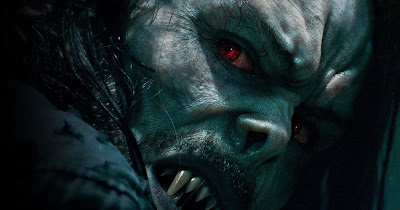
So here we are with Morbius. Shrug off the negative hype and see it for what it is: a decent little programmer, an unfussy little monster movie that plugs into the woe-is-me, tortured-creature thing that works well enough for it, even if it’s drowning in overfamiliar plot moves. Director Daniel Espinosa knows a thing or two about making derivative B-grade studio fare classed up with some fine casting and cleanly-cut action. His space-station-set sci-fi chiller Life is a cramped little Alien riff, and his Safe House lets Denzel Washington run circles around Ryan Reynolds in shaky bruising violence. Are they cliche genre pictures? Certainly. But they go down easy because Espinosa makes the elements play like well-oiled machines. So he knows how to make Morbius bubble to life with some attention to component parts—the tragic backstory, the fatal flaws, the dogged detectives, the arch-rival, the doomed lover—and casts well enough. The picture crawls to sufficient life, ambulating the cliches into something like minor popcorn pleasures.

The film finds Dr. Michael Morbius, genius inventor of cool blue synthetic blood, hard at work on a cure for his rare blood disease. One thing leads to another and, whoops, he’s a vampire now, sucking down his own invention until he sniffs out the superpowered benefits of the real thing. Jared Leto is awfully convincing as an aloof creep, who sometimes does good work, but also has everyone who is aware of him side-eying his decisions. His monster posture and pained expressions are a perfect camp match to his lunging for his blood bags and sucking them down like a Capri-Sun. The supporting cast includes Jared Harris as a conflicted older doctor, Matt Smith as a friend and fellow patient who turns villainous, and Al Madrigal and Tyrese Gibson as FBI agents hot on the trail of a rash of vampire attacks. Gee, who could that be? All involved elevate their stock material ever so slightly through sheer will, screen presence, and knowing how to sell the silliness.

The whole thing is too small to build to any real spectacle., but that’s almost refreshing in its dim, short, simple way. The basic story beats are hit with a steady plunk, and build to a reasonable one-on-one vampire fight. Along the way, effects like rippling sound waves and tendrils of supernatural senses pop in neat-enough comic book poses. And in the end, I did sorta care to find out if Morbius would get to save his love interest (Adria Arjona) from a fate worse than death and stop the villain from giving vampires a bad name. There’s some genuine poignancy to his dilemmas, and you can feel the better monster movie straining to get out. 

The screenplay may be a pileup on the trope highway, but there’s some actual feeling and imagination in its creaky premise. It’s worse the more it tries to be a standard modern superhero movie—never more so than its dire end-credits scenes nonsensically teasing surreally forced connections. And yet that’s what the people say they want? (Leave before you can see them unless you have morbid curiosity.) It’s better when it’s own little thriller, leaning into its own preoccupations, doodling in its own world. And it’s certainly a better bit of junk cinema than so many others of its ilk that mistake a traffic jam of cameos and references to a story. You know the ones.

Wednesday, December 8, 2021

Great Scott: HOUSE OF GUCCI and THE LAST DUEL

Ridley Scott is a director of contradictions. On the one hand, he’s one of Hollywood’s last great technicians of human epics. On the other, he’s an aged cynical graduate of advertisement who still simmers in the splash and flash—slick surfaces illuminating a sickness underneath. He doesn’t always hit, but when he does he’s top tier. And he’s always admirable for marshaling enormous technical craft and skill to communicate a vision that’s all his own. His latest is House of Gucci, a story of the fall of a once fashionable family. (In that way, it’s of a piece with his recent All the Money in the World, another true story of a wealthy family in conflict.) For Gucci, the chic, fashionable brand may still be strong, but the founding fathers are long gone, driven out by ego, scheming, and a wicked true crime twist. Scott joins them near the end. He surrounds them with tacky opulence and hollow golden accoutrement.

Maybe it’s the fact the movie was shot during the pandemic, which probably cramped the ability to assemble huge crowds or tons of moving pieces, but everything, from discos to villas to storefronts, seems pinched and empty. We see an obscenely rich family who have walled themselves off from the human element, like the nasty industrialists in Visconti’s The Damned if they had a better handle on some of their morals. (But just some.) There are the wrinkled brothers ruling over the stale roost of a company past its prime—an emaciated Jeremy Irons with a hacking cough, and a bloated Al Pacino delighting in his self-satisfaction—and their inadequate sons, a dweeby pushover with a reedy tone (Adam Driver) and a pompous rolly-polly oaf with a honking accent (Jared Leto cocooned in a fat suit and expansive balding forehead). Scott clearly relishes populating the screen with characters who are caricatures at best, gargoyles at worst. He finds the Gucci family in the late 70s and pushes into the 90s, as the glamorous fashion brand has fallen on hard times. The fact it won’t rebound until none of the above are involved, or alive, is treated as a giddy irony.

This stance is double-underlined by the central figure of this wildly uneven picture: a scheming lover played by Lady Gaga. Done up in Italian drag, Gaga serves up a six-course half-camp meal in which each course is ham. She swivels into every scene like a pneumatic refugee from the Ryan Murphy version of the tale, glowering from under heavy makeup, wriggling into tightly-fitted costumes, and chewing over every sentence like she’s prepared to swallow the scenery whole. Her character is constantly working an angle, using romance as a way up the food chain, and then snapping up the weak wealthy marks around her. Up against the likes of Irons and Pacino, she’s pushy and insistent. Playing off Driver, she’s constantly throwing herself against his comparative naturalism in their high melodrama. Her scenes with Leto play like nothing less than stumbling into the theater department’s two most outlandish students egging each other further over the top.

There’s fun to be had in this swanning buffet of performances, bubbling unpredictably between lively and dead-eyed, but Scott’s material loses track of the plot’s pulse. It becomes a string of handsomely realized empty echoes—a dim tour through a melting wax museum of fashion tycoons and true crimes past. The tone, amplified with pounding pop hits and shimmery gowns yet drug down to earth in dim negotiations and disputes, teeters between gloriously fake and dreary disbelief.  That’s why, no matter how fitfully engaging, it’s hard to get into the larger portrait of systemic capitalist excess, squirmy scheming at the heart of its ladder of success, and delirious drops from the heights of inequity. The whole picture is too sad to be funny, and too funny to be sad.

Far better—sharper, perceptive, and complicated—is Scott’s other period-piece epic of the year: The Last Duel. Instead of shiny surface elegance, it has actual elegance in its design despite some bruising subject matter. Set in medieval France, it’s the story of a rape accusation as told from three perspectives: first the victim’s husband’s, then her rapist’s, and, finally, hers. The intelligent construction doesn’t get lost in the subjectivity of the viewpoints—it’s careful not to make the key details up for dispute—but cleverly draws out the ways in which people can convince themselves they’re the wronged party, no matter the cost. Scott summons an army of craftspeople and extras to populate chilly castles, sprawling manors, and muddy fields of combat, with horses tromping up and down, swords clashing, and ladies’ dresses swishing over the cobblestones. It has the same attention to messy historical detail that made his Kingdom of Heaven and Gladiator, not to mention his debut feature, the similarly downbeat view of chivalrous violence, The Duellists. But because the focus remains squarely on the even messier, and evergreen, human failings and foibles driving the drama, the humanity is never dwarfed by the large scale. It’s intimate and uncomfortable despite the occasional flourishes of fluttering banners and clashing blades.

It helps that the performers are uniformly charismatic, and unafraid of looking pathetic, powerless, or petulant. Matt Damon, constantly small in the frame, plays a frustrated mid-level knight who rides off into battle and expects to be rewarded by the feudal system game by which he’s playing. His younger wife is played by Jodie Comer, who is dignified even in defeat, and rather clear about using her marriage as a way of social currency for her father. She loves her husband, but chafes ever so slightly against the ways her husband’s ego structures her life. Adam Driver, tall and intense in an interesting evil twin to his Gucci performance, is a knight who eventually has his eye on Damon’s wife. The two men are friendly on the surface, fighting together and both under the domain of the king’s cousin (Ben Affleck). That bleach-blonde aristocrat has a libertine swagger and fratty attitude—Affleck brings an oozing charm and nasty privileged self-impressed edge to every line. Driver’s in his good graces, and manages to wheedle some land that was to be promised Damon. This sets off a tense relationship that eventually culminates in the central crime, and Damon’s demand for a duel to the death. According to the court, in this case of he-said she-said, it’s the only way to prove his wife’s good word. (The arguments the men in power make to discredit her sound exactly like today’s right-wing talking points on similar matters, right down to the medieval understanding of biology; that it’s plainly presented and allows the audience to draw the connection on its own is a sign of the movie's subtly.)

Written by Damon and Affleck with Nicole Holofcener (that expert dissector of social interactions stewing in money, jealousy, clout, and pettiness with the likes of Please Give and Friends with Money), The Last Duel becomes a wide-angle lens that nonetheless focuses tightly on actions and consequences. It’s a surprisingly lively experience for such dour subject matter, skewering the pathetic squabbles and scrabbling for power amidst the men even as it understands their frustrations, and empathizing with the quiet dignity of the woman who recedes into the background despite being the ostensible focus. The overall Rashomon effect of the separate but complimentary and contradictory tellings, without an interlocutor to guide us, returns to the beginning of the conflict thrice. The build up to the crime is enhanced by the empty spaces that are fleshed out each time through. For the crime itself, at first it is merely recounted, but later seen twice, each intense, tactful and impactful. The first two times, the film pushes right up to the brink of its climactic duel before skipping back to tell the whole thing from next point of view. The screenplay is sharply balanced to bring us deeper into clarity.

When Comer steps into the lead for her section, the one that finally leads into the final fight, we’re explicitly told it’s “the truth,” and the sad thing is that it matters little to the outcome. Here’s a society in which choices are constrained, when people suffer under powerful men who protect their friends and allies at the expense of those deemed lesser than, and the inequalities of class and gender dictate so much about who is believed and whose control is maintained. In the end, the duel is the only thing giving Damon a chance to win some honor back (although, he’s warned, if he fails, he wife will literally be burned as a liar). What no one much seems to care about is the truth, the woman’s perspective, as she’s left to suffer in silence (that’s even the advice she gets from her mother-in-law in a clenched scene of matter-of-fact confession) and hope the right man is killed.

Saturday, February 6, 2021

Washingtons State: THE LITTLE THINGS
and MALCOLM & MARIE

No Denzel Washington movie is all bad because, no matter what, at least it has Denzel Washington in it. His latest, The Little Things, tests the thesis a little. It is a slow, dreary murder mystery that’s yet another movie of cops with flashlights tromping around scenes in which corpses of young women are splayed out surrounded by inscrutable clues and a stringy-haired creeper lurks in the margins as the obvious suspect—or is he? The thing is a procession of cliches — interrogation scenes, press conferences, stakeouts, cat-and-mouse games, solemn autopsies, and crime scene photography, and all the while detectives frown and sigh and triangulate — propped up by workmanlike filmmaking craft from John Lee Hancock (The Blind Side) with nary a surprise. Even the twists arrive with a dull thunk as the plot gears turn. 

 But then there’s a bit of an acting class going on in the center, in which Washington single-handedly puts the entire movie on his sturdy shoulders and almost makes the thing work. He seems to be doing very little—sitting still, talking slowly, moving deliberately. He quietly murmurs his lines. He’s interior to the point of flat. And yet he’s such a confident, capable Movie Star, that even tamping down his megawatt charisma, he holds every frame every moment he’s on screen. We’re told he’s a detective who dropped out the LAPD after a particularly troublesome case. Now his replacement, a buttoned-up serious investigator (Rami Malek), is looking into unsolved murders that point back to that case. It’s a nagging open wound for the both of them. The movie takes its simple stock premise and noodles around a character study at the margins, though we never learn overmuch about these men, and the ultimate question boils unsatisfyingly down to: does a tough case make a tunnel-visioned weirdo out of these guys, or are tunnel-visioned weirdos drawn to tough cases? Either way they pick at the faintest loose ends, pretty quickly zeroing in on a grade-A creeper of an appliance repairman (Jared Leto) who sure seems guilty. He’s so perfectly off in all the right ways; but so, too, is the case against him. What a conundrum. The shame, then, is that the whole lousy project goes pretty much nowhere and takes its sweet time getting there. What remains fascinating is how much Washington can do with so little, and how actors like Malek and Leto work so hard throughout and still have no chance of catching up.

Perhaps John David Washington has an unfair advantage in the department of younger stars hoping to follow in the great man’s footsteps and capture some of that natural charisma. He is, after all, the legend’s son. There’s something totally captivating about his screen presence, and malleable as he can be both full of wily bravado (like in BlacKkKlansman) or suave and coiled (like in Tenet). He’s so close to great. But there’s also a sense he’s not fully done cooking; he has the confident physicality of an athlete, and the soulful stares of a thespian, but he’s yet to have the exact right part to unlock his appeal. Seeing him in Malcom & Marie proves that maybe big meaty theatrical dialogue might get him there yet. The film teams him with Zendaya in a two-hander shot in grainy black and white for an authentic small-scale indie feel. It’s set over the course of a night as a young couple of Hollywood up-and-comers start off bickering and soon end up in a full-blown romantic argument that rumbles and rattles in long tangles of overwritten prose. 

 That the performers are two of the most promising new movie stars to come along in some time carries the movie — small, self-conscious, puffed up — much further than it deserves. Zendaya is a stormy, smoky inscrutable stunner in a gorgeous dress or less as she casually unravels her critiques and complaints about her swaggering, self-important director boyfriend. The film’s first twenty minutes or so are crackling with unspoken resentments and relational misjudgments expertly teased in these tense and sensual performances, the relationship’s flaws tensely embodied in unspoken shifts of weight and design. Alas, unlike the intensity and escalation of a John Cassavetes or Who’s Afraid of Virginia Woolf? argument, which are clear inspirations, this film’s bickering and bantering gets awfully tiresome and repetitive, failing to illuminate by minute 80 or 100 more than we’ve groked in the first flush of interest back in reel one. Writer-director Sam Levinson, who pulled off a much better two-hander in the great recent Zendaya-starring Special Episode of his otherwise overripe HBO show Euphoria, here finds moments of tight squirming intimacy, but ultimately can’t keep the novelty from wearing off fast. It becomes a case study of two fantastic performers easily outpacing their material. That it almost works anyway is to their credit.

Saturday, October 7, 2017

Do Androids Dream of Electric Love? BLADE RUNNER 2049


Ridley Scott’s proto-cyberpunk sci-fi noir Blade Runner is revived as a ponderous Villeneuve somber spectacle in Blade Runner 2049. Over thirty years after the original, which imagined a dystopian future L.A. with contours – smoggy rain; polyglot class stratifications; enormous looming digital neon advertising – setting the stage for many imitators, the new film digs into the implications of its world. Before, Harrison Ford played a cop tasked with hunting down rogue cybernetic beings called Replicants. Decades later, a new model Replicant played by Ryan Gosling is hunting down the last of the old models who are still hiding out under the radar, living lives of quiet desperation, their illegal problem programming allowing them just enough free will to shake off the yolk of their makers’ expectations. In the opening sequence Gosling flies his hovercar over a vast dried up terrain to a far-flung farm where a gentle giant of a Replicant (Dave Bautista) sighs in resignation, fighting back in futile self-preservation before the younger bot breaks him down and checks him off the wanted list. Sounds like pulp fun, but look and listen to the film’s atmosphere, director Denis Villeneuve using the suspense techniques honed on the likes of his Prisoners and Sicario to turn out slow, carefully considered images with grey-air-and-glowing-screen palates and a soft quiet unsettling as a pot boils in the background. These filmmakers mean to take a movie about robots, holograms, flying cars, and corrupted files very seriously indeed. 

After last year’s Arrival found Villeneuve working with a deep, powerful strain of emotional content – wrapping an egg-headed first-contact story around an effective contemplation of parenthood, memory, and grief – he takes a step back into ice cold dread. This late Blade Runner sequel is merely a speaker-rattling drone, a slow drip accumulation of dread and despair gorgeously lensed by the great Roger Deakins. He paints in greyscale gunmetal tones and harsh neon lights gracefully arcing across beautiful faces and austere jumbles of concrete-and-polymer industrial parks and towering brutalist architecture. This is a future world at once sparse and ornate, underpopulated and overstuffed. The place, brilliantly built out from the iconic look of Scott’s original, is tactile and disturbing in its all-absorbing qualities. The entrancing score – so often sounding like a window-rattling motorcycle engine roaring by outside, or like a pitch-distorted, extremely slowed down dial-up modem – and the beautifully photographed production design does the heavy lifting. Characters here are poses; worldbuilding is ominous terse monologue; emotion is as crisp and empty as watching an android kiss a hologram. We’re to be contemplating the chilly romanticism of digital beings, but it’s hard not to shake the feeling we’re watching ones and zeroes execute their complicated programs. That’s partly the point, but there’s a frustrating surface-level satisfaction to the movie’s long, languorous, cavernous contemplation of its eerie images. I loved a scene where a hologram slides over a human woman and syncs to her movements, an imperfect process of digital possession that creates ever-so-slightly overlapping images. But it looks cool more than it is actually intellectually stimulating.

The film runs nearly three hours, and its pleasures are absorbing but fleeting. Its appeal sits entirely in stoic characters wearing fabulous wardrobe – stiff high collars, starkly starched trench coats – and inhabiting handsomely striking sets – echoing rooms, windswept irradiated landscapes, a theater of holographic entertainers on the fritz, thunderous man-made waterfalls, junkyards exploding in sudden District-9-style bodily harm as sudden death rains from above. It’s the sort of movie interested in exploring the differences between mankind and artificial intelligence, probing the deep mysteries of what makes a soul and what it means to create life, but in which man and robot alike are equally placid and monotone in demeanor. The ace supporting cast – Robin Wright, Sylvia Hoeks, Ana de Armas, Mackenzie Davis, and even Jared Leto (who is fine in his blink-and-you’ll-miss-it turn) – are directed to be effective elements of the art direction, moving and emoting so precisely and mechanistically it makes a mockery of any sense you could figure out who’s real and who’s created. They’re all ghosts in the machine. Villeneuve’s style of handsome foreboding is admirably sustained, putting the script’s grinding inevitability and tangled, deliberately-paced core who-am-I? mystery plotting through a lens of impeccable craftsmanship. I was never bored, but never involved, always stimulated but never fully invested. It’s a remarkable technical achievement, but a hollow emotional and intellectual exercise. It’s incredibly cool and totally cold.

Wednesday, November 20, 2013

Die Another Day: DALLAS BUYERS CLUB


Far and away the best reason to see Dallas Buyers Club is Matthew McConaughey. His acting has been the best it’s ever been these last 18 months. He’s an actor of range and talent his early typecasting had done much to hide. After his Dazed and Confused early breakout performance and toiling in roles as idealistic young lawyers (A Time To Kill, Amistad), he became a star on the back of leading shallow shirtless lunkhead roles in increasingly exasperating comedies. But now, after his wide range of interesting supporting roles as of late, he’s grown into a career that’s varied, fascinating, and consistently excellent. With roles as a small-town prosecutor in Bernie, a sleazy hitman in Killer Joe, a strip club proprietor in Magic Mike, a fugitive in Mud, and reporter in The Paperboy, he made great movies (the first three) and less than good movies (the latter two) better for his being there. He went from a name that was no added value to a film’s promotion to a name that causes my attention to perk up when I see it in the cast of an upcoming project.

In Dallas Buyers Club, McConaughey plays Ron Woodroof a hard-drinking horndog who spends his time gambling and carousing when he’s not picking up day labor as an electrician to supplement his rodeo income. But he’s clearly ill, gaunt, sickly skeletal. McConaughey inhabits this diseased frame with painfully thin confidence, his swagger and charisma shining through so strongly I was afraid all the more that he’d break right in front of our eyes. The soundtrack picks up some high-frequency whines as he winces, overcome with pain as he squints and hopes it’ll pass quickly. It’s after a workplace accident that his blood happens to be drawn and flagged for further testing. The doctors (Jennifer Garner and Denis O’Hare) bring him the sad results: he has HIV. It’s the 1980s and HIV/AIDS is a mystery disease and treatment is fragmentary and rare. It’s widely assumed to be a disease affecting only gay people, so Woodroof, faced with a death sentence, reacts in a homophobic huff. It’s a mistake, he says, storming out of the building.

But what if it’s not a mistake? That’s the question that haunts Woodroof as he comes to accept the diagnosis. Told the best the hospital can do is offer him a spot in a clinical trial that may or may not help him, he researches treatment options, finding useful supplements that are unavailable in the States. The Food and Drug Administration has not yet approved these apparently helpful substances, so Woodroof sets out to get some, figuring he might as well help his fellow HIV/AIDS patients in the process. Craig Borten and Melisa Wallack’s screenplay relays the events as a sort of big-pharma medical heist story with a libertarian anti-FDA bent, smuggling meds through a loophole and getting them to those in need. Woodroof sets up a Buyers Club, selling memberships that entitle dues-paying customers as much medicine as they need. By not charging for the unapproved chemicals directly, he’s able to avoid directly breaking the law.

It’s the story of a man outliving his initial 30-day diagnosis, an angry prejudiced man thrown by circumstance into a culture he barely knows and doesn’t understand, but is initially certain he hates anyway. An early scene, shortly after his diagnosis sent gay slurs flying off his tongue in denial, finds his friends shunning him, spitting those same slurs back at him. He’s clearly crushed by this betrayal and that association, but soon his hospital roommate, a transgender man named Rayon (Jared Leto), becomes his business partner and friend. They have a fun and unlikely buddy chemistry that feeds into the film’s heist-like patter, even though their gaunt appearances and oft-ragged voices are clear indications that no matter the good they do, the end to their stories won’t be a cure. Even as they get these goods around the law, the FDA is sniffing around, circling, looking for a reason to shut their operation down. It’s about perseverance in a fight between bureaucracy and urgency, between funereal paranoia and hope.

The screenplay leans on speechifying and easy lessons, but has performances so electric that there’s a sense of liveliness to it all. Director Jean-Marc Vallée is hardly a subtle director. Why, the opening scene cross cuts a distractedly shot sex scene with a panting horse nearly throwing a rider in the rodeo, as if to make completely sure even the least observant audience member immediately gets the metaphor for risky behavior as HIV danger. There’s no room for subtlety here with filmmaking that’s largely only functional. But Vallée trusts his actors to put across this material, letting them express complexities of emotions in scenes that give them full attention. McConaughey runs away with the film with his frighteningly wiry intensity, balancing charm and disreputability, acting circles around Leto’s impressive-in-its-own-way look-ma-I’m-acting roller coaster of laughing, crying, flirting, and coughing.

It’s a film that’s largely a safe, solid, moralizing based-on-a-true-story message movie with plentiful generic uplift and triumph-in-the-face-of-adversity good feelings. But the acting is so strong, from McConaughey especially, that the performers manage to make it worthwhile. It might’ve seemed irredeemably phony if it were not for such a solid lead performance holding the whole thing together. If you want a more comprehensive, deeply felt, fully contextualized look at the 1980’s fight against the AIDS virus and those who would deny full opportunities for help, I’ll point you to last year’s excellent documentary How to Survive a Plague. But if you want to get a glimpse at the subject while appreciating yet again why McConaughey has become one of our most reliably excellent actors, here’s your chance. He sells everything down to the smallest moments, making subtlely out of broadness. I particularly like a scene in which he accompanies Rayon to a gay bar looking to recruit new Buyers Club members. He silently gives beefcake photos on the wall the side-eye, as if to suggest a man who is almost, but not quite, willing to loosen his bigotry in order to help his fellow man.