Showing posts with label Lily Gladstone. Show all posts

Sunday, October 29, 2023

Dead Reckoning: KILLERS OF THE FLOWER MOON

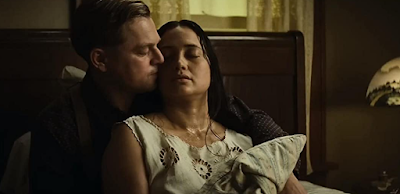
There’s a storm on the plains. Thunder and lightening rumble in the distance. Rain drops on the farmhouse in a steady drumbeat. The white man (Leonardo DiCaprio) goes to close a window. The indigenous woman (Lily Gladstone) stops him. The storm is powerful, she tells him. Give it your attention. It must be paid respect. And so they sit, she meditatively, he uncomfortably, as the rain falls. The sound fills the empty spaces in their awkward conversation, their fumbling flirtation. It’s a simple scene, and yet a key to understanding Martin Scorsese’s Killers of the Flower Moon. Here’s a movie about a metaphorical storm of violence and conspiracy and desire running through an Oklahoma community in the early 20th century. It gives us space to understand the conditions that created it, and the lasting consequences of it. The setting on the last bleeding vestiges of a wild west finds the moment when horses were traded for cars, fields for oil wells, and bartering for bank accounts. It’s a film about the transition, about beginnings and endings and who gets to lay claim to the land, and to the stories about it. Scorsese, always a director sharply interrogating human fallibility, fragility, and fearsome self-justification, here finds a moral righteousness driving underneath a knowing, provocative, and enveloping complexity. He finds the most staggering shifts of history sit squarely in the pressures of relationships and gestures.

It is a movie about real evil. It paints a damming portrait of the queasy intimate violence of greed and prejudice that built many a wealth in this country. It’s based a true story of an all-American evil—systematic murders in the early 20th century that chip away at the Osage tribe’s rights to Oklahoman oil money. We see a vibrant indigenous community living socially and economically intertwined with a rising white working class of maids and drivers and cooks and farmhands and bootleggers—and the wealthy white grifters rising to take advantage of them all. The wide frame, with ensembles in vintage attire and convincing locale looking for all the world like D.W. Griffith or John Ford had been building classical blocking in CinemaScope from day one, bustles with this activity of a society in flux. Notice how the scenes are full of Native Americans as the movie begins, and as it stretches on and on, the faces in the crowds are whiter and whiter. This time period finds freshly fading into the past the settlers’ mass exterminations and relocations of Native Americans in the poisoned name of Manifest Destiny. Now they’re in a stage of erasure as a more intimate kind—akin to domestic violence or terrorism. (No coincidence that the Klan has a big presence in the territory.) Here we see how a genocidal project can settle into a matter of encroachment. This is extermination by way of taking and taking and taking because it’s there and you want it and you can get away with it.

Scorsese locates deep-rooted pain of this history by making a sweeping movie that runs over three hours with a large cast and contains endless fascinating tributaries and details within its methodical momentum. He’s a filmmaker skilled with hard-charging historical panorama, sweeping scope in which he finds the up-close personal dynamics that drive the larger picture, whether with gangsters, financiers, filmmakers, priests, or Jesus. With Killers of the Flower Moon he situates, at the core, a real personal sense of betrayal. DiCaprio plays a World War I veteran returning stateside to work with his rich uncle (Robert De Niro). The older man is the one who suggests wooing Gladstone’s Osage woman. De Niro has never looked more sinister as an avuncular presence — loudly declaiming his support for the Osage, chummy condescension, while plotting their demise for the inheritance, and the insurance fraud. DiCaprio, for his part, has never let himself look more foolish, scrunching his face with the squint of half-comprehension, muttering and self-deceiving as he woos and eventually marries her and starts a family, without entirely understanding that his uncle hopes to murder the wife’s family to make sure their oil rights are passed to his. Does this husband love his wife more than money? The self-justification as he’s pulled deeper makes every tender moment with Gladstone all the more gripping and complicated and devastating. She plays the most multi-faceted role here, as a strong and observant woman who sees her friends and family die around her and yet is slow to implicate her own husband in her suffering. The stronger the love, the deeper the betrayal.

This is Scorsese at his best, as ever, with an ability to see a complicated world with clear-eyed understanding of its implications and resonances, and the supreme filmmaking skill to bring it to life in all its complexities. His emphatic camera moves and generous staging returns to his subjects of great moral complication and human nuance. His light touch with actors lets them get deeper, with richly textured performances and an easy rapport slipping easily between tenderness and toughness, dark laughs and darker depravity. It’s a story of crime and punishment, love and loss, ritual and art, religion and despair. The forward pull of its accumulating incident invites contemplation of the lingering effects of such tragedy. Here is history that’s not even a century old. We live with the after-effects. His telling overflows with memorable faces and enraging detail. He stages murders with vivid matter-of-fact brutality—a sudden pop, a splatter, a fall. He reveals culprits with a tilt of the camera or a quick, implicating cut. Because he draws out the humanity of its characters—lingering in uncomfortable grey areas with people making grave mistakes and planning, then taking, terrible action—it doesn’t allow us the comforting distance of historical perspective.

This picture has all the dimensions of historical horror, a potential for lurid melodrama held back by the restraint of cold, hard facts. It’s also a film that knows to explore the darkness that lurks in humanity, and the lengths to which people will go to build wealth and deny justice to their fellow man, is to explore its characters in all their dimensions. There’s immediacy to this discomfort. One of the darkest moments is an intimate domestic scene with a fire raging outside, their faces lit by flickering hellish orange through every window. Scorsese heightens the drama with this theatrical staging, and also looks close and sees them sweat. They’re only human, after all. We can’t safely put this in the past and feel better about our present enlightenment. The times may have changed, but the darkness remains. In the end, it’s about who gets to control the story, too. Whose narrative makes it to court, or the papers, or the True Crime retellings? Scorsese knows the importance of perspective, and the power of an image. Here is cinema put to powerful use, each formal flourish or patient development drawing fresh insight. Its final moments are moving and transformative in a way only cinema can accomplish. The film holds the audience in the middle of a storm and demands our patience as we pay it the attention it deserves. One leaves the theater still vibrating from its thunderous force.

Thursday, October 13, 2016

Lost and Found: CERTAIN WOMEN


Kelly Reichardt is one of our finest filmmakers. Her keenly judged eye for detail and sense for powerfully felt interiority imbues her films with casual and precise empathetic observation. Her latest is Certain Women, a trio of gem-like short stories so patiently unfolded and deeply considered, each moment, each shot, each breath is used to further their gripping emotional trance. Like the best short stories – these are adapted from the works of Maile Meloy, whose direct prose is of such concision and power she reads to me like nothing less than an Alice Munro, or a modern woman Hemingway – they turn on small shifts of emotion or perception, tremble with unspoken or thwarted desires, and snap shut with satisfying finality nonetheless played with notes of ambiguity. These are stories of isolation and loneliness, of women who need to make connections, feel satisfaction in their lives of quiet desperation. Set in beautifully austere small towns and open spaces of the northern midwest, Reichardt visualizes the quotidian with a poet’s spirit, and understands her characters’ deepest yearnings down to a molecular level.

Here’s a movie that inhabits its characters lives. We don’t just observe their strife or contemplate a crisis. We live with them, understand the rhythms and dramas of their days, and become so closely attuned to their personalities it’s possible to feel the entire weight of a story change in a silence, a stillness, a pause. Reichardt sees these women with great warmth and understanding. We meet a lawyer (Laura Dern) whose troubled client (Jared Harris) is frustrated by lack of progress on his disability claim. Then we spend time with a woman (Michelle Williams) who is scouting limestone for a house she’s building out in the country with her husband (James Le Gros). A stone pile they find belongs to an old man (Rene Auberjonois) with an emotional attachment to the building it once was. Then there’s a young professional (Kristen Stewart) stuck as an adjunct night class instructor, driving hundreds of miles in the dark to and from the course no one else wanted to teach. One student (Lily Gladstone) comes in from tending horses all week looking for a fleeting moment of human connection.

Every role is perfectly cast, sensitively observed, and naturally performed. Watch as Dern sneaks back into work after a long lunch with her lover, her shirt untucked on one side. We can tell that’s unusual, but there’s something about the way she goes about her exasperated day that tells us it’s not the first time she’s let a small detail slip. Later, as her case files are used in a way loaded with danger, we wonder if her drive toward honesty is going to lead her to a bad outcome. (She confides she wishes she was man, but only so her professional life would be easier since a client would listen to her and say, “okay,” instead of continuing to debate.) Williams sneaks in a smoke before meeting her husband, then watches as he presses the old man to make a sale a little farther than she’s comfortable with. This is hardly a showy drama. It’s a story about the subtle pushes and pulls of an awkward encounter. They’re not saying all they could, or maybe should. Everyone has little secrets, small competitions, carefully tentative lines of inquiry.

The thematic strands of the first two stories coalesce in the last, and best. As the inexperienced teacher, Stewart looks uncomfortable with the gaze of the class on her. She shifts and squirms, consults her notes a bit too faithfully as she avoids direct eye contact. (She is cautious and self-conscious about opening up, as evident in a scene in a diner where she wipes her mouth with the napkin without unwrapping it from the silverware.) Gladstone – her open expressions and clenched voice, a shyness barely cracking open in the presence of what she feels, or hopes, is a kindred spirit – is desperate for someone to talk to. Her job isolates her in the fields and the barns, hard work for poverty wages. She looks forward to the class not because she’s passionate about the subject – truth be told, she’s not even technically enrolled – but because she likes exchanging small talk with the instructor. It comes to a head with a long drive, and an agonizingly heavy pause.

Here’s a film with its key capstone suspense sequence simply a long silence while the audience – if on the right wavelength – stretches in rapt engagement wondering if someone will close the gap and say what they need to say. All three stories patiently consider hushed, routine, repetitive lives into which sudden emotional surprises build slowly to small shifts in approach or understanding. It’s an entire feature spun out from a recognizable, relatable, small but fraught instant: the tremulous moment where you’re standing across from a person you’d like to know better and just can’t find the words to bridge the distance. Reichardt has cinematographer Christopher Blauvelt frame the proceedings with a calm camera, aware of the vast the landscapes and the psychological distances between people. She is a tender filmmaker whose restraint has a relaxed rigor. She tells stories of everyday life for people on the margins – at a forest retreat (Old Joy), in poverty (Wendy and Lucy), on the Oregon Trail (Meek’s Cutoff), and in an eco-terrorist enclave (Night Moves). In each, her close attention to the smallest of shifts in mood and demeanor subtly and respectfully draws out the profundity of lived experiences. Certain Women is her best work to date.