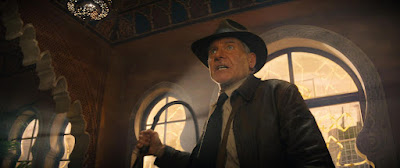
The most incredible part of Indiana Jones and the Dial of Destiny is how quickly it promises little, and how thoroughly it proceeds to under-deliver even on that. The deficit of imagination starts from the first shot. Remember how Spielberg’s great adventure serials would always immediately signal their exuberant visual playfulness with clever transitions out of the Paramount logo and into the action in ways that cue us to the fun to follow? Raiders of the Lost Ark fades from the studio’s painted mountain to an actual one—a flourish announcing an exciting adventure filled with cleverness. Temple of Doom goes to an engraving on a gong—the better to tell us the following will be loud, splashy, over-the-top clamor. Last Crusade fades into Monument Valley—a Western throwback telling us it is back in the zone of a comfortable lark with real imposing danger—while Kingdom of the Crystal Skull reveals a gopher hill—the better to signify the following picture will confound expectations with a mix of the self-referential and self-critical. Dial of Destiny, a much belated sequel helmed by James Mangold, and for which the raison d’ĂȘtre seems to be simply to cash in on one last chance for 80-year-old Harrison Ford to wear the fedora and wield the whip of everyone’s favorite action-archeologist, does something else entirely. New corporate owners mean we first see the Disney castle. Then we see the Paramount logo, followed by the Lucasfilm crest on a black background. We then cut to: a suitcase. There’s no attempt at making it a clever fade in or even a cute match cut. It just starts. I know it seems a small detail on which to focus, but the longer the movie went on, the more it seemed to typify the whole approach. Here’s a movie that cues us right from frame one to expect less.
The only one giving his all in this fifth and presumably final Indiana Jones movie is Harrison Ford. Every unadorned close-up of his aged face is full of pathos and experience that sells years of adventuring nearing its end. He’s now mostly done with field work, on the eve of retirement from his professorship, and feeling out of place in 1969. But of course a MacGuffin from his past—an ancient Grecian dial that just might have something to do with time itself—is suddenly the source of eager hunting from an ex-Nazi (Mads Mikkelsen, perfectly slimy) who’s hoping to beat a younger rogue archeologist (Phoebe Waller-Bridge, gratingly insincere) to its enormous powers. Good old Doctor Jones is the only one who can help. Or get in their way. Or both. It takes a long time for Indiana to get back in the whip-cracking spirit, and he often is without his trademark hat. He’s really, truly tired of all this. (There's nothing on that idea wasn't said more elegantly and effectively in Crystal Skull. We're in repeat territory here.) But save the world he must, though Ford’s better at sympathetically selling the weariness and reluctance now than the hard-charging action, which is left to a de-aged CG version of himself in an interminable flashback prologue or computer-assisted stunts in the present tense stuff.
Mangold, whose Logan and 3:10 to Yuma show he can make sturdy adventure elsewhere, does this no favors by shooting everything too close, and in a phony digital sheen slathered over, while cutting quickly with modern zippy animated stunt people. Early limp chases on a train and through a parade look so false and play so low-energy it’s hard to get the pulse up to care. The Foley work might be the familiar thwacks and thunks with each booming punch and echoing gunshot, and what a treat to hear John Williams once again scoring a movie with his lush orchestrations. But the pacing is all off throughout—too smooth and routine and so blandly choreographed that it all slides right off the eyeballs in an instant. Ford is the only element that feels real, even and especially when everything’s growing flimsier around him. There are a few fine gambits here—the fantastical final act, especially, is bound to be divisive, though I liked it, if more for the attempt than the weak execution. But this whole movie is weak like that, simply tired and underdeveloped thorough and through. It’s loaded with clunky plot points, scarce characterization for most side characters, and with barely an interesting image, let alone a compellingly staged action beat. Previous Indiana Jones pictures were rollercoasters. This one just coasts.
Showing posts with label Mads Mikkelsen. Show all posts
Friday, June 30, 2023
Thursday, September 23, 2021
Mads World: ANOTHER ROUND and RIDERS OF JUSTICE
As great a character actor as Mads Mikkelsen has been in America—and he’s been reliably among our finest heavies in Casino Royale, Hannibal, Rogue One, and “Bitch Better Have My Money”—it’s when you see him in action in his native Denmark that he reveals even more extra soulful layers. He always has that presence, the stillness combined with height, the dark eyes and angular facial features, bringing a weight, while the complications in his flickering placid countenance imply inner storms. He’s fluid and solid at once, a dramaturg’s mind in a dancer’s body. In this way, he carries the melancholy of complicated lives, and the latent potential for taking control however he can. With a nearly imperceptible wetness in his eyes, the slightest of stoops in his regal frame, he sells the deepest griefs, and the most intractable resigned dissatisfactions. He uses his striking figure to subtle effect.
He anchors Thomas Vinterberg’s Another Round with these qualities. It’s a film that, otherwise, to describe it, sounds like a boozy lark, the sort of thing Will Ferrell or Vince Vaughn might’ve made twenty years ago. There’s a group of middle-aged high-school teachers who have found their lives growing stale. When one proposes a novel theory that man’s natural blood alcohol limit is a smidgen too low, and thus their daily routines would be improved by maintaining a slight buzz at all times, they figure it’s worth a shot. Indeed, there is some comedy in this conceit as some of the guys find that, actually, it works for them. Mikkelsen, in particular, goes from a sluggish, boring lecturer into a loose, engaging teacher bringing his subject to life with energy and skill. You can see the sparkle of mischief in his, and his pal’s, eyes. And yet, Vinterberg, veteran of the same cohort of Danish filmmakers that gave us the merciless provocateur Lars von Trier, and maker of plenty bleak films of his own, is too attuned to the details of lived experiences to let this be a careless pro-alcoholism goof or a miserable scared-straight tragedy. Instead, he lets the scenes breathe, and gives his cast room for wandering into mixtures of tones as jobs, relationships, and families teeter on the brink of familiar strife in quasi-comic observational ways your friends’ and neighbors’ might. There’s a casual ambiguity to the picture that makes for a wobbling melancholy, a sense of mid-life ennui that burbles with half-spoken regrets and uneasy contentment. By the end, with an unexpected eruption of a dance party, it’s clear it’s a movie about people who need a release from the ordinary, however they can get it, in hopes of finding a better way to cope with their quotidian woes.
Steelier is Mikkelsen’s role in Anders Thomas Jensen's Riders of Justice, an ice-pick of a revenge thriller with a harrowing inciting incident, rounds of ammunition, and bloody consequences. One can almost imagine Liam Neeson in an American remake. (I hope I didn’t just jinx it.) But the film, like Vinterberg’s, is a nervier and more ambiguous statement within what threatens to be a more conventional experience. It finds a tragic train accident taking the life of Mikkelsen’s wife. He, a military man, returns home to comfort his daughter. That’s where he’s confronted by a man with a theory that the derailment was no accident, but the work of a criminal biker gang hoping to kill a witness in an upcoming trial. The smartest aspect of the screenplay is that we’re never quite sure if the theory is correct, even as Mikkelsen, eschewing therapy for gunfire, teams up with the bumbling conspirators as the muscle they need to investigate and, eventually, pick off the bikers in a variety of action sequences. These are shot not for easy John Wick flair or swooning Tarantino exploitation. They’re down-and-gritty, stumbling with the rough rhythms and painful violence one might expect from such an amateurish outfit. Here’s a revenge thriller that, sure, inhabits the usual talking points about how violence is never the answer and revenge is a path that leads to escalating blowback at worst, and soul-draining dissatisfaction at best. But the film also doesn’t ask us to thrill to the action, even as it finds an absorbing suspense. It’s rooted in character, as everyone from Mikkelsen to his posse—who admit their own tragic circumstances, past and present—to his grieving daughter find themselves caught up in the despair of loss and the futility they feel in escaping it. The result is an unusually gripping off-kilter depressive thriller that somehow hits the expected genre beats with enough syncopation to keep one guessing.
He anchors Thomas Vinterberg’s Another Round with these qualities. It’s a film that, otherwise, to describe it, sounds like a boozy lark, the sort of thing Will Ferrell or Vince Vaughn might’ve made twenty years ago. There’s a group of middle-aged high-school teachers who have found their lives growing stale. When one proposes a novel theory that man’s natural blood alcohol limit is a smidgen too low, and thus their daily routines would be improved by maintaining a slight buzz at all times, they figure it’s worth a shot. Indeed, there is some comedy in this conceit as some of the guys find that, actually, it works for them. Mikkelsen, in particular, goes from a sluggish, boring lecturer into a loose, engaging teacher bringing his subject to life with energy and skill. You can see the sparkle of mischief in his, and his pal’s, eyes. And yet, Vinterberg, veteran of the same cohort of Danish filmmakers that gave us the merciless provocateur Lars von Trier, and maker of plenty bleak films of his own, is too attuned to the details of lived experiences to let this be a careless pro-alcoholism goof or a miserable scared-straight tragedy. Instead, he lets the scenes breathe, and gives his cast room for wandering into mixtures of tones as jobs, relationships, and families teeter on the brink of familiar strife in quasi-comic observational ways your friends’ and neighbors’ might. There’s a casual ambiguity to the picture that makes for a wobbling melancholy, a sense of mid-life ennui that burbles with half-spoken regrets and uneasy contentment. By the end, with an unexpected eruption of a dance party, it’s clear it’s a movie about people who need a release from the ordinary, however they can get it, in hopes of finding a better way to cope with their quotidian woes.
Steelier is Mikkelsen’s role in Anders Thomas Jensen's Riders of Justice, an ice-pick of a revenge thriller with a harrowing inciting incident, rounds of ammunition, and bloody consequences. One can almost imagine Liam Neeson in an American remake. (I hope I didn’t just jinx it.) But the film, like Vinterberg’s, is a nervier and more ambiguous statement within what threatens to be a more conventional experience. It finds a tragic train accident taking the life of Mikkelsen’s wife. He, a military man, returns home to comfort his daughter. That’s where he’s confronted by a man with a theory that the derailment was no accident, but the work of a criminal biker gang hoping to kill a witness in an upcoming trial. The smartest aspect of the screenplay is that we’re never quite sure if the theory is correct, even as Mikkelsen, eschewing therapy for gunfire, teams up with the bumbling conspirators as the muscle they need to investigate and, eventually, pick off the bikers in a variety of action sequences. These are shot not for easy John Wick flair or swooning Tarantino exploitation. They’re down-and-gritty, stumbling with the rough rhythms and painful violence one might expect from such an amateurish outfit. Here’s a revenge thriller that, sure, inhabits the usual talking points about how violence is never the answer and revenge is a path that leads to escalating blowback at worst, and soul-draining dissatisfaction at best. But the film also doesn’t ask us to thrill to the action, even as it finds an absorbing suspense. It’s rooted in character, as everyone from Mikkelsen to his posse—who admit their own tragic circumstances, past and present—to his grieving daughter find themselves caught up in the despair of loss and the futility they feel in escaping it. The result is an unusually gripping off-kilter depressive thriller that somehow hits the expected genre beats with enough syncopation to keep one guessing.
Saturday, December 17, 2016
Dark Side: ROGUE ONE
Rogue One takes
what could’ve been trivial noodling around in Star Wars lore and turns it into a proficient sci-fi action movie
building to intimations of grand space operatic tragedy. It’s the second film
made after creator George Lucas sold his remarkable galaxy to Disney, who have
thus far been studious, respectful, and cautious custodians. Instead of an
idiosyncratic vision from one artist’s mind, it’s a committee polishing up
effective fan service. (At least the emphasis is on “effective.”) For promising
new narrative future, this latest film has nothing on last year’s The Force Awakens, with its immediately
vibrant new personalities and their lingering unresolved promise: the simmering
twisted villain Kylo Ren and fresh Force heroine Rey. But in staging Star Wars-ian action, Rogue One is the more complete
experience, with a beginning, middle, and end, a style more efficiently
beholden to what came before without strain, and a tone more willing to fit the
enormity of the sacrifice in this conflict. It’s overly engineered to be a
gleaming widget, fitting seamlessly into the larger franchise plan instead of
springing from a singular revelation. But at least this is still a film that
dreams a little bigger than most blockbuster product, playing in a hugely enjoyable
and intricately imagined fantastical universe with some sense of the painful
struggle to resisting brutal fascism.
This entry tells a big, confident tale of a dark corner of
the galactic conflict we’d long known about but never seen: the process by
which the Rebel Alliance discovered the existence of the super-weapon Death
Star and stole plans that’ll end up given by Princess Leia to R2-D2 in the 1977
original’s opening moments. A self-contained – despite the endless references
and offshoots into other areas of franchise canon – and admirably scruffy
combat heist film – think The Guns of
Navarone…In Space!! – it has a motley diverse crew of insurgents striking
back against the forces of an evil empire. Better symbols than characters, the
underwritten rebels make decent action figures. Through swooping, crashing,
clamorous adventure sequences across all manner of terrain – deserts, villages,
space stations, jungles, and tropical beaches – they fight. Reluctant rebel Jyn
Erso (Felicity Jones) joins a spy (Diego Luna), a comic-relief combat robot
(Alan Tudyk), an Imperial defector (Riz Ahmed), and two monk-like warriors
(legendary Chinese action stars Donnie Yen and Wen Jiang bringing fun
choreography). Their mission: contact her father (Mads Mikkelsen), an unhappy Imperial
scientist who knows how to take the Death Star down.
This leads to varied action beats, like an ambush in a
far-flung marketplace, a mountainous recon mission in a downpour, and a
dizzying dogfight above a gleaming citadel. Along the way we learn a little
more about the Rebellion than the earlier films had time to explore, with
different factions of the Alliance debating battle plans and how to deal with
extremists (like an under-used Forest Whitaker) in their midst. This mirrors the
Empire’s side, as a commander (Ben Mendelsohn) fights off the life-and-death
office politics of battle-station life. The script, pieced together by four
credited contributors (Chris Weitz, Tony Gilroy, Gary Whitta, and John Knoll)
juggles the movie’s hard-charging tough-minded warfare with hit-and-miss cameos,
fun one-liners, smart retcons, terse exposition, and shorthand emotion. That’s
a lot of balls to keep in the air – and the strain sometimes shows, especially
in the final product’s clearly tinkered dropped connections and foreshortened
beats – but there’s fun to be had in the tactile look and crisp pace. There’s
even a welcome commitment to feeling the losses, culminating in a staggering shot
of good characters embracing certain doom knowing they’ve done all they could
to win some small hope for their cause.
Although this is a side story, a spin-off, it’s identifiably
Star Wars in its concern with family
dramas writ large in galactic conflict and a sense of spirituality amidst
tactics, plus gearhead love of spaceships taking off and landing and fantasy
anthropologist appreciation of interesting creatures and beasties. (We get all
the old familiar X-Wings and TIE Fighters and fish-heads and tentacle-haired
beings, as well as slick new designs and goofy new aliens, like a massive
Force-sensitive slug used as a lie-detector test.) Plus it has a key insight to
style the cast like they’re actors from the 70’s – shaggy hair, groovy
mustaches – playing the characters. Though cinematographer Greig Fraser shot
gorgeous location photography and ILM filled it up with top-of-the-line digital
fakery, it has the scuffed retro-future look of the original trilogy, like a
modern re-creation of a 70’s vision. The much-ballyhooed lived-in universe
aesthetic of Lucas’s original trilogy still draws visual appeal because it’s so
densely designed. It proves there’s still a sense you could find a fascinating
new story around every corner in every frame of this series. It also proves
once more director Gareth Edwards (of 2014’s great Godzilla) is a master popcorn image-maker (despite many eye-popping
shots featured in trailers ending up on the cutting room floor).
The movie works best when it has soaring spectacle clued
into the enormity of its scale – a shuttle dwarfed by a planet behind it, the
orbiting Death Star creating a solar eclipse, a city destroyed by laser-blast
sending enormous shockwaves ripping up surrounding terrain in waves, and massive
space structures colliding in the way everyone has played with the toys has
dreamed about. But even in the moments when it’s merely workmanlike – or
overworked franchise caretaking – it has some of the appeal the old Expanded
Universe paperbacks did, varying in quality but consistently a drip, drip, drip
of more, more, more for fans. It has all the bells and whistles, the
immediately identifiable sound effects, music cues, and visual hallmarks of the
series, even if it now has an over-polished committee’s recreation of what was
once a singular personal pulp remix. The best thrills – a sensational final
battle like something out of N64’s Rogue
Squadron video game – feature dazzling effects and action better staged
than Abrams’. It may still be imitation Lucas – or maybe imitation Kershner at
this point – but it’s sturdy and entertaining nonetheless.
Friday, November 4, 2016
Stranger Things: DOCTOR STRANGE
Behold Doctor Strange,
the first movie in the Marvel Cinematic Universe to grow significantly better
in its action sequences. This massive franchise of interlocking superhero
series tends to stuff appealing comic book conceits full of bantering character
actors for fun setups that dim through endless pro forma digital destruction.
The best keep the same light touch from zinging dialogue in the violence
choreography, but they often err on the side of wearing out their welcome. Strange, though, finds itself dealing
with cosmic transdimensional threats above the Avengers’ pay grade, so the
movie is free to spiral out into wild visual invention. And somehow Marvel has
allowed director Scott Derrickson – shifting tone from his usual horror beat – enough
room to create some appealing, mind-boggling popcorn adventure images. Maybe
the entire creative team was carried away by the intoxicating silliness of
sorcerers, ancient magic, enchanted relics, pulpy gobbledygook jargon, and
loopy fantasy. This isn’t a great film, but it’s a pleasant surprise to see Marvel’s
ossifying superhero formula find some glimmers of new life.
The plot itself is standard origin story stuff, with quippy
arrogance humbled by exposure to great power and great responsibility. Doctor Stephen
Strange (Benedict Cumberbatch) is a hotshot brain surgeon who struts onto the
operating theater like all his life is a show devoted to his brilliance. He
plays his medical prowess as a Sherlockian neurologist, like Dr. House crossed
with Tony Stark. So of course he’s distraught when a hyperbolic car crash – his
sleek sports car pinwheeling off a cliff, down a ravine, through a shack, and
into shallow water – leaves his hands smashed to bits. Recovery is slow, and
will likely never allow him to wield a scalpel again, let alone with anything
remotely approaching his former skill. Out of options, he journeys to Katmandu
where he’s heard tell of a magical healer, a guru known only as The Ancient One
(Tilda Swinton, otherworldly as ever, bald and beautiful, and maybe the best,
coolest MCU performance yet). He’s initially put off by her ideas about astral
projection, chakra alignment, and infinite alternate dimensions, but soon can’t
deny the power she offers him. Open your mind, she says. He doesn’t even
hesitate long enough to ask if she takes his insurance.
Moving through the typical training montages, Derrickson
(from a screenplay he co-wrote with Jon Spaiths and C. Robert Cargill) finds
hallucinogenic imagery. As Strange trains with The Ancient One and her talented
acolytes (Chiwetel Ejiofor and Benedict Wong) in the ways of the Sorcerer
Supreme, he encounters glowing spells floating in the air, energy fields,
swirling portals, glowing martial arts weaponry, mirrored dimensions fracturing
the world in front of his very eyes, and abstract flourishes of phantasmagorical,
mind-bending, reality-contorting travel. Marvel steers into the visual
possibilities opened up by this concept, letting Derrickson and crew stage
creative adventure. You can see in the effects’ department’s talented
kaleidoscopic manipulation of matter – a city bending and warping in on itself,
time moving backwards for some and forwards for others in the same frame,
doorways to anywhere – Inception’s topsy-turvy
hallway fight and Matrix bullet time
plus Fantastic Voyage’s titanic
molecules and 2001’s trippy wormhole.
Here landscapes shift, tile patterns double and redouble, reality blurs and
slurs, slips and slides. This isn’t dull shooting and punching interrupting fun
characters’ hangouts. It’s, well, a visual Marvel much of the time.
And yet as much as it is fun to watch, it’s still in service
of business as usual plot machinations. Strange’s training is about to come in
handy, and the groundwork the early going lays for the imaginative imagery will
pay off, when the villain (Mads Mikkelsen, with his eyes surrounded in a craggy
dark glitter) appears, threatening the entire world with total destruction.
He’s the type of bad guy who is splintering our dimension in exchange for
immortality promised to him and his followers by an alternate universe ruled by
a writhing purple goop monster. The conflict plays out like you’d expect, with
fun side characters cycling in and out seeding future entries and forthcoming
conflicts. (No less than Rachel McAdams, Benjamin Bratt, and Michael Stuhlbarg
appear in such foreshortened subplots I couldn’t help but wonder if they’re
only there for the promise of sequels.) But the details of the narrative, and
the regular Marvel blend of light humor and apocalyptic stakes, take a back
seat. It’s their usual crowd-pleasing formula done up with a genuinely pleasing
visual snap. Compare it to their flat, dishwater grey, CGI airport tarmac in Civil War and it’s even more like a
whole new dimension of possibilities opening up in a dull world.
Like the Thor movies,
Doctor Strange is swept up in its
terrifically silly/serious concoction. Moments like a slapstick fight involving
a sentient red cape or a head-spinning M.C. Escher chase through a scrambled
sideways New York City are right up there with Asgardian rainbow bridges and pseudo-Shakespearean
Norse god mythos as the closest the whole MCU behemoth gets to massive pop art
spectacle, eye-popping splash-page fantasy filmmaking driven by an imaginative
use of screen space instead of the overused and overfamiliar slam-bang drudgery.
Strange is best when it lets its
visuals overpower its plot, taking off into uncharted cosmic wilderness. No
wonder it leaves behind its characters’ emotional journeys and down-to-earth
formulaic interactions by the end, consigning their mortal problems to get
sorted out later. It has a multicolored psychedelic lightshow to stage,
stretching out across a 3D IMAX screen every which way and then some. Its
spectacle may be no more or less empty than any other MCU smash-‘em-up, but at
least it’s entertaining spectacle used strikingly, surprisingly, and enjoyably down
to the last pixel.
Subscribe to:
Posts (Atom)