Showing posts with label Aidan Quinn. Show all posts

Tuesday, May 3, 2022

Liam Neesons: THE MARKSMAN, HONEST THIEF, BLACKLIGHT, THE ICE ROAD, MEMORY, and
ORDINARY LOVE

The moment that indisputably made Liam Neeson an action star is the phone call in 2009’s Taken. That junky, xenophobic little action thriller, lifted entirely by the spectacle of a prestige actor slumming it, has that one great memorable moment in which the star commands total attention and gravitas. He’s playing a special agent whose teenage daughter is kidnapped by human traffickers while on vacation in Paris. He gets one of the abductors on the phone and, in a low growl, says those infamous words:

"I don't know who you are. I don't know what you want. If you are looking for ransom I can tell you I         don't have money, but what I do have are a very particular set of skills. Skills I have acquired over a         very long career. Skills that make me a nightmare for people like you. If you let my daughter go now         that'll be the end of it. I will not look for you. I will not pursue you. But if you don't, I will look for you, I will find you, and I will kill you.”

Remembered as an ultimate steely action movie threat of promised retribution—a short speech and statement of purpose—it, more than anything else, opened the doors for Neeson’s next fifteen years of action movies. He was immediately able to play dozens of tough old guys who still know how to muster up the ability to kick in some teeth and survive chases and shootouts. But watch the scene again and notice that it also taps into what the best of those pictures find: his sadness. You can see the fear and doubt on his face, the deliberate weighing of words that are as much about talking himself into action as they are scaring the bad guy. He takes one heavy pause, a slow blink, as he steels himself for what he hopes won’t have to come next. He’s tired, but determined. When he asks the villain to “let [his] daughter go now,” you really feel that he hopes that will be the end of it.

It’s because Neeson is so tall, broad-shouldered, and has a voice so paradoxically soft-spoken while in a gravely tenor, that he makes obvious sense as a heavy threat. He speaks softly and carries a big stick, moving with a slow but inexorable gait laden with potential violence. But it’s that sadness in his eyes, the ways his brow and chin draw down with a resting reluctance, that make him so sympathetic, too. In the best thrillers of this stretch of his career, like A Walk Among the Tombstones or The Grey or Non-Stop or Run All Night, he’s played alcoholics, disgraced cops or retiring robbers, suicidal workingmen, grieving fathers, and sullen widowers. (And that this string of melancholy action pictures began shortly after the sudden death of his wife adds an extra layer to the downbeat mood.) In each, the power comes, not merely from the action itself—though it can be quite well done—but from the mournful weight to the violence. You can feel it, because he’s so clearly affected by it. He enters the pictures sad, and the dutiful action unspools cautiously, reluctantly, forcefully. The spectacle adds weariness to his stance, and his slow-speed pursuit of justice. Or is it simply something to numb the pain and stave off the end?

This was exciting at first—an injection of soulfulness into what could be routine genre elements care of a star finding new corners of his persona. But the last couple years have seen Neeson’s action movies themselves feeling sadder and more tired. (Hey, aren’t we all?) In The Marksman, he’s a rancher on the southwestern border who protects an undocumented teenager who crosses the border onto his property, hunted by cartel guys and border agents. The reluctant protector is written as a flat Clint Eastwood type. In fact, he’s so creaky and terse one imagines that part was written for Eastwood. (Writer-director Robert Lorenz has worked with Clint as a producer, and his only prior directorial effort was the elderly Eastwood vehicle Trouble with the Curve. You do the math.) Neeson inhabits the role uneasily, but gets off some good semi-earnest sentimentality in the part, and is given some functional suspense sequences. But the movie’s entirely muddled on a political level, and the story isn’t good enough to call that ambiguity, or distract from its incoherent messaging. Neeson can’t save this one. But he’s on some better ground in writer-director Mark Williams’ Honest Thief, which at least has a clever conceit. In this one, he’s a prolific mysterious bank robber who’s fallen in love, and so decides to turn himself in, but the government agents to whom he confesses steal his enormous cash pile and set him up for a fall. That’s neat, and the movie’s eccentric ensemble of quirky bit parts goes a long way to keeping it from falling too flat, but the plot is executed with a sluggish trudge that takes a long time going where we always think it will.

Neeson then re-teamed with Williams for Blacklight, a movie that also has a healthy distrust of law enforcement. In this one, Neeson’s an FBI fixer who is drawn into a larger understanding of a conspiracy to murder a progressive politician. He then has to help stop them before they hurt more people. In the opening scene, an Ocasio-Cortez kinda-sorta lookalike is killed in a hit-and-run, and soon an investigative journalist and a whistleblower are imperiled by nefarious Deep State death squads led by a sneering agent (Aidan Quinn) who casually talks about quashing protestors. (This one squirmingly feels the tenor of the times in spots.) The whole thing’s at once too hyperbolic and too chintzy, full of nearly provocative ideas for which it loses nerve, cavernous nowheres where the plot’s detail and dimension should be, and the Neeson character is almost superfluous to the plot’s mechanics. The picture wants pseudo-70’s paranoid style, but is shot in an overlit textureless digital smear in Melbourne doubling unconvincingly for D.C. I wish its style and substance was as wild as its ambitions. But at least those movies are not as perilously thin as Jonathan Hensleigh’s The Ice Road, in which Neeson’s ice road trucker gets entangled in some shady shenanigans. There’s nothing real or convincing about anything, from character to location to action. And it even has Laurence Fishburne around loaning just part of his natural gravitas to the proceedings!When they can’t make a truck chase across a frozen river exciting, you know the movie’s gone wrong.
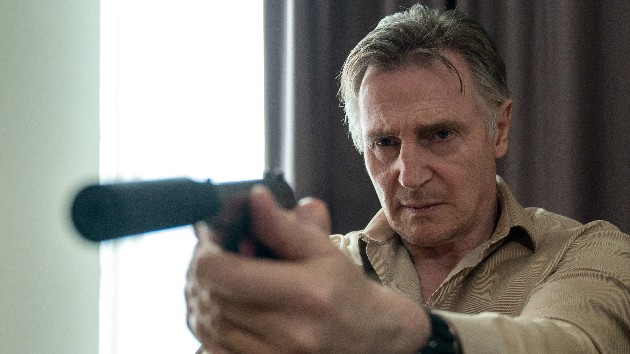
It’s starting to feel like the Neeson: Action Star project is just about out of steam. The feeling is all through his latest, Martin Campbell’s Memory. Though it has such a good idea for him to play, that makes it all the more disappointing it’s just another middling thriller built from off-the-shelf parts. (And from a director who successfully rebooted James Bond twice! Alas…) Here Neeson’s a veteran hitman succumbing to Alzheimers. What a frightening prospect! There’s a chilling moment in the middle of the picture where the guy’s refused to follow through on an assassination of a 13-year-old girl. That night, he has a nightmare in which he kills her. The next morning, her death is reported on the news. Wait, he thinks, did I? Or didn’t I? The movie plays on the terrible ambiguity, but only for a moment. Turns out he didn’t, so he spends the rest of the movie fighting his slipping mind as a supporting character to the larger investigation carried out by a detective played by a stringy-haired, slumped-shouldered Guy Pearce. The sheer tonnage of routine shoe-leather and rote shootings weigh down the potentially clever ideas at its center, and bury the actors—even Monica Bellucci as a dastardly real estate mogul—in a blandly developed conspiracy that’s too-easily unraveled for us in the audience. Once that’s sorted, then it’s just a glum matter of hoping the characters can figure it out in time.

As thrillers of this ilk have been diminishing returns for Neeson, his most satisfying movie of the past few years is a straight drama: Ordinary Love. The story it tells is ordinary, and it is tender plain-spoken simplicity that gives it power. Here’s a movie about an aging couple (Neeson paired with Lesley Manville). They’re comfortable with each other, so much that even their slight tensions and disagreements can be shrugged off. They go for walks. They grocery shop. They watch TV. They trade chores. There’s an unspoken absence. The mantle photos show a daughter they don’t mention for quite a while. You get the sense she’s dead before they ever make reference to her grave. Like any couple of this sort, they’ve accumulated quite the history, and it sits unspoken on their shoulders, weighing in on every exchange. This makes a fatal diagnosis a cruel puncture to their clearly hard-won comfort. The movie follows matter-of-factly the aftermath of this diagnosis as a course of treatment is decided upon and inevitable emotional and interpersonal struggles arrive from heavy potential outcomes hanging over their heads. The screenplay from playwright Owen McCafferty gives these actors space to explore the ideas inherent in this situation, with Manville providing such a heartrending quivering in her stiff upper lip, and Neeson’s facility with grief and sadness is refined in a film of pinprick specificity. Somehow he’s looped back around to this sort of picture being the refreshing change of pace. How satisfying to see a picture so small, so plain, and yet carrying a lifetime of feeling.

Monday, February 21, 2011

Guess Who: UNKNOWN

Unknown is a nice, chilly thriller that’s so pleasantly confounding for so long that the biggest shock of the last act is to find how dull and routine it becomes. I enjoyed the film, but only to a point. The mystery is tantalizing, but the big twist left me disappointed. It’s a real shame, considering how much enjoyment I had been getting from the moody opening which finds a biologist and his wife landing in Berlin for a big scientific convention of some kind. The biologist is Martin Harris (Liam Neeson, in the same ballpark as his surprise hit Taken), an imposing figure with a soft-spoken demeanor. His wife (Mad Men's January Jones) is an alluring frosty presence. The happy couple threads through the airport and end up in a taxi that cuts through the snow and slush taking them to the fancy hotel and conference center. When they arrive, Neeson discovers that he has left his briefcase at the airport. Rushing back to retrieve his important files, his taxi driver swerves to avoid an accident and ends up plunging off of a bridge and into the ice-cold river below.

Four days later, Martin Harris wakes up in the hospital. His only problem is his newfound sense of disorientation. He learns his wife wasn’t searching for him. That’s odd. When he shows up at the hotel, she claims she doesn’t know him. That’s odder. What’s more, another man (Aidan Quinn) is claiming to be the real Martin Harris. The camera tilts and the focus pulls. What’s going on here? The sense of confusion and impenetrable mystery kicked up by this development is intriguing.

Director Jaume Collet-Serra, who last directed the disturbingly effective 2009 horror film Orphan, keeps the atmosphere heavy and slick. The wintry Berlin wind kicks off-white snow down endless mazes of grey concrete and imposing architecture. There’s a chill in the air as Neeson makes his way through a crisis of identity. The existential dilemma is balanced nicely with the sub-Hitchcockian silliness of the plot. For quite some time, it’s a nice little B-movie with A-list talent.

As Neeson sets out to discover the truth behind his situation, the plot thickens. He searches for his cab driver (Diane Kruger) and, when he finds her, discovers that she doesn’t want to talk to him. Hit with a dead end there, he talks to a kind nurse who tells him about an acquaintance of hers, a former Stasi agent (Bruno Ganz) who likes to keep his mind agile by doing some light investigation on the side. Intrigued, he agrees to help.

After several enjoyable chases and surprising murders that force Neeson to team up with Kruger to find the truth behind the mayhem, the elderly agent makes a breakthrough. This leads to the greatest scene in the picture, a case of when very good scenes happen to mediocre movies. It involves Bruno Ganz’s investigator coming into contact with a shady gentleman played by Frank Langella. For this one brief scene, the two world-weary men converse easily and warily while revealing some Big Secrets about the upcoming plot twist. It’s an example of accomplished, dignified actors elevating their material.

But, unfortunately, the movie goes downhill from there. Once Martin Harris realizes the true nature of his reality and the full ramifications of what is about to happen, the film turns into a series of fairly standard action beats. While still technically accomplished pieces of action filmmaking, all the central tension of the film has gone missing. I could not care less about the late breaking MacGuffin. What hooked me into the film were the nice chilly thrills with a suitably rattled protagonist. It begins as a movie of icy blondes, mysterious strangers, and wise old men. It ends as a rote action thriller with a ticking time bomb of a threat. The questions the film sets up made me curious for answers and when they arrived I wish they hadn’t. It’s a shame that the long-awaited answers end up killing the tension. When a thriller about a man who doesn’t know who he is turns into thriller about a man who simply has to save the day, that’s kind of a letdown.