Showing posts with label Lesley Manville. Show all posts

Tuesday, May 3, 2022

Liam Neesons: THE MARKSMAN, HONEST THIEF, BLACKLIGHT, THE ICE ROAD, MEMORY, and
ORDINARY LOVE

The moment that indisputably made Liam Neeson an action star is the phone call in 2009’s Taken. That junky, xenophobic little action thriller, lifted entirely by the spectacle of a prestige actor slumming it, has that one great memorable moment in which the star commands total attention and gravitas. He’s playing a special agent whose teenage daughter is kidnapped by human traffickers while on vacation in Paris. He gets one of the abductors on the phone and, in a low growl, says those infamous words:

"I don't know who you are. I don't know what you want. If you are looking for ransom I can tell you I         don't have money, but what I do have are a very particular set of skills. Skills I have acquired over a         very long career. Skills that make me a nightmare for people like you. If you let my daughter go now         that'll be the end of it. I will not look for you. I will not pursue you. But if you don't, I will look for you, I will find you, and I will kill you.”

Remembered as an ultimate steely action movie threat of promised retribution—a short speech and statement of purpose—it, more than anything else, opened the doors for Neeson’s next fifteen years of action movies. He was immediately able to play dozens of tough old guys who still know how to muster up the ability to kick in some teeth and survive chases and shootouts. But watch the scene again and notice that it also taps into what the best of those pictures find: his sadness. You can see the fear and doubt on his face, the deliberate weighing of words that are as much about talking himself into action as they are scaring the bad guy. He takes one heavy pause, a slow blink, as he steels himself for what he hopes won’t have to come next. He’s tired, but determined. When he asks the villain to “let [his] daughter go now,” you really feel that he hopes that will be the end of it.

It’s because Neeson is so tall, broad-shouldered, and has a voice so paradoxically soft-spoken while in a gravely tenor, that he makes obvious sense as a heavy threat. He speaks softly and carries a big stick, moving with a slow but inexorable gait laden with potential violence. But it’s that sadness in his eyes, the ways his brow and chin draw down with a resting reluctance, that make him so sympathetic, too. In the best thrillers of this stretch of his career, like A Walk Among the Tombstones or The Grey or Non-Stop or Run All Night, he’s played alcoholics, disgraced cops or retiring robbers, suicidal workingmen, grieving fathers, and sullen widowers. (And that this string of melancholy action pictures began shortly after the sudden death of his wife adds an extra layer to the downbeat mood.) In each, the power comes, not merely from the action itself—though it can be quite well done—but from the mournful weight to the violence. You can feel it, because he’s so clearly affected by it. He enters the pictures sad, and the dutiful action unspools cautiously, reluctantly, forcefully. The spectacle adds weariness to his stance, and his slow-speed pursuit of justice. Or is it simply something to numb the pain and stave off the end?

This was exciting at first—an injection of soulfulness into what could be routine genre elements care of a star finding new corners of his persona. But the last couple years have seen Neeson’s action movies themselves feeling sadder and more tired. (Hey, aren’t we all?) In The Marksman, he’s a rancher on the southwestern border who protects an undocumented teenager who crosses the border onto his property, hunted by cartel guys and border agents. The reluctant protector is written as a flat Clint Eastwood type. In fact, he’s so creaky and terse one imagines that part was written for Eastwood. (Writer-director Robert Lorenz has worked with Clint as a producer, and his only prior directorial effort was the elderly Eastwood vehicle Trouble with the Curve. You do the math.) Neeson inhabits the role uneasily, but gets off some good semi-earnest sentimentality in the part, and is given some functional suspense sequences. But the movie’s entirely muddled on a political level, and the story isn’t good enough to call that ambiguity, or distract from its incoherent messaging. Neeson can’t save this one. But he’s on some better ground in writer-director Mark Williams’ Honest Thief, which at least has a clever conceit. In this one, he’s a prolific mysterious bank robber who’s fallen in love, and so decides to turn himself in, but the government agents to whom he confesses steal his enormous cash pile and set him up for a fall. That’s neat, and the movie’s eccentric ensemble of quirky bit parts goes a long way to keeping it from falling too flat, but the plot is executed with a sluggish trudge that takes a long time going where we always think it will.

Neeson then re-teamed with Williams for Blacklight, a movie that also has a healthy distrust of law enforcement. In this one, Neeson’s an FBI fixer who is drawn into a larger understanding of a conspiracy to murder a progressive politician. He then has to help stop them before they hurt more people. In the opening scene, an Ocasio-Cortez kinda-sorta lookalike is killed in a hit-and-run, and soon an investigative journalist and a whistleblower are imperiled by nefarious Deep State death squads led by a sneering agent (Aidan Quinn) who casually talks about quashing protestors. (This one squirmingly feels the tenor of the times in spots.) The whole thing’s at once too hyperbolic and too chintzy, full of nearly provocative ideas for which it loses nerve, cavernous nowheres where the plot’s detail and dimension should be, and the Neeson character is almost superfluous to the plot’s mechanics. The picture wants pseudo-70’s paranoid style, but is shot in an overlit textureless digital smear in Melbourne doubling unconvincingly for D.C. I wish its style and substance was as wild as its ambitions. But at least those movies are not as perilously thin as Jonathan Hensleigh’s The Ice Road, in which Neeson’s ice road trucker gets entangled in some shady shenanigans. There’s nothing real or convincing about anything, from character to location to action. And it even has Laurence Fishburne around loaning just part of his natural gravitas to the proceedings!When they can’t make a truck chase across a frozen river exciting, you know the movie’s gone wrong.
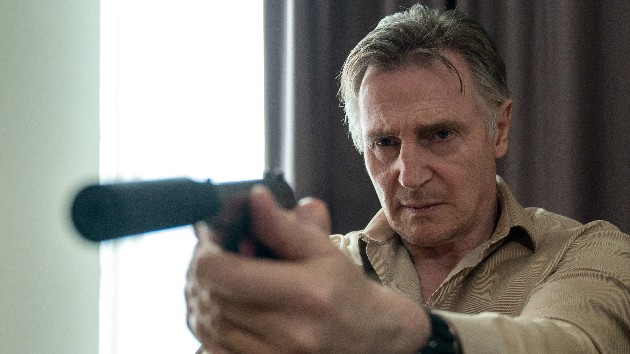
It’s starting to feel like the Neeson: Action Star project is just about out of steam. The feeling is all through his latest, Martin Campbell’s Memory. Though it has such a good idea for him to play, that makes it all the more disappointing it’s just another middling thriller built from off-the-shelf parts. (And from a director who successfully rebooted James Bond twice! Alas…) Here Neeson’s a veteran hitman succumbing to Alzheimers. What a frightening prospect! There’s a chilling moment in the middle of the picture where the guy’s refused to follow through on an assassination of a 13-year-old girl. That night, he has a nightmare in which he kills her. The next morning, her death is reported on the news. Wait, he thinks, did I? Or didn’t I? The movie plays on the terrible ambiguity, but only for a moment. Turns out he didn’t, so he spends the rest of the movie fighting his slipping mind as a supporting character to the larger investigation carried out by a detective played by a stringy-haired, slumped-shouldered Guy Pearce. The sheer tonnage of routine shoe-leather and rote shootings weigh down the potentially clever ideas at its center, and bury the actors—even Monica Bellucci as a dastardly real estate mogul—in a blandly developed conspiracy that’s too-easily unraveled for us in the audience. Once that’s sorted, then it’s just a glum matter of hoping the characters can figure it out in time.

As thrillers of this ilk have been diminishing returns for Neeson, his most satisfying movie of the past few years is a straight drama: Ordinary Love. The story it tells is ordinary, and it is tender plain-spoken simplicity that gives it power. Here’s a movie about an aging couple (Neeson paired with Lesley Manville). They’re comfortable with each other, so much that even their slight tensions and disagreements can be shrugged off. They go for walks. They grocery shop. They watch TV. They trade chores. There’s an unspoken absence. The mantle photos show a daughter they don’t mention for quite a while. You get the sense she’s dead before they ever make reference to her grave. Like any couple of this sort, they’ve accumulated quite the history, and it sits unspoken on their shoulders, weighing in on every exchange. This makes a fatal diagnosis a cruel puncture to their clearly hard-won comfort. The movie follows matter-of-factly the aftermath of this diagnosis as a course of treatment is decided upon and inevitable emotional and interpersonal struggles arrive from heavy potential outcomes hanging over their heads. The screenplay from playwright Owen McCafferty gives these actors space to explore the ideas inherent in this situation, with Manville providing such a heartrending quivering in her stiff upper lip, and Neeson’s facility with grief and sadness is refined in a film of pinprick specificity. Somehow he’s looped back around to this sort of picture being the refreshing change of pace. How satisfying to see a picture so small, so plain, and yet carrying a lifetime of feeling.

Tuesday, March 16, 2021

Family Matters: LET HIM GO

The most frightening aspect of the exceptionally taut thriller Let Him Go is the bloodlust it whipped up in me. I can’t remember the last time I was so involved in one of these that I was on the edge of my seat rooting for the painful punishment of its villains. But there I was, by the end of the picture, hoping against hope that Diane Lane or Kevin Costner would get to that shotgun and blast Lesley Manville and Jeffrey Donovan away. This is a masterfully manipulative bit of moviemaking, the kind of clean, spare, simple story — a sort of mournful melancholy Magic Hour midcentury western — that gets its hooks in early and pulls tighter as the suspense simmers and you just know the only way out will be bloody. Lane and Costner bring a leathery goodness and low-boil righteous anger to their roles as rancher grandparents whose only child has died. His widow (Kayli Carter) remarried a man who, it is quickly clear, is abusing her. When the new husband suddenly up and moves to North Dakota, absconding with his new wife and her son, our leads’ beloved grandson, the older couple decides to track them down and make sure they’re all right. They’re so not. The abusive husband, turns out, comes from a whole family of abusers, a manipulative, controlling bunch held together under the domineering watch of a cruel matriarch (Manville), her creepy brother (Donovan), and her gaggle of large adult sons. When our sympathetic leads finally get their way to their grandson — the way there winding, and full of long sighs and pregnant pauses and weary pulp wisdom like “that’s all life is: a list of what we have lost” — it’s sadly apparent that the new in-laws are not about to let the grandson or her mother out of their sight. By the second half of the picture, it’s become a tense battle of wills between the new and old in-laws, and we’re on Lane and Costner’s side every step of the way. It’s clear they need to save their grandson and former daughter-in-law from the clutches of this awful family, but how to navigate such an extrication is trickier by the moment. As danger rises, it’s clear there’s no easy way to loosen these villains’ grip.

Thomas Bezucha writes and directs with a keen eye for simple, direct emotion, clear and crackling spare dialogue, and classic widescreen staging. He’s composing shots to tighten disconnection between our leads and their foes, or to allow the blocking to heighten the danger of encroaching ill intentions, while balancing the vast open spaces that make this mid-20th-century western landscape look every bit the inheritor of the traditional family feud western. And he trusts his cast to imbue the underpinnings and subtext of scenes with weight and pain, allowing Lane and Costner the easy empathy and tough decisions that the shark-like maneuvering and twisted logic of Manville and her brood lack. It’s a balance of control the cast plays out, confident and still, gentle with a spine of steel, inevitable in trajectory but alive in the moment. And it all serves the crisp plot that slides into place with a cast iron weight and a dried-meat snap. Bezucha builds the desire for revenge so achingly that it somehow uses the barest layer of sentimentality to crack open the most intensely felt rage. These sweet grandparents simply must be reunited with their grandson and save him from the cruelties of his new stepparent. Buzucha, whose previous films are the 2005 ensemble Christmas comedy The Family Stone, and 2011’s sparkling G-rated girls’ vacation lark Monte Carlo, usually does fine work with family dynamics. Here he adds Eastwood-inspired filmmaking: direct, plain-spoken, uncomplicated, and driven by a small-c conservative vision of domesticity and safety. It has a relaxed confidence of vision and bone-deep understanding of character that makes its grip all the tighter. Its gripping finale and explosive desire for a righteous reckoning is hard-fought and well-earned. This is a terrific, expertly crafted thriller.

Friday, May 30, 2014

Like a Villain: MALEFICENT


Maleficent, the sorceress who gives Sleeping Beauty her cursed slumber, is one of Walt Disney Animation’s greatest accomplishments. Frightening and elegant, she has a tall, statuesque presence, high model features, towering horns growing from her head, and flowing dark robes swooshing around her. She glows green with dark magic, and by the end uses her powers to conjure the form of a dragon to fight off the Princess’s chances for True Love’s Kiss. She’s an iconic image. Thus the challenge for Maleficent, a live-action retelling of the story from the sorceress’s point of view. How to fill the role with a mere flesh and blood actor? How to recapture the power of those drawn images, so striking and so fearsome? Luckily, the filmmakers were able to meet the challenge and cast Angelina Jolie, whose high cheekbones, piercing eyes, and elegant silhouette make her an imposing presence when draped in the makeup and wardrobe to match the character’s iconic look. Here her eyes are fierce, her face is sculpted and angular. She’s a perfect fit.

But making Maleficent the center of this story is not without its problems. In the 1959 film, as in the fairy tale upon which it was based, she’s pure evil, bestowing an awful curse on an infant for her parent’s crime of failing to invite the witch to a party. Maleficent is a force of destruction and looms large over the plot as pure threat, casting a dark shadow over innocent first love, worried parents, and sweet dotty fairies in a colorful Disney kingdom. Maleficent is out to make some changes, moving the title character into the position of protagonist. This isn’t Sleeping Beauty of old. It opens with a narrator (Janet McTeer) telling us about two lands that sit side by side. One is a kingdom ruled by man. The other is a magical forest ruled by no one, the better for fairies, living trees, sprites, and other fanciful creatures to frolic freely. In this forest a young Maleficent lives, carefree until the day a man (Sharlto Copley) appears, tells her he loves her, and then steals her wings.

The man presents the wings to the dying king in order to be named his successor. Now the new king, he has a daughter. She is cursed on the day of her christening by the vengeful, violated Maleficent who lashes out at the man who hurt her by attacking his child. Hidden away in the forest by three largely incompetent fairies (Imelda Staunton, Lesley Manville, and Juno Temple, great actresses doing bad comic relief), the baby grows up to be Aurora (Elle Fanning). Something - lingering guilt, perhaps, over hurting a child for the crimes of her father – makes Maleficent hang around, offering unseen assistance to Aurora as she grows, becoming something like a fairy godmother to her. And so, regretting her curse, Maleficent and her raven sidekick (Sam Riley) try to undo it before it is too late. Meanwhile, the evil king is plotting to invade the enchanted forest and slay the sorceress once and for all.

Flipping the script on a classic villain, Linda Woolverton (of Disney’s Beauty and the Beast and Tim Burton’s Alice in Wonderland) has written a screenplay that’s a bit of a mess, but at least finds thorny thematic issues with which to wrestle. Now it is not a fairy tale about unexplained evil and the pat True Love that will conquer all. Instead, it’s a movie about the marginalization of women, in which the king sees both Maleficent and Aurora as pawns in his life story instead of people with thoughts, feelings, and ambitions of their own. Just as surely as Maleficent is wounded for the sake of his promotion, his daughter is cast aside for his peace of mind. In the end, Maleficent made huge mistakes, but it’s the king who is the real bad guy.

That’s all interesting, but if only the film had the patience to stop and wrestle with the ideas. Instead, it’s content to only suggest deeper thoughts as it hustles its way through exposition and character beats with a sense of obligation instead of enchantment. Even the appearance of Prince Phillip (Brenton Thwaites) is a huge non-event, which is at once a hilarious example of the movie’s welcome shifting of gender roles and an example of its half-hearted plotting. I love how it takes a story about a young woman whose fate is decided by her father and her love and makes it a story about misunderstood and victimized women and their complicated relationship with each other, but the movie is simply too frustratingly thin to support these deeper concerns.

While Sleeping Beauty is less emotionally complex, it has a stronger and more direct sense of storytelling. Maleficent has a vague understanding of what a story looks like, but often plays like a series of haphazardly connected scenes. Characters have changes of heart and evolutions of thinking for no other reason than because the movie needs them to do so. Consequently, there is not a lot of momentum here and the film grows mushy and aimless in the center as it spends its time telling us what we need to know instead of allowing it to unfold. The result is a small cast standing against flat, over-lit CGI backgrounds reciting dialogue that sounds like someone left all the subtext on the surface of the rough draft and never did a rewrite to bury it.

At least it fits the general phoniness of everything around them. There is never a sense this fantasy world is real. It just doesn’t look good. Director Robert Stromberg is a visual effects artist making his directorial debut. The picture is filled with competently visualized spectacle, with tree-creatures and strange little fantasy animals wandering around. When Maleficent flies about it’s with a convincing woosh and the dragon in the climax is as big, scaly, and fiery as you’d expect. But the action is repetitive and dull. The environments are stiff and dead. It never feels like a coherent vision of a place or time. It’s just disconnected digital frippery. If it was chintzier, you could almost accuse it of feeling like it was shot in a corner of the Disney backlot. Instead, it just looks like endlessly green-screened busyness. This is the movie’s biggest downfall. On a visual level, it simply isn’t as convincing, as inky dark and richly imagined as its lead performance.

Jolie stands in the center of the movie as iconic a screen creation as ever there was. The scene in which the screen darkens as shadows cast by scary green fire flicker over her face as she bellows sinister magic into a crib is genuinely spooky. And yet, Jolie sells her character’s hurt and regret, her elegance and her frozen mask of emotions that slowly melts for the child she has doomed. She’s a sympathetic, complicated creature, capable of glowering harm and glimmering compassion. It’s a great, full-blooded performance in a movie that’s simply not up to the task of working on her level. She’s so good I wished there was enough to the scenes to allow her to really sink her teeth in and chew. She’s big. It’s the picture that’s small.

Sunday, October 13, 2013

True Love Never Did Run Smooth: ROMEO AND JULIET


A Shakespeare adaptation has an inescapable feeling of repetition. That’s not a bad thing, necessarily, provided those behind the scenes know how to make the text work for them. The main question becomes whether the new production works. In the case of Romeo and Juliet, there are two scenes that are absolutely crucial to making a worthy retelling. The first is the balcony scene, the moment where the audience needs to fully understand the attraction between the star-crossed lovers. The second crucial scene is the finale, the result of bits of coincidence that create the conditions for the tragic conclusion and must seem to flow naturally, reaching a poetic climax of heartbreak. In the newest big screen adaptation of the play, these scenes worked for me. My heart swelled when Romeo calls up to Juliet and they speak hushed infatuation. My eyes were a tad wet when the tale terminates in woe. With those moments locked down, the film can’t be all bad. The center’s too strong. That Shakespeare knew what he was doing.

This adaptation is a solid work that tells the well-known story with an earnest and heartfelt approach, tremblingly scored, capably performed. It was filmed on location in Italy with a cast dashing and gorgeous in period-piece appropriate clothing, speaking in Masterpiece Theater accents. The immortal narrative of two households, both alike in dignity, where ancient grudge leads to civil blood making civil hands unclean, has its inherent interest and power intact. Julian Fellowes, screenwriter of Gosford Park and creator of Downton Abbey, wrote the script, which stays true to the tone and shape of Shakespeare’s original play. It is not, however, an adaptation of total fealty to the Bard’s text. It’s not simply a matter of abridgment or subtly shifted emphasis. Some scenes are invented; lines are reworked and reworded. It’s distinctly Romeo and Juliet, but shifted ever so slightly away from the language on the page.

But that makes it sound like a calamity, a gross modernization, and it’s not that. Much of the original text’s most famous passages – “Wherefore art thou?” – remain nearly verbatim, while the rest of the film proceeds with not disastrously rewritten lines that remain true to the essence of the play. And, though Fellowes is talented, he is not Shakespeare. Still, the new dialogue clangs not to these ears, even if it’s not exactly at the same level. The original narrative is so strong, not to mention unscathed, and the production so dedicated to the feeling and tone of the text that it moves with a resonance that rings true to the play’s spirit, if not always its linguistic specifics. The cast finds the dialogue easily tripping off their tongues, smoothly and with great feeling.

In the leads are Douglas Booth, new to me, and Hailee Steinfeld, the remarkable young woman who stole the show in the Coen brothers’ True Grit. They make a very pretty Romeo and Juliet, she with her youthful open countenance and emotive eyes, he with prominent cheekbones and male-model smolder. But they don’t only look the part. There’s a fresh-faced adolescent impulsive obsession in their romance, a quivering discovery that vibrates on a tastefully melodramatic level. We don’t have to believe it is True Love, only that Romeo and Juliet think it is. As Taylor Swift once sang, “When you’re fifteen and somebody tells you they love you, you’re going to believe them.”

Filling out the supporting cast are plenty of character actors doing good work with classic roles, from Homeland’s Damian Lewis as Lord Capulet to Let Me In’s Kodi Smit-McPhee as Benvolio, frequent Mike Leigh collaborator Lesley Manville as Nurse, and Stellan SkarsgĂ„rd as the Prince of Verona. Best of all is Paul Giamatti’s Friar Laurence, who in this telling takes on a terrific twinkle in his eye, is tickled by his plan to help wed, and later reunite, the lovers, and is fantastically distraught when it all goes wrong. As the characters go through the paces, the movie rushes along, finding sometimes-awkward transitions. A cut from a covert wedding to Ed Westwick’s Tybalt scowling while practicing his sword skills is a tad laughable. But in general, the film does the play justice.

The cinematography by David Tattersall is handsome; the costumes are appealing. It’s not exactly a lavish production – a bush in the balcony scene is a bit of conspicuous fakery – but it’s largely nicely done. Director Carlo Carlei, a relative unknown here in the States having worked mainly in Italian TV, is the least interesting aspect of the film. He’s no George Cukor or Franco Zeffirelli or Baz Luhrmann, far better directors who brought (wildly dissimilar) cinematic styles to their versions of Romeo and Juliet. For better and worse, Carlei brings only the stuffy, undistracted gloss that you’d find in any blandly proficient prestige project. The best that can be said is that he stays out of the way. This is Fellowes’ project through and through, and even he plays second fiddle to Shakespeare. This is Romeo and Juliet and all that implies. My heart swelled. My eyes got wet. Because the film gets the most important aspects right, it works.