Showing posts with label Austin Butler. Show all posts

Monday, September 1, 2025

Batter or Worse: CAUGHT STEALING

Darren Aronofsky’s Caught Stealing is atypical for him since it’s shorn of self-conscious ambition. He’s a filmmaker usually loaded down with style while straining for abstractions and existential metaphor. When it works it works. Consider the Biblical fantasy of Noah or epic existential time-spanning sci-fi The Fountain or the panicked pressure-cooker allegory of mother! or the twirling mirrored ballet nightmare of Black Swan. He’s an energetic image-maker, expert at enveloping with consistent mood and getting committed performances out of talented casts. For better and worse, there are no small choices in an Aronofsky film. The hysteria of his addiction dramas, the manic druggy Requiem for a Dream and doom-laden overeating of The Whale, is maddeningly misjudged. But the jumpy intensity of the grit and grain to his character drama The Wrestler is intensely focused. When his choices hit, they hit hard; otherwise they’re painful wild swings that totally miss. So it’s fun to see his newest feature be his breeziest and least burdened by weighty themes. It’s an up-tempo, low-level thriller set on the streets of New York City. It’s 1998 and an alcoholic ex-baseball player (Austin Butler) is barely making it work as a bartender with a nice girlfriend (Zoe Kravitz). Too bad, then, that he makes the mistake of agreeing to watch a pet cat for his punk neighbor (Matt Smith). This gets him caught between competing drug dealing gangsters (Bad Bunny and some Russians on one side; Hasidic Vincent D’Onofrio and Liev Schreiber on the other) who think the punk left him a clue to their cash. 

It sets off a mad, darkly funny, increasingly violent scramble to get out of trouble. Not even a weary cop (Regina King) seems much help. He’ll have to do it himself. Butler makes such a fine, sympathetic presence at the center of the tension. He’s stepped confidently into leading man mode, using his physicality to get and hold attention in the frame with an easy charm and casual energy that’s somehow both perfectly posed and totally relaxed. Now there’s a Movie Star. He holds the center easily as the thriller plotting pops off around him. Aronofsky gives it all a hurtling momentum, like a madcap After Hours take (there’s even Griffin Dunne) on the kind of scrappy, chatty, irreverent post-Tarantino thrillers that would’ve been on screens in 1998. Now that’s commitment to period accuracy. It’s a movie of small choices with big effects: the crack of a bat to bring our lead out of a recurring nightmare; an affinity for elegant long tracking shots; a well-spun collection of needle drops; a steady teetering between lighthearted eccentric characterizations and heavy deadly twists and turns. The movie has speed on its side; the thing doesn’t feel thin until the credits have ended and you’re walking back to the parking lot. If it’s ultimately just glossy genre pulpiness for the sake of it, then at least it’s done with such a high level of confident skill. I could get used to this style of Aronofsky. 

Wednesday, July 30, 2025

We Wear the Mask: EDDINGTON

Over the course of his first four features, writer-director Ari Aster has made a habit of divisive movies, but, love them or hate them, you have to admit he has impressive control over the formal elements of filmmaking. He knows exactly what his movies should look and sound like, and every precise choice builds a coherent whole. Here’s a director in complete command of his craft, each movie a darkly funny, intensely upsetting experience. No wonder it gets people polarized as they stumble out. His first two pictures were solidly in the horror genre, with a possession passed down through the generations of a haunted family in Hereditary and a creepy cult in a folkloric freakout for Midsommar. Those movies built settings that closed in on their characters and thus trapped performances that built on a steady crescendo of madness and howling grief. His third effort was Beau is Afraid, a three-hour movie I often found endless and excruciating, but I’ll also acknowledge that that’s exactly Aster’s aim. Star Joaquin Phoenix plays a clinically anxious man with deep-rooted psychological issues relating to his mother. The entire movie is in his heightened mind as it clenches and extrapolates until its paranoid hallucinations reach a fever pitch of hyperbolic metaphors slipping further from our reality. It’s a movie that’s way more fun to talk about than watch, but it has some big laughs and such fascinating performances and Aster’s vision is so all-encompassing in layers of artifice and anxiety that it’s hard to dismiss. 

Now comes Eddington, perhaps his most straightforward movie and that’ll make it all the more upsetting. It’s a movie about what’s wrong with our modern American society, not in the easy talking points but in the core muck of broken relationships and festering paranoid suspicions. It’s about how often political stances are formed as reaction to personal slights or positive attention. It takes the idea of politics as personal deeper into wounded immediacy. This tendency isn’t new, but is certainly enhanced by the warped fun house mirror of online, a space that’s somehow both real and unreal at the same moment. Characters here are surrounded by screens, reflected in phone cameras and lit up at night by scrolling. Their sense of selves are both shallowly confident and so slippery as to be easily manipulated. But their digital selves and algorithmic diets move into the physical space of the world, and as they roam the dusty, empty streets of their tiny New Mexico town the movie pokes at the performative and the attention-seeking of the well- and ill-intentioned alike. There it finds a shared common void of purpose that leaves everyone floundering to feel important or at least needed. This emptiness is set in a No Country for Old Men-style modern Western, a needling, mordantly funny drama that becomes slow rolling thriller that erupts in violence and watches as characters scramble in its wake. This sense of alienation and division, of being trapped in your bubble and flailing in confused disconnection, is only enhanced by the decision to set the events in May 2020, with a pandemic raging and a public frightened and fractious. 

Tap-dancing on the third rail, the movie finds the town of Eddington’s exhausted sheriff (Joaquin Phoenix) deeply ambivalent about the whole COVID precautions thing. He’s clearly imbibing some misinformation. As he’s drawn into deeper rivalry with the town’s mayor (Pedro Pascal), while seeking the approval of his troubled wife (Emma Stone) and avoiding the scorn of his conspiracy theorist mother-in-law (Deirdre O’Connell), he impulsively decides to run for the office himself. His platform of freedom from masks and business closures grows increasingly conspiratorial itself, making muddled baseless accusations and driving around in a truck covered in misspelled handwritten signs (“Your being manipulated!”) and speakers that broadcast his meandering stump speeches. (It’s an echo of Altman’s Nashville, another movie about an American town in a particular fractious moment.) Eddington is also currently home to: a handful of shop owners and restauranteurs, a black deputy (Michael Cole), a ranting unhoused man (Clifton Collins Jr.), a roving cultish influencer (Austin Butler) who makes hyperbolic speeches about trafficking, a tribal officer on the reservation (William Belleau), a white teen girl (Amélie Hoeferle) who organizes protests when she’s not doing TikTok dances celebrating, say, finishing a James Baldwin novel, and the teen boys (Matt Gomez Hidaka and Cameron Mann) who want to get her attention. They’re all rattled and on edge, growing increasingly suspicious of each other from within their quarantined misinformation inflammation and boxed in by the cinematography that keeps trapping them in isolation, alone together and apart.

Aster develops his plot with his usual deliberateness and an eerie surface calm, while the characters tussle with the complications of pandemic life and fall into conflicts that escalate until they’re out of control. They’re all operating with darkness and denial or just deprivation in their lives, these deep holes they’re desperately trying to fill. But you can never fill emptiness with hollowness. Here are characters who are constantly trying to have the right position, the right attention, the right purpose, and talk all around the big ideas of the moment. Yet for all their talk, they get nowhere, and believe only what they need to cling to in order to survive another day. And they’ll say whatever’s convenient in the moment, scrambling about for ways to provoke a reaction. Phoenix complains the mayor’s being performative, then heads out to his car to film a video for Facebook. The mayor tells his son not to go out with a group because of the optics, then later is blaring Katy Perry at a backyard fundraiser. But this isn’t an easy “both sides” view from nowhere. These are specific characters, and the movie draws a pretty clear moral vision, the end point of all this culture war division and who’s doing the dividing. (It has something to do with the A.I. data center going up outside town, a threat to further drain their resources and give them hallucinations in return.) It sees the powerless reaching for easy answers and sacrificing more of their power in the process. 

When people reach out to make a connection through culture war buzzwords or interpersonal grievances they’re playing a game they’re already losing. It’s a movie about the dangers of not wanting to believe, but being seen believing. Here’s a movie about people who use their speech not as a vessel for ideas but as weapons to wield. An anti-masker just has to disingenuously bark “six feet” to get his adversary to back off. And when your words are just a means to an end, you’ll say whatever gets you the attention you seek. No wonder the result is darkly funny despair and intense violence. They have no core truth on which to build themselves. The movie takes these impulses to extremes, then executes five or six sudden turns in the finale that’ll provoke most audiences into wondering how and if it works. For my money there’s a startling escalation that gives a sense of an ending without a sense of closure. And that’s what makes it feel all the more 2020. 

Sunday, June 26, 2022

If He Can Dream: ELVIS

Baz Luhrmann’s Elvis is made with an energetically heightened reality that bursts through the cliches of the rock ’n roll biopic and the overfamiliar caricature that is its subject. It restores life and vitality to both, making something enormous and earnest and enveloping. This is a perfect match of filmmaker and subject. Luhrmann has a brand of cinematic theatricality in which wall-to-wall music covers a visual feast. Every shot is a riot of movement and color, frames are filled with flashing lights and flashy design, and every performance is goaded higher and higher until most gestures are big and broad. Elvis Presley, for his part, was a shock to the system. He defined the mold that continues to mint music stars as part of a wave of midcentury entertainers who began to scramble ideas of race, sex, and gender for the mainstream. His life, too, was as outsized as his stardom. Every facet of it has passed into iconography and a cartoon of fame: his mansion, his marriage, his movies, his scandals, his eccentricities. The modern version of celebrity culture is yet another element of our world he was at the right place and time to pioneer. This movie is a huge, swaggering tour of the familiar stages of Elvis’ life and career. It goes on for nearly three hours and doesn’t dig deeper into arcane trivia or thornier contradictions. But what it does instead is recreate the sensation of the shock of the new, and the societal and showbiz tensions the shaped and destroyed him. Luhrmann’s excesses match this mood, and this project: to build a shining monument to an icon of Americana—and to see how the darkness surrounding his becoming swallowed him whole.

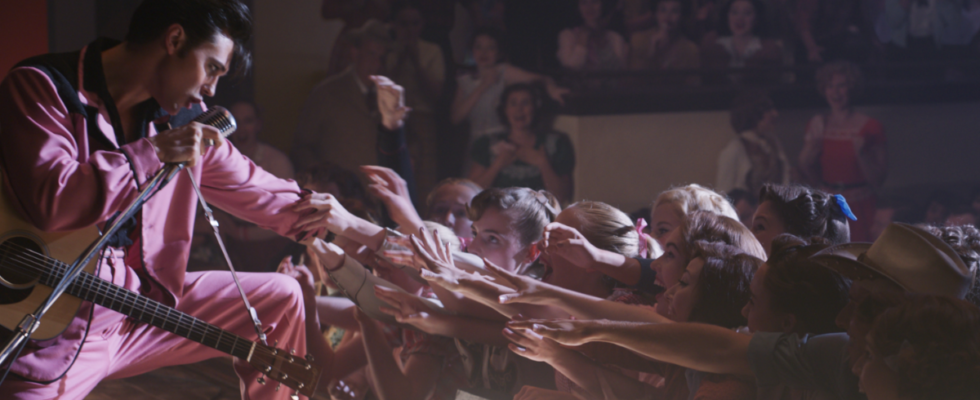
The result is a rock opera and historical panorama that sells the intensity and immediacy of Elvis’ impact and the titanic complicated edifice of his legacy. Shot like a diamond-studded kaleidoscope’s view, this three-hour music montage flows from one number to the next, chopped and remixed and covered and tracked, amped up, stripped down, or played straight. When it lingers on a specific performance—his first big break winning over an audience with his rhythmic wiggling on stage; a triumphant comeback with lush orchestrations and pounding crowd-pleasing stamina—it is electrifying. So often these musical biopics tell us a moment was important by assuming we’ll know it was by the recognizable hit covered by its lead. Here, Luhrmann actually makes us understand 1.) how much hard work it takes to make that sort of impact, and 2.) why his subject was a huge deal. Austin Butler plays Elvis with pretty looks and expert timing, often drenched in sweat on stage, hair flopping, legs twitching, hips plunging. We feel the exertion of putting on a show, and also can get swept up in it. All the smash-zooms in on screaming young women—partly hollering for their fresh crush, but also in surprise at the reaction they’re having—and erupting crowds in dizzying editing or split-screens doesn’t come across as parody, but genuine live-wire enthusiasm. You’d think 2007’s great poison-pen satire of the sub-genre, Walk Hard, would’ve killed these stories dead. But watching Butler come alive on screen, inhabiting the appeal of this star so fully and convincingly, one might realize it’s worth grinding through all the bad versions of these movies just to get to one this remarkable.

In Butler’s compelling performance we see anew why Elvis became who he was. He’s surrounded by Black artists as he grows up, but his whiteness gets him chances they don’t. This is partly why he courts controversy from the segregationists of the time—and one wonders how the racists right-wingers of our time won’t see themselves in the portrait of sniveling politicians complaining about how he’s exposing their white children to ideas of blackness. He’s a white man performing rhythm-and-blues, a bridge between jazz and country as he helps forge a whole new style on the backs of those who get less credit, less fame, less money. But he’s a racially ambiguous figure over the radio, and in live performance is also playing on some unspoken androgynously provocative visual appeal. He’s a hip-thrusting young man at once forceful and smooth, pulsing staccato guitar strumming with loose-limbed pleasure in his own talents, singing in a sensitive baritone timbre from soft, delicate features. (A great evocative moment finds a nasty senator’s teenagers in front of the TV, lost in desire for this new figure of lustful interest.) Subsequent rock stars would blur these lines in more overt and outré ways; but here’s a movie that restores the sexual and racial fault lines of his times in order to bolster its argument for why his stardom was such a lightning rod.  

That’s the benefit of Luhrmann providing a movie that’s gloriously artificial and reverently specific as it sloshes around. He’s so good at movies that drip performative sex appeal and sexual tension, of high-gloss spectacle, loud music that resonates in the chest, expressive complicated camera moves you can hardly take in at once, and emotional dynamics you can believe in an instant. He’s also fond of tragic romantics destroyed by the troubles of their times. In his Romeo + Juliet and Moulin Rouge! and The Great Gatsby we see swooning melodrama, preening showmanship, and bombastic glamour. That’s where he loads in the opulent period style, gilded cages remixed with anachronistic fervor. And locked in the center are these tortured beautiful people who want to love and be loved. Here it’s Elvis, who searches in his family and his lovers and his audiences and, yes, even his sneaky, villainous manager (Tom Hanks) for that approval, that what he’s doing matters and will last. He’s a sensitive and artistic young man taken in, lifted up and exploited by a charismatic scheming promoter into the life of an international superstar. Hanks acts chummily threatening from within layers of makeup and a fat suit, speaking with a marble-mouthed accent and wielding a cane with a snowman top. His narration flows through the picture as well, a frustrated unreliable narrator who can’t quite prove he’s not the bad guy here. He’s a clear contrast with Elvis, the business side of the singer’s show. Somehow, they need each other, even if it will leave them worse off, too.

The movie is totally swallowed up in Elvis’ life and times. It argues that, far from being the Singular Great Man, Elvis was a product of his culture and his collaborations, forged by forces beyond his control and the contributions of others. He’s constantly surrounded by family, friends, business people, audiences, cops, politicians, and hangers-on. In the few dark, quiet moments of empty solitude—stewing in a suite, or lonely in a spotlight on an empty stage—he’s surrounded by doubt. Here’s a celebrity biopic that vigorously sells the spectacle and excitement of such a life—and the fundamental unknowability of such a man, even to himself. What a show! What a cost.