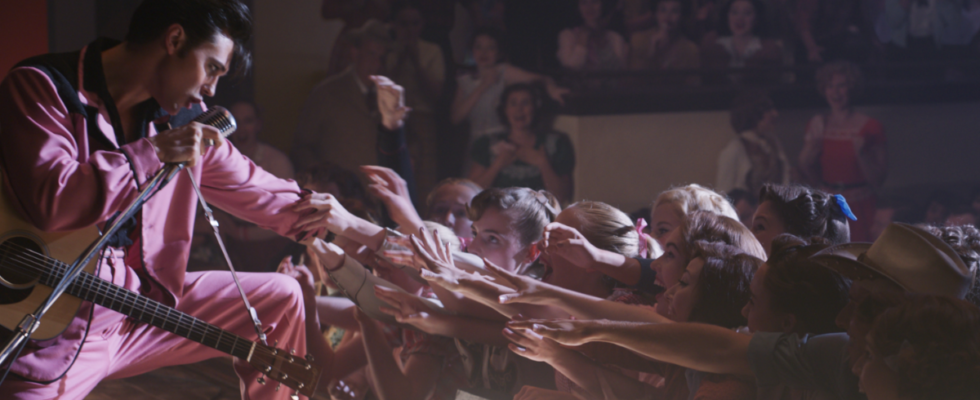
Baz Luhrmann’s Elvis is made with an energetically heightened reality that bursts through the cliches of the rock ’n roll biopic and the overfamiliar caricature that is its subject. It restores life and vitality to both, making something enormous and earnest and enveloping. This is a perfect match of filmmaker and subject. Luhrmann has a brand of cinematic theatricality in which wall-to-wall music covers a visual feast. Every shot is a riot of movement and color, frames are filled with flashing lights and flashy design, and every performance is goaded higher and higher until most gestures are big and broad. Elvis Presley, for his part, was a shock to the system. He defined the mold that continues to mint music stars as part of a wave of midcentury entertainers who began to scramble ideas of race, sex, and gender for the mainstream. His life, too, was as outsized as his stardom. Every facet of it has passed into iconography and a cartoon of fame: his mansion, his marriage, his movies, his scandals, his eccentricities. The modern version of celebrity culture is yet another element of our world he was at the right place and time to pioneer. This movie is a huge, swaggering tour of the familiar stages of Elvis’ life and career. It goes on for nearly three hours and doesn’t dig deeper into arcane trivia or thornier contradictions. But what it does instead is recreate the sensation of the shock of the new, and the societal and showbiz tensions the shaped and destroyed him. Luhrmann’s excesses match this mood, and this project: to build a shining monument to an icon of Americana—and to see how the darkness surrounding his becoming swallowed him whole.
The result is a rock opera and historical panorama that sells the intensity and immediacy of Elvis’ impact and the titanic complicated edifice of his legacy. Shot like a diamond-studded kaleidoscope’s view, this three-hour music montage flows from one number to the next, chopped and remixed and covered and tracked, amped up, stripped down, or played straight. When it lingers on a specific performance—his first big break winning over an audience with his rhythmic wiggling on stage; a triumphant comeback with lush orchestrations and pounding crowd-pleasing stamina—it is electrifying. So often these musical biopics tell us a moment was important by assuming we’ll know it was by the recognizable hit covered by its lead. Here, Luhrmann actually makes us understand 1.) how much hard work it takes to make that sort of impact, and 2.) why his subject was a huge deal. Austin Butler plays Elvis with pretty looks and expert timing, often drenched in sweat on stage, hair flopping, legs twitching, hips plunging. We feel the exertion of putting on a show, and also can get swept up in it. All the smash-zooms in on screaming young women—partly hollering for their fresh crush, but also in surprise at the reaction they’re having—and erupting crowds in dizzying editing or split-screens doesn’t come across as parody, but genuine live-wire enthusiasm. You’d think 2007’s great poison-pen satire of the sub-genre, Walk Hard, would’ve killed these stories dead. But watching Butler come alive on screen, inhabiting the appeal of this star so fully and convincingly, one might realize it’s worth grinding through all the bad versions of these movies just to get to one this remarkable.
In Butler’s compelling performance we see anew why Elvis became who he was. He’s surrounded by Black artists as he grows up, but his whiteness gets him chances they don’t. This is partly why he courts controversy from the segregationists of the time—and one wonders how the racists right-wingers of our time won’t see themselves in the portrait of sniveling politicians complaining about how he’s exposing their white children to ideas of blackness. He’s a white man performing rhythm-and-blues, a bridge between jazz and country as he helps forge a whole new style on the backs of those who get less credit, less fame, less money. But he’s a racially ambiguous figure over the radio, and in live performance is also playing on some unspoken androgynously provocative visual appeal. He’s a hip-thrusting young man at once forceful and smooth, pulsing staccato guitar strumming with loose-limbed pleasure in his own talents, singing in a sensitive baritone timbre from soft, delicate features. (A great evocative moment finds a nasty senator’s teenagers in front of the TV, lost in desire for this new figure of lustful interest.) Subsequent rock stars would blur these lines in more overt and outré ways; but here’s a movie that restores the sexual and racial fault lines of his times in order to bolster its argument for why his stardom was such a lightning rod.
That’s the benefit of Luhrmann providing a movie that’s gloriously artificial and reverently specific as it sloshes around. He’s so good at movies that drip performative sex appeal and sexual tension, of high-gloss spectacle, loud music that resonates in the chest, expressive complicated camera moves you can hardly take in at once, and emotional dynamics you can believe in an instant. He’s also fond of tragic romantics destroyed by the troubles of their times. In his Romeo + Juliet and Moulin Rouge! and The Great Gatsby we see swooning melodrama, preening showmanship, and bombastic glamour. That’s where he loads in the opulent period style, gilded cages remixed with anachronistic fervor. And locked in the center are these tortured beautiful people who want to love and be loved. Here it’s Elvis, who searches in his family and his lovers and his audiences and, yes, even his sneaky, villainous manager (Tom Hanks) for that approval, that what he’s doing matters and will last. He’s a sensitive and artistic young man taken in, lifted up and exploited by a charismatic scheming promoter into the life of an international superstar. Hanks acts chummily threatening from within layers of makeup and a fat suit, speaking with a marble-mouthed accent and wielding a cane with a snowman top. His narration flows through the picture as well, a frustrated unreliable narrator who can’t quite prove he’s not the bad guy here. He’s a clear contrast with Elvis, the business side of the singer’s show. Somehow, they need each other, even if it will leave them worse off, too.
The movie is totally swallowed up in Elvis’ life and times. It argues that, far from being the Singular Great Man, Elvis was a product of his culture and his collaborations, forged by forces beyond his control and the contributions of others. He’s constantly surrounded by family, friends, business people, audiences, cops, politicians, and hangers-on. In the few dark, quiet moments of empty solitude—stewing in a suite, or lonely in a spotlight on an empty stage—he’s surrounded by doubt. Here’s a celebrity biopic that vigorously sells the spectacle and excitement of such a life—and the fundamental unknowability of such a man, even to himself. What a show! What a cost.
Showing posts with label Baz Luhrmann. Show all posts
Sunday, June 26, 2022
Saturday, May 11, 2013
Borne Back Into the Past: THE GREAT GATSBY
It’s easy to see why over the years some have seen in F.
Scott Fitzgerald’s 1925 novel The Great
Gatsby a fine idea for a film. The book contains memorable characters and
quotable lines contained in a plot of some intrigue and mystery, romance and
regret. It’s not hard to see how it can all be pushed into tasteful melodrama
of the kind the movies are so good at. (They’re even better at tasteless
melodrama, but that’s not my point yet.) What previous adaptations of Gatsby have failed to grasp, however, is
that this great novel needs not a cinematic transcription, but a jolt of cinema
itself to play on screen. Last seen in theaters in 1974 directed by Jack
Clayton from a screenplay by Francis Ford Coppola, the story felt stale, stiff
and humorless, despite the best efforts of an all-star cast headlined by Robert
Redford. This time around, the director and co-adapter is Baz Luhrmann of Moulin Rouge!, Romeo + Juliet, and Australia, one a musical and two so
broad, vibrant, and melodic they might as well be. He makes films in a style
that’s a kaleidoscope of the gaudy, the campy, the kitsch, proudly waving the
flag of melodrama while shouting from the rooftops his themes and ambitions. He
brings the spark of cinema the story needs to really take off on screen.
Glittering and glowing with colorful period detail and
wailing a mix of jazzy standards and anachronistic tunes from the likes of
Jay-Z and Lana Del Rey (not to mention a great Charleston-style cover of
Beyoncé’s “Crazy in Love”), Luhrmann’s film is bursting at the seams with
invention of the kind that illuminates Fitzgerald’s text without subsuming it.
Now, I’m of the opinion that adaptations have no particular obligation to
faithfully reproduce every aspect of their source materials. But this Gatsby is both faithful to the events,
characters, themes, and symbols of Fitzgerald’s, while the telling – structure
(mostly) aside – is all Luhrmann’s. It has the wild exuberance of a Gatsby
party with all the distance to see how hollow it ultimately is. Using generous
amounts of Fitzgerald’s original text verbatim in voice over, dialogue,
and on-screen titles, the film maintains a sense of wit and social commentary
amidst the colorful party atmosphere and melodrama that bursts forth.
The film, like the novel, uses the character of Nick Carraway
as narrator and observer. It’s the height of the Roaring Twenties. He’s moved
to New York City for a job on Wall Street and finds himself living in fictional
West Egg, procuring a cottage next door to the mansion of the mysterious Jay
Gatsby. No one knows much of anything about the man; they only know he throws
great parties, wild, packed, affluent parties in which the rich and wannabe
rich, the influential and the climbers all rub elbows, drink bootleg alcohol,
and dance the night away. Luhrmann, in a more restrained version of the carousing
Moulin Rouge! hyperactivity, films
these elaborate soirées with exuberance, using his mishmash of music choices
and Catherine Martin’s impeccable production design to highlight the glamour
and excitement of such an event. Gatsby parties seem fun, but they seem just as
meaningless. No one knows precisely why they’re there any more than they know a
thing about Gatsby beyond wild rumors. The host, for his part, seems
spectacularly uninterested in the spectacle of his own making.
The summer setting is the perfect time for these lengthy
nights separated by endless languorous days spent whiling away the hours. Carraway
(Tobey Maguire) tells us all about the vacuous, energetic people he meets away
from Gatsby’s, including his cousin Daisy (Carey Mulligan), her brutish
old-money husband Tom (Joel Edgerton), his mistress (Isla Fisher) and her
husband (Jason Clarke). Carraway starts a flirtation with a famous golfer
(Elizabeth Debicki). Sometimes he goes to work. He’s a busy guy, but he’s not
really drawn into this world until he meets Gatsby. Luhrmann films the title
character’s entrance in a grand, theatrical way that does not disappoint.
Gatsby, played by Leonardo DiCaprio, turns in slow motion, raising a cocktail
glass in toasting, smirk on his face, fireworks slowly erupting in the sky
behind him while the soundtrack and his eyes are lost sparkling in a dreamy
blue rhapsody.
I’ll preserve the mystery of Gatsby, his relationships, and
his ambitions for those who haven’t read the book. But I will say that as the
film goes along, Luhrmann brings a satisfying bitter romance, full of as much
sadness as swooning, that slowly builds to a sequence in a hothouse of a hotel
room where a crisply edited small party becomes uncomfortably personal until
emotions boil over. It’s a lovely luridness of love and death, affairs and
scandal, loss and loneliness. The performances are sharply drawn, from
Maguire’s Carraway’s starry-eyed wonder giving way to hindsight skepticism to
Mulligan’s Daisy’s flat affect and foolish affectations cracking under the
pressure of the possibility of remaking her life. And then there’s Gatsby.
DiCaprio brings exactly the right combination of irresistible charm and
unknowability. He’s slick and smooth, but what’s he up to? He’s sympathetic,
but how much do we really know about him? It’s a slippery performance that
never feels unmoored as the audience learns more about who he really is.
What’s best about the film is its consistency of vision, a
vibrancy that never forsakes the source material while confidently striding
forward as its own postmodern construction. Luhrmann freely mixes and matches
artistic inspirations, bringing his swooping 3D camera through digital
recreations of Jazz Age architecture, energy, and glamorous coarseness. He’s such
a big believer in the power of movie magic to evoke strong emotions through
gorgeous fakery that he’d never mention the unutterable fact that it’s not always
true. He’s too busy making the story burst to life with every trick he knows.
For this, Gatsby feels truly
cinematic in ways it never has on screen before. It’s lively, funny, and
rewarding without suffocating under its seriousness. Through irresistible,
shameless visual frippery and vividly colorful melodramatics Douglas Sirk might
have been proud of, Luhrmann finds and takes as his own Fitzgerald’s core laser-sharp,
gin-dry social commentary. Consider this exchange between Carraway and Gatsby,
concerning complicated decorative plans for a small get-together: “Is it too
much?” Gatsby asks. Carraway replies, “I think it’s what you want.” Is this Gatsby too much? It's what I wanted.
Subscribe to:
Posts (Atom)


