
Tragedy, in the most classic sense, is about consequences. It’s forged in the moment where characters are confronted, inescapably, with the cold, hard facts of their downfall and realize that they brought it on themselves. It is thus that Shakespeare’s Macbeth is perhaps his most tragic tale. Not the saddest, and not the most dramatic, necessarily, but perhaps the most tragic for it sits almost entirely in that moment of realization. Macbeth is quickly brought to commit treasonous murder—from inscrutable witches on the one hand prophesying his kingship, and from a scheming wife’s goading on the other—and the rest of the play watches as the weight of such a deed sends him to his doom. This deep engagement in what happens and what inevitably results from those happenings is something writer-director Joel Coen, adapting the play for his first film without his brother Ethan, understands. (Quite a brotherly compliment to replace Ethan with the Bard; they do share a love of language.) The Coens have made a career out of films, often some mixture of bleakly suspenseful and darkly funny, about characters confronted with the distance between what they think they can get, and what life’s circumstances have in store for them. I often think of an exchange from their 2009 effort A Serious Man, still perhaps the finest film in a body of work made up almost entirely out of excellent films. In this moment, a harried professor confronts a befuddling student, telling him: “Actions have consequences.” To which the young man replies: “Yes, sir. Often.” The professor’s immediate frustrated response: “No! Always! Actions always have consequences.” There’s no running from that.
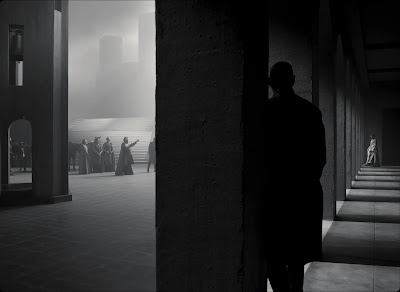
So here’s The Tragedy of Macbeth, a stark and unsparing black and white feature shot in sharp digital closeups, filmed on spare stages cloaked in artifice and darkness, backgrounds that are bleary and sets cavernously empty. A boxy aspect ratio forms a proscenium around the performers, trapping the characters even as their proximity to the camera often causes a startling immediacy. You can see every pore in their face, every wrinkle, each subtle darting of the eye or twitching of the lip. The film is at once intimately engaged in its actors’ decisions and held back at a theatrical remove—a cold and distant picture that’s nonetheless inscrutably, uncomfortably near. Coen’s vision of this story, made vivid by cinematographer Bruno Delbonnel and production designer Stefan Dechant, is one that’s part the high-contrast lighting of a film noir—a look that turns Lady Macbeth into a regal femme fatale—and the woozy constructed angles in crooked stairways and enormous windows of German expressionism—down to its extension of anxieties about dreams and realities. Coen at every turn emphasizes the moral confusion inside the characters by highlighting the foggy displacement around them. The opening shot looks like it is staring up into milky sky, a bird circling, until the fog starts thinning and we see it’s a vast expanse of pale dirt and puddle where crouches our otherworldly portents ready to unfold a grim tale in which its characters are cogs. In this warped world of oppressive contrast and artifice, the potential majesty of the throne is all implication—down to the landscapes terminating in blankness the color of a scrim, through which the castle can be only just barely glimpsed, a flicker in the distance like Kane’s Xanadu. You just know that’ll be unsatisfying for anyone who wants to rule there.
And that’s how Denzel Washington approaches the lead role, as a man who, perhaps unconsciously, already senses that achieving a royal status won’t solve the deep dissatisfactions in his soul. Washington takes his considerable charisma—he easily commands attention like few of his or any generation—and twists it inward in hesitation and guilt. His head hangs heavy even before the crown, like his mind really is plagued with scorpions, leading him to question his choices before, after, and as he makes them. He becomes a reluctant conduit for his own malevolence, and as such is almost going through the motions as a spectator. His soliloquies are hushed, tortured. His later outbursts of madness have none of the live-wire aggrandizement you might expect. Although he holds considerable power in the lives of the other characters, he always carries himself like a pawn. It’s an embodiment of what Emma Smith, professor of Shakespeare studies at Oxford, identifies as a central question of the text: “Is [Macbeth] in control of his own actions…or is he merely working out a part that has been written—by witches’ prophecies, by historical chronicle, by Shakespeare himself?” Washington’s approach wrings pathos from this uncertainty as he frets his hour upon the stage, worried that his life, in the end, will signify nothing. Coen’s film never once roots for his victory; it sees too well how this insecurity leads to his brutality. And Macbeth’s uncomfortable wracked nerves and slippery senses in this telling makes the characters plotting his downfall seem like an act of planning to put him out of his misery.
The movie constantly feels the crushing weight of inevitability. Other characters exist either in direct dialogue with Macbeth, or lurk outside of his notice, each playing their preordained part in the tale. There’s his wife (Francis McDormand), a brittle shiv of ambition whose inability to handle hiding their dark deeds marks the couple’s conjoined unraveling. There are assorted men of more and less power in the kingdom (Corey Hawkins, Brendan Gleeson, Harry Melling, Ralph Ineson, and more) who go under the knife or jostle for power in ways violent, righteous, and self-involved. (Stephen Root’s careless drunken babbling is a fine counterpoint there.) And then there’s the innocent, victimized Lady Macduff (Moses Ingram) sees her home and family burned to the ground by the cruelty of men’s ambitions. All are brought into the nightmare logic of the filming and of the tragedy, positioned as fellow travelers in what fate has in store. Everything is trapped in that aim, as just another facet of the design. Loud on the soundtrack are the steady drips of falling water, or blood—thuds and knocks in a regular rhythm like Poe’s tell-tale heart, or the clock that one should ask not for whom it tolls. We hear fluttering birds and heavy footfalls against cavernous castle walls, every action a reaction. The three witches, all deviously inhabited in the contorted body and raspy voice of the same performer (Kathryn Hunter), remain scarily ambiguous, clearly otherworldly and possessed of dark powers through shifting specters. Are they predicting the future or controlling it? Everything they say comes to pass. Yet dark forces unleashed by greed, guilt, and despair have their own cruel, predictable logic. And tomorrow and tomorrow and tomorrow creeps in from day to day to the last syllable of recorded time. Tragically, one can find too late the consequences of actions are all one’s left in the end. They can signify everything.
Showing posts with label Coen Brothers. Show all posts
Sunday, January 9, 2022
Friday, February 5, 2016
No Business Like Show Business: HAIL, CAESAR!
There’s a zen saying that suggests, “The most
dangerous thing in the world is to think you understand something.” This could
be a good description for the outlook of any Coen brothers’ film, works invested
in ambiguities and absurdities of human lives as reflected in the worldviews
and systems that control them. One man’s belief is another man’s mystery, and
Joel and Ethan Coen have made a career out of stories of existential crises
told through oddball humor and offbeat suspense. Their latest is Hail, Caesar!, a film full of people who
think they understand, having figured out deep reverence for some larger
ideological force or another: the Bible, Das
Kapital, Hollywood’s studio system. But where does that certainty get them?
It’s the early 1950s, and a studio fixer (Josh Brolin) is heading into a day
that’ll be full of complications to test many a person’s certainties, a
straight-faced screwball panic, or maybe philosophical wrestling on laughing
gas. Either way it’s a pip, but with typical Coen precision and deliberateness.
Sustained goofing on classic Hollywood, a
day-in-the-life on the backlot not too far removed from Don Lockwood and Lina
Lamont’s, the Coens follow Brolin’s studio suit from set to set wrangling
stars, quelling complaints, and staving off controversy. The fictional Capitol
Pictures is hard at work on several movies: a bathing beauty musical, a wordy
melodrama, a dancing sailors movie, a singing cowboy picture, and a Biblical
epic. Bopping between the films in progress we’re presented with a great imitation
of Hollywood iconography: a little Robert Taylor here, some Esther Williams
there, with Gene Kelly, Roy Rodgers, and others thrown in for good measure.
It’s like a bleary Turner Classic Movies binge if you kept passing out and
dreaming ridiculous connective behind-the-scenes tissue between disparate films.
The Coens have fun conjuring up winking nods to historical references points,
and mimicking the style of 50’s filmmaking. (Lap dissolves, rear projection, matte
paintings and more show up.) It’s in love with its pastiche, but has enough
distance to maintain an aloof absurdism.
Between fun sketches of films within the film
we’re treated to a stew of behind-the-scenes silliness, wacky shenanigans that
find increasingly offbeat expression on their way to some head-scratching
conclusions. (“Accept the mystery,” as a character from the Coen’s great, maybe
greatest, work A Serious Man might
say.) Hail, Caesar! is set in motion
when work on said Biblical epic is thrown into jeopardy when its star (played
with daffy blockheaded charm by George Clooney) is kidnapped by two devious
extras intent on delivering him to a clandestine meeting of Hollywood
subversives in Malibu. This is, of course, the day’s biggest problem for
Brolin’s harried studio middleman, who’s fielding a job offer from an aircraft
manufacture, but can’t quite shake the fun of all this show business. He tries
to keep the story quiet, even as ransom notes show up and there’s a dozen other
problems needing his attention. Who ever said his job was easy?
This is the Coen’s fizziest
man-on-the-verge-of-a-nervous-breakdown story, like the better, more downbeat,
though still plenty funny, Barton Fink
or Serious Man or Inside Llewyn Davis played in a major
key. Brolin scurries around dealing with an unmarried ingénue (Scarlett
Johansson) whose pregnancy is a problem for her innocent image, a Western star (Alden
Ehrenreich) who is an awkward fit for a drawing room drama by a fancy director
(Ralph Fiennes), and competitive twin gossip columnists (Tilda Swinton)
sniffing around the smell of scandal. A host of studio employees (played by the
likes of Channing Tatum, Clancy Brown, Wayne Knight, and Frances McDormand, to
name a few) scramble through the story, most getting a few amusing moments
bouncing off Brolin’s clench-jawed determination. He’s grinding through the
day, keeping total calamity at bay. Sure, a job overseeing airplane factories
would be easier, but wouldn’t he miss the fun of racing around Los Angeles,
dealing with all the kooks and their crisises?
In its meandering way, Hail, Caesar! takes the usual Coen delight in dialogue, peculiar
turns of phrase, droll patter, looping repetition, dry sarcasm, airy
eccentricities, and narrative dead-ends and cul-de-sacs. And all this, of
course, serves only to reveal characters dancing over the deep abyss of
uncertainty. Like a softer version of what their sharply cynical Burn After Reading did to the espionage
game – turning paranoid thriller mechanics on their ear to amplify the
absurdity and the impossibility of “making sense” – this film asks if cinema –
with all its egos, pretentions, and petty gossip – is serious business. The
answer is: not really. Show business is cut from some deeply silly cloth. But
it’s no better than anyone else who claims to be doing important work – a
priest, a rabbi, a pawn of the military-industrial complex, a studio stooge, a
Communist. That round-up sounds like a cast list for a great joke, and that’s
what the Coens try for here, staging scenes in which all the above, and more
too, make themselves out to be figures of fun when they take themselves too
seriously.
The film often feels slight, busy goofing
around, doodling with silly details and funny performances, Roger Deakins’ brightly
lit, primary color-popping cinematography letting wacky backstage antics and a
variety of movie genres bleed off the backlot and into conversation with one
another. But it picks up weight as it punctures windbags’ hot air and scoffs at
those who are too sure they have the perfect understanding of anything –
history, economics, politics, morality, you name it. Everyone’s spinning their own
stories about how the world works, but their boats are easily rocked. Shouldn’t
there always be room for doubt, like an actor delivering a passionate speech, but
forgetting his closing line? The movies, this film seems to say, may be
frivolous gossamer illusions, but isn’t anything we cling to in order to make
sense of our lives? If we’re going to lose ourselves in soothing fictions, it
may as well come from dazzling Technicolor fantasies lighting up the silver
screen.
Monday, October 19, 2015
The Man Who Went Into the Cold: BRIDGE OF SPIES
A powerfully humane legal drama, Steven Spielberg’s Bridge of Spies tells the story of James
Donovan, an American lawyer who, at the height of the Cold War, was asked to
defend an alleged Soviet spy. Donovan’s humble professional commitment to
fairness, justice, the value of hard work, and the worth of all persons takes
his case much further than he ever expected, into the halls of United States’
power and beyond, into shadowy negotiations between foreign powers. This causes
much fear and prejudice directed towards him, his family’s doubts and worries
about the stigma of providing legal aid to an enemy spy validated in the sneers
he gets when recognized in public, and by the bullets shot through their front
window by some angry concerned citizen. Even the cops responding to that
frightening incident wear a how-could-you snarl.
This is a story that affirms with beautiful moral clarity
aspirational bedrock American values, but not the sanctimonious sort used as smarmy
stand-ins for greed, intolerance, and crypto-fascism. It’s a hopeful movie with
Capra-esque ideals upheld and uplifted: kindness, compassion, empathy, and the
willingness to do what good you can. Late in the film the lawyer, weary from
his task, confides, “It’s not what other people think. It’s what you know you
did.” We see Donovan as a man who values his logic and thinking, preparation
and good judgment, tenaciously following his moral compass. Who else could
embody those qualities but Tom Hanks? With every passing year his screen
presence embodies more easy everyman paternal gravitas, the sort that used to
be found in Lewis Stone’s Judge Hardy, vintage Atticus Finch, or evening
newscasters. His projecting steady moral certitude goes a long way selling this
earnest material.
Of course it also helps that Spielberg is a master filmmaker
whose works are almost unfailingly absorbing and well crafted yarns. Here he’s
taking talky scenes of legal process and tense negotiations and making them
riveting. He has a script by Joel and Ethan Coen, masters of dry dialogue and
complicated plotting, and the effect is watching great voices working
seamlessly together. From a draft by Matt Charman, they’ve generously provided
an unrelenting tick-tock pace and fluid crackling conversations. It’s a true
story told with warm humor and disarming expressions of wit and character in
every exchange, a lively and reverent story that’s as entertaining as it is
moving. Donovan is a character who exudes decency, and who is generally a nice
guy, stubborn only in his belief that even one person can make a difference.
It’s amazing how much humor and suspense can be wrung out of good old plain
niceness.
Spielberg opens with a great silent cat-and-mouse espionage sequence
that introduces the Soviet spy (Mark Rylance, calm, sly, meticulous, droll,
unknowable) as he’s captured. From there the film quickly sets up the trial,
intercutting Americans abroad who are on a path to importance in the plot later
on. Complicated geopolitical terrain and historical context are brought to life
with immediate vivid clarity, while characters’ dynamics are established with
wordless flickers of expression and clever blocking. The sharp dialogue is
nonstop, and Spielberg knows his way around a scene, moving lightly and clearly
through exposition, allowing clever turns of phrase to land with pleasing
snaps. The storytelling economy is breathtaking, especially as a potentially
muddled everyman-turns-LeCarre plot unspools with riveting precision and
perfect focus. There are scenes with layers of subterfuge, where characters we’ve
never met are, through smart placement of details, instantly understood to be
putting on a show for the sake of spycraft.
For spycraft is what enters the film as the CIA
understandably wants to use the captured spy for their own interests, using him
as leverage in some high-stakes, top-secret Cold War negotiations. A wry
handler (Scott Shepherd) ends up recruiting Donovan for the task as civilian
middleman for the government’s offers, the better to disavow if it all goes
wrong. This creates a complicated scenario in which Donovan is more prepared to
follow the letter of the law than agents eager to punish the Russians in any
way they can, and through which the layman can never be sure how much truth is
being told by any other person he’s talking to, even and especially suspicious
Soviet and East German agents (Mikhail Gorevoy and Sebastian Koch). The air is
thick with Cold War paranoia as frigid and frosty as snow-swept Berlin streets.
Spielberg has once again entrusted a film’s look to cinematographer Janusz
Kaminski who here captures every bit of the uncertain situation and the sturdy
man at its center in fluid camera movements and gorgeous textures, bathing grey
areas in cold blue and white glow from every light source.
Spielberg and crew create a sympathetic political drama,
attentive to actors’ movements and expressions in relation to one another with
gentle precision. (His longtime editor Michael Kahn provides sharp cuts and
meaningful juxtapositions, while accommodating unshowy one-take master shots.) It
thoroughly humanizes every participant. We see little home life (though what we
do is drawn in great shorthand by the likes of Amy Ryan and Eve Hewson), little
of the men whose lives are being potentially traded by their governments.
Instead, we’re to view people as the movie tells us Donovan does: as equally
valuable human lives. Take, for instance, Rylance’s caught spy, who dryly
assesses his plight, sees Donovan as an admirable advocate, and in the end
emerges not as a martyred other or enemy combatant, but as a man, warm,
pragmatic, and doing his best. We see in the faces of every man in a suit a person
who’s juggling expectations of bosses and countries, who might be convinced to
do what’s best through nothing more than the right smart argument.
Like so many of Spielberg’s historical dramas, Bridge of Spies puts his skill for
crowd-pleasing spectacle to use illuminating sharp complicated ideas. In this
case, hard-fought optimism emerges from clear and refreshing political
resonances. It’d be difficult not to think of our gridlocked national discourse
while watching a movie squarely situated on a talking cure, the value of
compromise, of speaking with those you hate or distrust to find mutually
agreeable ways forward. (It makes a fine pairing with his last film, Lincoln, in that regard.) Donovan
realizes there are reasons to find fault with life behind the Iron Curtain,
seeing fleeing Germans gunned down on the wall, knowing an American POW is
tortured in interrogation that’s certainly “enhanced.” But still he insists the
Americans treat their prisoner well, ensures a fair trial, and follows due
process every step of the way. Hanks wears this American heroism in all its
exhausting, modest, rewarding weight. The film is a deeply moving vision of a
man doing the right thing in the face of seemingly insurmountable odds.
Friday, December 6, 2013
No Direction Home: INSIDE LLEWYN DAVIS
It feels like it has always existed, just waiting to be
brought into being. Inside Llewyn Davis
casts a spell of tone and mood like the best folk songs. It’s plaintive
melancholy, a sustained sense of a soul laid bare before our eyes,
introspective and yearning. Writer/directors Joel and Ethan Coen are masters of
films – from Blood Simple and Fargo to Raising Arizona and A Serious
Man – that suggest as much as they show, creating convincing worlds much
like our own, richly populated with eccentric individuals and a sly
determinism. Their characters want better lives and are frustrated when they
come up short. It makes notes of triumph all the sweeter, but Llewyn Davis
(Oscar Isaac), a struggling folk singer in 1961 New York City, is rubbing up
against the end of his rope. Triumph, for him, seems perpetually out of reach.
In this film we watch him circle around the city, begging a night’s sleep on a
variety of friends’ couches. His music career is going nowhere fast, but his
big break is right there, ever so slightly out of his reach.
We know Llewyn Davis is talented, but we also are quickly aware
of his difficulties. The opening of the film is a sequence set in a small club,
Llewyn softly plucking his guitar as his voice, soft and strong, wafts out over
the audience. It’s hushed. They’re rapt. We see a glimmer of satisfaction on
his face. After the performance, he heads out to the back alley where he’s
promptly confronted by an angry man who punches him in the face a couple times,
walking away as Llewyn sits on the ground, hurting. In this opening, we have
the film in miniature. It’s a film focused on Llewyn’s quietly ecstatic musical
satisfaction, and the pain he’s constantly receiving. He’s a man for whom music
and pain are attracted to him and created by him. They’re as self-inflicted as
they are God-given. It might not sound like it, but there’s warmth to the
Coens’ approach here. Perceptive without judging, the film is a wise and
compassionate look inside this man’s emotional states and drives.
He’s capable of great cruelty – a scene in which he heckles
an older woman had me wincing – and yet he’s so precisely nuanced a frustrated
artistic type that it’s easy to feel for him as he tries to navigate a path to
the future that grows murkier the harder to tries to get there. I empathized
with him to an almost painful extent; it filled my heart even as it faintly
ached. He stubbornly works to get ahead. It’s a frustratingly circular path
he’s on – performing in clubs, lucking into some studio work for which he
short-sightedly signs away the rights to royalties, and talking to his manager (Jerry
Grayson) who looks at him with sad eyes while avoiding the inevitable “no”
answer to the question of how much he’s earned from a record well into the
process of flopping. Llewyn is struggling and getting seemingly nowhere. And
yet he’ll go on. It’s scary to go on, but it’s even scarier not to. In the
haunting lyrics of the folk song he sings that bookends the film, “Wouldn’t
mind the hanging / But the laying in the grave so long.”
Stubbornness: it’s the very thing keeping him going and a
key part of what’s holding him back. He wants to succeed on his own terms, scrambling
to come back after being thrown by unforeseen circumstances that have occurred
before the film has even begun. Two losses define him: one a girl he loved who
has moved to Akron nearly two years prior, the other his music partner who sometime
in the recent past forcibly made their duo a solo act. We never meet these
people, but we feel their absence acutely. Oscar Isaac, playing Llewyn, ably
communicates the resonant emotional wounds that have rattled him, and the
combination of talent and arrogance that drives him to continue pursuing folk
music success. It’s an interior performance that lets the inner gears turn,
expressed outward through wry speech and moving music. Isaac, doing his own
singing and guitar playing, represents the Coen’s typical ability to cast the
exact right person in each and every role.
This is a fascinating character study, bolstered by a
universally strong ensemble. It finds its characters distinct and fully formed,
situated wholly and completely in casually perfect costume and production
design. Each person who arrives on the scene – there for a moment or two never
to return, unless, of course, they do – contributes immeasurably to the
richness and depth of the world the Coens create. We meet a musical couple
(Carey Mulligan and Justin Timberlake) who are alternately antagonistic and
accommodating, as well as Llewyn’s patience-strained sister (Jeanine Serralles).
As Llewyn navigates narrow halls to friends’ apartments pinned and pinched in
corridors that terminate in tiny corners or heading out into the world that
opens up with snowy sidewalks and slippery highways, smoky stages and creaky
roadside cafes, he meets all manner of strangers. There’s an eerily polite
solider moonlighting as a singer (Stark Sands), a sickly old grump (John
Goodman) and his driver (Garrett Hedlund), a kind older couple (Ethan Phillips
and Robin Bartlett), a struggling solo act doing backup singing on novelty
records (Adam Driver), and an intimidating record executive (F. Murray
Abraham).
In typical Coen fashion, the dialogue is so dry it crackles.
Consider the following exchange in which Llewyn is told by his manager’s
secretary (Sylvia Kauders) that the old man is out of the office attending yet
another funeral. Why? “He likes people.” Llewyn replies, “Fewer and fewer.” The
film moves from memorable moment to memorable moment, a fascinating period
piece odyssey with not a single line or gesture out of place. It manages to
view, with Bruno Delbonnel’s exquisite cinematography, the past through
almost-hazy mists of time without glorifying or condescending to the context or
circumstances. Its imagery is at once soft and sharp, as if emerging from a
timeless place with startling immediacy, powerfully direct, as piercing and
singular as anything the Coen brothers have brought us. Inside Llewyn Davis is a masterful character study and a wondrous
and precise evocation of time, place, and music. As the film’s final sequence
unspools, I gasped at its detail as my heart swelled, at once broken and full. The
spell the movie casts in the moment lingers, stuck circling in my mind like a
great old melody that’s always been there, deep and true, ready to stay.
Saturday, February 13, 2010
A Serious Masterpiece: A SERIOUS MAN
“When the truth is found to be lies, and all the hope within you dies, then what?”
When I sat down to write about A Serious Man, the latest Coen brothers’ film, I ended up getting carried away and writing well over a thousand words on some of their earlier films and that was just initially my introduction. At some point in the future, I should recycle that writing into a more comprehensive retrospective of their career. For now I think it’s only important to note that I was reflecting on their past achievements mostly because this film feels in many ways like the film they’ve been inevitably building towards, an important landmark of their artistic progression that feels both incredibly personal and yet emotionally restrained. With A Serious Man, the Coens have taken their finely honed skills and have further perfected their mastery of the art of filmmaking. It is a staggering work of absolute perfection. In this film every shot, every word, is absolutely integral. There are no wasted moments to be found. The Coens have complete control over every aspect of the experience and use that control to create a generously thoughtful and tremendously affecting experience, while also containing a seemingly limitless ability to surprise.
One of the major reasons the film feels like the perfect apotheosis of the Coens’ style is how wholly personal it feels. Following a middle-class Jewish family in suburban Minnesota during 1970, it is firmly entrenched in the milieu of the Coens’ childhood. And yet, this isn’t exactly autobiographical. The story focuses on Larry Gopnik, a professor at small college whose upcoming tenure hearing is just one good reason for him to be stressed out. His wife wants to divorce him. His bosses have been receiving anonymous notes denigrating him. He has a student who tries to bribe him. His son’s bar mitzvah is fast approaching. His brother has to move in with them while he looks for work and drains a massive cyst on the back of his neck. Their TV antenna is unreliable. He can’t make an appointment with the rabbi, the one thing that he hopes might help him understand his plight. This movie has been called an updated telling of the Biblical story of Job, but that’s only partially true. The story of Job is a story of a man whose faith in God remains steadfast as his life goes from bad to worse to excruciating. Larry Gopnik’s story, while following a superficially similar structure, is one of searching, about how hard it is to maintain faith or come to a greater understanding of your faith, when absolutely everything is going wrong.
Michael Stuhlbarg plays Gopnik in the performance of the year. On the surface, it’s a very reactionary role, a role that requires little more than receiving bad news and letting it settle in. Yet that’s not quite the part, and Stuhlbarg knows it. He plays the scenes with a subtlety and a soft dark humor that’s both realistic and stylized, caught in the perfect Coen pitch of character and tone. This is an immensely likable character, even as he gets more and more frustrated with his life. “But I didn’t do anything!” becomes a common refrain as the next horrible event happens, as if his passive nature should insulate him from the world. And yet, this never becomes pathetic or grating. This is a compassionate performance and it evokes powerful emotion and wicked laughs. I never felt like they were laughs of derision, though. This movie’s humor comes twofold: humor from writing that’s simply witty or unexpected and dark nervous chortles of disbelief as things go even further downhill. The Coens have us laugh so we don’t cry.
It seems wholly inadequate to merely examine in just several hundred words the achievement of this film. In a perfect world this piece would be many thousands of words long, touch upon theology, philosophy, and physics, and contain dozens and dozens of stills from the film, but even that would pale in comparison to the experience I had watching the film. In 2009, A Serious Man and Inglourious Basterds were the only two films that felt fully and totally memorable from the opening moments through the end credits. Each moment is a total gem of filmmaking, each line feels quotable. But this is not just formally exceptional, well written artistry that goes no further. (Basterds wasn’t either). This film has a deep resonating core of emotion, a wonderful sense of humanity. I see no trace of the misanthropy that some of the harshest critics of this and other Coen films like to point out. This is a deeply humanistic film. It presents as its protagonist a man who is having a very hard time, but while the Cones examine suffering and allow dark humor to shine through, the way they hold the camera in sympathetic close ups and allow his reactions to subtly and slowly play out across his face created in me a deep empathy. This is not a cruel film, but an exhilarating one, like in the moment where Gopnik stands atop his house, staring across the endless suburban space sprawled out below him. For one small moment, he is on top of the world.
The supporting cast is typically Coen, filled with character actors and entirely perfect. There’s Fred Melamed as Sy Ableman, a man who seems to have his life together and is thus the object of simultaneous jealousy and derision by Gopnik. Melamed has a morosely comic way of seeming to condescendingly sigh his lines. Sari Lennick, as Mrs. Gopnik, creates a monstrously comedic portrait of a woman whose scarily composed unraveling threatens a similar fate for her family. Richard Kind, as the brother, gives a shattering, yet bleakly funny, performance of a broken man, serving to show Gopnik how much worse things could be.
Other characters, including rabbis, lawyers, college faculty members, and neighbors both beguiling and menacing float in and out of the plot as the Coens work from their perfectly structured script with a tight sense of pacing. Everything associated with a Coen brothers film is in its finest form here. There’s excellent, subtle and beautiful cinematography from Roger Deakins, a darkly swirling score from Carter Burwell, and amazingly precise editing from Roderick Jaynes (though I suspect that he received a lot of help from the Coens, as he usually does). There are instantly memorable characters delivering wonderfully written dialogue matched with a plot that continually tightens the screws, pulling the movie tighter and tauter. The Coens have always known that nervous tension and dark comedy can often come from the same place. They use that knowledge here as well as, and in some ways better than, they ever have.
But above all, this is a haunting character study. Larry Gopnik is as great a character as the movies have ever given us, in a movie that knows just how to use him. This is a wonderfully thoughtful movie, honestly engaging with notions of belief and disbelief, tradition and modernity, meaning and meaninglessness. And yet, despite being, at times, a bleak existentialist cry, the film allows there to be nobility in searching for answers, as Gopnik continually pleads for understanding, searching for meaning in meetings with Rabbis and in the equations coating his chalkboard. In one great moment, we cut away from his piece of chalk scraping out small numerals to see the board coated with equations, dwarfing him, dominating one wall of his classroom, as we hear him say “this proves that we can never really know anything.”
Despite having seen the film three times in the theaters and eagerly awaiting the moment when I can put my Blu-ray copy in for a spin, what I envy most is the experience of seeing it for the first time, reveling in the perfection as it unspools. And yet, the movie does come close to replicating that sense of discovering within me, even as each viewing brings new and varied interpretations, and deeper understandings, and intriguing connections. Some may find A Serious Man open-ended, vague, pointless, or unsatisfactory, but that’s their loss. They would deny themselves the rich images, the absorbing dialogue of the newest, and maybe greatest, Coen masterpiece. They need to accept the mystery to find this film as eminently habitable as it truly is. This is a film that held me gripped from frame one all the way through the end credits, the kind of film that leaves me breathless, pinned to my seat through the credits until I’m staring at a blank screen, turning the experience over and over in my head while desiring to see it again as soon as possible.
Note: Three events occur in the first third of the film that are vital clues to fuel the mind when thinking about the movie’s implications. When you watch it the second time, pay attention to the opening parable. Is he a Dybbuck or not? Does it matter? Pay attention to Gopnik’s explanation of Schrodinger’s Cat. Pay attention to this exchange Gopnik has with a student:
“Actions have consequences.”
“Often.”
“No, always!”
Subscribe to:
Posts (Atom)


