Showing posts with label Scarlett Johansson. Show all posts

Monday, July 28, 2025

Family Business: THE PHOENICIAN SCHEME

In a filmography full of flawed father figures, there’s a good case to make for The Phoenician Scheme’s Anatole Zsa-Zsa Korda (Benicio del Toro) as the most flawed Wes Anderson father yet. He’s a rapacious international tycoon, brazenly skirting laws and regulations to exploit the world by any means necessary for his business interests. Those interests? Getting more. Little wonder his cold disregard for others leaves him dodging assassination attempts. They’re so frequent he practically yawns as he shrugs off others’ concerns about dangerous developments. “Myself, I feel very safe.” That we’ve seen an employee of his literally exploded in half in the opening moments makes us wonder where he finds that sense of safety. But it nonetheless must be this sense of mortality that drives him to invite his estranged daughter Liesl (Mia Threapleton) for a visit where he insists she leave her intention to become a nun and instead be his official heir. He takes her, and a nerdy tutor-turned-assistant (Michael Cera) on a whirlwind tour of a fictional Middle Eastern country. At each stop he renegotiates with various scoundrels and business interests (a diverse group including Tom Hanks, Riz Ahmed, Jeffrey Wright, Scarlett Johansson, Benedict Cumberbatch, and more) to fund parts of an enormous real estate and public works project that he claims will be his legacy. Of course he brings gifts to grease the wheels: complimentary hand grenades. 

You may at this point have suspected that this sounds a little harsher than the usual Wes Anderson picture. Indeed, it is his coldest picture, with a hard edge and, despite his usual visual whimsical specificity, little of his obvious sentimentality. Even his masterful Grand Budapest Hotel, with its parable of encroaching fascism, found a bit more lightness in its step. Here the characters speak in the deadest of deadpan, extreme even for his style, and the emotion buried deep within is deeper still. Sure, the film is stuffed with his usual love of still-life, dioramas, old-fashioned effects, and mid-century frippery, contained in his dryly funny framing and hyper-specific structural eccentricity. (This one is built out of a series of plans kept in small, ornate boxes.) One goes to a Wes Anderson film to delight all over again at his cohesive and coherent style or one doesn’t go at all. But here in The Phoenician Scheme he’s taking a hard look at a bad man and asking what could stop the greed in his heart. All of the capitalists, con men, and crooks he meets have some stage of the same affliction. Greed is an insatiable monster. Contemplating the monster makes for a movie that’s darkly cynical, with violence tossed off as casual gags and an imperious Del Toro unflappably determined to bulldoze any obstacle in his way. In true Wes Anderson fashion, he has an intricately imagined procession of obstacles and eccentrics to reveal along that route. Is there hope for Korda? Perhaps the only thing that’ll make a bad man even a little bit better is if he could possibly be forced to have nothing at all. 

Unfortunately, Korda’s in the business of more, more, more, and has a habit of corrupting all relationships toward this aim. This gives the movie an interest in the state of the soul, with religion and business and politics twisting around for purchase in materialistic persons. It’s a movie filled with schemers surrounded by paintings and literature and classical music. What beauty could a businessman possibly leave behind? Contemplating mortality, this spiritual dimension is underlined by the movie’s most startling and moving element: visions of an afterlife in blocky black-and-white where bearded sages, deceased family, and God himself sit in judgement of Korda. Whether or not his near-death experiences could help him come to a sense of self-improvement is up in the air. Like Royal Tenenbaum and Steve Zissou before him, Anatole Korda thinks he has it all figured out and needs no such self-reflection, convinced that he’s the father who knows best. But his daughter challenges him to be more of an actual, not just a theoretical, father figure, even if he may have murdered her mother. The ways in which their personalities collide and converge is a source of interest in the movie which clearly has lineage and legacy on its mind. Korda also makes mention of an unseen late father of his own whose influences on his son continue to reverberate in his decisions. (That lends poignant echoes to the short conversation which he has with God. Oh, how sons are treated.) The movie, though clever and bemused, is not as immediately lovable as Wes Anderson’s best works, so wedded as it is to its discomfiting, closed-off characters. But the ending finds Korda’s logic collapsing, and there just might be tentative hope in the wreckage.

Wednesday, July 2, 2025

Dino Might: JURASSIC WORLD REBIRTH

Screenwriter David Koepp has written several perfectly structured movies in his career. He’s responsible for Raimi’s first Spider-Man’s thrilling uplift trajectory, and Fincher’s Panic Room’s tightening claustrophobia. He directed his own expert thriller Premium Rush, a bike messenger chase that knows just when to shift into the next gear like clockwork. He’s recently on a great run of collaborations with Soderbergh across genres: pandemic tech mystery Kimi, haunted family drama Presence, and twisty spy investigation Black Bag. But still his greatest screenplay is the original Jurassic Park, a movie with nary a line out of place or sequence mistimed. Every character beat, line of exposition, and complication revealed is precisely calibrated and exquisitely balanced. It’s a movie with such a sturdy structure that it only grows in the skill of Spielberg’s direction which embellishes the intensity of the emotions and the suspense until it reaches its transcendent blockbuster heights. Koepp’s clearly a pro who knows what he’s doing. So far be it from me to note Koepp’s return to the franchise for its seventh entry, Jurassic World Rebirth, has one obvious structural problem, but here goes. 

This movie picks up a few years past the conclusion of Colin Tervorrow’s Jurassic World Dominion. In the Rebirth we find that our ecosystem can’t support dinosaur life anywhere but the equator, which means the whole world building is rest to confine the cloned prehistoric life on the original islands. In a lengthy first act we follow a pharmaceutical rep (Rupert Friend) recruiting a team to secretly go to a Jurassic Island and steal some dino DNA in order to develop a miracle cure. He explains the deal to a mercenary (Scarlett Johansson), who goes with him to meet a scientist (Jonathan Bailey), who joins them to hire a boat and its captain (Mahershala Ali). Each step repeats a lot of the same plot information as we meet a new character. (We’ll repeat the character information throughout, too, a nagging drag on the picture.) Then we cut to a vacationing family (father Manuel Garcia-Rulfo, daughters Luna Blaise and Audrina Miranda, and the older girl’s boyfriend David Iacono) as their sailboat capsizes in the middle of the ocean. They’re rescued by the team en route to Jurassic danger and pretty quickly realize they’ve been brought into a dangerous journey. The movie’s off to a pretty slow, uncertain start until the family joins. Then there’s a clean line of suspense and momentum as the rescue boat is attacked by dinosaurs and crashes on the island, forcing the whole ensemble to scramble around and survive until rescue can arrive. I entertained the idea of an instantly better version starting with the family and introducing more mystery about our all-star mercenaries while getting to the goods faster, but at least the movie as is gets there eventually. 

Koepp provides a sturdy enough framework for the basic Jurassic creature feature sequences. Director Gareth Edwards, of the great 2014 American Godzilla, shapes them with style and heft. He restores a sense of scale and awe to a franchise that has recently lacked in those departments. He has a great eye for teasing out details, putting the camera in the right place to start stringing them along, accumulating complications with a long fuse that twists and turns on its way to exploding. It’s beat for beat the best directed Jurassic movie in a long time. Just the pleasure of watching humans and dinos arranged with intentionality in the frame for surprise and suspense is enough to keep the proceedings agreeably entertaining. Hanging off a boat while enormous jaws chomp, or dangling on a mountainside while pterodactyls swoop and snap are good use of the variables one would expect from a movie like this. (Edwards gets a little of the vibes of Howard Hawks' big game chases in Hatari! going here.) A scene with a t-rex and an inflatable life raft is a fine manipulation of teasing reveals, and a sequence involving winged raptors in a convenience store and down into some conveniently large drains is a decent use of space. It’s a fine popcorn programmer, delivering precisely what one wants from a movie like this. The creatures look great, the jungle landscapes are attractively shot, the soundtrack is booming, and the characters are just believable enough types to wish them well (or ill, in the case of the slimier ones). You go to a Jurassic movie for simple pleasures at this point, or you don’t go at all. If this one doesn’t even begin to reach the heights of the original, well, none of the others have. At least it also doesn’t hit the lows of the more recent sequels, either. I went in asking if we really needed to keep this series going, and left thinking we might as well. 

Friday, June 23, 2023

Story Telling: ASTEROID CITY

Asteroid City is something of a skeleton key for Wes Anderson’s approach to filmmaking. It consistently tells you the whole picture is artifice all the way down—and surfaces genuine emotion on the regular anyway. That’s the Wes Anderson way. He’s always doing that—using his dollhouse designs, symmetrical blocking, picture-book precision, handcrafted effects, nesting-doll framing devices, play with aspect ratio, and deadpan witty dialogue to dig deeply into ideas and emotions that hit all the harder for having been approached slyly and indirectly. An audience can be dazzled by the parade of delights he seemingly unfolds with great whimsy, only to realize the subtleties and nuances of the earnest, deliberate intentionality behind his grand designs. Detractors who misinterpret his methods as shallow affectation or meme-worthy ticks or airless style betray only their own lack of depth.

For in a Wes Anderson movie, the apparent limits are what instead allow limitless capacity for deep contemplation. He presents us perfectly designed jewel box settings and finds his characters’ melancholies radiating, uncontainable, as they, and we, are forced to confront the messiness of art, science, family, religion, sex, violence, and everything that makes life. After his Grand Budapest Hotel found bittersweet endings in its screwball capers and romantic nostalgias cut short memorialized by a writer’s work and The French Dispatch an anthology of aesthetic reveries in a funereal tribute for a magazine editor—both pictures as political and elegiac as they are surface fizz—this new film foregrounds its form and telling even further. In so doing, it also furthers Anderson’s commitment to exploring the power of storytelling—not as a pat inspirational cliche, but as the vital stuff of human existence.

Of course a playful movie so deeply and delightfully engaged in ideas about how we explain ourselves to ourselves, and how our senses of identity and purpose are constructed, would be self-conscious as it searches for deep meaning. The movie opens on a host (Bryan Cranston) telling us we are about to watch a rehearsal for a play. In boxy black-and-white framing with theatrical lighting, we see an author (Edward Norton) at a typewriter, and the large cast assembled, and the rigging and stagehands and fakery in the wings. And then, as the story-within-that-story begins, it transforms into widescreen color full of its own artificial tricks—matte paintings, miniatures, stop-motion, and a small town where every window and door is its own proscenium arch. Here, at Asteroid City in 1955, a quaint nothing town in what’s cheerfully described as “the middle of the California, Nevada, Arizona desert,” we find a troop of Space Cadets with parents and a teacher along for a Star Gazing meetup around an ancient asteroid. The tiny motor lodge with individual cabins, next to a gas station and across from an observatory, is just another stage on which life can play out its little eccentricities.

At the center is grief, with a sad photographer father (Jason Schwartzman) telling his nerdy teen son and three cute little daughters that their mother has died. Their grandfather (Tom Hanks) is going to meet them there and drive them home, a necessity because the car just died, too. C’est la vie. It’s building a picture of a world where, no matter how much we seek to quantify and contain, people die, machines break, and the universe never loses its capacity for surprise. A mechanic (Matt Dillon) confidently tells the family that there are only two possibilities for what’s wrong with the car, only to quickly run into trouble and declare that the problem is “a third thing.” (Late in the picture, a character will matter-of-factly comment on a makeshift invention: “Everything’s connected, but nothing’s working.) More than once, a character asked “why” will respond with “It’s unclear.” And as we track back into the black-and-white world for expressionistic reenactments of the dramaturgical process, one actor will admit to not understanding his character or even the play itself. His director tells him, simply, “keep telling the story,” a phrase of advice that radiates back down into the fictions-within-fictions, and back up to us, too.
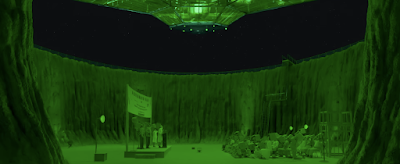
The look and tone is a fine blend of mid-century influences—Western-themed architecture and vintage technologies and designs and non-stop cowboy folk songs wafting over the town’s radios—and reflexively playful about the kinds of melodramas, both abstract and overheated, that a mid-50s writer might conjure. Knowledgeable audiences might clock the relation to the sandy sunlit widescreen staging of John Sturges’ Bad Day at Black Rock or the Technicolor small-town anxieties in Vincente Minnelli’s Some Came Running, not to mention Thornton Wilder and Samuel Beckett and Tennessee Williams and Arthur Miller and so on. (The town also has a roadrunner who chirps “meep meep,” a fine cartoon wink to foreshadow and top off the drama’s impending dusting of sci-fi elements.) And yet, for all this meta-text, we’re seeing a television special inside reenactments inside a rehearsal inside a production about a fictional town populated by dreamers and actors and schemers and scientists, every layer lost in losses and daydreams, grief and preoccupations. Perhaps an ecstatic peak of all this is when a kid performs a song, and as his classmates and teacher join in the dance, we see they’re being watched on a closed-circuit television. It’s all performances within performances.

Anderson keeps these meta-fictions spinning as an expertly choreographed and brilliantly staged nesting doll of fakery. It layers the colorful whimsy of its central story—the Star Gazers and the locals are soon trapped in town by a bizarre series of events, Close Encounters by way of Buñuel—in fictions and their tellings. It allows the movie to access both the charms of its simply plotted southwestern magical realism and its characters’ aching emotional issues, and the dizzying effort the telling. It gets at fiction itself—stories we’re told and stories we tell—and how we can get lost in it by giving ourselves over to what’s real truth within them—even kitsch, even obscure artful gestures, even when we’re unsure but “keep telling the story.” The film finds all kinds of rituals—religious sentiments, scientific methods, philosophical musings, method acting exercises, military orders, keynote addresses, backstage gossip—and notices with great melancholic empathy we’re all looking for, or clinging to, something that’ll explain our place in the vast mysteries of the universe. We need to find ourselves in the right story.

Although many of Anderson’s prior pictures allow the audience to get totally carried along in a compelling narrative and invested in characters in his controlled style, here he utilizes the grinning delights of his aesthetics of geometrical camera movements and perpendicular staging to make us always aware we’re sitting on the fourth wall. (There are even fleeting eye-contacts with the camera.) And here’s the magic: I still cared, deeply, about the characters at even the deepest levels of the fictions. There are beautiful moments of performance and writing that suddenly bring tears to the eyes with their emotional honesty. Anderson’s ability to suggest with the subtlest shifts and swiftest shimmers of interiority, whole lives behind the eyes, deep wells of regrets and confusion, longing and yearning flowers beautifully. I know I’m watching an actor playing an actor playing a character—the movie reminds us constantly—and yet, suddenly, I’m drawn in by his grief, or her confusion, or his confusion. An actress (Scarlett Johansson) in the story-within-the-story asks to run lines with a new friend and suddenly those lines (a mere half-glimpsed excerpt of another story) are somehow moving, too. It’s marvelous, the entire movie constantly making hairpin shifts between cold cerebral conceit and warm sentiment—committing fully to both and serving the thoughtfulness of each equally. The whole movie is this magic trick only a master filmmaker could pull off. It’s deeply poignant and intelligently articulated, a heady blend of heart and mind. It’s a director delivering a disquisition on his style and its intended effects, that also lands those effects with the very best of them. We’re so lucky to have Wes Anderson telling us these stories as only he can.

Friday, July 9, 2021

Fighting with Her Family: BLACK WIDOW

After a decade spent hanging around the movies of other heroes in the Marvel Cinematic Universe, Black Widow gives Scarlett Johansson's action hero a movie all her own. It’s set between Civil War and Infinity War, but the best part is you don’t really have to know that. The movie is, as far as these things go, pretty self-contained, token Avengers references aside. It’s also smaller and with a bit more of a hard edge to the action; when people fall, they might break a leg, or at least take some ibuprofen and wrap a bandage before bouncing back into the fight. We knew Black Widow is a defector from a secret program of brainwashed women assassins. This story involves her discovery that her old captors (led by a glowering Ray Winstone) are still up to their nasty tricks. To help put a stop to them once and for all, she’s pulled back into the life of her sister (Florence Pugh) and parents, father a Russian super solider (David Harbour) and mother a scientist (Rachel Weisz). That they aren’t her real family, but were a family of Soviet spies given to each other as a cover story and then tearfully separated decades prior, makes this one weird reunion. This emotional spine of betrayal and reconnection gives slightly better than average rooting interest to her endeavors, and a desire to see the group actually find a way to belong to one another again helps to give some small amount of tension to the superheroics that are the inevitable endpoint here.

Because it takes a step back, and finds a potentially complicated globetrotting plot quickly and legibly sketched, there’s room to find nice character moments. The prologue is given over to a scene of childhood happiness torn asunder; later we’ll find room for an awkward family dinner as the years melt away to prickly banter around the table. It’s sweet, especially because the rest of the movie — think The Americans by way of Bourne with sci-fi Marvel touches, a comparison which wouldn’t surprise me to hear was on screenwriters Eric Pearson, Jac Schaeffer and Ned Benson’s cork board — is wall-to-wall action that’s about as good as Marvel can do it. The acrobatics and strategy play out comprehensibly, and the steady escalation of stakes and scale allows it to be the rare MCU property that gets a good climactic workout instead of mere repetitive CG glop. Director Cate Shortland leans into the strengths: the talented stunt team and her excellent cast, who bring satisfying personality to the scenes between chases and flips and kicks. What can I say? I cared about this family. Best in show has to be Florence Pugh, who has great plucky and teasing little-sister energy in her scenes with Johansson, and proves herself adept at navigating a role that’s equal parts comic relief and setup to a new hero we’ll definitely see return. That’s part for the course. But because the movie feels so tight, even at its just-over-two-hours runtime, the familiar never overstays its welcome, and finds a far more satisfying subtext — about autonomy and control — and backstory for Black Widow than what was only hinted before. If we have to have Marvel dominating our discourse and our screens, at least this entry is one of the better ones.

Friday, April 27, 2018

All Superheroes Go To Heaven: AVENGERS: INFINITY WAR


Of all the Marvel Cinematic Universe films so far, the latest, Avengers: Infinity War, is certainly the very loudest. I suppose it has a right to be. Billed as the Series Finale when anyone with a working brain knows it’s merely the biggest Season Finale yet, it’s the culmination of ten years of these things. Ever since Samuel L. Jackson’s Nick Fury stepped out in the post-credits scene of 2008’s relatively compact, swift, and charming Iron Man, promising to introduce that hero to a few others, it’s been an endless string of formulaic origins and meetups. At least the formula – 90 minutes of exposition, banter, and fun with character actors, followed by a 30-minute CGI shooting gallery – remains sturdy enough, and the performances roped in charismatic enough – that it rarely feels too much. They vary in quality. I prefer the looser hangouts where the action has a zing of screwball B-movie appeal (Iron Man 2, Avengers 2, Thor 2, Spider-Man Homecoming) or earnestness (Captain America 1, Black Panther) to the ponderous self-important ones (Captain Americas 2 and 3) with the ones in between tolerable, too. But generally they are completely disposable diversions. I enjoy them, and then they evaporate, leaving only vague impressions and the sense they should bring back Sam Rockwell someday. Infinity War is what all 18 films have built towards, the culmination of many Infinity Gem MacGuffins and Thanos references, as the purple titan himself (voiced with a growl by Josh Brolin, whose likeness stares back at us from soulful computerized eyes) comes crashing down to Earth looking for ultimate power, and two dozen heroes assemble to beat him back. 

This results in apocalyptic sequences as the characters are genuinely frightened for once in the franchise. Their quips pale in comparison to a man wielding an enormous gold gauntlet slowly studded with the glowing powers needed to wipe out half of existence in the snap of his fingers. When a ginormous whirring oval spaceship hovers over New York City, there are ominous stakes as Doctor Strange (Benedict Cumberbatch), Hulk (Mark Ruffalo), and Iron Man (Robert Downey Jr) mix worry into their determination. They all want to defeat Thanos – once they’re caught up on his plan, that is – but aren’t sure how to go about doing it. He’s already one of the galaxy’s most powerful beings, with an evil plot nigh incomprehensible in its universe-wide genocidal scope. What are a bunch of plucky knockabout do-gooders going to do in the face of that? Still, this is a Marvel movie, and the jokes fly fast and frequent, and, as directed by the Russo brothers and scripted by series’ regular writers Christopher Markus and Stephen McFeely, ably balances the tones. It also shuffles a massive cast in interesting ways, letting characters hitherto separated by time and space collide in fun exchanges and tenuous team-ups in bright, clear, IMAX cinematography.

Of course, it doesn’t hurt that it leans on its best features – letting Spider-Man (Tom Holland) earnestly tag along behind Stark and Strange, and ceding all of the film’s galactic plotting to the winning combination of the Guardians of the Galaxy (Chris Pratt, Zoe Saldana, Dave Bautista, et al) and Thor (Chris Hemsworth). (They are the funniest and, funnily enough, the most emotionally engaged, too.) It’s something of a screenwriting and editing marvel (oh, pun not intended, believe me, but now I’m sticking with it anyway) to keep something like 30 major speaking roles – all major players in their respective realms – and a couple different tonal modes balanced to such a successful extent. Part of it is the streamlined plot, subplots carried over mostly shunted to the side due to the enormity of the main dilemma, allowing the characters to focus on one goal. Part of it is giving different pieces of the goal to different smaller team-ups: a cosmic crew, an Earthbound squad (led by Captain America (Chris Evans), Black Widow (Scarlett Johansson), and a stay with T’Challa (Chadwick Boseman) in Wakanda), and one travelling between. It’s perfectly engineered to bounce between these groupings of heroes, giving each and every one a crowd-pleasing entrance and perfectly timed laugh line or action pose throughout.

These performers have a certain iconoclasm to their positioning in the roles by now, and it’s great fun watching them spar and quip and fight side by side. The action is largely satisfying, too. Not quite as deadening as usual, it has heft and design, some cleverness, and some big, booming consequences (that will inevitably be almost or entirely reversed next summer, but are still satisfying shock in the moment). Best of all are the applause-break splash panel moments – my favorite goes to a thrilling late-breaking electric return in the battle royale finale. It may be a big, dumb, violent cartoon, but improbably Marvel Cinematic Universe productions have accumulated affection and accrued pleasures that outweigh any individual film’s successes and flaws. It’s a high-budget, high-spirit corporate product. It’s blockbuster serialized filmmaking, a massive sporadic television production on the big screen. The only gamble is that we’ll want to see our favorite charming superhero buddies pummeled and bloodied and beaten down to their lowest point yet, and still clamor to see them bounce back again, and again, and again. As long as the movies are this passably satisfying, agreeably diverting, and leave the audience just curious enough to see what happens next, they will. Infinity War, indeed.

Monday, December 26, 2016

Don't You Worry 'bout a SING


Sing is the least you can do to make an inoffensive all-ages animated amusement. It’s not particularly inspired or entertaining, with none of the visual beauty of a Laika or Ghibli, the innovation of a Pixar, or the all-around crowd-pleasing nature of a Disney. Despite a host of celebrity voices and colorful shenanigans, it doesn’t even have a leg up over Trolls, the other recent jukebox karaoke musical comedy aimed at youngsters and the adults who don’t mind taking them to such things. No, Sing doesn’t have higher highs or lower lows, because it’s not trying to do as much. It’s set in a world of animals behaving like people in an expansive metropolis, but hasn’t a tenth of Zootopia’s imagination. It is filled with characters yearning to make something of themselves, but with nary the picture book psychology of an Inside Out. It finds a plucky koala (Matthew McConaughey) throwing a singing competition to save his crumbling theater – Muppets much? – and gathers a menagerie of contestants with individual little dramas and conflicts, but isn’t interested in setting up American Idol suspense. It just wants to live up to its title and sing. That’s it. And so it does.

Totally undemanding, the movie starts out like it’ll be a family friendly Altman picture, swooping around its city to find the characters who’ll be the finalists. There’s a harried hog mother (Reese Witherspoon), soulful gorilla (Taron Egerton), moody porcupine (Scarlett Johansson), sleazy rat (Seth MacFarlane), shy elephant (Tori Kelly), sparkling pig (Nick Kroll), and others who fall by the wayside as the big show approaches. That they all have little problems to overcome – stage fright, gambling debts, bad dads, and so on – is par for the course. That none of these issues derail the movie’s genial good spirit and even keel plotting contributes to its blasĂ© sense of anodyne amiability. Some wild cards – a lazy rich sheep (John C. Reilly) whose grandmother (Jennifer Saunders) was once upon a time a theater (or, as she’d pronounce it, “thea-tah”) star – enter the proceedings just to keep churning incident between bobble-headed snippets of pop songs sung loudly and enthusiastically from the mouths of cartoon critters.

The songbook is at least somewhat admirably diverse. Animals sing hits by BeyoncĂ©, Taylor Swift, Van Halen, Frank Sinatra, Nicki Minaj, Elton John, and many, many more. Remember those infomercials for multi-CD sets of “Greatest Hits,” which would reliably end with brief excerpts from songs included while a complete tracklist would scroll by in garish yellow font? That’s how many a child parked in front of the TV would get introduced to earworms of times gone by. (That and the oldies stations were formative instruments of pop knowledge.) So maybe that’s the function Sing will serve in this on-demand age, letting kids hear a broad swath of easy pop listening while their parents smile in recognition at a couple measures of, say, Crazy Town’s “Butterfly.” That we get a plot punctuating abbreviated musical numbers is too bad, as the whole thing grinds to a halt when we need to care that a mammal is cut from the competition due to his excessive flatulence or that another critter in need of money throws a car wash and uses his fur to buff and dry.

There’s really nothing else to it other than bland believe-in-yourself moralizing that’s been done better, and with more conviction, in a dozen other animated family films of the last quarter century. It has a whole colorful animal world that’s been imagined at the level of a particularly underdeveloped picture book, with not even a scrap of the visual ingenuity and clever visual gags of a Zootopia. There’s even a missed opportunity for an exploration of what these real-world singers look like in the parallel animal world. Think of all the puns left for the taking. Diana Sloth. The Beetles. Llama Summers. Weird Al Yak-ovic. Director Garth Jennings (of the decent Hitchhiker’s Guide to the Galaxy from a decade ago) and the team at Illumination (of the Despicable Mes) are content to simply groove on the borrowed charms of fun songs to power their blandly amiable time-waster.

Friday, May 6, 2016

War of Superhero Agression: CAPTAIN AMERICA: CIVIL WAR


Once more we return to the Marvel Cinematic Universe, where an ever expanding roster of superhero Avengers quip and spar and save the world across interlocking franchises and overlapping continuity. Captain America: Civil War is only the latest in this series to expend energy maneuvering the multicolored combatants around while teasing more stories to come. It’s nothing but sequels to a variety of its predecessors – in addition to the third Captain America it operates as Avengers 3 and Iron Man 4 – and setups for its own future entries, plus previews of coming attractions as a variety of new characters and conflicts crowd the screen. All MCU properties do this to some extent, but this one does it the most joylessly, playing out as a grinding plot conveyance system full of sound, motion, and incident, but little in the way of story. Much of grave import is muttered with flashes of dull wit and routine twists between blandly assembled and weirdly small-scale action sequences. And in the end, we’re basically right back where we started.

We pick up shortly after the events of last year’s Avengers: Age of Ultron, a film criticized in some corners for its overstuffed qualities. I found it entertaining, carried over with a light tough by Joss Whedon. He, like Jon Favreau, who had the bright idea to play Iron Man and Iron Man 2 with the pace and charm of fizzy comedy, knew how to juggle the demands of these massive spectacles with something approaching relaxed ease. That’s largely gone here, as Civil War powers forward weighed down with something serious in mind. Captain America (Chris Evans) leads the new Avengers (Scarlett Johansson’s Black Widow, Anthony Mackie’s Falcon, Elizabeth Olsen’s Scarlet Witch, and Paul Bettany’s Vision), who, in an opening action beat, stop a villain, but accidentally blow up some civilians in the process. This is the last straw for many people around the world, so 117 nations sign accords demanding these super-beings be given governmental oversight. I mean, if you saw lawless beings smashing apart buildings to get at supervillains, you might be concerned, too.

When various characters from previous films gather to sit around a table and talk this out, the magic computer man Vision makes a good point. Since the Avengers have been public, calamitous world-threatening events have increased exponentially. Maybe they’re drawing this negative attention. Iron Man (Robert Downey Jr.) agrees, and demands the others sign up to work under government supervision. Cap’s not so sure, and demands he be allowed to stay a free agent. This is the conflict, such as it is, amplified by Cap’s old pal Bucky (Sebastian Stan), the brainwashed supersoldier, who is framed for an explosion that kills several foreign leaders. Cap wants to go outside the law and save Buck to prevent him from taking responsibility for a crime he didn’t commit. Sure, he’s been assassinating and bombing plenty of people for decades, but he didn’t do this one. I get his loyalty to his scrambled friend, but this is some hard logic to follow. It creates one big misunderstanding the Captain and the Iron Man can’t seem to deescalate.

The first forty minutes or so are brisk enough, filled with colorful and loud conflict, as well as some mildly intriguing questions. What’s a superhero’s obligation to society? What happens when doing good means different things to different people? When is intervention more dangerous than helpful? There’s a certain amount of superhero melodrama as various players line up on different sides of the issue, straining relationships and casting doubt on tenuous friendships. But the whole operation grows monotonous as characters exchange increasingly hollow barbs, taking the whole thing Very Seriously even as we know the eventual fighting won’t be too consequential. There are too many sequels and spin-offs that need them. By the time we’ve been introduced to Black Panther (Chadwick Boseman) and Spider-Man (Tom Holland) – pausing for extended sample scenes for their forthcoming features – it’s easy to know the Civil War will be more like a scrimmage, everyone simply stretching their powers before their next solo outings.

Directors Anthony and Joe Russo, sitcom vets who helmed the last Cap, keep things brightly lit and blandly staged, pulling up tight on good actors, some more invested than others, trying to put real feeling in phony dialogue and then bouncing into action that’s a jumble of frenzied editing and blurry effects. Curiously small – only a few brawls and a chase or two – for running well over two hours, it’s a movie with elaborate hand-to-hand choreography (John Wick’s directors worked second unit) photographed with shaking, swooping cameras cut together to often deemphasize the impact. Sure we have War Machine (Don Cheadle) and Hawkeye (Jeremy Renner) and Ant Man (Paul Rudd) and the rest lining up to show off their moves, throwing balls of light and color at each other in ways that fleetingly resemble cool comic panels – Spidey crawling over a giant’s mask; Vision shooting light from the jewel in his forehead; Ant Man shrinking and enlarging. But there’s nothing here to get invested in. It’s just not the sort of movie that’ll allow its major figures to hurt one another, not when their hurt feelings animate only this slapstick-adjacent goof-around scuffle on the way to tearful revelations. It’s tediously busy.

With nods – more like thin posturing – to serious disagreement tossed aside in favor of colorful action and bad quips, the screenplay by series regulars Christopher Markus and Stephen McFeely cops out by making it all about personal grudges. Instead of actually engaging with intriguing inciting ideas about power and authority, it becomes digital shadowboxing drawn out between endless empty rounds of the kind of double-talking political Rorschach test corporate spectacles are best at. The Marvel machinery can’t afford dislike of these characters, and unconvincingly lets the ones in the wrong off the hook. After a poorly developed plotter (Daniel Bruhl), I’d call Captain America the closest thing this movie has to an antagonist, pushing along the conflict by refusing to accept responsibility for his actions, but this sure isn’t the movie willing to take a stance like that. He embodies the movie’s fight against consequences and for the status quo, demanding we care about morality of hero work and then distracting us with so much movement marking time we’re to forget they ever brought it up, let alone fail to resolve it in any way. It’s all left dangling, just a big prelude for the next one, and the next, and the next.

Friday, April 15, 2016

Man Cub's Burden: THE JUNGLE BOOK


Disney’s latest attempt to transmogrify one of their animated classics into a live-action spectacle is The Jungle Book. This production takes their 1967 Rudyard Kipling adaptation, a simple, rambling, musical story, down to its bare necessities, building it back up into a pleasant jungle adventure. In the process it loses most of the cartoony energy and all but hints of two songs. But some of what it loses in vibrant animated silliness it gains in the weight and heft of the best imitation wilderness money can buy. It’s CGI made with an eye for live-action, computer animated with a real boy running through. The amiable feature tracks along leafy green oasis and rocky cliff, swampy waterhole and cavernous ruin, getting undemanding picture book tableau out of every development. It’s high-stakes and kid-friendly, a child’s eye view of the jungle as a place where, if you believe in yourself, you’ll survive just fine with the help of your animal friends.

In this jungle-as-playground we meet Mowgli, the kid who was found abandoned as a baby and raised by a pack of wolves. He’s played by newcomer Neel Sethi, an agreeable boy who seems to enjoy scampering about the scenery and speaking to the animals who growl and howl around him. (He also doesn’t mind wearing only red shorts, the traditional garb of the Jungle Boy, from Bomba on down. Nice of the animal parents to understand the need for pants.) He’s enjoying life as a wolf, playing with pups and looking up to his canine parents (Lupita Nyong’o and Giancarlo Esposito). Alas, the menacing tiger Shere Khan (Idris Elba) knows the danger man poses and demands Mowgli be killed for the good of all jungle kind. This leads wise panther Bagheera (Ben Kingsley) to decide the best option is taking the man cub to be safely reunited with his own kind. There’s not much to it, the characters filled in by typecasting and cultural memories, but the movie has a sturdy construction on which to build its digital sights.

What follows is a trip through beautifully fake scenery, with towering waterfalls and sun-dappled trees, swinging vines and staggering vistas. It’s as much like a jungle as a greenscreen stage in downtown L.A. can be these days. Top-notch effects work creates an often-convincing vision, fitting a movie that’s content to poke along through episodic little vignettes enjoying the company of a variety of animals. The creatures Mowgli encounters will be familiar to anyone who knows Disney’s original. Screenwriter Justin Marks makes sure to include the expected cast of characters, some voiceless (elephants, birds), others voiced capably by recognizable performers, like sneaky snake Kaa (Scarlett Johansson, slithery seduction), sweet lazy bear Baloo (Bill Murray, warm and loveable), and the envious orangutan King Louie (Christopher Walken, making eerie musical use of his usual unusual punctuation). Every majestic creature – a menagerie that would barely look out of place in a motion-capture Planet of the Apes – is animated with uncanny accuracy and remarkably authentic textures, real enough to pull off the illusion, but fake enough to not scare too many kids.

Director Jon Favreau is a good fit for this sort of film. Think of his work on Christmassy Elf, sci-fi board-game trip Zathura, and kicking off the Marvel Cinematic Universe with two Iron Mans. He knows his way around bright, clean, clear popcorn imagery, bringing a fine workmanlike competence to the spectacle that works because he believes in the movie magic of his effects and has the cast and crew to pull it off. There is some real majesty to its best moments, and at its worst a sense of predetermined comfort. We know where we’re going, but the way there is reasonably entertaining. There are primal fable-like qualities to the images of an innocent boy standing next to these dangerous beasts and finding his way to be their equal. It’s not a story of man conquering the flora and fauna, but becoming a part of them, an age-old scamper-through-the-wilderness-to-find-yourself tale.

Favreau realizes the Kipling tale’s cinematic heritage as a red-blooded boy’s adventure story, eager to admire the beauty of its setting and creatures so cheerfully faked for our amusement. It may take direct inspiration from Disney’s own classic in story, character, and music cues, but it’s as indebted to the Kordas’ Technicolor 1942 version, or Stephen Sommers’ 1994 pulpier-ish iteration. It’s always about giving a man cub a fantastical place in the natural spectacle of nature, to play with danger and emerge safe and sound. Favreau concludes his Mowgli’s story with appealing lessons about standing up for what you believe in, using your talents to protect others, and being proud of becoming your best self. Though it is interesting to note where the boy ends up. This isn’t a story about emerging from the wilderness to become a man, but engineering a way to remain boyish forever. Seems a fitting message for a company that hopes we’ll keep paying to see new versions of old childhood staples.

Friday, February 5, 2016

No Business Like Show Business: HAIL, CAESAR!


There’s a zen saying that suggests, “The most dangerous thing in the world is to think you understand something.” This could be a good description for the outlook of any Coen brothers’ film, works invested in ambiguities and absurdities of human lives as reflected in the worldviews and systems that control them. One man’s belief is another man’s mystery, and Joel and Ethan Coen have made a career out of stories of existential crises told through oddball humor and offbeat suspense. Their latest is Hail, Caesar!, a film full of people who think they understand, having figured out deep reverence for some larger ideological force or another: the Bible, Das Kapital, Hollywood’s studio system. But where does that certainty get them? It’s the early 1950s, and a studio fixer (Josh Brolin) is heading into a day that’ll be full of complications to test many a person’s certainties, a straight-faced screwball panic, or maybe philosophical wrestling on laughing gas. Either way it’s a pip, but with typical Coen precision and deliberateness.

Sustained goofing on classic Hollywood, a day-in-the-life on the backlot not too far removed from Don Lockwood and Lina Lamont’s, the Coens follow Brolin’s studio suit from set to set wrangling stars, quelling complaints, and staving off controversy. The fictional Capitol Pictures is hard at work on several movies: a bathing beauty musical, a wordy melodrama, a dancing sailors movie, a singing cowboy picture, and a Biblical epic. Bopping between the films in progress we’re presented with a great imitation of Hollywood iconography: a little Robert Taylor here, some Esther Williams there, with Gene Kelly, Roy Rodgers, and others thrown in for good measure. It’s like a bleary Turner Classic Movies binge if you kept passing out and dreaming ridiculous connective behind-the-scenes tissue between disparate films. The Coens have fun conjuring up winking nods to historical references points, and mimicking the style of 50’s filmmaking. (Lap dissolves, rear projection, matte paintings and more show up.) It’s in love with its pastiche, but has enough distance to maintain an aloof absurdism.

Between fun sketches of films within the film we’re treated to a stew of behind-the-scenes silliness, wacky shenanigans that find increasingly offbeat expression on their way to some head-scratching conclusions. (“Accept the mystery,” as a character from the Coen’s great, maybe greatest, work A Serious Man might say.) Hail, Caesar! is set in motion when work on said Biblical epic is thrown into jeopardy when its star (played with daffy blockheaded charm by George Clooney) is kidnapped by two devious extras intent on delivering him to a clandestine meeting of Hollywood subversives in Malibu. This is, of course, the day’s biggest problem for Brolin’s harried studio middleman, who’s fielding a job offer from an aircraft manufacture, but can’t quite shake the fun of all this show business. He tries to keep the story quiet, even as ransom notes show up and there’s a dozen other problems needing his attention. Who ever said his job was easy?

This is the Coen’s fizziest man-on-the-verge-of-a-nervous-breakdown story, like the better, more downbeat, though still plenty funny, Barton Fink or Serious Man or Inside Llewyn Davis played in a major key. Brolin scurries around dealing with an unmarried ingĂ©nue (Scarlett Johansson) whose pregnancy is a problem for her innocent image, a Western star (Alden Ehrenreich) who is an awkward fit for a drawing room drama by a fancy director (Ralph Fiennes), and competitive twin gossip columnists (Tilda Swinton) sniffing around the smell of scandal. A host of studio employees (played by the likes of Channing Tatum, Clancy Brown, Wayne Knight, and Frances McDormand, to name a few) scramble through the story, most getting a few amusing moments bouncing off Brolin’s clench-jawed determination. He’s grinding through the day, keeping total calamity at bay. Sure, a job overseeing airplane factories would be easier, but wouldn’t he miss the fun of racing around Los Angeles, dealing with all the kooks and their crisises?

In its meandering way, Hail, Caesar! takes the usual Coen delight in dialogue, peculiar turns of phrase, droll patter, looping repetition, dry sarcasm, airy eccentricities, and narrative dead-ends and cul-de-sacs. And all this, of course, serves only to reveal characters dancing over the deep abyss of uncertainty. Like a softer version of what their sharply cynical Burn After Reading did to the espionage game – turning paranoid thriller mechanics on their ear to amplify the absurdity and the impossibility of “making sense” – this film asks if cinema – with all its egos, pretentions, and petty gossip – is serious business. The answer is: not really. Show business is cut from some deeply silly cloth. But it’s no better than anyone else who claims to be doing important work – a priest, a rabbi, a pawn of the military-industrial complex, a studio stooge, a Communist. That round-up sounds like a cast list for a great joke, and that’s what the Coens try for here, staging scenes in which all the above, and more too, make themselves out to be figures of fun when they take themselves too seriously.

The film often feels slight, busy goofing around, doodling with silly details and funny performances, Roger Deakins’ brightly lit, primary color-popping cinematography letting wacky backstage antics and a variety of movie genres bleed off the backlot and into conversation with one another. But it picks up weight as it punctures windbags’ hot air and scoffs at those who are too sure they have the perfect understanding of anything – history, economics, politics, morality, you name it. Everyone’s spinning their own stories about how the world works, but their boats are easily rocked. Shouldn’t there always be room for doubt, like an actor delivering a passionate speech, but forgetting his closing line? The movies, this film seems to say, may be frivolous gossamer illusions, but isn’t anything we cling to in order to make sense of our lives? If we’re going to lose ourselves in soothing fictions, it may as well come from dazzling Technicolor fantasies lighting up the silver screen.