Showing posts with label David Cronenberg. Show all posts

Friday, August 8, 2025

Separate Ways: TOGETHER and THE SHROUDS

Together is a gnarly little horror movie that emerges like a growth out of a simple relationship drama. It’s about a couple who’ve been dating for five years. Their move from the city to the country might induce a breakup. But that’d be pretty messy given all the entanglements that develop over so long living in each other’s lives. The horror springs up when it literalizes the idea that these two people might find it difficult to pull away and separate. It stars Alison Brie and Dave Franco, actual married actors, as the long-term couple. As such they have the sort of easy rapport that shows a total comfort with one another as they portray people who’ve started to take each other for granted. Brie plays the one who took a job that necessitated the move; Franco’s trying to make an idling career in music kick into another gear and laments leaving theoretical opportunity. She suggests they break up before they move or else it’ll hurt more later. (How right she is.) He dismisses the suggestion, shrugging off resentment we know is brewing under his increasingly strained grins as they move in.

Writer-director Michael Shanks, in his first feature, has a fine sense of atmosphere, letting their new little house in the woods become a reason for them to heighten the tension of the cracks forming in their relationship. And then there’s a paranormal thing in the woods that they come into contact with and suddenly, when they touch, it’s more and more difficult to pull apart. Hence the title. There’s are some fine cringing moments of sticky makeup and squishy Foley sound effects as the skin on their legs or arms (and even more uncomfortable parts) pull and stretch, increasingly strained as they rip apart. The trajectory of this logic is pretty clear once we get a fun sliding contortion scene where their bodies are literally drawn closer from across a hallway as they desperately try to grab hold of door frames and furniture. As a picture of a reluctantly co-dependent relationship that’s become a ’til-death situation whether they wanted that or not, it has its potent moments and crescendoes effectively. It also has a few moments where characters behave irrationally for plot purposes, and indulges some (hopefully accidental) nasty stereotypes in its suspicious neighbor character. That's all in service of an ending that’s satisfying in theory, but pretty underwhelming in execution. It may not ultimately know what it’s doing with its metaphor, but the vivid visuals are enough to keep it interesting right up until it’s not. 

David Cronenberg’s body horror movies never have that problem. In the likes of Videodrome and The Fly and Dead Ringers and eXistenZ and Crimes of the Future, he’ll follow a neatly nasty metaphor’s oozing and spattering with easy jolts and deep chills to its logical protrusions. He’s a master at the unsettling and the uncanny, looking at the fragility of the human body, penetrating the mysteries of life with keen psychology and a brave, unflinching look at physical and mental states of disrepair. Not to be too morbid, though I’m sure he won’t mind morbid, it’s worth mentioning that he’s at the age where every new movie might be his last. His latest, The Shrouds, is a work of such bone-deep grief and unshakable melancholic mortality that you’d surely pick up on its easy late style even if you didn’t know it was made by an 82-year-old. The movie stars Vincent Cassel as an entrepreneur who is an owner of a new style cemetery. His signature invention is a burial shroud weighed down with high-tech sensors that allow mourners to live stream the corpse. His wife is in one of the graves, and he shows her off to a date. The living woman’s expecting to see an old picture and is visibly disturbed in the background of a shot as, in the foreground, he pulls up an image of decaying skeletal remains. He obsessively zooms in and rotates the image, inspecting his late wife’s bones. He can’t look away, clinging all the more tightly the more she’s gone. 

Here’s a movie that literalizes a most painful aspect of a long-term relationship: how difficult it is to permanently lose the presence of a person whose life, and whose body, was joined with yours. We watch a man who has never emerged from mourning, watching as his wife quite literally fades away piece by piece. It’s unsettling, and in its exaggeration, painfully understandable. Cronenberg extrapolates upon this pain in his typical clinical style, staring straightforwardly into the plot’s complications with cold observational frames and a steady metronomic pacing that grows icily nightmarish. We get dream flashbacks to the wife (Diane Kruger) as she undergoes cancer treatments, showing up as a fleshy specter gaining stitches and losing limbs with each appearance. Kruger also plays the woman’s living twin sister, married to a frazzled programmer (Guy Pearce). The story soon encompasses gravestone vandals, a potential Chinese hacker conspiracy, eerie A.I. personal assistants, and a Hungarian tycoon’s blind wife (Sandrine Holt) who starts an affair with Cassel. It all clicks together with a chilly illogic, watching bodies and considering what we do with them, alive or dead. Where, then, is the soul, and the mind, as the body fails and exposes its fatal weaknesses? Cronenberg’s movie is so self-reflective and retrospective that it can’t help but echo back across his filmography’s pustules and decay and find another dark mirror on which to ruminate, all signposts and signifiers, an austere headstone to a auteur’s master thesis about human persistence and cold inevitabilities. 

Sunday, June 5, 2022

Body Talk: MEN and CRIMES OF THE FUTURE

Screenwriter Alex Garland is steadily building a directorial career of high concept genre projects interested in showing misogyny as a social prison we desperately need to escape. There’s the tech bro compounds in Ex Machina and Devs, and the lonely toxic wilderness of Annihilation, all twisted around a need to control and objectify and watch as the victims either are subsumed or seek revenge. Chilling stuff. His latest goes one step further into making his meaning quite literal. It’s called Men. Enough said, right? It starts with a woman in mourning. She asked her husband for a divorce and he almost immediately jumped to his death. A shocking start to a movie, to say the least. She (Jessie Buckley) is off to the countryside, where she’s rented a house in a tiny village. She’s going to be by herself a while and recover. That’s the plan, anyway. Alas, the village is seemingly entirely populated by creepy men of one sort (insinuating landlord) or another (unctuous priest) or another (bratty teen) or another (naked drifter). She encounters them (all played by Rory Kinnear in a procession of wigs) one after another. This is not the trip she needs. Garland makes good use of the rural quiet and empty natural spaces. When a silhouette suddenly stands at the end of a tunnel and runs toward our lead—and us—it’s frightening. Same when the nude drifter is suddenly lurking behind her, peering unnoticed in a picture window, or when the priest somberly listens to her testimony of trauma and priggishly asks: you must ask, why you made your husband kill himself? Yikes.

The tension builds until a long, gory, completely fantastical climax. Here Garland’s tight, atmospheric little horror movie nosedives into allegory its metaphorical scaffolding can’t support. There are three great shivers-up-the-spine moments, but then it becomes a morass of soupy, bloody imagery that stretches itself in an elaborate symbolic gesture that makes a rather simple point early and often. It’s not difficult to clock its pseudo-religious folk horror intensions from the start. What happened to her husband? A fallen man. What does she do when she arrives at her rental home? Eats an apple from the tree. She’s surrounded by verdant garden imagery. So it’s a movie about sin and consequences, who begets them and who gets blame. I like all of that, but Garland never gets any deeper than the peel, leaving the core untouched. Once we’ve gotten the sense of Buckley’s emotional state, an impressively on-edge performance, and seen an increasingly unsettling creepiness in every encounter—both overtly upsetting and sinister underlying subtext—the ground is set for a fascinating freak out. Instead, Garland only provides a tedious unfolding of symbolism that’s, by the end, somehow both easy and inscrutable, as one toxic man births another and another and so on until the end of time. And then woman inherits the earth.
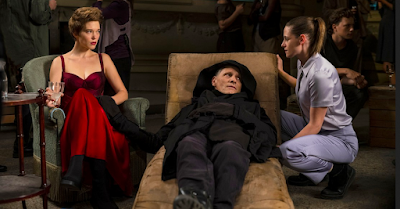
Leave it to David Cronenberg to make the truly upsetting, and atypical, horror movie of the moment, all the more unsettled for playing like a gross drama, never stretching for obvious scares. He hasn’t made a film in nearly a decade, and not one so overtly engaged with the body horror of The Fly or Videodrome for longer than that. This new work is a relaxed and confident idiosyncratic vision, an old master showing us how it’s done. Crimes of the Future is a sickly melancholy movie that looks about at our current states, imagines a dim, dirty, empty future, and feels queasy. We’re evolving to survive on trash, to digest garbage and call it sustainable sustenance. That’s quite a provocative thesis for this fascinating and disgusting movie, a picture of bodies in revolt, and revolting bodies cut open. In this future world, humankind has stopped feeling pain. This has led to surgery becoming a form of entertainment—“Surgery is the new sex,” one fan purrs—with performance artists willingly getting outré and novel plastic surgeries—new gills and folds and flaps and ridges—for the benefit of appreciative audiences. One scantily clad man whose body is covered in decorative ears dancing somberly to pounding club beats in a dank basement proscenium is typical of this new art scene. We meet characters who propose to shock people with an autopsy, and others who fear what all this messing with physiology might mean for human evolution. Either way, it’s a grim vision of attempting to control others’ bodies, and one’s own, and the futility of it in the face of biological inevitabilities and vulnerabilities. Maybe society is as doomed to decay as we are? How grim.

The best of the bunch in this future art scene is a performance artist (Viggo Mortensen) who is literally growing new and unusual organs inside his body, and then his surgeon (Léa Seydoux) cuts them out on stage. What an act! The surgeries, of course, happen without anesthetic, and with the use of a complicated mechanical sarcophagus that’s full of intestine-like wiring and run with a fleshy remote. The reception afterwards features the organ of the day on display. It gives new meaning to the typical artist small talk: so, what are you working on? It’s not difficult to see this as metaphor for Cronenberg himself—a master at contorting the human body for his horror films, here confronting the material that made his name, wondering if he has it in him to pull another out for our amusement. Mortensen grunts and coughs and moans, staggers and limps, is clad in black with a hood pulled low in public and a cloth over his mouth. He cuts a figure like one shambling straight out of a Universal monster movie. The sound of a fly buzzing sometimes follows him around—one wonders what this movie smells like. He’s fascinating because he’s not one simple metaphor—he’s an artist gestating new and unusual ideas, ripping himself open for an audience’s judgment; he’s an aging man whose body is changing in uncomfortable ways, a fact over which he has little control; he’s a tortured man who isn’t sure if he should change with the times. He has further entanglements that are unfolded as the movie proceeds, but the core is his artistic and romantic relationship with his surgeon. There’s a queasy scene where they bond, cuddled up, for some mutual self-harm. In a world without pain, what does it mean to feel?

Here’s a film full of rich and puzzling characters—a grieving father with some sick plans (Scott Speedman), a bureaucrat who wants to set up a new organ registry (Don McKellar), his assistant who is twitchily drawn to this underworld (Kristen Stewart). Throughout there’s a sense of a society in flux, fluid definitions of what’s expected and where to go next. All are in some kind of discomfort. Some take pleasure in that state. It’s a film of open wounds and tumorous growths, of slippery internal organs and gooey foodstuffs, of sticky drool and singed skin. It’s a gross world. People buy skeletal chairs that adjust their spines to better digest meals. They gawk in backroom surgery shows. Their bodies are who they are. It’s matter-of-fact, though by the end it’s small comfort to know some sights will still shock them. Cronenberg’s vision here is one of a future driven by this sense of biological change, a world caught mid-shift, where new generations may be inheriting the garbage of their ancestors and irrevocably changed by their bodies’ attempts to process it. What a haunting idea of sins of the old inescapably passed on to the new, physicalized and embodied by the grotesqueries we see. But what hope we find in the beauty of the human body, and its capacity to survive even this. By the end, the story is even edging toward an epiphany—man’s capacity to make peace with his body, and embrace what it needs. The film moves with Cronenberg’s typical icy deliberateness, the better to ruminate on these themes and wonder about these characters. It’s complicated and unresolved, alive to the protrusions and pustules of messy life.

Tuesday, April 14, 2015

Hollywood Endings: MAPS TO THE STARS


David Cronenberg’s name is inextricably tied to body horror. His first couple decades of filmmaking brought us gooey protrusions, sunken orifices, and unholy amalgamations of oozing flesh as bodies betrayed their owners again and again. In The Fly, Jeff Goldblum fused with an insect in a crumbling mutation. In Videodrome and eXistenZ, man and machine melded physiologies, while Dead Ringers and Crash featured close-ups of metal objects later inevitably plunged into human flesh. And in Scanners, heads explode. These memorably disquieting horror images, playing off the fear of our physical being’s fragility and ability to turn against us with disease and disgust, sealed his reputation as a conjurer of disturbing images.

But his last decade of filmmaking has found a larger body to tease apart and catch mid-decay: society. Look at A History of Violence, a gory drama picture about the lingering effects of murder, or Eastern Promises, a grim Euro-thriller about borders between crime and safety, punishment and brutality, or A Dangerous Method, a period piece of mental anguish at the dawn of psychiatry, or Cosmopolis, with a young billionare on a limo drive through an emotionally and economically deadening New York City. In these films Cronenberg finds violence, yes, but also metaphoric putrefying flesh, seeping sickness deep down in the guts of humanity. His clinical eye finds great drama and the darkest comedy in the damage people do to each other. Certainly, our bodies can betray us. But our actions can perpetuate cycles of damage to all those around us. We fail ourselves when we fail each other, parts of a whole, unpredictable and easily broken.

His latest film, Maps to the Stars, has often been mistaken for a Hollywood satire simply because it’s set in Los Angeles amongst a group of industry types who are, to a person, capable of awful behavior unsparingly detailed in bleakly humorous ways. But what else could it be but some kind of societal body horror when we are regarding poison seeping into the culture? The film looks at damaged people scrambling to work out their psychosexual dramas in public for our amusement on our screens. This isn’t satire. It’s a deeply cynical creepy/comic biopsy, turning up exaggerated rot underneath glamorous surfaces. (Or, at least you can only hope it’s exaggerated.) Imagine Altman’s The Player, but darker, ruder, more lacerating in its oddball effects.

Characters include: an aging actress (Julianne Moore), a hack self-help guru (John Cusack), his stunted teen star son (Evan Bird), the boy’s terse mom (Olivia Williams), a meek chauffer (Robert Pattinson), and a mysterious burn victim (Mia Wasikowska) who arrives on a bus from far away, determined to make it in Tinseltown. They cross paths, some victims of the same tangled tragic backstories (arson, abuse, addiction), others on the precipice of fresh tragedy (mistakes, murders, and Machiavels). Speaking in dryly, believably ridiculous dialogue from screenwriter Bruce Wagner, these people behave like shambling showbiz types, selfish, rapacious id-driven beings. They’ll screw or screw over anyone they care to, while yearning in vain for something to bring meaning to their lives.

Under an intense California sun, Peter Suschitzky’s cinematography so bright it’s practically scorching, performances move with a hollowed-out quality. The guru appears exhausted in his TV appearances, Cusack playing him as a man who doesn’t believe what he’s selling anymore, if he ever did. The middle-aged actress is scrambling to stop falling back down the industry ladder, grasping for a role made famous by her long-dead abusive movie star mother (Sarah Gadon). Moore’s performance is a tightrope walk of vanity and desperation, playing a character at once tragically damaged, overwhelmingly insecure, and monstrously shortsighted, hilarious and heartbreaking. A different sort of heartbreak is the teen star. He has a flat affect common to anyone his age, but his dull gaze shows a boy who has already been to rehab, has access to temptations everywhere, and who thinks he sees ghosts. Perhaps he does.

The characters are running from haunted pasts, with apparitions real, imagined, or half-remembered returning to mock their emptiness. It informs their current pain. They’ve achieved some level of material success, and yet can’t shake memories of and impulses towards abusive behaviors, deceit, addiction, and insanity. The most eerily self-possessed among these desperate people is Wasikowska’s creepy spin on the ingénue role. She drifts into entry-level jobs, interacts with these supposed stars with a calm sense of destiny. She’s moved by prophecy, a sense of inevitable destruction she’ll embrace by film’s end. This confident madness brings out the madness in others, especially as we learn the full extent of her unexpected connections to them. At every step, under Cronenberg’s rigorously sinister sense of humor, the ensemble plays out wickedly funny, unsparingly unsettling sadness, warped, specific, and yet recognizable.

Tuesday, March 27, 2012

Talking it Out: A DANGEROUS METHOD


In A Dangerous Method, Carl Jung (Michael Fassbender) meets Sigmund Freud (Viggo Mortensen). It’s a film as much an academic character study as it is a dramatized clash between crucial differences in the field of psychology just as it was gaining some respect. This is a clinical and, pardon the pun, methodical film, based on a similar play by Christopher Hampton, about intellectual lives spilling over into the personal lives of professional men hiding their passions and their personal and academic foibles. You might not expect such a relationship drama from David Cronenberg, who started his career directing gooey body horror like Scanners and The Fly, but in recent years has turned to icy, brooding, bloody thrillers like A History of Violence and Eastern Promises. But with A Dangerous Method, Cronenberg has made an outwardly composed film about messy psychological interiors, a film in which stillness and silence masks all manner of sins and contradictions, horror in its own interior way.

Expressive psychological horror is found in the character of Sabina Spielrein (Keira Knightley), a mad woman who is carted into Jung’s sanitarium howling and contorting herself, her psychological problems expressing themselves with painful physical movements. The film begins with Jung trying out the “talking cure” on Spielrein, who Knightley provides with great gasping hesitations in her answers, speaking through teeth not clenched, but painfully twisted, her jaw jutting out fearfully far. It’s a raw performance. The path history takes this woman on is a fascinating one; the role she plays in the film, her relationships to the men in question as well as to psychology in general, become more fluid than at first appears possible.

Jung grows fascinated with this patient and feels close to a breakthrough. That’s when he decides to head off to Vienna to meet and consult with the elder statesman of his profession, Freud. In contrast to Knightley’s Spielrein, Fassbender’s Jung is slick and carefully composed. He speaks with a cold clip, even to his wife (Sarah Gadon), a tone that grows suspicious when confronted with a brilliant, but crazy colleague-turned-patient (Vincent Cassel). The first glimmer of passion we see from Jung is when he discusses his work with Freud.

The older man is clearly a kind of mentor figure, maybe even a father figure. Theirs is a helpful, collegial, inquisitive relationship, but one that grows subtly territorial and divergent as the years go by. It’s a relationship upon which all manner of Freudian implications can be read. (I’m sure that’d make Freud happy). Mortensen’s Freud first appears as a bearded delight, a warm and welcoming presence, inviting Jung to share a meal with his family and passing hours discussing their work. (In a rare light touch, the film takes silent notice of the way Freud is always chomping down on a cigar). But Freud nonetheless can grow harsh and judgmental adhering to the infallibility of his own work and to some extent worried about the path forward for the field to which he dedicated his life.

The differences in approach and philosophy between Jung and Freud are well documented, but the small, quiet genius of the film is the way it takes the potentially dry history of psychology and makes it into the stuff of stately period drama, then puts it in the hands of a talented director with a great cast and allows it to grow into something unsettling. At times it errs on the side of stuffy and slow, but this material, fully capable of tipping at any moment into the stuff of moldy docudrama, has instead the kind of tangled emotional undergrowths of quietly compelling cinema.