Sunday, April 12, 2026
Romancing Atone: YOU, ME & TUSCANY and THE DRAMA
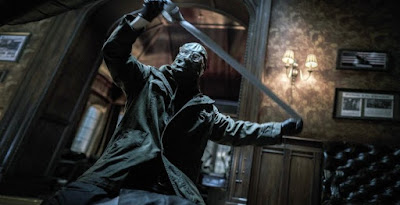
Kristoffer Borgli’s The Drama is also technically a romantic comedy, insofar as it is about romance and has a consistently percolating sense of humor bubbling over into hugely funny moments. But to call it a rom-com would lead potential viewers astray. For all its surface gloss and handsome New York apartments, this is a spiky, prickly movie about a relationship on the brink of marriage and the precipice of disaster. It’s the week of the wedding and the happy couple are given a trust exercise. Name the worst thing you’ve ever done. Big mistake. Robert Pattinson’s flustered Brit — he’s giving 90’s Hugh Grant — becomes slightly, slowly, then all at once undone by the admission of his fiancé (Zendaya). I shan’t spoil her answer, but it’s worth mentioning the movie’s tricky tone and prankish social satire comes out of the sheer liability of the leads and the jolt of electric discourse that their confessions inspire. The movie smirks as it watches others with comparable, or worse, behaviors get sanctimonious, and as it finds characters asking if you can ever really know another person. Here’s a movie about the baggage everyone carries, and how difficult it can be to open it up for someone, even the closest someones, knowing that you’re risking judgment. And, if you’re getting married, you know their baggage will be weighing you down, too. It allows scenes of usual pre-marriage jitters to compound the stress through squirming social situations and escalating psychological sweatiness. The movie’s a sly conversation starter like that, tossing up awkward behaviors and philosophical posturing and watching as the characters flail to get back to a livable normal. Let he who is without sin cast the first stone.
Sunday, February 25, 2024
Borne Back Ceaselessly: TENET (70mm Re-Release)
After my initial viewing I wrote: In Christopher Nolan’s Tenet, backwards run sequences until the mind reels. It’s a time travel thriller, but not like you’re thinking. It’s about a magic box that can reverse the chronology of an item—or a person. Reverse entropy, they say. Inversion. The plot concerns a secret agent (John David Washington) recruited to stop a snarling Russian arms dealer (Kenneth Branagh) from reversing the flow of time for the entire universe. That’d destroy everything, one reluctant ally (Elizabeth Debicki) is told simply and slowly. She considers it for a moment and solemnly intones: “including my son.”
Yeah, that line’s still a clunker. But on a second viewing—and one on such a massive scale—it gets swallowed up in the massive machinery of the thing. I almost felt it as a small pang of the personal in the middle of the impersonal grinding inevitabilities of societal collapse.
When first reacting to Tenet I wrote that it’s “simultaneously one of Nolan’s most logistically jaw-dropping and emotionally flimsiest.” I don’t agree with my past self’s math there. If anything the logistically jaw-dropping elements are even more apparent, stark and enveloping. Here it’s…all go-go-go M.C. Escher timeline. Cause and effect are ruptured in boggling ways. There are stunts and combat and strategizing, with some elements of the action behaving unusually: a bullet hole filling up as the ordnance flies back into the barrel; tumbling fisticuffs that cartwheel with unnatural grace as one combatant flies backwards when they should be ahead; a car zipping the wrong way through traffic after rolling back over from a crash, windows reconstructing as tires squeal in reverse.
This time, rather than straining against what I once took as the flimsy strains of emotionality within, I now found myself drug into the undertow of the sensation of all that dazzling craftsmanship and felt the animating melancholy under that surface chill. And the cool logic of its time travel convolutions are all the more compelling for the intuitive logic of it all. Why did I, along with the common critical refrain of late 2020, insist that the movie is convoluted or confusing? Maybe it just takes a second look to smooth out those wrinkles. The movie is nothing but logical, laid out on clear time travel tracks that need just a bit of mental energy to sort out—a bit of story problem graphing in the margins of your mind as the car chases and shoot outs rattle your senses.
…there are agents rappelling up a building or spinning a sailboat or crashing a plane or maneuvering through a series or airtight vaults or hanging off the side of a moving firetruck to hop between cars. That’s all thrilling stuff.
And within that logic, there’s that buried emotional core, contained in a glimpse of a future you’s freedom leaping into the ocean, or the hint of a beautiful friendship that may be ending with a violent abrupt foreshortening in the present, but the future will fill in the past. I found myself curiously moved by the movie’s consequences—rending cause and effect with regret, only to be joined again my the insistence of the montage, and its characters’ motivations.
I came away from a first viewing with sheer admiration for its construction, its impressive scope, its grounding sense of tactile reality even as the effects slip sense away. This time, the sense was present. It’s perfect movie sense, one image and sound after the next building a persuasive fantasy vision of a twilight world, where time’s running out, and where the future grows dim but for the valiant efforts of those who hold out that dim distant flicker of hope. It’s strikingly photographed globetrotting, with the hero and his partner in spies (Robert Pattinson) dashing and capable in slick suits and big action beats. The pounding score and booming bass has a pavlovian effect—it’s exciting, and kicks up the energy of seeing a great Christopher Nolan movie… The me of 2020, with all the sociopolitical anxieties that assumes, and the lonely, isolated, individual TV viewing it implies, doubted it was a great Nolan film. The 2024 me, back in the world, in a crowded theater, before an enormous screen, and surrounded by massive sound, is sure it actually is. I felt like I met myself in the middle distance between then and now, on my way back to realize it then.
Friday, March 11, 2022
Dark City: THE BATMAN
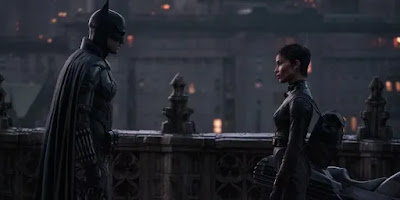
There’s something pessimistic at the core of this hero. When talking DC’s icons, Superman is what we hope America can be. Batman is who we fear America is. No high-flying truth and justice here. Bruce Wayne and his alter ego can suit up and punch villains every night, but the sad truth of capitalist corruption and crime—a city where the cops and robbers are often one and the same, and everyone from the Mayor to the District Attorney to the mob bosses are all part of the same pool of dark money and influence—just won’t budge. So Reeves, an intelligent big budget filmmaker coming off of two interestingly textured and thoughtful Planet of the Apes pictures, visualizes these ideas by making his Gotham constantly overcast, usually raining, generally nocturnal. (It has to be a close cousin to the unnamed city in Fincher’s compellingly gross serial killer thriller Se7en.) There’s always a cloud hanging over the scenes, and the slow, patient drip of detective information about the central mystery takes precedence over slam-bang action. That makes the one fun car chase all the more thrilling, a welcome sparking rattling roar of an engine revving to life as the Batmobile makes its long-awaited appearance tearing off after a slimy bad guy. And it leaves the proceedings to move at a steady trudge, resisting the usual fanfare. To its credit, this downbeat affair that creaks by at a long three-hour run time, is trying for something genuinely wiggly and unsettling in the middle of so much iconography and cliche.
The whole thing kicks off with the murder of the mayor by a mysterious killer known only as The Riddler (Paul Dano). More victims follow. At each, he’s recording viral videos and leaving taunting clues in greeting cards at the scene for lead detective Gordon (Jeffrey Wright) to give to The Batman. Together, the two men hunt for clues and chase down leads. Sometimes they cross paths with a slinky nightclub waitress Selina Kyle (Zoe Kravitz), whose cat burglar outfit is the best since Pfeiffer’s. She has her own reasons to investigate the goings-on at a club run by the town’s top gangster (John Turturro) and his waddling underling (Colin Farrell buried in a fat suit). Reeves leans into the tight-lipped pathos of these pathetic, wounded characters creeping around the shadows of society, looking for leverage over each other in an attempt to make things a little brighter by any means necessary. Unlike the usual comic book dichotomy—or pat mirroring that leads villains to the inevitable “we’re two sides of the same coin” monologuing—this movie makes clear that everyone’s inevitably shaped by societal forces beyond their control. Batman, Catwoman, The Riddler, Detective Gordon—all are willing to bend rules and skulk around to reshape Gotham toward their ends, some for slightly better, some for way worse. There’s never a sense anyone will actually unambiguously triumph. Michael Giacchino’s pounding score takes that cue, edging along Elfman horns while plucking some “Tubular Bells.”
Here’s a city possessed with an urban rot that no one can escape. This makes for a brooding, brutal, cynical, ice-cold, paranoid and conspiratorial picture. It’s not fun, exactly, but from its opening montage of vandals and muggers spooked by the sight of the Bat-signal in the sky, to an ending where Gotham is significantly worse off than before the movie started, there’s a grimly compelling fatalism that gets its hooks in, even as the plot dwindles to a hesitant close. It’s all of a piece—a mumbled noir narration, a dimly fuzzy filmic-by-way-of-digital-and-back-again look, a sumptuously gaunt color palate, a murmuring collection of careful performances, a superhero movie that resists the overfamiliar spectacular climaxes we’ve come to expect. Like Pattinson’s sunken performance—a rare Wayne that’s not even a little sparkling—The Batman is obsessive, haunting, and unresolved. Sure, that’s partly the usual superhero move of making one feel like a first entry is so much prologue for promised future story. (And, sure, I’ll take another one with this cast and vibe.) But here that lack of resolution has tonal and thematic sense, too. Gotham, as we’ve long known, has deeply rooted systematic problems. No wonder its citizens, good and bad alike, are going mad. Who can relate?
Friday, December 18, 2020
Hello, I Must Be Going: TENET
It’s a film that surprises and exhausts in equal measure. There are those wild visual flourishes, so convincingly done — although it did, on occasion, remind me of Bob Saget’s America’s Funniest Home Videos doing fun rewind montages — I barely could process them, but appreciated their effective crescendos. Elsewhere there are agents rappelling up a building or spinning a sailboat or crashing a plane or maneuvering through a series or airtight vaults or hanging off the side of a moving firetruck to hop between cars. That’s all thrilling stuff. Would that there was any reason to hold onto the inventiveness other than sheer admiration for its construction, its impressive scope, its grounding sense of tactile reality even as the effects slip sense away. When you get past the scrambled visual conceits, the movie underneath is too straightforward to care about overmuch. There’s the protagonist and antagonist, sparsely characterized, fighting over a MacGuffin. It’s strikingly photographed globetrotting, with the hero and his partner in spies (Robert Pattinson) dashing and capable in slick suits and big action beats. The pounding score, booming bass, and enormous images have a Pavlovian effect—it’s exciting, and kicks up the energy of seeing a great Christopher Nolan movie, even if it doesn’t exactly reach those heights. By the ramp up to the enormous climactic action sequence, I was rather worn out. I found myself thinking about how thrilling it was to see Inception a decade back, and could understand why the temptation to make a whole movie out of that one’s hallway fight must’ve been tempting.