Children, as the old song goes, are the future. But that’s not quite the case, right? The children are also now. They exist in the present, too. And yet to see a child is also to see a future, the potential not just for that person’s life, but for humanity itself. This recognition is one that can drift easily into sentimentality, shaving away the uncomfortable elements of childhood into a purity of progress. Far better to also recognize children’s humanity, in all the mess that implies. Tennessee Williams once wrote that kids are “precociously knowing and singularly charming, but not to be counted on for those gifts that arrive by no other way than…experience and contemplation.” (I might quibble with this quote, too, but I’ll get to that later.) Some movies about children try too effortfully to pile on the experience and contemplation. I usually prefer those that more artfully let young lives take their course.
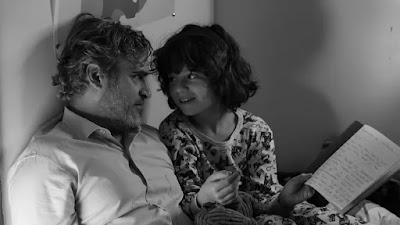
Writer-director Mike Mills tends to understand this. He’s made lovely films about growing into the person you’re always becoming—a short documentary Paperboys; a late-in-life coming-out in Beginners; and his best, 20th Century Women, a deeply-felt 70s’ ensemble piece about a teenage boy and the various influences in his life. His latest is C’mon C’mon and it has the gentle rhythms and tones of an episode of This American Life. It stars Joaquin Phoenix as a cuddly, bearded, well-intentioned New York intellectual out collecting interviews with children for his public radio program. He goes to Detroit, Los Angeles, and New Orleans with his producers finding participants. How do these kids see the world? How do they see their future? Each kid, in a real interview, gives answers that seem honest in their unfussy plainspokenness, though one wonders if they think it’s also what he and his audience wants to hear: parents just don’t understand, the dangers of our world weigh heavily on them, and so on. But Phoenix presents such an open and earnest listener that it’s clear he draws something natural out of them as their subtle interlocutor. They also talk about their dreams and aspirations, and the real difficulties and obstacles in their way. Phoenix warmly guides them toward comfort in these exchanges, promising nothing more than a sympathetic ear.
Into this project arrives his precocious grade-school-aged nephew (Woody Norman), left in his care as the boy’s mother (Gaby Hoffmann) has to see to the institutionalization of the boy’s troubled father (Scoot McNairy). Phoenix clearly loves his nephew and wants what’s best for him. He’s delighted by his creativity and impressed by his thoughtfulness. But he’s also worn down by the daily demands of child care and tending to the emotional needs of a boy still learning how to regulate himself. (He also has some ritualized flights of fancy that can grate on his caretaker.) The movie is patient with both characters, allowing them the space to challenge each other as well as grow in mutual understanding. That makes for a small, delicately crafted movie perched on the same soft-spoken NPR assumption that it’s worth hearing what others have to say. It has not a perspective so much as an attitude, stubbornly sentimental and loaded with references to books and art spoken and shared reverently by its cast of characters. In simply observed black-and-white frames, the film blends documentary and fiction for a small, close story of cross-generational understanding. And in this style it finds a real familial warmth and charge in the scenes between Phoenix and the boy, a tentative and tender forging of meaningful memories in fleeting everyday moments. It doesn’t push to make its child characters beyond-their-years clever, and resists turning anyone into a mere symbol. This can sometimes give the movie a meandering focus. But at its best, it has the observational insight to simply let its performances play out and develop in something close to life-like dimensions.
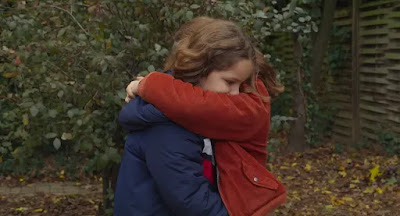
An ever more delicate and mysterious vision of childhood is Céline Sciamma’s Petite Maman. It proceeds like a fragile spell, a magic trick, a fable. And even that doesn’t do justice to the ways in which its fantasy just happens, casually, without fuss, with barely a flicker of the unreal. Sciamma’s films—the observational likes of Water Lilies, Girlhood, and Tomboy forming a triptych of perspectives on formative years in lives of young women—are typically cast in a realist light. Here she uses the same techniques to make a film built entirely out of a high concept, but anyone watching a random clip might never guess it. A little girl goes with her parents to a small house in the woods, the home of her recently deceased grandmother. The adults have the task of cleaning out the place, which gives the kid plenty of time to occupy herself. She wanders off into the yard, through some trees, and arrives at what she thinks is the neighbors’ house, where there’s a little girl her age inviting her to play. There’s something sweet and real about how a child can just make a friend, form a bond, in a blink of a simpatico eye. What a viewer will notice right away is that the girls look suspiciously alike. (They are played by twins, so that explains that.) Their houses, through subtle cues of set design and prop placement, are similar, too. As the girls meet in the woods for playtimes multiple times, it’s clear: the daughter has made friends with her own mother as a child—her petite maman.
One could imagine this twinning time-travel conceit in lesser hands heading for antics or silliness—maybe The Parent Trap by way of Back to the Future. Sure, if done right, that could be fun. But Sciamma approaches this picture with supreme restraint and total straight-faced matter-of-fact seriousness and commitment. She’d understand that Tennessee Williams shortchanged a child’s capacity for contemplation. In the faces of the two girls at the center of this film, she locates all the gentle severity of such an occurrence. As they realize their relationship’s time-bending qualities, they ponder and reflect on what it might mean. The future mother looks into the face of a child she now knows she’ll have, and can learn when, exactly, her own mother will pass away. The younger (if one can call her that) can now see concretely the tangible childlike qualities that surely still sit buried within her mother. Together, though, they just are who they are. Sciamma lets them be, playing politely and sensitively together as little girls can do—tromping through the woods, making plans for little imaginative games and skits, plotting the best way to get a sleepover. There are moments nestled within these quotidian affairs, though, that catch one’s breath in a simple, hushed expression of fantasy cross-generational connection. Typical of its effect is a gift from the future—music played on a pair of headphones we don’t hear, but the girl in the past hearing this unknown song out of time smiles an inscrutable Mona Lisa smile at the sound, a private preview. Most striking, though, is a softly murmured admission from mother to child—I’ve always wanted you. Here’s a movie that appears to do very little—and accomplishes so much. It respects a child’s capacity to take things as they are, and to engage in a sense of wonder that’s perfectly natural—deep thinking taking place in growing minds.
Showing posts with label Gaby Hoffmann. Show all posts
Sunday, December 26, 2021
Wednesday, December 3, 2014
Walkabout: WILD
Wild is a movie
about a troubled woman who sets off by herself and walks over 1,000 miles in three months. It’s a
literal journey of self-discovery. The most admirable aspect of the film made
out of this trip is its willingness to downplay the discovery in favor of the experience
of the isolation. We see her trudge across the wilderness of the Pacific Crest
Trail reflecting on her life, cataloging her mistakes, confronting her regrets,
and emerging on the other end with a greater understanding of herself. She’s
not an immediately better person, but we see the seeds of awareness that will
hopefully be flowering in her future. Because the movie’s based on author
Cheryl Strayed’s bestselling memoir of the same name, we know she’s about to
see better days. The movie doesn’t linger overmuch on her change, giving center
stage to the steps along the way.
We meet Cheryl (Reese Witherspoon) as she begins her long
hike, struggling to stand up after overloading her backpack, a rookie mistake.
In other words, she’s dealing with some heavy baggage. Get it? We don’t
know why she feels the need to attempt this walk, but there’s a real unease in
Witherspoon’s demeanor, a hollowed out rawness that’s about to be bruised and
blistered by her chosen ordeal. She’s always been a smart performer, even in
movies so breezy or junky (like Legally
Blonde or Fear) that it was easy
to take her for granted. There’s intelligence behind her bubbliness, her charm,
her bright eyes and petite stature. Here, she’s tapping into a shrewd wounded
intelligence that’s flatter and glummer than we’ve seen her in quite some time.
Her character is in a mental space that slowly reveals itself as coming from a
place of addiction and grief.
It’s a terrific performance that anchors what is essentially
a character study with a mystery at the center. Who is she? What brought her to
this place? That was enough to keep me at least mildly interested. As we follow
Cheryl’s walkabout, her backstory is filled in with non-chronological flashes
of past. It becomes clear she’s a person whose life hasn’t gone the way she’d
hoped, hitting a rough patch of unwanted pregnancy, divorce, substance abuse,
and infidelity. We see her relationship with her ex-husband (Thomas Sadoski), and
her free spirit mother (Laura Dern). Other figures from her past (like Gaby
Hoffmann) come to her mind. Meanwhile, in the present, she encounters all sorts
of characters on the trail, fellow hikers, farmers, hippies, college kids, and
a guy who says he’s a reporter for The Hobo Times. It’s uneven by its very
nature. When it works, fine, but when it doesn’t, I was wishing it would hurry
up and move on to the next stop.
Whatever small restraint screenwriter Nick Hornby (About a Boy, An Education) and director Jean-Marc Vallée (Dallas Buyers Club) show in refusing to find easy lessons in a real
life’s complications is partly undone by their stumbling approach caught
halfway between sentimental uplift and artful impressionism. It’s a wobbly mix
of earnest self-help sparkle and collage of memory and pain. It neither solves
the problem of the episodic repetition of depicting the long, mostly lonely,
walk, nor uses the grinding monotony of her journey as experiential aesthetic. It
gives her moments of insight, danger, despair, and connection, but seems to be
trudging along, hitting its emotional mile markers more than it is evoking her mental
and physical state.
She’s broken down spiritually, and has to break down bodily
to begin to build back up again. That’s moving. Witherspoon’s performance sells
it. But the movie itself is at a loss as to how best maximize that asset.
Hornby’s script makes fine connections and moving juxtapositions, but Vallée’s
direction is so self-consciously loose and scruffy, slipping from past to
present with a flat-footed sense of obviousness. He’s simply pointing his
camera at ideas of womanhood, literature, illness, and wilderness without
actually engaging with the content. It’s representation, not interpretation.
Perhaps that’s why he’s so good at capturing great performances and then
diluting their potential impact by entombing them in glossy but flavorless
movies, like McConaughey in Dallas Buyers
Club or Emily Blunt in The Young
Victoria. Wild is the best of the
three, especially worth seeing for Witherspoon successfully stretching her
acting muscles. But I wished it could’ve been a wilder, more adventurous movie
to better match the material and be worthy of its lead’s good work.
Wednesday, July 2, 2014
Expect to be Treated Like a Fool No More: OBVIOUS CHILD
Amiable though it is, the indie comedy Obvious Child is nonetheless a clear political act, all the more
successful for how unassuming it is. The movie follows Jenny Slate as Donna, a
struggling stand-up comic living through her late-twenties in Brooklyn,
navigating her relationships both personal and professional. In this story,
small and sweet, writer/director Gillian Robespierre uses her directorial debut
to tell a good, simple, character-driven story, and assert the basic personhood
and agency of women. It’s sad to think that’s controversial in any way in 2014,
but here we are and so it can be. Donna is faced with difficult circumstances in
this film and arrives at a decision that’s right for her and the people around
her. Robespierre deftly walks an attention-grabbing concept down an emotional
and tonal tightrope, all the more effective for making her film with specificity in the writing, preserving a sense of healthy respect for a woman’s right to choose
her own path.
We first meet Donna when she’s being dumped. In a state of
depression she complains to her warm father (Richard Kind) and frostier mother
(Polly Draper), cries on the shoulder of her earthy roommate (Gaby Hoffmann),
and gets drunk with a stand-up pal (Gabe Liedman). She’s doing shots when she
bumps into Max, an attractive stranger (Jake Lacy). Sparks fly. They go back to
his place. They dance goofily to a Paul Simon album. They have sex. Through the
fog of her hangover the next morning, she’s unsure if she wants this
one-night-stand to go any farther. Over the next few weeks, they keep finding
their way back into each other’s lives for tentative flirtations in scenes
charmingly fluttering with romantic potential. This is all standard cutsey
low-key romantic comedy stuff of the indie persuasion, but it’s enlivened by
likable performances that convey a sense of specificity to these people and
their lives. The movie is about the uncertainty and awkwardness of struggling
to get a foothold in a creative industry and making meaningful personal connections,
allowing the struggle to sweat it out on the characters’ expressions.
Into this mix comes a notable complication. Donna discovers
that she’s pregnant. She decides to have an abortion, but her appointment is a
few weeks away (and on Valentine’s Day, of all days). And so she doesn’t tell
Max right away, a clear obstacle to figuring out whether she wants to date him.
What works for handling a topic like abortion in a comedic context is the
way the procedure itself is never a joke and hardly used for cheap dramatic
stakes. It’s discussed. (Hoffmann has a line about old white men in black robes
making decisions about women’s health that has an extra timely bite after a
certain recent Supreme Court ruling.) Nor is the movie saying hers is the only
valid decision a woman can make. It’s a fair, nonjudgmental film that looks
generously and compassionately on its characters, weighing their feelings with
a degree of care. It’s a movie that features calm, productive discussion of
abortion without letting it overwhelm the whole. It features as much crude
stand-up, flatulence, silly banter, and sarcasm as it does tenderly written
and acted scenes of real emotional openness and welcome candor.
The screenplay (from a story by Robespierre and
collaborators Karen Maine, Elisabeth Holm, and Anna Bean) sometimes stretches
to fill its runtime. It has some weaker, self-absorbed patches and scene-long
tangents that feel like typical debut-film bugs. It’s shot simply and modestly. But what makes the movie such an affectionate, positive experience overall is the way it makes
clear in all aspects that its characters are specific people who can’t be
easily reduced to stock types. Most people, men and women alike, don’t live
rom-com lives that conclude happily ever after at the altar or in a delivery
room. Here is a movie for people whose idea of a happy romantic comedy ending would be curling
up on the couch to watch a movie. How refreshing to see a movie about romance
that sweetly embraces the complications of life. In Slate’s performance is a
character who is bright, driven, insecure, and struggling, manipulating her
voice and mannerisms as if she’s always self-consciously performing, cutting
awkwardness with a barbed comment. It’s a terrific, complicated performance in
a comedy full of characters with real, convincing presences.
Obvious Child is a
movie about characters who make all kinds of decisions about their lives,
arriving at them honestly. It’s a film that intends not to score points, but to
provoke empathy. Slate makes Donna intensely sympathetic. She may not make it
as a stand-up comic. She and Max, good chemistry between the actors aside, may
not have a relationship in the future. But the uncertainty of the struggle is
what makes them so compelling, and the way they resolve conflicts so
understandable. It finds humor in its situations out of what makes its
characters tick. Take the scene where she finally confides in her mother. They
have the following exchange. Donna: “I’m pregnant and I’m thinking of having an
abortion.” Mom: “What a relief. I thought you were going to say you were moving
to L.A.”
It’s a small movie, but it is bighearted smallness, humble,
personal, funny, and quietly important. And in this particular case, about this
subject, that is far more powerful than a screed would ever be. Robespierre has
a made a film that’s warm and specific. It allows its characters room to find
what works for them at this particular point in their lives. This isn’t a universal
recommendation or a solution. It’s freedom. Would that we all could have such
freedom of choice.
Subscribe to:
Posts (Atom)

