Children, as the old song goes, are the future. But that’s not quite the case, right? The children are also now. They exist in the present, too. And yet to see a child is also to see a future, the potential not just for that person’s life, but for humanity itself. This recognition is one that can drift easily into sentimentality, shaving away the uncomfortable elements of childhood into a purity of progress. Far better to also recognize children’s humanity, in all the mess that implies. Tennessee Williams once wrote that kids are “precociously knowing and singularly charming, but not to be counted on for those gifts that arrive by no other way than…experience and contemplation.” (I might quibble with this quote, too, but I’ll get to that later.) Some movies about children try too effortfully to pile on the experience and contemplation. I usually prefer those that more artfully let young lives take their course.
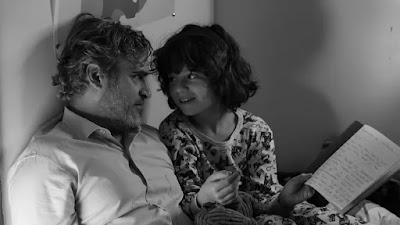
Writer-director Mike Mills tends to understand this. He’s made lovely films about growing into the person you’re always becoming—a short documentary Paperboys; a late-in-life coming-out in Beginners; and his best, 20th Century Women, a deeply-felt 70s’ ensemble piece about a teenage boy and the various influences in his life. His latest is C’mon C’mon and it has the gentle rhythms and tones of an episode of This American Life. It stars Joaquin Phoenix as a cuddly, bearded, well-intentioned New York intellectual out collecting interviews with children for his public radio program. He goes to Detroit, Los Angeles, and New Orleans with his producers finding participants. How do these kids see the world? How do they see their future? Each kid, in a real interview, gives answers that seem honest in their unfussy plainspokenness, though one wonders if they think it’s also what he and his audience wants to hear: parents just don’t understand, the dangers of our world weigh heavily on them, and so on. But Phoenix presents such an open and earnest listener that it’s clear he draws something natural out of them as their subtle interlocutor. They also talk about their dreams and aspirations, and the real difficulties and obstacles in their way. Phoenix warmly guides them toward comfort in these exchanges, promising nothing more than a sympathetic ear.
Into this project arrives his precocious grade-school-aged nephew (Woody Norman), left in his care as the boy’s mother (Gaby Hoffmann) has to see to the institutionalization of the boy’s troubled father (Scoot McNairy). Phoenix clearly loves his nephew and wants what’s best for him. He’s delighted by his creativity and impressed by his thoughtfulness. But he’s also worn down by the daily demands of child care and tending to the emotional needs of a boy still learning how to regulate himself. (He also has some ritualized flights of fancy that can grate on his caretaker.) The movie is patient with both characters, allowing them the space to challenge each other as well as grow in mutual understanding. That makes for a small, delicately crafted movie perched on the same soft-spoken NPR assumption that it’s worth hearing what others have to say. It has not a perspective so much as an attitude, stubbornly sentimental and loaded with references to books and art spoken and shared reverently by its cast of characters. In simply observed black-and-white frames, the film blends documentary and fiction for a small, close story of cross-generational understanding. And in this style it finds a real familial warmth and charge in the scenes between Phoenix and the boy, a tentative and tender forging of meaningful memories in fleeting everyday moments. It doesn’t push to make its child characters beyond-their-years clever, and resists turning anyone into a mere symbol. This can sometimes give the movie a meandering focus. But at its best, it has the observational insight to simply let its performances play out and develop in something close to life-like dimensions.
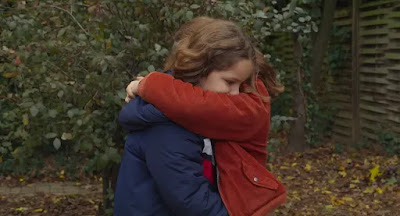
An ever more delicate and mysterious vision of childhood is CĂ©line Sciamma’s Petite Maman. It proceeds like a fragile spell, a magic trick, a fable. And even that doesn’t do justice to the ways in which its fantasy just happens, casually, without fuss, with barely a flicker of the unreal. Sciamma’s films—the observational likes of Water Lilies, Girlhood, and Tomboy forming a triptych of perspectives on formative years in lives of young women—are typically cast in a realist light. Here she uses the same techniques to make a film built entirely out of a high concept, but anyone watching a random clip might never guess it. A little girl goes with her parents to a small house in the woods, the home of her recently deceased grandmother. The adults have the task of cleaning out the place, which gives the kid plenty of time to occupy herself. She wanders off into the yard, through some trees, and arrives at what she thinks is the neighbors’ house, where there’s a little girl her age inviting her to play. There’s something sweet and real about how a child can just make a friend, form a bond, in a blink of a simpatico eye. What a viewer will notice right away is that the girls look suspiciously alike. (They are played by twins, so that explains that.) Their houses, through subtle cues of set design and prop placement, are similar, too. As the girls meet in the woods for playtimes multiple times, it’s clear: the daughter has made friends with her own mother as a child—her petite maman.
One could imagine this twinning time-travel conceit in lesser hands heading for antics or silliness—maybe The Parent Trap by way of Back to the Future. Sure, if done right, that could be fun. But Sciamma approaches this picture with supreme restraint and total straight-faced matter-of-fact seriousness and commitment. She’d understand that Tennessee Williams shortchanged a child’s capacity for contemplation. In the faces of the two girls at the center of this film, she locates all the gentle severity of such an occurrence. As they realize their relationship’s time-bending qualities, they ponder and reflect on what it might mean. The future mother looks into the face of a child she now knows she’ll have, and can learn when, exactly, her own mother will pass away. The younger (if one can call her that) can now see concretely the tangible childlike qualities that surely still sit buried within her mother. Together, though, they just are who they are. Sciamma lets them be, playing politely and sensitively together as little girls can do—tromping through the woods, making plans for little imaginative games and skits, plotting the best way to get a sleepover. There are moments nestled within these quotidian affairs, though, that catch one’s breath in a simple, hushed expression of fantasy cross-generational connection. Typical of its effect is a gift from the future—music played on a pair of headphones we don’t hear, but the girl in the past hearing this unknown song out of time smiles an inscrutable Mona Lisa smile at the sound, a private preview. Most striking, though, is a softly murmured admission from mother to child—I’ve always wanted you. Here’s a movie that appears to do very little—and accomplishes so much. It respects a child’s capacity to take things as they are, and to engage in a sense of wonder that’s perfectly natural—deep thinking taking place in growing minds.
Showing posts with label Mike Mills. Show all posts
Sunday, December 26, 2021
Wednesday, November 2, 2011
Backwards and Forwards: BEGINNERS
It’s never too late to get a new start. At least, that’s
what writer-director Mike Mills has to say in Beginners, a semi-autobiographical movie that follows a father and
a son, each starting new romantic relationships. It’s a mostly solid effort, a film in
which characters feeling boxed in by the lives they are living attempt to break
out of them by trying to connect with others, to try and make their new starts
last.
The father (Christopher Plummer), a handsome, recently
widowered elderly man, sits down his son (Ewan McGregor), a single artist, to
finally divulge a long-held secret: “I’m gay.” This surprises the son, but what
surprises him more is the joyful intensity and all-consuming nature of this
revelation. His father gets new clothes, new friends, and finds a boyfriend.
He’s vibrantly alive in ways he had never been before, freed from the
constraints of the closet. A few years later, he dies.
While grieving, his son glumly heads to a Halloween party
where he meets a pretty young woman (Melanie Laurent) who came to celebrate the
holiday despite suffering from laryngitis. They strike up a flirtation. He
murmurs his charm from underneath a fog of depression. She writes down her
responses in a small notepad, accenting her scribbles with gestures and
wide-eyed expressions. From this Meet Cute, they begin a relationship. Mills
cuts back and forth between the new beginnings of father and son, creating a
film in which the memories of the father slip into the rhythms of the son’s
narrative. The man just died, but he remains a presence. The grieving son is
moving forward, but, through the film’s structure, he keeps moving backwards to
reflect the past.
This is a low-key film of shaggy charms, wistful laughs and
gentle sobs, filled with endearing performances amidst spare visuals. There’s a
forced whimsy to it all, though. McGregor narrates the film with a super dry
deadpan that errs on the side of preciousness, a fussed-over stream-of-consciousness that
is interrupted from time to time by little drawings, photographic montages, or,
worst of all, subtitles that give us unwanted insight into the thoughts of his
pet dog. I could have done without the twee embellishments of such cutesy
accoutrements.
Though I have plenty of little quibbles with smaller
details, this is a muted film that
works slowly and quietly and I can’t deny the power of the big picture. Yet I feel
some indifference, some ambivalence, towards the film. I could see, respect,
admire, and occasionally feel the impact of Mills’s choices, even if I was
rarely drawn into the film. But the emotion of the film filters out through the
layer of whimsy and feels painfully, acutely real. The contrast between father
and son is the emotional heart of the film, a loving but testy relationship
that uses their pasts to reveal emotions and expectations for the future.
Plummer is nicely subtle as a dignified older man surrounded
by the books and artifacts of a long and learned life energized with the new
freedom of living without secrets. He’s so good, in fact, that when we shift
back to the present, I felt disappointed that we didn’t get to spend more time
with him. This is, I suppose, part of the point. In the present, his son is
trying to move forward without him, to start a new relationship while he still
feels the pain of losing his father. He misses his father, and so do we. It’s a
film about the damages of ending one part of life in order to gain the possibility
of beginning again, that is itself somewhat damaged.
Subscribe to:
Posts (Atom)
