Showing posts with label Jude Law. Show all posts

Tuesday, December 10, 2024

Hate Crime: THE ORDER

The Order
is a tense and absorbing real-life thriller set against a backdrop of the American northwest, with stunning views of mountains and forests and rivers and farms on which plays out a standard procedural about good men with guns in pursuit of the bad men with guns. This gives it the feeling of a Western, albeit one with machine guns and pickup trucks from its mid-80’s milieu. It’s only fitting for a true crime story that’s about the very conflicts that continue to drive our country’s madness to take on the trappings of a genre that’s always about American identity. This picture finds an FBI agent (Jude Law) investigating the works of a white-supremacist militia. He’s a grizzled and exhausted veteran who rolls into town and soon teams up with a boyish local cop (Tye Sheridan) to start asking the right questions, and some wrong ones. The militia under suspicion is a recent breakaway group from a larger, slightly more sedate hate group. It’s led by a hot-headed extremist (Nicholas Hoult) who’s leading his small band of men in robberies and bombings, leading up to planned assassinations and more. Ominously, there’s a shot of blueprints for the United States capitol tacked up on his bulletin board. I half expected a title card at the end to tell us one of their group would go on decades later to storm it. Or be elected to Congress.

Director Justin Kurzel is a good fit for the material with his interest in man’s capacity for violence and the ways in which aimless men can bond over a sense of duty, misguided or not, that can emerge from its pursuit. (This makes for an interesting companion to Kurzel’s Macbeth, Assassin’s Creed, and True History of the Kelly Gang in its exploration of bloody codes of conduct and grim perspective.) He has a straight-faced somberness of tone and a steady grip on suspense erupting into violence. Here are long, crackling sequences of law enforcement jargon and investigation, jostling personalities behind the scenes of cops and criminals alike, and then the inevitable shootouts and bombings and chases. (There’s also an event that’ll be familiar to anyone who knows it inspired Oliver Stone’s electric underrated Talk Radio.) Kurzel moves the plot with a well-paced progression of clues and escalations, keeping a close eye on the revealing gestures of the performances. Law convincingly plays an older agent who was hoping to slow down, but finds he just can’t stay out of the game. He moves like an old pro, interrogates with a gruff edge, and runs with a hard-charging fervor that had me worried the character would give himself a heart attack. Sheridan is a fine youthful idealist coming into his own, making a fine pair with Law’s grizzled determination. (Jurnee Smollett is a good by-the-book third wheel when they call for backup.) They’re easy to root for. As their Hoult is scarily blank, a void of charisma that nonetheless has other racist young guys enthralled to his promise of a better, whiter America. There’s a sick dread to the FBI’s righteous pursuit of their group, as we know the sick appeal of their target's evil message will continue to linger past this particular flashpoint.

Monday, May 1, 2023

Puberty Blues: PETER PAN & WENDY and
ARE YOU THERE GOD? IT'S ME, MARGARET.

When Disney wants a live-action version of an animated classic to have some weight and elegance and freshness, it turns out David Lowery is the writer-director on whom to call. His Pete’s Dragon was a lovely, low-key coming-of-age fantasy that turned its fantastical conceit into something shaggier—a boy-and-his-dragon tale. Lowery’s non-Disney work, like The Green Knight, also proves he’s a literate, sensitive filmmaker. He can dig into a classic text and draw out its deep, resonant inner life while making it his own. And with these skills, he can, in the case of Peter Pan & Wendy, hook into authentically Edwardian romanticism while cleverly adapting the mythos to make it resonant for his purposes. He doesn’t exactly revive J.M. Barrie’s original text, or Disney’s animated version, beat for beat, though there’s a flourish of “You Can Fly” in the score. Nor does he draw out everything that makes the work last, the work of a scholar who might capture it by pinning it down. But what he does do is provide it a sense of life and space with windswept verisimilitude—location photography that’s lush and vivid on grassy cliffs and verdant forests full of moss and shadow. And within this convincing locale captured with a filmic eye, he pulls on one simple lively thread from the classic story of a girl who’s given a glimpse of Neverland: the dread of growing older.

Perched on the precipice of puberty—Peter and Wendy are here cast in the last possible week they can be simultaneously the oldest children and youngest adolescents possible, depending on the angle—here’s a movie that pushes on the urgency of aging. They’re at an age where choices and fantasies mingle—and where growing up might be the biggest, bravest adventure. There’s the usual tangle of business with Lost Boys and Captain Hook and Tiger Lily, though all that’s done with a graceful shorthand. And the beautifully casual diversity of the Boys—some are even girls—and the melancholy backstory for Hook (Jude Law, with more real pain than sneering cartoon) feeds into the ideas of aging as a process by which you discover truths about yourself. To deny yourself, or others, that adventure, even through fantasy, is, after all, a kind of conflict that Lowery’s happy to explore outwards with some fairy tale logic and a bit of piratical swordplay. The film’s most moving moment finds Wendy, having walked off the plank, seeing her life flash before her eyes—but forward, not back. That’s a perfectly sentimental moment. And so, though the movie has swashbuckling with weight and peril, and a grand, old-fashioned Kids’ Adventure spirit, it falls back on that smaller, tremulous time where anything is possible, and the passage of time is just about to fall in with the limits of age and nothing can stay the same.

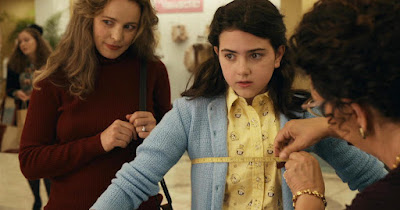
Much less metaphoric about growing older is Are You There God? It’s Me, Margaret, in which burgeoning young adulthood is a source of much literal curiosity and angst. Here’s a movie tenderly attentive to the tenderest of times in a girl’s life. Based on the classic Judy Blume book, it tells the story of Margaret (Abby Ryder Fortson), a sixth grader whose life seems to be nothing but changes. Her parents (Rachel McAdams and Benny Safdie) have moved her from New York City to suburban New Jersey. She has a new school with new kids, and suddenly she’s getting crushes on cute boys and needs to ask her mom to go bra shopping for the first time, and her new friend group is made up of popular girls jealously testing their new ideas. Their gossipy preoccupations are starting to make Margaret nervous about when, exactly, she’ll be getting her period. Writer-director Kelly Fremon Craig keeps the movie loose, light, and episodic, so casually specific about moments in this girl’s life that there’s a generosity of insight just in the act of watching it unfold. There’s a comforting normality to what feels like, to its lead character, the first time anyone’s ever gone through such outsized changes. I suppose it’s true that, though most women go through this, for every woman it’s a once-in-a-lifetime discovery. This movie respects that balance.

But, also true to life, Craig keeps the movie balanced on all manner of youthful preoccupations—grades, parties, holidays, family dynamics, friendships, gossip, and vacations. Here’s a movie about a year in a life that doesn’t hurry toward big climactic melodramas, but instead leans back into the usual ups and downs of young adolescent life. Craig, whose previous film was the sharp and unusually perceptive teen comedy The Edge of Seventeen, in which a high schooler’s life goes flailing after her brother starts dating her best friend, is a writer-director smartly able to balance the intensity of youthful emotions with the perspective to see them clearly in a more mature context. So here the girls’ fluttering of fears and fantasies is both intensely focused and cut with cute dramatic ironies. They don’t know what they don’t know, and it’s exciting and exasperating all at once for them, and their loved ones. The movie becomes a fully realized world for Margaret, a cozy 70s period piece that doesn’t condescend to its times or its characters. It simply lets them be.

Here’s a movie that knows life is a continual process of self-discovery. As such, it has the conviction to also dig plainly into thornier issues of family and spirituality, as our lead finds herself questioning whether she should be Christian like her mother or Jewish like her father. Neither parent particularly cares, but her loving paternal grandmother (Kathy Bates) and estranged maternal grandparents certainly do. The movie has a multi-generational generosity as it brings to life a story of mothers and daughters—especially in McAdams’ glowingly natural performance, built entirely out of lovely grace notes and simple gestures that communicate so much love and good intentions built out of an aging uncertainty. It ties Margaret and her mother together, as potential adolescent conflicts share space with an older vision of daily social struggles. Here’s a movie that says you’re never too old to feel awkward, and never too young to start discovering your confidence. You just have to find those who love you either way. Craig’s compassionate and clear approach is both respectful and honest—just the encouraging balance a young audience might need, and their parents can appreciate. This is a charming movie—so sweet and simple that it casts the gentlest of spells, and clears space for earning its characters’ learning.

Friday, April 15, 2022

Old Magic:
FANTASTIC BEASTS: THE SECRETS OF DUMBLEDORE

I basically liked Fantastic Beasts: The Secrets of Dumbledore, but I feel a defensive crouch is necessary to broach the topic. Need I rehearse the litany of complaints the Fantastic Beasts movies have received? Many say they’re shapeless, strangely paced, full of narrative dead ends and inscrutable motivations. I agree. They have little of the sprightly British boarding school structure of the Harry Potters to which they are ostensibly prequels. Certainly true. The big villain of these pictures has accidentally been a revolving door of casting—a misjudged twist gimmick in the first, and off-screen allegations after the second, resulting in three different actors across three films. Irritating. And their creator, J.K. Rowling, has eroded the goodwill she got from writing an instant-classic work of children’s literature by spending most of her public statements of late transmitting bigoted anti-trans messages. Frustrating would be an understatement. (One hopes that, generations hence, that’ll be biographical detail and not active annoyance.) I can’t defend that, or any of the above, and I won’t. But I’ve had more of a good time than not sitting in the world these movies create. There’s the sheer pleasure of its fantasy gewgaws and the sturdy craftsmanship of its many collaborators, and, gee, even the story starts to threaten to get somewhere interesting.

While the early movies felt like so much stage-setting, this one actually starts to take off. Maybe it’s because Rowling’s screenplay was given a co-writing assist from Steve Kloves, who so smartly adapted the original novels into the wonderful films they became. Here the evil Grindelwald, fresh from committing his Crimes in the last one, continues gathering his forces to fight against tolerance of muggles. (Maybe they’ll get there in the next one. If there is a next one.) The wizard supremacist hopes to exploit weaknesses in the electoral system of worldwide magic high council or something. Only Professor Dumbledore (Jude Law) and his trusty zoologist buddy Newt (Eddie Redmayne), with some allies new (Jessica Williams) and old (Callum Turner, Dan Fogler), can sniff out a way to stop him. Maybe. They hope. It’s a little confusing, deliberately so to confound Grindlewald’s ability to see the future, a convenient excuse. ((The funniest confusion has to be a long sequences near the beginning in which Dumbledore explains why he can’t do something, then he proceeds to do it in the finale, and, when questioned, basically shrugs.) But the actors are swanning about the elaborate bits with appropriate sprightliness. They seem to know what they’re doing. There’s a lot of globe-hopping, creature-admiring, spell-casting zipping around—from an underground German torture pit with a multi-limbed critter’s tentacles stabbing out of the dark, to a mountaintop village erupting with enchanted obstacles. It’s all in service of trying to prevent a sclerotic bureaucracy from accidentally, through a combination of cowardice and corruption, letting an egotistical fascistic cult leader take over their democratic norms. When one wizard pontificates about “the peaceful transfer of power” and dithers over charging Grindlewald for his crimes, the allegory is pretty clear.

Along the way, I most admired the work of Wizarding World vets. A franchise is so much more than one person, after all. This one remains an extended victory lap for people who brought Potter to such vivid life, and as such has constant reminders of the craft that made it so appealing. Director David Yates has a patient eye for the fantasy filigrees and takes all the murmuring about hidden secrets and wizard politics very seriously. I don’t always follow it, but it clearly means something to someone, and plays like it could. When we see the Berlin Ministry of Magic with its brutalist structures and severe members, or a Bhutan temple decked out in enormous flags on rope bridges and towering staircases for an international magic election, there’s fun to the peeks into new corners of this world beyond Hogwarts. (Once more, brief stops at the old school renew its status as one of the great created locations of moviemaking.) Yates marshals the returning behind-the-camera talent to their usual high standard. This is a series with an admirable consistency of style, look, and feel. Production design from Stuart Craig gives each location, new and old, the requisite sumptuous detail—spinning with both old-fashioned appeal with its early-20th-century setting and the neat floating flourishes of magic life. The costumes from Colleen Atwood are neat, too—crisp and cool, flowing and vintage, for muggles and wizards alike. The lush orchestral score from James Newton Howard swells and fanfares with its own invention as it teases around John Williams’ iconic themes sparingly. It’s all of a piece with a fun, familiar world. Sometimes that’s enough.

Wednesday, May 17, 2017

Once and Future KING ARTHUR: LEGEND OF THE SWORD


Guy Ritchie takes a mythic English figure and turns his story into a scrappy ye olde Guy Ritchie-style story in King Arthur: Legend of the Sword. With good gusto, he makes Arthur the nexus of a scampering rebellion, a gang who will become the knights of the round table plotting to take down an evil king and crown the rightful heir by heisting supplies, staging ambushes, beating back black-helmeted ne’re-do-wells, and sinking ships. They’re like the distant ancestors of the grubby, low-level criminals who populated Ritchie’s early works – Lock, Stock, and Two Smoking Barrels, Snatch, RocknRolla. This is fun at times, watching bantering, quick witted oafs and bruisers scheme their way into the highest positions in the land, and all for a noble reason. It’s especially charming because such a light touch and unassuming mode sits right next to the lugubrious solemnity of High Fantasy, dark magic swirling up stone walls, slithering snake women promising good luck in return for blood sacrifice, giant bats, enormous serpents, war elephants, magic rocks, and a sword in a stone. (That that last one is guarded by David Beckham cameoing as one of the villain’s henchman tells you something about the contrast set up here.) This isn’t nearly as fun a finished product as Ritchie’s spry, visually playful, charmingly plotted reimaginings – two red-blooded Sherlock Holmes adventures and a super cool Man from U.N.C.L.E. – but it has its charms.

The film errs on the side of gloopy CG confrontations and thin characterization, especially in its drearily predictable grand finale, but is otherwise fantasy filmmaking done up with pleasurable genre resonances. Its murky opening, quietly drifting across foggy green hills while mysterious magic erupts in the distance reminds me of nothing less than John Boorman’s brilliantly bonkers sci-fi Zardoz crossed with his Arthurian take, Excalibur. Fire blasts forth and a ginormous battle involves a king jumping his horse from a parapet onto an elephantine platform. This noble hero king (Eric Bana) is victorious, but abruptly betrayed by a nefarious usurper (Jude Law) who covets the crown (and works on self-taught Dark Arts, hoping to one day graduate to master Firestarter). A tiny orphaned prince is floated down the river – Moses style, in this never-ending parade of legendary allusions – and raised in a blisteringly rapid-fire montage that takes him from naïve boy taken in by kind criminals to a tough, streetwise brawler. Grown (into Charlie Hunnam), he’s as quick with his quips as he is with his fists, all swaggering confidence even when he’s doubting himself, like when that sword comes out of the stone and the kingdom’s revolutionaries (led by Djimon Hounsou, Aidan Gillen, and Astrid Bergès-Frisbey) scoop him up into their plots against the evil reigning o’er the land.

Generally easy going and light on its feet, despite plodding inevitably to a dull, clangorous climactic confrontation, Ritchie goes all in on his stylish energy. His films, good, bad, and in between (like this one), manage to be at once rough-and-tumble and smooth operators. He fills this telling with snap zooms, propulsive smash cuts, speed ramping, and zippy, fluid, computer-assisted dipping, spinning, and flying establishing shots. He also draws on his Rubik’s-cube-jumbled approach to what in other hands would be conventional setups and payoffs. Instead of long sequences of exposition leading up to bursts of action, he will often intercut the two, cross-cutting speeches and arguments and planning with execution. We see Arthur and his band of would-be heroes devise a trip into a monster-filled wasteland where he must learn to control his magic sword by placing it on a magic rock, their words carrying over as the soundtrack to a lightning fast montage of creature feature derring-do. This gives the picture a jumpy jangle, at once ponderously mythic and casually loping. No one has time to catch their breath between spasms of style, but the movie somehow accrues a sense of heavy sag.

It never quite finds a way to reconcile these competing tendencies, but as a Ritchie romp – co-written, photographed, scored, and edited by some of his familiar collaborators – it never quite loses its loose-limbed charms either. They’re there jolting and jumping underneath even the stateliest fantasy tropes, production design from Game of Thrones vets turned slightly askew, like when the Lady in the Lake appears to pull Arthur through an impossibly deep mud puddle in a dime-store adventure version of a memorably gross Trainspotting swim. So, it’s not totally satisfying. But it’s also not every day you see a movie that straight-faced sends its hero into battle against Rodents of Unusual Size, or includes a moment when a growling Jude Law cuts off a man’s ear and whispers one last threat into it. Those are the sorts of charming eccentricities of which these dusty big-budget boondoggles could use more.

Friday, June 5, 2015

Live and Let SPY


A big, broad action comedy, Spy works by using evergreen genre elements – in this case, secret agent thriller tropes – and taking them seriously. There’s a missing nuke floating around the black market and the CIA wants to stop its sale. The process involves evil arms dealers, slimy smugglers, fancy women, and clever gadgets. At every turn we find bruising hand-to-hand combat, bloody shootouts, and fast chases involving several modes of transportation. There are surprise reversals, unexpected reveals, and double, triple, quadruple crosses from agents in too deep. It plays like a rip-roaring globetrotting adventure. That it just so happens to be hilarious is even better. It’s the rare action comedy that holds up both ends of its bargain.

By treating genre elements so plainly – squint a little and it looks like a Bond movie – writer-director Paul Feig gets comedy out of writing scenes slightly askew from the norm. This isn’t a spoof or parody of the spy picture. No Austin Powers here. This is a full-on embrace of the spy picture. Its title sure isn’t lying to you. Spy is what it is, simply and funnily. In the center is Melissa McCarthy, working with Feig for the third time after Bridesmaids and The Heat. They’re having a productive collaboration turning the expected beats of a chosen comic subgenre slightly on its head through force of offbeat screen presences and his ability to get not just laughs, but genuine, affecting performances. Here Feig writes her a starring role in a take on an oft sexist genre and uses it to refute sexist assumptions. In scene after scene, a woman male colleagues dismiss gets the job done. Anything a Bond can do, she can do.

McCarthy plays a mild-mannered desk-bound agency employee, used to compiling dossiers and feeding field agents recon through their earpieces. Over the course of the movie, she’s forced into the field and there, after initial fish-out-of-water floundering, her talents bloom. Putting her in the place of the usual strong silent spy, dry quips become filthy barrages of exasperation and determination. She, an unassuming, underestimated agent, is called into an undercover mission because a baddie (Rose Byrne) is in possession of a list identifying all known agents. An unknown is needed to track Byrne down and take her out, especially since she’s also the one selling the loose nuke and has already removed one suave agent (Jude Law) from the equation. Scenes of espionage take on fresh interest as McCarthy gets an opportunity to be every persona in her range. She’s playing a sweet professional who’s out to prove her doubters wrong, slipping effortlessly into disguises: sad cat ladies, confident whirlwinds of profanity, and glamorous international women of mystery.

Between exposition, one-liners, and dirty insults, Spy is a rush of physical comedy and exciting action. Feig finds a balance between slapstick and violence, moving from tense to jokey, exciting to funny, gory to gross-out gags. It’s a tricky dance of tone pulled off with aplomb. The characters are appealing, the plotting is crisp and clear, and the stakes are silly and high. It’s the breeziest spy picture in ages, delighting in how light it is. It works because the writing is consistently clever, the performances are terrifically calibrated to straddle the demands of serious thriller mechanics and goofy comedy while still feeling consistent in character. The entire ensemble has great fun tweaking their images, playing familiar parts in eccentric directions.

Byrne is a delightful icy villain, while Law has a good time taking the suave superspy to a goofy place of dangerous unflappability. There’s a goofy assistant back at the base (Miranda Hart, in a role calling on eager happiness incongruous to the dire stakes), a no-nonsense superior (Allison Janney), and a greasy Big Bad (Bobby Cannavale, pickling his charm). Best is dependable man-of-action Jason Statham as a macho master spy frustrated after being sidelined by McCarthy. He blusters about her inadequacies while bumbling his way through the story, making things worse for everyone. Showcasing a welcome sense of humor, he pokes fun at his usual roles. At one point he rattles off a list of exaggerated near-death experiences from prior missions – “I once drove a car off a freeway on top of a train while I was on fire” – that’s both amusingly hyperbolic and could easily be actual scenes from his filmography.

And yet McCarthy’s the clear star here. Her arc is treated respectfully without losing sight of her comic gifts. Even when she tumbles out of a scooter or vomits over a corpse, the joke's with her, not at her expense. She's in command of every scene. It’s one of her finest, funniest performances, terrific sight gags and muttered asides keeping the laughs flowing while building up real affection and sympathy for her character. She moves between slippery false identities, slowly increasing a core of self-esteem while becoming a very good spy. She shows her character’s progression filtering through layers of disguises in action. It helps that Feig is a more confident visual stylist with each film he makes. Spy looks, sounds, and moves not like a comedy, but like any big studio thriller, glossy and expensive. The surface sheen makes it all the funnier as it moves so fleetly through its exciting silliness. I was more thrilled and amused by McCarthy's espionage than many non-comic movie spies'.

Tuesday, March 25, 2014

A Story Told in a Twilight: THE GRAND BUDAPEST HOTEL


The Grand Budapest Hotel is a caper perched between the World Wars. Writer-director Wes Anderson (inspired by the writings of Austrian author Stefan Zweig) creates an abstracted Old World caught as it is disappearing, a colorful fantasy Europe that’s poisoned by drab fascist forces and left forever changed. In true Anderson fashion, he’s designed his fictional European country (Zubrowka, he names it) as a candy-colored dollhouse of meticulous design. At the center is The Grand Budapest Hotel of the title. It’s a wondrous creation, a massive structure nestled in the Alps where it looks for all the world like a hotel Rankin and Bass characters might’ve passed on their way to the North Pole. Its exterior is a pale pink, floors stacked like a cheerfully, elaborately frosted wedding cake. Inside, a lushly carpeted and handsomely furnished labyrinth of luxuries wraps around itself in a square that forces guests and employees alike to walk in crisp geometric patterns. At this Hotel, a caper is hatched, a war encroaches, then years later a writer is inspired. Still later, that writer’s work lives on, calling us back into its melancholic past.

Layers upon layers, the film is a memory inside a book inside a movie. As it begins, a young woman opens a book and begins to read. The author (Tom Wilkinson) appears to us in his office, ready to recount the time he first heard the story his book relays. We see The Author as a Young Man (Jude Law) at the Grand Budapest in the late 1960s, now a cavernous, sparsely populated space not too far removed from The Shining territory, albeit without the supernatural elements. The author meets a lonely old man (F. Murray Abraham) who invites the author to hear the story of how he became the owner of the hotel. Intrigued, the author agrees. And so back once more into the past we go, to the 1930s, when the Grand Budapest was at its peak. For each time period, Anderson designates a different aspect ratio, boxy Academy Ratio 30s stretch into anamorphic late-60s, before growing shallow and simple in 16x9 present day. It’s as mischievous as it is exact, moving through time with clear visual orientation.

The film spends the bulk of its time in the 1930s. We meet Monsieur Gustave H. (Ralph Fiennes), a supercilious dandy who manages the Grand Budapest Hotel with a suave charm and a composed pompous sincerity. His new lobby boy (Tony Revolori) tells of the man’s peccadilloes, namely wooing the little old ladies that visit the hotel. These early passages operate with a dizzying fizz, whiffs of the Lubitsch touch generating much sophisticated posturing and door-slamming farce. Anderson here, working with deep focus lenses and finely calibrated tragicomic performances, has the giddy architectural design of Lubitsch’s silents and the bubbly urbane wit of his talkies. The boy and his boss move through a world of color as vivid as in any Powell/Pressburger film, helping the Grand Budapest’s guests in any way they can. Fiennes and Revolori’s performances are nicely synchronized, the former a fatuous perfectionist, the latter a wide-eyed innocent whose deadpan acceptance in the face of disbelief and disaster balances it out.

Through briskly delivered dialogue and a lovely score by Alexandre Desplat, the metronome is set perfectly for a caper that’s about to erupt, escalating in suspense and incident at an engaging tempo. As the plot gets underway, one of Gustave’s very rich elderly lovers (Tilda Swinton, beneath a generous application of makeup) has died. At the reading of the will, all her most distant acquaintances arrive, shocked to hear that the hotel manager has been left her most valuable painting. While her lawyer (Jeff Goldblum) assures her son (Adrian Brody) that this late-arriving addendum must be authenticated, Gustave and his lobby boy abscond with the painting and take off for the Grand Budapest. Soon, the woman’s son’s thug (Willem Dafoe), a missing butler (Mathieu Amalric), a fascist Inspector (Edward Norton), a scowling prisoner (Harvey Keitel), a sweet baker (Saoirse Ronan), the leader of a team of concierges (Bill Murray), and more get pulled into a scampering plot involving locating, hiding, or aiding and abetting the movement of this most desirable painting.

All the while, the threat of violence looms large. Soldiers brutishly ask travelers for papers. Guards are stabbed to death. A pet meets a gory end. Fingers are misplaced. The film is crisply playful in unspooling its brisk and wry heist plot, loving in its evocation of period-appropriate cinematic touchstones, from the aforementioned Lubitsch and Powell/Pressburger to a mountain cable car right out of Carol Reed’s Night Train to Munich. It’s affectionately constructed, miniatures adding whimsy that somehow doesn’t distract from the real menace in the action.  Nonchalant gore, periodic splashes of vibrant red and matters of life and death in an otherwise charmingly pastel, idealized Old World Europe maintains reality as an inescapable intrusion. No matter the perfectly constructed melancholy nostalgia, the violence of greed and war are an inevitable erosion of this ideal.

The fizzy sophistication of loose permissiveness as signified by Gustave’s unflappable reign of pleasure in the Grand Budapest grows frazzled and tossed as he’s thrown, by his plotting and by the march of time, into danger and exile, on the run from dark intimations of violence and despair. Though, like a typical Wes Anderson protagonist, he projects confidence, even when circumstances are at their most dire. He thinks he’ll get by because that’s all he’s ever planned on. He carries himself with great sense of purpose, even when stumbling into situations deteriorating rapidly, falling into doom, or at least humiliation. The entire oddball ensemble has characters similarly driven towards their goals, a perfect set of traits for people in a story of careful caper construction. When the cogs fall into place and the wheels make their final turn, interlocking every variable, it’s most satisfying, indeed.

For Anderson, film is an artifice, but his style is never an affectation. His pictorial beauty (again with his usual cinematographer Robert Yeoman), visual wit, symmetric blocking, high angle shots, laconic profundities, dead-pan peculiarities, 90-degree whip pans, finicky fonts, cutaway gags, witty repartee, and editorial precision (this time with editor Barney Pilling) add up to an intensely personal and deeply felt playfulness. He comes by his style honestly, carefully, a magic blend of planning and happenstance. It’s all too easy to imagine making a mockery of such meticulousness, but all Anderson parodies miss the depth roiling within the rich and lovingly assembled surfaces. Here is a film that’s on one level a lark, with its bouncy caper, funny lines, and familiar faces. Crescendos of tension and suspense build into action sequences of tremendous delight and dips of apprehension. But underneath sits the darkness.

Here he creates a world of colorful eccentricity soon to be snuffed out, or at least irreparably damaged, by the marching armies at the border. After it all, the Grand Budapest remains, but the world it represents can only be accessed through stories. Layers upon layers of storytelling, of artifice, are not arbitrary comic filigrees or distancing effects. Here the tragedies of the past linger with overwhelming melancholy as we back out of our main story, to the old man who at one point stops his tale to wipe back tears, to the young woman who cherishes the book in which it was immortalized, to the audience as the lights come up and the credits roll. The Grand Budapest Hotel is a totally enveloping aesthetic pleasure, funny and exciting, sharp and sad, so very moving, so completely transporting.

Saturday, February 9, 2013

Bitter Pill: SIDE EFFECTS


Emily (Rooney Mara) is depressed. Her husband (Channing Tatum) is getting out of prison after serving a four year sentence for insider trading, but she’s wearing a frown, her eyes turned downwards, her pale skin still and pensive. It’s shortly after he returns home that she deliberately drives her car into the wall of a parking garage. At the hospital, Dr. Jonathan Banks (Jude Law), a psychiatrist, comes to check on her. She knows the drill. She’s been in therapy before. She asks that he let her go home on the condition that she meets with him regularly for consultations. She says she feels hopeful that the right medication will help her feel better. This is just the start of Side Effects, a twisty thriller that starts out as one kind of darkly psychological movie and is thrown by a single moment of unexpected violence into a second kind of thriller, one with a shift in protagonist, with knotty mysteries that slowly simmer and bring into focus clues that lead towards a series of climactic revelations that reveal it all to be, perhaps, in the end, a bit too predictable.

But through it all, masterful director Steven Soderbergh, in what he claims is his penultimate film before retirement, views with startling specificity and smooth digital surfaces the tensions and foibles that the characters find themselves trapped within, slowly, selfishly jockeying for their best possible outcome in an increasingly disreputable series of events. It’s the kind of story about sharply dressed young professionals crossing paths, interrogating their feelings, and turning their problems into the stuff of pulp fictions that would’ve been perfectly at home as one of those mid-budget 90’s thrillers. You know the kind, the ones that would probably star Ashley Judd or Michael Douglas. Here, though, Scott Z. Burns (who also wrote Soderbergh’s even better films The Informant! and Contagion) has written a script that goes down smoothly with psychological twists that are given pleasingly sleek textures with Soderbergh’s keen sense of framing visual spaces in evocative ways and using jazzy, syncopated editing to methodically keep things moving. It’s a typical thriller elevated by the committed talents of all involved.

There’s a scene early on when Emily, suddenly appearing distraught at a cocktail party, the first social event she and her newly freed husband have gone to since their reunion, steps away from the group and slides up to the corner of the bar to silently weep. The frame is entirely blurry until she learns closer, the camera pulling the picture into focus. This trick is repeated to various degrees through the film. Through scene after scene shot with shallow depth of focus, perhaps the foreground is blurred, or maybe a character leans into the range of focus. These images serve to underline that these characters are people who feel fuzzy emotionally, legally, and professionally. They aren’t seeing clearly or are operating without all the information, doing the best they can under the circumstances to advance selfish goals and come out on top.

The doctor, having commiserated with his patient’s former psychiatrist (Catherine Zeta-Jones) at a conference, prescribes anti-depressants to Emily. The side effects end up snowballing into a high-stakes legal dispute that calls into question the motives of everyone involved. Questions of power, who has it, who needs it, and who really has the upper hand, become important, the difference between imprisonment and freedom, riches and poverty. I’m being deliberately vague here. The pleasures of the film come from the brisk, involving way Soderbergh, relaxed, twists the knife of the screenplay, effortlessly making the plot turns sharply and without losing sight of the big picture.

In observant close ups, the actors are given a chance to reveal their characters’ true intentions – or are they? – with the glance of an eye or the twitch of a cheek. Key flashbacks and montages fill in perceptive details that reveal shadings to incidents and environments that change the meanings of previously held beliefs about what happened, what the characters want, who is helping and who is hurting the goals of the others. Thomas Newman’s needling score joins forces with the crisp cuts to keep it all off-kilter, teetering on the brink of greater dangers. Only disappointing in the way it concludes with less of a flourish than it begins, Side Effects is a fine work of thriller craftsmanship from all involved, and a typically expert genre bauble that’s as sensible an auteurist signifier as anything Soderbergh has done. In its twists, it finds reason to nod towards nearly every theme and preoccupation he’s dealt with throughout his career. If we’re really nearing a goodbye, he’ll be missed, but he’ll also be leaving behind a wonderful collection of films worth revisiting.


Monday, December 10, 2012

Hear the Train a Comin': ANNA KARENINA


If I may borrow and twist around the opening line to a famous Leo Tolstoy novel, in fact the very one soon to be in question here: average filmmakers are all alike, but every experimental filmmaker is experimental in his own way. That’s not completely true, but it’ll go a long ways towards understanding the career trajectory of Joe Wright. He began his career with a confident adaptation of Jane Austen’s classic novel Pride & Prejudice, moving on to a showy, but deeply felt, adaptation of a modern literary classic, Ian McEwan’s Atonement. His third film, The Soloist, was a contemporary based-on-a-true-story flop that felt like a misjudged attempt at conventional restraint. After that, rather than turning back to the realm of the literary adaptation, Wright leapt into more daring territory with Hanna, a near-masterpiece actioner with fairy tale overtones. Built from a potentially schlocky script, it is a film enlivened by a fracturing, emphatic use of bold compositions, a dreamy visual mood and intense sound design. He’s proven himself a filmmaker torn between the stately and the off-putting, between holding emotion close and letting pure sensation take over.

Wright’s latest film is a return to the world of canonized literature, namely Tolstoy’s Anna Karenina. (It’s the one I hinted at earlier, although you may have gathered as much from the headline above.) Rather than representing a retreat to the familiar, it’s easy to see while watching the film unfold that Wright has quietly become one of the most experimental mainstream filmmakers working today. Whereas Pride & Prejudice plays it safe and stately, Atonement was filled with bravura show-off camera moves and narrative twists, and Hanna was an artful display of art house action filmmaking, Karenina finds Wright trying out his most daring experiment yet. Tolstoy’s massive novel about an unhappily married Russian woman has been abridged and thinned by playwright Tom Stoppard, but it’s Wright’s idea to place scenes set in Moscow and St. Petersburg inside a theater, literally making, for the people of high society, all the world a stage.

Through this conceit, Wright brings a kind of cinematic theatricality, heightened and ornate in ways the stage wouldn’t allow.  He uses every bit of the theater too, with characters framed by gas lamps downstage or climbing up into the rafters and rigging, descending into the aisles – the seats are gone, the better to become a racetrack or dancehall. The sets are flat, but detailed, as scenery scrolls by outside carriage windows and a forest of false trunks sit upon the floorboards. The fakery here is obvious and elaborate. Complexly choreographed camera moves through shifting stagecraft turn an office into a street into a restaurant around a moving character. It’s a sort of wonder, bold aesthetic artifice that becomes an enclosed experiment that manages to contain a sweeping historical epic in an interior. The scenes that leave the theater city for countryside of endless snowy or vibrantly green and yellow fields are bracing retreats from the rigid constraints of society.

But such a determined focus on physical spaces does not reveal similar interest in mental interiors. The film’s visuals are a sometimes intoxicating, sometimes repetitive blend of ballet and Brechtian conceits, but this splendid feat of technical artistry walls off the cast’s most excellently engaged performances. It’s a film as distant as it is exquisite. As Anna Karenina herself, Keira Knightley brings a kind of static suffering, to which Wright is happy to add heavy-handedly haunting by foreshadowing. (Do you hear that train whistle blowing? How could you miss it?) The film follows Tolstoy’s plotting, but its rush to fit so much in a relatively compact 130 minutes leaves emotion and motivation as nothing more than shorthand to be glimpsed dancing across the actors’ faces through the set design.  The rest of the cast of characters, from Anna’s husband (Jude Law), lover (Aaron Johnson), brother (Matthew Macfadyen) and his wife (Kelly Macdonald), to a handful of Countesses (like Emily Watson and Olivia Williams), play their parts very well with the performers sinking convincingly into their roles. But they seem almost like an afterthought. They’re prominent and well cast, but feel like just so many cogs in the artful narrative machine.

Trapping Tolstoy’s characters in a constructed artifice of splendor may make for good metaphor and fine visual filmmaking, but it’s a difficult construction with which to invite an audience in. I found myself desperately wishing I were enjoying the movie more than I was and for a while I did. But in the end, standing outside looking in grew too difficult and, though I admired the sights, I couldn’t ponder the themes or feel the emotions for all the metaphor-embellishing bric-a-brac in the way. Wright is no less an impressive director for trying, but his adaptation is sadly an experiment that comes up empty in the end.


Friday, November 23, 2012

The Jack Frost Rises: RISE OF THE GUARDIANS


When it comes to representations of magical legends of childhood, it’s basically Santa Claus or nothing. Rise of the Guardians starts off with a good idea by knocking the jolly old elf down a peg or two by putting him on equal footing with his fictional colleagues: the Easter Bunny, the Sandman, and the Tooth Fairy. The movie imagines them as a sort of holiday-themed supergroup a la The Avengers, using their powers of presents and wonder to protect the children of the world. Would that they could also use their powers to preserve a sense of wonder and fun in this film, but hey, one problem at a time.

At the film’s start, things appear to be relatively peaceful, but soon the apparently long gone Boogeyman appears. He’s gathered some kind of mumbo jumbo ability to convert Sandman’s dream sand into pure nightmare fuel, which leads to some finely animated menace with galloping yellow-eyed sand creatures and roiling seas of black grit. Santa, a burly, tattooed chap with a thick Russian accent activates the Aurora Borealis, which is apparently the secret distress signal for legendary beings. Once assembled, these guardian angels hear from their silent leader, the man on the moon. He signals that the Guardians need a new member to help them save the world’s dreams: Jack Frost.

Frost is a thin, hoodie-wearing scamp who flies around the world spreading cold and snow, touching surfaces with his magic staff that spreads frost in a way reminiscent of the ice-spreading fairies in Fantasia’s Tchaikovsky segment. Though he enjoys bringing slippery ice and snow days to the children of the world, he’s sad that none of them believe in him. When the Guardians show up and ask for his help, he’s reluctant. If you guess that he’ll end up travelling a rough approximation of the hero’s journey from begrudging help to a full-fledged Guardian throughout the course of the movie, you’d be right. This being a rather self-serious, if still determinedly bouncy, fantasy, he’s given the requisite troubled past, though here the twist is that he can’t remember it. (The reveal is one nice card the film has up its sleeve). The plot, adapted from the William Joyce books by playwright David Lindsay-Abaire, becomes a typical clash of good and evil played out thinly, but with some energy.

Every aspect of the film is highly competent, brightly colored and full of hectic movement. The character design is more or less as creative as the voice work is functional. Frost (Chris Pine) is designed, oddly enough, as some kind of teen matinee idol, as if shipped from a Generic Protagonist factory. I liked the rougher conception of Santa (gruffly voiced by Alec Baldwin) as an amiable bruiser with an army of big, helpful yetis and diminutive, largely useless, elves at his command. The Easter bunny (Hugh Jackman) is simply a large rabbit, but I like the way his colorful eggs can sprout legs and hide themselves. The Sandman’s a silent, short, sandy fellow, whereas the Tooth Fairy (Isla Fisher) is a giant hummingbird lady who flits to and fro. The Boogeyman, however, makes for a rather bland villain, like someone sanded the distinctiveness off of Tom Hiddleston and gave him the voice of Jude Law. He’s easily dwarfed by his nightmare-magic.

Where the movie fails most of all is in its central thesis. The Guardians gain their powers from children believing in them and so they, in turn, protect children with their powers. That’s all fine, but the film plays out like forced frivolity, constantly extolling the benefits of childlike wonder and belief in magic while being itself depressingly literal about magic while assuming that an audience’s wonder will follow. Though first-time director Peter Ramsey has a nice control over the film’s visuals, no aspect of the film manages to rise above the level of competent. It felt to me like a long 97 minutes, filled with lots of talk of magic, but little magic felt. It clunks along from one sequence to the next, stopping at each of the characters’ lairs for a little bit of visual invention and spinning the oh-so-simple plot in place long enough to movie it ever-so-slightly forward. I’d bet kids won’t mind it so much, but what do I know? I’m not them. It’s a colorful distraction with a modicum of imagination, but all that I can testify to is that sitting through it once was more than enough for me, thanks.