Showing posts with label Kathy Bates. Show all posts

Monday, May 1, 2023

Puberty Blues: PETER PAN & WENDY and
ARE YOU THERE GOD? IT'S ME, MARGARET.

When Disney wants a live-action version of an animated classic to have some weight and elegance and freshness, it turns out David Lowery is the writer-director on whom to call. His Pete’s Dragon was a lovely, low-key coming-of-age fantasy that turned its fantastical conceit into something shaggier—a boy-and-his-dragon tale. Lowery’s non-Disney work, like The Green Knight, also proves he’s a literate, sensitive filmmaker. He can dig into a classic text and draw out its deep, resonant inner life while making it his own. And with these skills, he can, in the case of Peter Pan & Wendy, hook into authentically Edwardian romanticism while cleverly adapting the mythos to make it resonant for his purposes. He doesn’t exactly revive J.M. Barrie’s original text, or Disney’s animated version, beat for beat, though there’s a flourish of “You Can Fly” in the score. Nor does he draw out everything that makes the work last, the work of a scholar who might capture it by pinning it down. But what he does do is provide it a sense of life and space with windswept verisimilitude—location photography that’s lush and vivid on grassy cliffs and verdant forests full of moss and shadow. And within this convincing locale captured with a filmic eye, he pulls on one simple lively thread from the classic story of a girl who’s given a glimpse of Neverland: the dread of growing older.

Perched on the precipice of puberty—Peter and Wendy are here cast in the last possible week they can be simultaneously the oldest children and youngest adolescents possible, depending on the angle—here’s a movie that pushes on the urgency of aging. They’re at an age where choices and fantasies mingle—and where growing up might be the biggest, bravest adventure. There’s the usual tangle of business with Lost Boys and Captain Hook and Tiger Lily, though all that’s done with a graceful shorthand. And the beautifully casual diversity of the Boys—some are even girls—and the melancholy backstory for Hook (Jude Law, with more real pain than sneering cartoon) feeds into the ideas of aging as a process by which you discover truths about yourself. To deny yourself, or others, that adventure, even through fantasy, is, after all, a kind of conflict that Lowery’s happy to explore outwards with some fairy tale logic and a bit of piratical swordplay. The film’s most moving moment finds Wendy, having walked off the plank, seeing her life flash before her eyes—but forward, not back. That’s a perfectly sentimental moment. And so, though the movie has swashbuckling with weight and peril, and a grand, old-fashioned Kids’ Adventure spirit, it falls back on that smaller, tremulous time where anything is possible, and the passage of time is just about to fall in with the limits of age and nothing can stay the same.
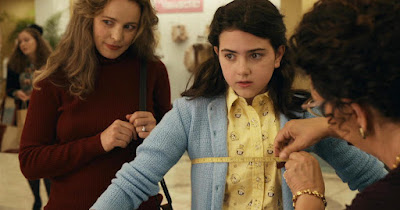
Much less metaphoric about growing older is Are You There God? It’s Me, Margaret, in which burgeoning young adulthood is a source of much literal curiosity and angst. Here’s a movie tenderly attentive to the tenderest of times in a girl’s life. Based on the classic Judy Blume book, it tells the story of Margaret (Abby Ryder Fortson), a sixth grader whose life seems to be nothing but changes. Her parents (Rachel McAdams and Benny Safdie) have moved her from New York City to suburban New Jersey. She has a new school with new kids, and suddenly she’s getting crushes on cute boys and needs to ask her mom to go bra shopping for the first time, and her new friend group is made up of popular girls jealously testing their new ideas. Their gossipy preoccupations are starting to make Margaret nervous about when, exactly, she’ll be getting her period. Writer-director Kelly Fremon Craig keeps the movie loose, light, and episodic, so casually specific about moments in this girl’s life that there’s a generosity of insight just in the act of watching it unfold. There’s a comforting normality to what feels like, to its lead character, the first time anyone’s ever gone through such outsized changes. I suppose it’s true that, though most women go through this, for every woman it’s a once-in-a-lifetime discovery. This movie respects that balance.

But, also true to life, Craig keeps the movie balanced on all manner of youthful preoccupations—grades, parties, holidays, family dynamics, friendships, gossip, and vacations. Here’s a movie about a year in a life that doesn’t hurry toward big climactic melodramas, but instead leans back into the usual ups and downs of young adolescent life. Craig, whose previous film was the sharp and unusually perceptive teen comedy The Edge of Seventeen, in which a high schooler’s life goes flailing after her brother starts dating her best friend, is a writer-director smartly able to balance the intensity of youthful emotions with the perspective to see them clearly in a more mature context. So here the girls’ fluttering of fears and fantasies is both intensely focused and cut with cute dramatic ironies. They don’t know what they don’t know, and it’s exciting and exasperating all at once for them, and their loved ones. The movie becomes a fully realized world for Margaret, a cozy 70s period piece that doesn’t condescend to its times or its characters. It simply lets them be.

Here’s a movie that knows life is a continual process of self-discovery. As such, it has the conviction to also dig plainly into thornier issues of family and spirituality, as our lead finds herself questioning whether she should be Christian like her mother or Jewish like her father. Neither parent particularly cares, but her loving paternal grandmother (Kathy Bates) and estranged maternal grandparents certainly do. The movie has a multi-generational generosity as it brings to life a story of mothers and daughters—especially in McAdams’ glowingly natural performance, built entirely out of lovely grace notes and simple gestures that communicate so much love and good intentions built out of an aging uncertainty. It ties Margaret and her mother together, as potential adolescent conflicts share space with an older vision of daily social struggles. Here’s a movie that says you’re never too old to feel awkward, and never too young to start discovering your confidence. You just have to find those who love you either way. Craig’s compassionate and clear approach is both respectful and honest—just the encouraging balance a young audience might need, and their parents can appreciate. This is a charming movie—so sweet and simple that it casts the gentlest of spells, and clears space for earning its characters’ learning.

Thursday, July 3, 2014

Road to Somewhere: TAMMY


Melissa McCarthy is a movie star and that makes me very happy. It’s not just that she’s incredibly likable, intensely sympathetic, and awfully funny in everything I’ve seen her in. She’s also a woman who is over forty and isn’t a supermodel. Even when she is in a bad movie, she’s wonderful. That her talent and charm is recognized on a level that makes her an Oscar nominee and a bona fide box office draw is good enough. That she has chosen to cash in on this recognition by writing herself a starring role in a big studio movie, then made room for a generous ensemble of beloved actresses of all ages, shapes, and sizes is even better. Tammy, which she co-wrote with her husband Ben Falcone, who also directs and appears in a brief role, is an unkempt road trip comedy that pokes around Midwestern towns, celebrating underdogs wherever it may find them. It’s a little scattershot, a little uneven, and the direction creaks with the slips of a safe first-time filmmaker shooting blandly, putting the camera in a spot to capture the comedy and little more. But when jokes land it’s gut-bustingly hilarious, and when they miss, at least the film is still so warm and generous.

That generosity of spirit stands out in stark contrast to the rest of the Hollywood comedy machine. So often R-rated comedies (and many PG-13, and some of the PG) are purposelessly crass, uncomfortable, and mean-spirited, usually omnidirectionally, but mostly punching down to those least worth laughing at. Look at how smug a Grown Ups or Horrible Bosses or Bad Teacher can be, asking us to sympathize with obliviously privileged upper-middle-class (almost exclusively white) people being cruel to each other and laughing at those who would stand in their way, or worse, dare to exist outside their group. The quiet revolution of Tammy is the way it finds compassion for characters of all types. At its center is a working-class woman whose blundering rudeness is a cover for her insecurity. She comes by her sloppiness honestly. She’s ground down by the world and the  movie decides to help her pick herself back up. She has a good heart underneath her surface slob – tangled hair, greasy T-shirts, baggy shorts, clutter and litter – and the movie is kind enough to see that.

It starts with the woman of the title late for work at a KFC knockoff. Her car’s busted after she hit a deer or, as she puts it, a deer hit her. It’s the last straw, so her boss fires her. After throwing a comical fit through the cheap restaurant – “That’s not chicken!” she hollers at the patrons – she storms home and finds her husband (Nat Faxon) cheating on her with a neighbor (Toni Collette). Then, tearfully trying to maintain composure, her suitcase breaks open, spilling belongings every which way as she leaves. Tammy can’t take it. She storms over to see her mother (Allison Janney) and demands the car keys, vowing to leave their stupid small town once and for all. Her grandmother (Susan Sarandon) thinks that sounds good, packs her booze, and runs away with her. Together they set off for Niagara Falls, but one thing after another (a jet ski accident, drunken disorderly behavior, and more) puts roadblocks in their path. They’re loud, wild, and difficult, quick to bristle at any slights real or perceived. They’re quite a pair. 

The loose, episodic plotting takes them to campgrounds, roadside diners, a BBQ, liquor stores, fast food joints, jail, and a lakeside mansion owned by a distant relative (Kathy Bates at her most lovable). From time to time, it even threatens to tip over into a small-time caper. There’s a pair of robbery scenes that had me laughing hysterically through McCarthy’s fumbling bravado, clumsy mannerisms, and others’ reactions to her. Through it all Tammy struggles with finding a new, more productive path for her life and her randy grandma struggles with alcohol. There are moments of real drama between them, as drunken sniping hurts and diabetes is deadly serious. But mostly it’s a lark that regards their plight with sympathy. It’s a road movie without much of a sense of direction and once in a while spins it wheels, but that seems to match the lead duo’s lives pretty well.

As setbacks, both accidental and self-inflicted, weigh her down, Tammy just keeps charging forward. There’s this small gesture that never fails to make me snicker. She moves forward with total slapstick confidence until she pauses for a brief flicker of doubt – am I behaving strangely? – before doubling down on her commitment to whatever physical gag she’s in the middle of. McCarthy is as dexterous with slapstick as she is with banter and petulant outbursts of profanity. Here she’s a star who lets others share center stage, as generous as the movie she wrote. Everyone, from Sarandon and Bates, to small roles for Gary Cole, Mark Duplass, Sandra Oh, and Sarah Baker (of the terrific monologue that was the high-point of the most recent season of Louie), do fine, charming work. It’s the rare comedy that likes just about everyone, except for the few who deserve a smidge of scorn. But even that goes soft by the end, for the most part.

This sweet, charming, warm-hearted movie is a fun, shaggy, hangout with loveable misfits on a likable self-improvement journey, even if they didn’t realize it at the time. It’s worth the trip. By the end, it’s been a noncondescending Fourth-of-July Midwest tour celebrating the drunk, the sloppy, the unlucky, and the striving, while recognizing their need to make changes for the better. It’s a loving movie full of all manner of average folk: mothers, daughters, and granddaughters; lesbians; fast food workers; bluegrass bands; police officers; farmers; low-level criminals. And they’re all okay in Tammy’s eyes. It ends up being a holiday-weekend tribute to America, land of rough edges and kind hearts, where a woman with a mess of a life can head out into the heartland and figure herself out.

Monday, June 20, 2011

Anything Goes: MIDNIGHT IN PARIS

Note: Many critics have no problem launching into spoiler territory while discussing this film, but I’ll keep it relatively spoiler free here, discussing themes and plot in such a way as to preserve the surprise of utterly splendid paths the movie takes.

Who could have guessed that the most transporting fantasy of the summer would take place in a film that never really leaves the real world? Woody Allen’s latest, his forty-first film, is Midnight in Paris, a wholly enveloping diversion, a pleasantly layered delight. It presents Paris as a city of real magic with an irresistible draw that pulls in anyone on the right wavelength. I must admit that I fell in love with the city myself while on a school trip last year. It’s a city of such beauty, such fine art, and with a clear, direct sense of connection to times gone by, a city that I felt had always resided in my soul, that I found myself nodding with agreement when a character in the film mentions that Paris just might be the hottest spot in the universe.

Allen opens his film with a dreamy tourist’s gaze. He draws his film slowly and patiently into being with a loving sightseeing montage that looks, really looks, at Paris. It’s plain to see why it’s so easy to fall in love with this city, the cobblestone streets, the stunning architecture, and the extraordinary sights around every corner. It’s also easy to see why a self-proclaimed Hollywood hack like Gil Pender (Owen Wilson) would want to use his visit as the perfect opportunity to buckle down and finish his first novel. His fiancé (Rachel McAdams) and her parents (Kurt Fuller and Mimi Kennedy) would rather zip along on a tight schedule to shop and taste wine. They’re not attuned to the magic of their surroundings. “If I see one more charming bistro…” the fiancé grumbles.

Gil’s not like his future in-laws. He lets the city simmer in his psyche. He knows the place has great magic. He reveres the Paris of the 20’s, a time when American artists of all kinds showed up to create masterpieces, and sees himself, the struggling author that he is, as one of a long, continuous line of talents living, partying, and creating during their time as Parisians. Gil is so inspired that one night he leaves his fiancé and her finicky pseudo-intellectual friends (Michael Sheen and Nina Arianda) behind just to wander the city, to get his creative energy sizzling and buzzing. Paris contains such magic in this film that when a car pulls up and partygoers wave at him and ask him to join them not only does he go along, he finds only ever more to delight and surprise him. When he ends up at a party where everyone is dressed in 20’s garb and a man is playing Cole Porter songs at a piano, why, it only seems natural that he’s fallen immediately into the right crowd.

While his increasingly befuddled family resign themselves to letting him wander off to enjoy himself, he gets to mingle with all manner of Parisians. Wilson plays the part of the yearning nostalgic neurotic artist perfectly with the right blend of anxiety and affability. He comes into contact with all sorts of interesting characters, a gruff, manly writer (Corey Stoll), a socialite (Alison Pill) and her author husband (Tom Hiddleston), a gorgeous fashionable muse (Marion Cotillard), a self-absorbed surrealist (Adrien Brody), and a warm, encouraging editor (Kathy Bates), among many others.

This is a love-drunk fan letter to Paris, literature, and art that makes for a casually dense, parable-like tale that’s a warm rebuke and sentimental smirk to nostalgia and a loving embrace of all that makes us human. Here’s a film that falls in love with a city that forever repays that love. Here’s a film that says artists are human, heroes are flawed, and yet can’t creating and experiencing art be a source of endless joy? One simply can’t live in the past, but isn’t it pretty to think so? To create is to look forwards and backwards at once, a tricky prospect. Here Allen has made a film that seems to do just that for him. It pulls together some of his favorite themes (artists, art, relationships) and passions (literature, jazz, history) and repackages them in ways new and surprising, comforting and familiar.

The beauty of the film is that it can be so thoughtful, philosophical even, and yet so utterly transporting, so completely and utterly entertaining that the outside world melts away for a while. It’s the flat out funniest picture Allen’s made in one or two decades. It’s a grand hug of a film that loves France, loves art, loves love and only grows richer the more you are able to catch the historical references. It’s a sort of romantic comedy, but it succeeds by treating the romance as almost a side-thought. It’s an artful, sweet tourist’s fantasy that succeeds by being so matter-of-fact about its movie magic. What a wonderful film! I practically floated out of the theater with the film resonating so deeply and beautifully, filling me with total joy. Living in the present might not always be so beautiful, so we beat on, boats against the current, borne back ceaselessly into the past.

Wednesday, August 5, 2009

Cheri (2009)

The best moment in Cheri comes late in the film as the camera lingers on a close-up of a woman’s face as the narrator matter-of-factly states that a character’s demise is the direct result of wanting this woman but being unable to get her back. As the statement spills from the narrator’s mouth we stare at the woman, this sad beauty who stares out at us. Then the shot continues, lingering a moment longer than expected. It’s devastating, or rather, nearly so. To be truly devastating, the film would have had to work harder to be less of a frothy bauble, or at least more fun.

The film stars Michelle Pfeiffer as an aging courtesan in early 1900s France who finds herself falling in love with Cheri (Rupert Friend), a much younger man. They have an affair that is complicated only by the fact that Pfeiffer is friends with Cheri’s mother (Kathy Bates) who wishes to marry her son off to the daughter of another high society member. The movie titters and gossips along with these, and other, wealthy ladies, flitting from one scandal to another, ruminating on love lives and dishing all the dirt.

This is an exquisite froth that never truly delights, a romance that never truly swoons, and a drama that stays too surface to move. As a soap-operatic melodrama, Cheri never kicks up enough heat. The characters are superficially developed, leaving the audience out of the affair. There’s never a sense that the characters care about each other. Cheri, and all those around him, remain blank canvases. For all the light, delightful moments from Pfeiffer and Bates, there’s a never a real sense of what makes these people behave the ways they do, other than vague nods towards the societal context.

The film is well mounted, handsomely shot by Stephen Frears, who has made great films in the past (most recently The Queen and High Fidelity) and will hopefully make them again in the future, but this film is nothing more than pretty, vacant, people moving through pretty landscapes and architecture, which brings me back to the narrator (Stephen Frears), who observes and comments on it all. Most of the important events in the film, both internal and external, are either redundantly narrated or narrated without being shown at all. He’s (apologies to Mr. Frears, who’s voice is certainly pleasant) a total detriment, only adding to the sense of forced frivolity, the sense of watching someone else play with dolls while we strain over his shoulder to watch and understand.

Wednesday, June 3, 2009

Revolutionary Road (2008)

Revolutionary Road is now available on DVD and Blu-ray.

Since 1961, when Richard Yates’ great novel Revolutionary Road was published, it has become thoroughly frequent to see “daring” artists scrape at the layers of happiness covering both suburbia and the 1950s and 60s to find the hopelessness and emptiness within. The biggest danger in adapting the book to film now is in failing to making what was original exciting once more. Director Sam Mendes fails for the most part. This is fairly routine stuff at times. The book’s greatest strength is its fluid prose which floats through character’s heads. We see motivation and emotion effortlessly woven and incorporated into character’s actions. As good as Leonardo DiCaprio and Kate Winslet are as performers, they don’t manage to convey the same intensity of purpose. For all the great histrionics of their acting they don’t dig into the roles. Here they become examples of Age-Appropriate-Dialogue-Delivery Devices, to use the astute nomenclature of the great Sam Van Hallgren.

But there are moments of visual perfection: a sea of top hats flowing into a subway station, a group of children staring at the television unaware of their father’s voice. But for every scene of effortless emotional twinge that the pictoral vision can evoke, even great early moments like the one that finds DiCaprio returning home from an affair in the city to be greeted by his children was done better by the TV show Mad Men. A curious thing about the movie, though, is that, although it starts by sputtering its engine, once it roars to life it has a pretty good roar.

The roar is due, in no small part, to the great supporting cast. David Harbour and Kathryn Hahn are perfect as a middle-class post-war all-American couple slowly colliding with the façade of the suburbs. Maybe they should have been the leads. But knocking everyone else in the cast out of the ballpark are Michael Shannon and Kathy Bates who are operating on another level altogether. They know just the way the material should be handled. Why didn’t anyone else (other than Harbour and Hahn) catch on? Even if the movie doesn’t, maybe even couldn’t, have the same wallop as the novel, the end still manages to deliver its plot twist with a satisfyingly sickening crunch – a sort of sick cinematic flip to the saccharine sacrifice that caps Kate and Leo’s Titanic. The extent that it does work I found a little surprising considering pessimism is much more relatable from the inside out and Mendes keeps the film firmly entrenched on the outside.