Showing posts with label Mahershala Ali. Show all posts

Wednesday, July 2, 2025

Dino Might: JURASSIC WORLD REBIRTH

Screenwriter David Koepp has written several perfectly structured movies in his career. He’s responsible for Raimi’s first Spider-Man’s thrilling uplift trajectory, and Fincher’s Panic Room’s tightening claustrophobia. He directed his own expert thriller Premium Rush, a bike messenger chase that knows just when to shift into the next gear like clockwork. He’s recently on a great run of collaborations with Soderbergh across genres: pandemic tech mystery Kimi, haunted family drama Presence, and twisty spy investigation Black Bag. But still his greatest screenplay is the original Jurassic Park, a movie with nary a line out of place or sequence mistimed. Every character beat, line of exposition, and complication revealed is precisely calibrated and exquisitely balanced. It’s a movie with such a sturdy structure that it only grows in the skill of Spielberg’s direction which embellishes the intensity of the emotions and the suspense until it reaches its transcendent blockbuster heights. Koepp’s clearly a pro who knows what he’s doing. So far be it from me to note Koepp’s return to the franchise for its seventh entry, Jurassic World Rebirth, has one obvious structural problem, but here goes. 

This movie picks up a few years past the conclusion of Colin Tervorrow’s Jurassic World Dominion. In the Rebirth we find that our ecosystem can’t support dinosaur life anywhere but the equator, which means the whole world building is rest to confine the cloned prehistoric life on the original islands. In a lengthy first act we follow a pharmaceutical rep (Rupert Friend) recruiting a team to secretly go to a Jurassic Island and steal some dino DNA in order to develop a miracle cure. He explains the deal to a mercenary (Scarlett Johansson), who goes with him to meet a scientist (Jonathan Bailey), who joins them to hire a boat and its captain (Mahershala Ali). Each step repeats a lot of the same plot information as we meet a new character. (We’ll repeat the character information throughout, too, a nagging drag on the picture.) Then we cut to a vacationing family (father Manuel Garcia-Rulfo, daughters Luna Blaise and Audrina Miranda, and the older girl’s boyfriend David Iacono) as their sailboat capsizes in the middle of the ocean. They’re rescued by the team en route to Jurassic danger and pretty quickly realize they’ve been brought into a dangerous journey. The movie’s off to a pretty slow, uncertain start until the family joins. Then there’s a clean line of suspense and momentum as the rescue boat is attacked by dinosaurs and crashes on the island, forcing the whole ensemble to scramble around and survive until rescue can arrive. I entertained the idea of an instantly better version starting with the family and introducing more mystery about our all-star mercenaries while getting to the goods faster, but at least the movie as is gets there eventually. 

Koepp provides a sturdy enough framework for the basic Jurassic creature feature sequences. Director Gareth Edwards, of the great 2014 American Godzilla, shapes them with style and heft. He restores a sense of scale and awe to a franchise that has recently lacked in those departments. He has a great eye for teasing out details, putting the camera in the right place to start stringing them along, accumulating complications with a long fuse that twists and turns on its way to exploding. It’s beat for beat the best directed Jurassic movie in a long time. Just the pleasure of watching humans and dinos arranged with intentionality in the frame for surprise and suspense is enough to keep the proceedings agreeably entertaining. Hanging off a boat while enormous jaws chomp, or dangling on a mountainside while pterodactyls swoop and snap are good use of the variables one would expect from a movie like this. (Edwards gets a little of the vibes of Howard Hawks' big game chases in Hatari! going here.) A scene with a t-rex and an inflatable life raft is a fine manipulation of teasing reveals, and a sequence involving winged raptors in a convenience store and down into some conveniently large drains is a decent use of space. It’s a fine popcorn programmer, delivering precisely what one wants from a movie like this. The creatures look great, the jungle landscapes are attractively shot, the soundtrack is booming, and the characters are just believable enough types to wish them well (or ill, in the case of the slimier ones). You go to a Jurassic movie for simple pleasures at this point, or you don’t go at all. If this one doesn’t even begin to reach the heights of the original, well, none of the others have. At least it also doesn’t hit the lows of the more recent sequels, either. I went in asking if we really needed to keep this series going, and left thinking we might as well. 

Sunday, November 27, 2016

Black and Blue: MOONLIGHT

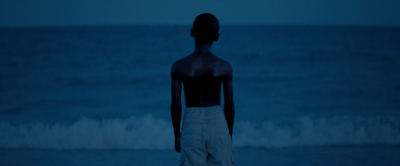
Barry Jenkins’ Moonlight is a movie about being Black and blue, about the sensitive emotional bruises of a melancholy young African American man growing up a misfit. He’s looking for connections – parental, friendly, romantic – and yet can hardly admit to himself how deeply his yearning goes, and in which directions it grows. It takes raw material that’d easily slip into standard issue social drama and fits it to a far more embodied and expressive form, rippling with tangible detail, staging dialogue scenes freighted with pregnant pauses and tender nuances under a softly crackling mood. It’s a coming-of-age and a coming-out story, a boy realizing he’s different as he’s trying to find his place. He’s a young boy, growing up impoverished in Miami, learning to fend for himself, drawn to a compassionate surrogate father figure: the neighborhood drug dealer who supplies his addict mother with her fix. He’s a teenager, shy and withdrawn, barely registering the slight trembles of flirtation with a brash peer’s similarly unspoken desires. He’s a young man, bulkier, tougher, more confident, but with a soft sweetness drawn out with the right words.

Told in three sections – each a resonant short film unto itself – Jenkins, adapting a work by Tarell Alvin McCraney, structures the film around relationships in the process of forming or deforming. In the first part, we meet the boy (Alex Hibbert) as he’s taken under the wing of the dealer (Mahershala Ali). He’s spotted alone, fleeing both the rough boys who tease him and the mother (Naomie Harris) in and out of her highs. The older man treats him to kindness, a gentle respect that cuts against the typical drug dealer stereotype. Consider a quietly stunning scene in which the boy, having internalized a bullying jeer, comprehending the intent without understanding the words, asks the fatherly influence, “What’s a fag?” There’s a long silence while the man chooses his words carefully and generously. Jenkins allows to hang in the empty space the potential for calamity (stoked, perhaps, by our culture’s preoccupation with miserable worst-case-scenario “realism” in this sort of fiction, an erroneous denial of possibilities for kindness, grace, and small favors). The release, and relief, comes as the boy gets exactly the right age-appropriate advice, an oasis of support in a turbulent childhood.

We next meet him as a teenager (Ashton Sanders), sullen and withdrawn, beholden to his mother’s whims and his social isolation. The rippling tensions he carries between his shoulder blades is bound to erupt—maybe in a tender moment of hesitant pleasure on the beach, or an explosive moment of violence in the cafeteria. They each have their momentary satisfactions for the boy. But neither get him all the way to where he wants to be. The movie’s final act—scenes, really—is a reconnection between the boy, now-grown man (Trevante Rhodes), and an old friend (André Holland). In Wong Kar-wai wooziness and smoky smoldering, the men hesitantly reminisce, tight-lipped and taciturn dialogue loaded with implication. For that’s what the movie’s best at, Jenkins mining the unspoken and the half-whispered for the expressively lit and intuitively cut connections that draw out the melodrama of the everyday. Here’s a tremendous work of empathy and sensitivity, moving and melodious as it lets its characters’ vulnerabilities draw them further into themselves, while holding out the possibility of fuller self-expression.

Friday, November 20, 2015

Grey Zone: THE HUNGER GAMES: MOCKINGJAY - PART 2


Hardly the victory march some will expect, I suspect The Hunger Games: Mockingjay – Part 2 will surprise audiences unfamiliar with Suzanne Collins’ books with its glum, mournful approach. It’s a typical sci-fi dystopian setup involving an opulent fascistic regime controlling a population through violence and the common people rising up in rebellion. But what makes this concluding feature so potent and satisfying is the way it eschews easy moral binaries and the temptation to turn in a rousing finale of action and comeuppances. No, Mockingjay – Part 2 picks up where the previous feature left off, with the rebellious Districts of Panem preparing to invade the Capitol and depose evil President Snow (Donald Sutherland), and finds in the toil and terror of revolution only destruction and pain. It sits with our heroes and asks if their entire struggle was worth it. A quietly radical conclusion has us root for unrest and upheaval, and then explore the difficulties of putting a society back together, especially for those who blew it all up.

This is a series that’s gotten slightly better each time out, not because the overall quality has improved dramatically, but because it has complicated its character’s ideas and emotions. Now that we have all four films we can see the complete picture, a dim, cynical allegory with a glimmer of hope in the end. Our protagonist, Katniss Everdeen (Jennifer Lawrence, fusing determination and uncertainty in one of her best performances), started as a pawn of the Capitol in their Hunger Games, a propaganda tool, gladiatorial combat to keep the masses intimidated and entertained. But, with her games partner, Peeta (Josh Hutcherson), she managed to escape certain death in the arena, and in the process sparked a growing rebellion that soon conscripted her to be their symbol. How rare to see a hero who is confused about her role, who recognizes and bristles at her lack of control, and yet continues to struggle to do what’s right.

As Mockingjay – Part 2 begins, rebel leaders (Julianne Moore, Philip Seymour Hoffman) allow Katniss to head to the front lines of the assault on the Capitol as part of a propaganda squad. With her old friend Gale (Liam Hemsworth), a kind-but-tough commander (Mahershala Ali), and team of soldiers (including Sam Claflin and Natalie Dormer), their job is to follow behind the fighting, inspiring the troops, and scaring the Capitol citizens, with video reports. Unfortunately, Snow has ordered the Gamesmakers to spread traps throughout the city, turning a bombed-out urban setting – all grey pockmarked rubble and dirt – into an even more twisted Hunger Games. This is how the action proceeds, the team picking through a minefield of deadly contraptions while working their way to Snow, the man they want to assassinate to end the war, bringing a new, and hopefully better, government to Panem.

Screenwriters Peter Craig and Danny Strong smartly keep the focus on our characters, allowing most of the epic battle to take place off screen through suggestion. The violence we see isn’t the massive depersonalized clashes of CG armies. It’s up close, panicked, sweating, sudden. Horror movie mechanics are used to spring traps – like automatic weapons, oil slicks, and mindless sewer mutants – with jump scares jolting firefights and foot chases into action. Between flashes of chaos, director Francis Lawrence (who has capably, artfully helmed three of the four Hunger Games) uses stillness and quiet, as characters catch their breath, debate strategy, and let the traumatic events stop ringing in their ears, if only for a little while. There’s dread everywhere, not only in the probing close-ups, which capture every bit of fear and doubt, but in the sense that all this fighting may be futile.

This has always been a series that’s both action-oriented and deeply disturbed by violence. From the shaky-cam elisions of the first Games and the brutal executions of Catching Fire to the bruising civilian uprisings in the first Mockingjay (the series' high point), it’s a franchise the looks at bloodshed with great sadness, keenly aware of cycles of trauma, fear mongering, propaganda, and war. It treats even the enemy as people, this last film finding fleeing Capitol citizens and viewing them with compassion. What started as a satire of reality TV and conspicuous consumption has become a war zone, with refugees fleeing both rebel bombings and oppressive government retaliations. (Real world echoes are impactful and messy.) The violence of the Hunger Games becomes the violence of revolution. It’s a movie too engaged with its tragic elements to create action scenarios full of mindless villains to slaughter. Every kill is felt. The cast convincingly inhabits characters who are exhausted by the chaos, and throw themselves into it anyway.

Where will it stop? And if it does, how will Katniss ever feel normal again? Her nightmares are getting worse. Her sense of purpose is the only thing keeping her moving forward. But it’s hard to tell who has her best interests at heart – one old ally has been brainwashed; others may just as soon allow her to be martyred for their cause. Worse still is the question of whether what’s best for Katniss and what’s best for Panem are or can be one and the same. It doesn’t stop with defeating Snow. Revolution is hard enough. Filling the power vacuum that follows it will be harder. Here’s a movie actually interested in contemplating these tough questions, and in a slick, pop blockbuster package that’ll draw big crowds to see this four-part story wrapped up. It takes gut-wrenching twists, and allows time to slowly contemplate howls of sorrow and confusion. That it doesn’t find easy answers, and leaves an unsettled feeling lingering in a dénouement of tenuous hope, is to its credit.