Showing posts with label Ramin Bahrani. Show all posts

Saturday, May 1, 2021

Succession: THE DISCIPLE and THE WHITE TIGER

We are in a moment that prizes the overnight success, the amateur who bests the pros, the wunderkind. Too often this robs us of recognizing the long, patient, apprenticeship which can deepen and strengthen an artist’s skills and appreciation for their chosen forms. Too often, too, we conflate hard work with good work; how frequently do you hear that putting-in-the-work and staying-on-that-grind is synonymous with working effectively or knowing your stuff? How frustrating for the youthful or even not-so-youthful and struggling artists to hear all their hard work must not be enough. Even monkish devotion to a chosen art is insufficient when confronted with those outside the fold.

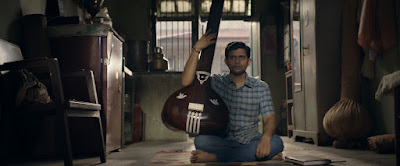
Those are central tensions in The Disciple, a new film from Indian writer-director-editor Chaitanya Tamhane. It follows a young musician (Aditya Modak) studying Indian classical music at the feet of a master (Arun Dravid). The 24-year-old is good, but not great. He’ll admit it. He spends time doting, with two other students, on the old guru, literally sitting at his feet. The old man gives them advice. They play backing for his concerts, intimate affairs in small rooms where he’ll drone on in long melodious phrases that invite the listener to lean in and study the quavering of the notes in a contemplative, meditative state. As the film goes on, with these long, patient sequences of teaching and listening, the film itself teaches the viewer how to listen. By the end, I felt I could differentiate between the workmanlike skills of the younger singers, and what sets distinguishes the brilliance of the elders. He is a movie about a man with a single-minded pursuit of his goal, and the many obstacles and competing ideas that get in his way. He devotes himself to the history and the craft of this form, even as the world seems determined to marginalize and undervalue the hard work he’s put into it.

As such it’s a story about passion and obsession—a pursuit of artistic purity as a dogged, stubborn, quixotic quest. The young man practices. He listens to lectures, rarities on tape he cherishes as a connection to the past. We hear them as he does, on long rides deep into the night down city streets. His devotion to his craft, his sacrifice—putting off urging of others to look for other work to help support himself while he struggles—becomes nigh fanatical. He simply must be the best. His late father, we learn, was a similarly passionate, frustrated practitioner of this classical music. There are all kinds of stubborn psychological implications underneath the long, placid pace of the lengthy shots and scenes. He’s following a chosen path of artistic purity passionately, devotedly, and maybe a little blindly. When confronted by fans, critics, musicians who see their field from a different perspective, he has a hard time reconciling these divisions. Similarly, he can’t always reconcile his continual hard work with his seeming lack of progress.

Here is a moving, gently cutting film that’s honest about the emotional labor involved in scraping out a marginal career in an artistic pursuit. Its accumulation of detail is well-chosen, well-considered. We see honest moments in which the young man is prickly toward those who don’t share his vision, even those who share some elements of his interests. We also see scenes of isolation, where the only companion he has at night is the lonely glow of a laptop screen. At his most frustrated, he seems to be asking why can’t others see in him what he is trying to perfect, or why others can’t care even a little bit about the aspects of his art he sees as essential. (Shades of Llewyn Davis, there.) The film is as slow and patient as this musician’s journey, with simple framing, steady zooms, and inevitable chipping away at a dream. This is a movie about an art and a trade, and the intersections that ask so much. The work is a source of frustration and satisfaction. It builds him up, even as he grinds in place.
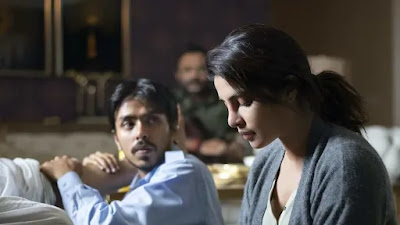
Ramin Bahrani’s The White Tiger is also a story of a striver, but its telling is brash and hustling, shot with a fluid Scorsesian swagger to its chopping pace, pushing camera, and energetic emphasis on inequalities. Where The Disciple finds its lead pining for a past structure for success and validation that seems to be slipping away from his generation, The White Tiger’s main character is an impoverished young man who looks at those exploiting his class and thinks, if you can’t beat them, exploit them. He (Adarsh Gourav) is a lower caste man who ingratiates himself into the lives of a wealthy couple (Rajkummar Rao and Priyanka Chopra Jonas). At first he’s thrilled to be one of their chauffeurs, but his close position to the rich family allows him a vantage point from which to see their privilege. They’re dripping in bribery and tax schemes, and no matter how nice they are to him, he’s still disposable. That becomes awfully clear sooner than later.

This inspires, in turn, our lead’s scheming and scraping, throwing his shoulder to the wheel of grubby capitalism to break out of his caste. Here’s a movie that deals with splashy scandal ruthlessly scapegoated, leveraged for merciless mutual benefit. Bahrani, whose earlier works are small observational films about American poverty—like the immigrant food truck operator in Man Push Cart, the orphaned children of Chop Shop, or the evicted families in 99 Homes—takes an emphatic approach here. His camera is often pushing or gliding, montage is quick and vigorous, narration is fluid and posturing. It becomes a bleakly entertaining, sometimes breathtakingly cynical picture of aspiration and wealth, looking at what this poor young man has to do to even try muscling his way into the upper class. It sees a society with a foundation of staggering inequality, understands the work and access needed to find a shallow success, and thinks that in a harsh world of winners and losers, even the winners are losers.

Sunday, October 11, 2015

Inequality for All: 99 HOMES


Michael Shannon and Andrew Garfield are opposing economic forces in 99 Homes, a deliberate and obvious recessionary American thriller set in the scraggly, ugly, ragged edge of the popped housing bubble. The older man is a Grim Reaper of real estate, evicting exhausted homeowners in a flurry of bullying panic, the better to flip the house for a nice profit. He’s colluding with banks, police, and lawmakers to line his pockets, exploiting loopholes, cheating the system, and calling that winning. The younger man is one of his victims, a single dad who, along with his son (Noah Lomax) and mother (Laura Dern), is thrown out of his family home after an unsuccessful appeal. Desperate to make money any way he can, he takes a job working for the very man who so slimly kicked his family to the curb. The young guy wears jeans and smokes; the older guy wears suits and vapes. They’re a study in contrasts, naïveté versus cynicism, good intentions versus heartless greed, together making the Faustian bargain we call the American dream.

Painting in big strokes, writer-director Ramin Bahrani combines the low-key observation of his breakthrough indies, films like Man Push Cart and Chop Shop, intimate class-conscious portraits of marginalized urban poverty, and the swaggering melodrama of his overripe corporate-agriculture-fighting-family-farms message movie, the pleasurably outsized At Any Price. The blend is an uneasy mix of scene chewing monologues and pokey naturalism. We follow Garfield as the need for money draws him into the shady underbelly of Florida real estate, the vulture capitalists preying on misfortune sown by the very industry in which they operate. “We don’t bail out the losers!” Shannon snaps, as if he’s prepping to open a Trump fundraiser. He’s made to speak the film’s moral perspective by shouting the opposite, unblinking in the face of the tragedy Bahrani wants to portray. Garfield, on the other hand, is asked to simply inhabit its lessons.

Towering over his new employee, Shannon’s shark lays out his worldview: America is a nation “of the winners, by the winners, for the winners!” It’s screaming blunt moralizing, while the movie’s message is better imbued in Garfield’s uneasy posture and embarrassed expressions as he’s forced to serve eviction notices, suddenly on the other side of the very shock he experienced not so long ago. He is living in a cheap motel room with his son and mother, surrounded by other similarly displaced families. Then he heads out on the job, where he’s creating insecurity in lives of people just like him. It’s a nasty position in which to be, especially when the siren song of material success shows him McMansions glittering for those who are able and willing to step on others to get there. This is the sort of deeply felt hot-button message movie that so cleanly and clearly lays out an obvious wrong, that its most agonizing moments caused bile to build up in the back of my throat.

Watching economic devastation and its exploitation is hard to take, especially as Garfield’s pained expression and torn conscience run up against the cold eyes of Shannon’s harsh money-grabbing, property-cheating worldview. It’s all too real, and yet Bahrani pushes past the immediate feeling of right and wrong, overemphasizing the devilish bargain with overheated speeches and undercooked characters. They’re symbols, no matter how good the actors are. Garfield is every blue-collar worker shoved out of a comfortable life, and Shannon is every suit who did the pushing. There’s not a lot of nuance here in the design, a defeatist plot loaded with coincidences, built only to shine a light on a murky corner of wrongdoing presented in obvious dichotomies. The muddy digital photography, at times a nearly unwatchable storm of fuzzy washed-out pixels, is an inadvertent compliment to the film’s unsatisfying approach: it’s too bright, and too smeared, starkly revealing too much while flattening the picture.

Still, what keeps this well-intentioned monotonous one-note movie marginally interesting are the performances. Garfield and Shannon are allowed space to breathe complexities into their characters that aren’t necessarily inherent in the material. The former reveals mild shark-like ambition through his psychological and economic turmoil, shaking off sadness to earn some dough, while the latter lets sneaking warmth bleed in around the edges of his evil eye for exploiting his worst tendencies. Then there’s Dern who plays the pure conscience of the movie, with literally nothing more to do than register the wrongness of what’s going on around her. She somehow makes that into something like a real character, a minor miracle. But what Bahrani does with these characters is so schematically obvious, clashing two mirrored men in an uneasy business relationship to the breaking point, the better to leave us wrung out with reminders of our country’s debased and broken response to continually deepening inequality.