We are in a moment that prizes the overnight success, the amateur who bests the pros, the wunderkind. Too often this robs us of recognizing the long, patient, apprenticeship which can deepen and strengthen an artist’s skills and appreciation for their chosen forms. Too often, too, we conflate hard work with good work; how frequently do you hear that putting-in-the-work and staying-on-that-grind is synonymous with working effectively or knowing your stuff? How frustrating for the youthful or even not-so-youthful and struggling artists to hear all their hard work must not be enough. Even monkish devotion to a chosen art is insufficient when confronted with those outside the fold.
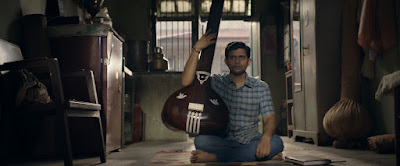
Those are central tensions in The Disciple, a new film from Indian writer-director-editor Chaitanya Tamhane. It follows a young musician (Aditya Modak) studying Indian classical music at the feet of a master (Arun Dravid). The 24-year-old is good, but not great. He’ll admit it. He spends time doting, with two other students, on the old guru, literally sitting at his feet. The old man gives them advice. They play backing for his concerts, intimate affairs in small rooms where he’ll drone on in long melodious phrases that invite the listener to lean in and study the quavering of the notes in a contemplative, meditative state. As the film goes on, with these long, patient sequences of teaching and listening, the film itself teaches the viewer how to listen. By the end, I felt I could differentiate between the workmanlike skills of the younger singers, and what sets distinguishes the brilliance of the elders. He is a movie about a man with a single-minded pursuit of his goal, and the many obstacles and competing ideas that get in his way. He devotes himself to the history and the craft of this form, even as the world seems determined to marginalize and undervalue the hard work he’s put into it.
As such it’s a story about passion and obsession—a pursuit of artistic purity as a dogged, stubborn, quixotic quest. The young man practices. He listens to lectures, rarities on tape he cherishes as a connection to the past. We hear them as he does, on long rides deep into the night down city streets. His devotion to his craft, his sacrifice—putting off urging of others to look for other work to help support himself while he struggles—becomes nigh fanatical. He simply must be the best. His late father, we learn, was a similarly passionate, frustrated practitioner of this classical music. There are all kinds of stubborn psychological implications underneath the long, placid pace of the lengthy shots and scenes. He’s following a chosen path of artistic purity passionately, devotedly, and maybe a little blindly. When confronted by fans, critics, musicians who see their field from a different perspective, he has a hard time reconciling these divisions. Similarly, he can’t always reconcile his continual hard work with his seeming lack of progress.
Here is a moving, gently cutting film that’s honest about the emotional labor involved in scraping out a marginal career in an artistic pursuit. Its accumulation of detail is well-chosen, well-considered. We see honest moments in which the young man is prickly toward those who don’t share his vision, even those who share some elements of his interests. We also see scenes of isolation, where the only companion he has at night is the lonely glow of a laptop screen. At his most frustrated, he seems to be asking why can’t others see in him what he is trying to perfect, or why others can’t care even a little bit about the aspects of his art he sees as essential. (Shades of Llewyn Davis, there.) The film is as slow and patient as this musician’s journey, with simple framing, steady zooms, and inevitable chipping away at a dream. This is a movie about an art and a trade, and the intersections that ask so much. The work is a source of frustration and satisfaction. It builds him up, even as he grinds in place.
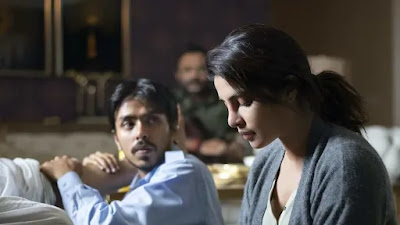
Ramin Bahrani’s The White Tiger is also a story of a striver, but its telling is brash and hustling, shot with a fluid Scorsesian swagger to its chopping pace, pushing camera, and energetic emphasis on inequalities. Where The Disciple finds its lead pining for a past structure for success and validation that seems to be slipping away from his generation, The White Tiger’s main character is an impoverished young man who looks at those exploiting his class and thinks, if you can’t beat them, exploit them. He (Adarsh Gourav) is a lower caste man who ingratiates himself into the lives of a wealthy couple (Rajkummar Rao and Priyanka Chopra Jonas). At first he’s thrilled to be one of their chauffeurs, but his close position to the rich family allows him a vantage point from which to see their privilege. They’re dripping in bribery and tax schemes, and no matter how nice they are to him, he’s still disposable. That becomes awfully clear sooner than later.
This inspires, in turn, our lead’s scheming and scraping, throwing his shoulder to the wheel of grubby capitalism to break out of his caste. Here’s a movie that deals with splashy scandal ruthlessly scapegoated, leveraged for merciless mutual benefit. Bahrani, whose earlier works are small observational films about American poverty—like the immigrant food truck operator in Man Push Cart, the orphaned children of Chop Shop, or the evicted families in 99 Homes—takes an emphatic approach here. His camera is often pushing or gliding, montage is quick and vigorous, narration is fluid and posturing. It becomes a bleakly entertaining, sometimes breathtakingly cynical picture of aspiration and wealth, looking at what this poor young man has to do to even try muscling his way into the upper class. It sees a society with a foundation of staggering inequality, understands the work and access needed to find a shallow success, and thinks that in a harsh world of winners and losers, even the winners are losers.
Showing posts with label Priyanka Chopra. Show all posts
Saturday, May 1, 2021
Friday, May 26, 2017
Beach Movie: BAYWATCH
Exactly the sort of big, dumb, industrial-strength, R-rated
action comedy primed for the chattering classes to claim superiority over, Seth
Gordon’s Baywatch movie is so base,
so low, and so sincere in its shameless tittering silliness and commitment to
creaky formula that of course it’s a good time at the movies. It’s shot with
phony glossiness, filled with hot bods in skimpy clothes, and ready to go for
endless banter and gross-out tangents alike. (A lengthy sequence of revulsive
body horror comedy in a morgue is the movie’s indefensible nadir.) But,
although it’s uneven, it’s also largely a good time. It has the grinning
comportment of a genial half-sleazy/half-silly goof, just far enough over the
top you can see its makers winking as they nudge their borrowed concept –
overzealous lifeguards interceding beyond their authority – in the ribs. We’re
not talking full on Lord/Miller meta in a screenplay credited to a committee of
six writers, but just a dusting of self-awareness to the pleasantly empty
formula.
Gordon fills the ensemble with a collection of aspiring
lifeguards under the macho man benevolence of Dwayne Johnson’s master swim
survivalist. He’s the best at what he does and, in typical The Rock movie
fashion, is only held back by those who won’t let him fix everything himself.
It’s how his AWOL rescue chopper pilot in San
Andreas doesn’t read as completely despicable when he absconds with Coast
Guard property, abandoning his post to save his own family. Here he’s whipping
a callow Lachte-lite scandalous Olympic swimmer (preposterously ripped Zac
Efron) into shape as his replacement, while the other lifeguards (runway ready Alexandra
Daddario, Ilfenesh Hadera, and Kelly Rohrbach, and chubby sight gag Jon Bass)
help out where they can. The whole thing could be dripping in leering objectification, a la the
original slow-mo bounce. But despite plenty of ogling, it’s all good-natured
and balanced between the genders: heaving cleavage and rippling pecs alike, and
suits hugging every sculpted tuchus tightly. There’s something refreshingly
harmless about its equal opportunity eye-candy frivolity.
A generic drug-smuggling action plot airlifted right out of
the 1980s passes for story – Priyanka Chopra’s kingpin (or should I say
“queenpin?”) is a stylish, affable villainous presence – but for all the
fireworks that conflict sets off – and satisfyingly so, with action beats
pleasantly brisk – it’s the loose hangout vibe of the picture that makes it
work more often than not. In its likeably slumming stars, splashy shiny half-faked beachfront cinematography, and sandy shaggy digressions (including some half-painful
cameos from the original series), the whole endeavor is so agreeably low. Although I still wonder if Gordon (having
made the likes of Four Christmases and
Horrible Bosses, decent for middling
affairs) will ever make a fictional comedy as good as his 2007 doc The King of Kong: A Fistful of Quarters (still
the funniest work of his career), this big-screen junk-TV revival is his best
attempt yet.
Thursday, August 8, 2013
Stuck on the Runway: PLANES
I’ve never found the world of Pixar’s Cars movies to be all that difficult to believe. It’s Earth, but
every living thing is a vehicle. Of course the level of realism is close to
nonexistent, but you know what else isn’t real? Talking cars. There comes a point
where you aren’t picking away at the plausibility of a fantasy world and you’re
just simply resisting the premise. When people wonder, say, how cars managed to
build a cathedral or why they’d need farms, well, there’s no good answer other
than “they just do.” Those questions simply don’t bother me because the world
of Cars and Cars 2 is nothing more than a moderately clever spin on ours that’s
only use is as a backdrop for fast-paced sequences of comedy and excitement
vividly brought to life through Pixar’s typically virtuosic attention to
animated detail and terrific sound effects. That they aren’t deep Pixar doesn’t
mean they aren’t enjoyable in their own right. They’re cartoony and operate
within their own cracked world perfectly. I choose to believe in it because I
find them fun enough to avoid nitpicky questions.
Planes, on the
other hand, is the movie that people who don’t like the Cars movies think they are. It’s a junk heap of cliché and
distractingly haphazard approach to keeping the fantasy world making some sort
of consistent internal sense. If nothing else, I hope it’ll help some Cars haters realize that, at the very
least, those movies aren’t this bad. Pixar
has had bad buzz around their recent sequels and prequels, as if follow-ups are
inherently uncreative. I don’t think that’s the case. Nor do I think that
they’re forced to make movies they don’t want to make. Proof is Planes, which is a spinoff of the Cars movies that was punted to their
corporate sibling Disney Animation to cook up as a direct-to-DVD release. For
some reason this on-the-cheap piece of rote animated family filmmaking has been
deemed worthy of the big screen. Maybe Disney had an opening on the schedule
they needed filling or hoped that it could cushion the blow of the mega-budgeted
The Lone Ranger should it flop. (It
did, but don’t let that stop you from seeing it if you haven’t. It’s very
good.)
Watching Planes
had me questioning aspects of this universe I’d never contemplated before. It’s
the story of a crop-duster (Dane Cook) who’d really like to be a racing plane.
With the encouragement of a fuel truck (Brad Garrett), a forklift (Teri
Hatcher), and a World War II (really) fighter plane (Stacy Keach), he enters an
international globetrotting race filled with lazy cultural shorthand for
contestants and destinations. The crop-duster is laughed at until he starts to
make progress and win friends with his good heart. But isn’t this world one
with a great deal of predetermination? If you’re born a crop-duster, don’t you
have some mechanical limitations that could never be overcome? If you’re born a
train, a popemobile, or a jumbo jet, isn’t your job pretty much set? Cars finds a racecar learning to enjoy
life in the slow lane, while Cars 2
finds a tow truck mistaken for a secret agent. But neither advocates them doing
things they’re just not built to do.
I realize it doesn’t make a good kid’s film moral to say
that these vehicles are built to do certain jobs and should be happy with their
lot in life, but isn’t that what’s happening here? To claim otherwise is to
promote willful ignorance about the way life in car-land is built. This world
has a pretty rigid caste system. Why else would a forklift (Sinbad) and the
other racers (Julia Louis-Dreyfus, John Cleese, Priyanka Chopra, Cedric the
Entertainer, Carlos Alazraqui, and Roger Craig Smith) relentlessly mock the
crop-duster for his God-given technical specifications? So what happens when a
vehicle goes into the shop? Is it major surgery to improve the engine block?
How about getting outfitted with shiny new aerodynamic wings? Plastic surgery
or performance enhancement? There’s a deeply strange moment when the
crop-duster is worried about removing his sprayer to improve his speed.
If there had been anything distinctive or enjoyable about
this movie I probably wouldn’t have been stuck contemplating the underlying
philosophy and countless technical details of this fantasy world. I also found
myself asking why this world even needs crops, let alone crop-dusters and, in
the vehicular World War II, what type of car was Hitler? A shot of the New York
City skyline had me briefly wonder what happened in this world on 9/11. I
realize these aren’t questions the target audience is likely to be asking, but
I had to do something to keep my mind active. It’s not often a studio approves
its own cheap knockoff, but here one is anyways. The animation is vanilla, the
plotting achingly predictable and painfully simple, and the moralizing cheap,
sentimental, and tone-deaf. (The only mildly enjoyable touch is the casting of
Anthony Edwards and Val Kilmer as Top Gun fighter jets.) Director Klay Hall and
screenwriter Jeffrey M. Howard (responsible for three direct-to-DVD Tinkerbell movies between the two of
them) have made a movie that’s nothing more than a timewaster, a space-filler,
and, worst-case scenario, a babysitter. Kids deserve better than this lame hunk
of junk.
Subscribe to:
Posts (Atom)

