There’s a transcendent sequence in the middle of Ryan Coogler’s Sinners where the power of blues music blows apart the boundaries between space and time. A 1930s’ speakeasy concert starts with a few chords on an inherited guitar and then suddenly, with a fluid camera move, is layered with inspirations past and present until ghosts and premonitions share the same space as the roof is set ablaze. It’s as bold and earnest and symbolically rich a gesture as any sequence a Hollywood genre picture has ever given us. It’s also the highest high in a high-powered movie—a musical and muscular and confident piece of craft. Coogler gives us a historical dark fantasy Deep South vampire musical and plays fair with each component part as he makes them a coherent whole. It’s a film that flows with The Blues, a heartfelt yowl of pain so potent it summons the supernatural. It’s also a film that moves with an urgent craftsmanship that propels its images and ideas forward to populist crowd-pleasing effect. Coogler has long been one of our most promising young directors. His based-on-a-true-story Sundance debut Fruitvale Station is a warm, intimate real-life tragedy. His following franchise efforts somehow center that same intimacy, with Creed finding new nuanced character studies stepping out of the shadow of Stallone’s Rocky, and his Black Panthers tackling messy sociopolitical and moving interpersonal concerns within the slam-bang explosions of CG expected from such entries. So of course Sinners shares the recognizable thematic preoccupations of a Coogler picture. It’s about legacy, lineage, protecting one’s community with a tension between insularity and inspiration, fraught family dynamics, grief, manipulation, and the light of mortal goodness in the depths of immortal darkness. And it displays these themes in massive, iconographic shots in filmic IMAX frames—a deeply satisfying crackling warmth imbuing its story with the personal touch—set to a crunchy, textured, regional score from the reliably excellent, and surprising, Ludwig Goransson.
It’s a visually and sonically enveloping blockbuster, suggesting an enormous world beyond its margins while balancing the genuine emotionality of characters’ earnest communications with the outsized metaphors of supernatural invasion. The first half of the picture follows twin gangsters (Coogler’s regular star Michael B. Jordan in a neat dual role) returned to their rural hometown from a stint in the Chicago mob wars. They’ve escaped with enough money and booze to build their own juke joint on the outskirts of sharecropper’s cotton acres. We watch as they set out recruiting people who’ll help them with their grand opening—an innocent cousin (Miles Caton), an ex-wife (Wunmi Mosaku), a bouncer (Omar Miller), a drunk pianist (Delroy Lindo), bartenders (Li Jun Li and Yao), and some attractive partiers (Hailee Steinfeld and Jayme Lawson). Their business is intended to be a refuge from Jim Crow oppression and hard work in the fields. But their solidarity is threatened by the vampire (Jack O’Connell) who hears the call of their music and demands to be let in. Coogler frames the conflict in eerie slow building to spasms of violence. In its melancholic final moments, quiet after the loud catharsis, we see
a young man, changed by his experiences of that fateful night, fully
embodying a memorable observation of Bram Stoker's Dracula: "No man knows till he has suffered from the night how sweet and dear to his heart and eye the morning can be." The movie’s moral seriousness and storytelling seduction are clearly in conversation with others of its blood-sucking genre—Kathryn Bigelow’s Near Dark’s roving rural vampires and John Carpenter’s Vampires’ pseudo-mythic realism, and Robert Rodriguez’s From Dusk Till Dawn’s giddy fang reveals. But it’s all Coogler in its crackling synthesis that’s a hugely satisfying popcorn experience and an honest expression of his thematic and stylistic concerns. It uses the tropes well, and has a tense escalation from the logic of their clever deployment, cutting on actions, and cross-cutting with a teasing sense of build and release that matches its emotional skill. To see it is to see one of our best young filmmakers step fully into his power.
Showing posts with label Ryan Coogler. Show all posts
Monday, April 21, 2025
Saturday, November 12, 2022
Life Finds a Way: BLACK PANTHER: WAKANDA FOREVER
I don’t envy the cast and crew of Black Panther: Wakanda Forever's task in creating a sequel after its star unexpectedly passed away. Imagine being obligated to make a blockbuster feature film for the most popular ongoing franchise for the biggest studio, but it has to be about the sudden death of your friend and co-worker. That writer-director Ryan Coogler and his collaborators manage to make a movie that’s simultaneously enormous spectacle and gently grief-stricken is some kind of miracle. It has such incredible liftoff that it manages to avoid the downward drag of Marvel formula for more of its runtime than you’d expect. Wakanda Forever is a superhero movie. Technically. But it’s not really interested in building huge CG slugfests, and, indeed, is at its worst when it has to fill half of its climactic confrontation with hectic effects shots of big armies blandly hurtling at each other. What does work is its mournful qualities, which extend not only to its characters mourning the death of Chadwick Boseman’s Black Panther, but to its exploration of the legacies left by tragedies—familial, royal, colonial. It opens with a funeral, and throughout finds tenderness in scenes with Queen Angela Bassett and Princess Letitia Wright. Starting with such somber celebration—a franchise sendoff that would be crass if it didn’t stay just on the right side of an honest salute—it keeps a fragility throughout.
This sequel finds the fictional African nation tossed into uncertainty as Western nations seek to exploit its resources. Meanwhile, Wakandans are also confronted with another secret nation—an underwater kingdom populated by mutant descendants of a lost Mayan tribe. And so the encroaching conflict is about indigenous survival in the face of genocidal oppression, and the ways in which the pressures of potential colonization turn tribes against each other. Coogler takes the time to build the antagonistic king of the underwater people, Namor (Tenoch Huerta Mejía), into a richer character than we usually see in the more formulaic of these pictures. With evocative backstory filled in quickly, in generously evocative historical flashbacks during a sensitive monologue, we see the pain of Namor’s past sits close to the surface. And the angling between Namor and the Wakandans takes on some complicated real-world edge as characters on all sides consider taking violent steps to protect their own, even at the cost of others. Pity that their conflict has to run through some scenes with Martin Freeman and Julia Louis-Dreyfus back in the States, especially since they tease a promising geopolitical wrinkle that’s summarily dropped. Besides, it’s underwater and in Africa that the movie is most alive.
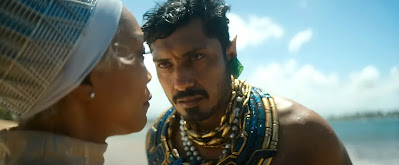
We get a sense of history in the ways the characters speak to each other, in their gestures and intentions, and as the frames push out into small, suggestive, murky glimpses of a fantastical setting. Coogler keeps his camera close to the characters, but pulls back just enough to give a sampling of worlds populated by unique peoples and cultures their rulers want to protect. The plot globe-hops in a way that feels expansive, and the stakes feel genuinely large. Turns out when you build conflict rooted in character and expressed through their emotional deliberations and deep lineages, you can suggest world-changing suspense without shooting a blue laser into the sky or summoning swarms of aliens or robots to punch for an hour at a time. The result is a comic book plot—complete with side-quests and living MacGuffins—that’s often warmly characterized. Wright, in contrast to the eager comic relief she played last time, is sunken with grief, and sees opportunity for connection with new characters before growing tempted by sorrowful vengeance. Bassett is strong regal suffering—a speech culminating in “Have I not given EVERYTHING!?” is a powerful expression of emotional pains. Returning supporting characters (Lupita N’yongo, Winston Duke, Danai Gurira) have slightly less to do, and I wish there was more attention paid to their moral dilemmas, but their presence is a warm reminder of what the first film did so well: building a community of characters whose words and deeds have consequences, and who relate to each other in ways that have actual weight.
Coogler, unlike most directors working for Marvel, has ideas and knows how to communicate them. His work—a day-in-the-life of a man murdered by police, Fruitvale Station; a celebration of an old franchise by reframing its perspective, Creed; and the original Black Panther—has consistently considered questions of what one can build for oneself while alive, and what one leaves behind for others once gone. He’s suited to make a film about an absence, about characters struggling to live up to a good example that’s been taking from them too soon. But this is also a movie that complicates this easy sadness. It’s earnestly committed to questioning violence and lamenting cycles of retribution. It comes by this honestly, engaged with issues of vengeance and victimhood, expectation and exploitation. Namor is never entirely in the wrong; Wakandans are never entirely right. This makes for good drama, with our heroes wrestling with a sense of morality, weighing what’s satisfying in the moment against what might be better long term. In the movie’s most exciting moments, the spectacle—a fun car chase with an instantly-compelling new character, a concussive water-bombing of Wakanda—runs hand-in-hand with a thrilling sense of wondering how these peoples can find a way to deescalate.
By the end, though, the movie has lost some track of these ideas, burying them in so much zapping and stabbing and chaos that’s atypically, for Coogler, and typically, for Marvel, unreflected upon. I found myself puzzling back through the chain of events and lamenting the shortcuts and sanding-down that had to happen to force a more typically Marvel climactic collision. Here’s a movie that pretty persuasively makes its own case against the formulaic stuff that’s weighing it down. It’s difficult to care about armies colliding, let alone the teases for future conflict, when the movie itself has made it clear it is about, and builds towards more characters realizing, that war does not make one great. Coogler has made an open-hearted franchise picture that’s often genuinely funereal and always interested in rebuilding its heroes’ broken hearts by helping them find new purpose. For the first couple hours, it’s alive and engaged and animated by interesting ideas beneath the fast vehicles, big explosions, and sparingly deployed quips. And in its final moments, it returns to a soft, quiet, tender spirit. That’s the stuff that will linger long after the noisy, simple, limp action of the finale fades.
This sequel finds the fictional African nation tossed into uncertainty as Western nations seek to exploit its resources. Meanwhile, Wakandans are also confronted with another secret nation—an underwater kingdom populated by mutant descendants of a lost Mayan tribe. And so the encroaching conflict is about indigenous survival in the face of genocidal oppression, and the ways in which the pressures of potential colonization turn tribes against each other. Coogler takes the time to build the antagonistic king of the underwater people, Namor (Tenoch Huerta Mejía), into a richer character than we usually see in the more formulaic of these pictures. With evocative backstory filled in quickly, in generously evocative historical flashbacks during a sensitive monologue, we see the pain of Namor’s past sits close to the surface. And the angling between Namor and the Wakandans takes on some complicated real-world edge as characters on all sides consider taking violent steps to protect their own, even at the cost of others. Pity that their conflict has to run through some scenes with Martin Freeman and Julia Louis-Dreyfus back in the States, especially since they tease a promising geopolitical wrinkle that’s summarily dropped. Besides, it’s underwater and in Africa that the movie is most alive.
We get a sense of history in the ways the characters speak to each other, in their gestures and intentions, and as the frames push out into small, suggestive, murky glimpses of a fantastical setting. Coogler keeps his camera close to the characters, but pulls back just enough to give a sampling of worlds populated by unique peoples and cultures their rulers want to protect. The plot globe-hops in a way that feels expansive, and the stakes feel genuinely large. Turns out when you build conflict rooted in character and expressed through their emotional deliberations and deep lineages, you can suggest world-changing suspense without shooting a blue laser into the sky or summoning swarms of aliens or robots to punch for an hour at a time. The result is a comic book plot—complete with side-quests and living MacGuffins—that’s often warmly characterized. Wright, in contrast to the eager comic relief she played last time, is sunken with grief, and sees opportunity for connection with new characters before growing tempted by sorrowful vengeance. Bassett is strong regal suffering—a speech culminating in “Have I not given EVERYTHING!?” is a powerful expression of emotional pains. Returning supporting characters (Lupita N’yongo, Winston Duke, Danai Gurira) have slightly less to do, and I wish there was more attention paid to their moral dilemmas, but their presence is a warm reminder of what the first film did so well: building a community of characters whose words and deeds have consequences, and who relate to each other in ways that have actual weight.
Coogler, unlike most directors working for Marvel, has ideas and knows how to communicate them. His work—a day-in-the-life of a man murdered by police, Fruitvale Station; a celebration of an old franchise by reframing its perspective, Creed; and the original Black Panther—has consistently considered questions of what one can build for oneself while alive, and what one leaves behind for others once gone. He’s suited to make a film about an absence, about characters struggling to live up to a good example that’s been taking from them too soon. But this is also a movie that complicates this easy sadness. It’s earnestly committed to questioning violence and lamenting cycles of retribution. It comes by this honestly, engaged with issues of vengeance and victimhood, expectation and exploitation. Namor is never entirely in the wrong; Wakandans are never entirely right. This makes for good drama, with our heroes wrestling with a sense of morality, weighing what’s satisfying in the moment against what might be better long term. In the movie’s most exciting moments, the spectacle—a fun car chase with an instantly-compelling new character, a concussive water-bombing of Wakanda—runs hand-in-hand with a thrilling sense of wondering how these peoples can find a way to deescalate.
By the end, though, the movie has lost some track of these ideas, burying them in so much zapping and stabbing and chaos that’s atypically, for Coogler, and typically, for Marvel, unreflected upon. I found myself puzzling back through the chain of events and lamenting the shortcuts and sanding-down that had to happen to force a more typically Marvel climactic collision. Here’s a movie that pretty persuasively makes its own case against the formulaic stuff that’s weighing it down. It’s difficult to care about armies colliding, let alone the teases for future conflict, when the movie itself has made it clear it is about, and builds towards more characters realizing, that war does not make one great. Coogler has made an open-hearted franchise picture that’s often genuinely funereal and always interested in rebuilding its heroes’ broken hearts by helping them find new purpose. For the first couple hours, it’s alive and engaged and animated by interesting ideas beneath the fast vehicles, big explosions, and sparingly deployed quips. And in its final moments, it returns to a soft, quiet, tender spirit. That’s the stuff that will linger long after the noisy, simple, limp action of the finale fades.
Friday, February 16, 2018
Superb Hero: BLACK PANTHER
Black Panther is
easily one of the best entries in the Marvel Cinematic Universe, at this point
a sprawling, occasionally mind-numbing constant in modern multiplexes. This one
succeeds for the same reasons the other good ones do. It’s loaded with a ridiculously
charismatic and overqualified cast delivering good-enough quips, and built out
of splashy comic book action that barely overstays its welcome. But the movie
leaves a slightly bigger than average impression because it is allowed a bit
more personality. Offering control over to Ryan Coogler, the promising young
writer-director of Fruitvale Station and Creed, the story of the princely
superhero ruler of fictional pan-African paradise Wakanda is given a genuine
charge of retro-Afro-futurism. Here is a gleaming modern city hidden away
behind a force-field in the heart of Africa, the capitol of Wakanda, a country
both a towering symbol of sci-fi technical might – the most advanced in the
world – and rich in tribal tradition. Untouched by colonialism and slavery,
Wakanda is strong and isolated. This becomes both its greatest asset and a
potential weakness, as characters debate the long-held seclusion of their
people. What do they owe the greater world? Heavy is the head that wears the
Black Panther crown. There’s slightly more charge – in politics, character
dynamics, and world-building – than is the norm in this type of thing.
Played with paradoxically shy bravado, a soft-spoken
Chadwick Boseman is T’Challa, ruler and protector of Wakanda, and the hero of
the title. We last saw him introduced in the worst MCU film, the interminably
boring Captain America: Civil War,
where his father was killed in a terrorist bombing. Now, his people look to him
to lead. His mother (Angela Bassett), tech-genius sister (Letitia Wright),
advisors (Forest Whitaker, Daniel Kaluuya), spy (Lupita Nyong’o), rival (Winston
Duke), and military leader (Danai Gurira) have competing and overlapping
interests. Some wish them to be more proactive, sharing their technology –
flying cars, miracle medicine, hover trains – with the world’s underprivileged.
Others wish to protect their secrecy at all costs. Enter the villains – a
scene-chewing thief (Andy Serkis’ Ulysses Klaue, last seen getting his arm
chopped by Ultron in Avengers 2) and
a rabble-rousing zealot (Michael B. Jordan) – who are hellbent on breaking into
Wakanda and zooming out with high-powered weapons to send hither and yon to the
oppressed everywhere. A new world order is what they’re after, and though deep
down they ideologically align with the Wakandan ideals of freedom, their process
is suspect. Yes, Wakanda may be prepared to fight off baddies with violence –
they have an army and battle-rhinos, after all – but at least they aren’t
indiscriminately murdering their way through a plot for world domination. There
is real political heat to this conflict, and it is rooted inextricably in
character. Jordan, especially, brings great simmering rage and expressive,
pointed attack that’s more vivid and personal than the typical superhero
villain.
So Coogler does more than the usual MCU picture gets up to,
while managing to draw several immediately lovable new characters and
relationships. It’s an entire cast of scene-stealers, fun on the surface. But,
beyond the pleasure of charming performances, that it’s an all-black cast makes
it powerful representation – a swaggering thrill of diversity in an otherwise
very white franchise. It’s not even explicitly addressed in the film itself; best
is how it takes this state as natural and right and moves on to business as
usual. Here the cast goes zipping through light banter and fun action. There’s a car
chase through Korea that’d be the best action sequence in any other MCU film,
and its almost a letdown following a fantastic brawl in an underground casino –
sets up a space that looks like a Bond lair and sings with a Kendrick Lamar song
before sliding through a digitally-composited long take that slides up and down
a multi-level set. It has exquisite design, clothing its characters in colorful
patterns and an assortment of accessories drawing equally from African fashion
through the ages and vintage Marvel looks from the groovy to the modern. That
it has all this vibrancy of personality and ideas makes it all the more
depressing that it must culminate in one of those endless CGI slugfests that –
though still slightly more fun than the deadening conclusions to, say, the
otherwise semi-charming Guardians of the
Galaxy – will clearly call out for a fast-forward button in any at-home
rewatch. Still, it effortlessly and entertainingly opens up a fascinating new
corner in a franchise that risked falling into dull repetition. It may fall
into the same routine eventually, but at least it gives us something relatively
fresh to admire on the way there.
Thursday, November 26, 2015
Eye of the Fighter: CREED
Adonis Creed (Michael B. Jordan) hopes to prove he’s not
making a mistake following in his father’s footsteps. Similarly, Creed hopes to prove it’s not a mistake
to make another Rocky movie. Adonis’s
old man was legendary boxer Apollo Creed (Carl Weathers), who years ago fought
Rocky Balboa (Sylvester Stallone) and became his friend. Creed, Sr. died in the
ring before his son, the result of an affair, was born. Now the young man, who
bounced around the foster care system before being taken in by his dead father’s
widow (Phylicia Rashad), is out to become a great boxer on his own. So both the
movie and its lead character could be held back by impossible expectations and
audience skepticism: the sixth sequel to an Oscar-winning introduction to an iconic
character, and the son of a champion looking to excel in the very arena that
made his father famous. You could be excused for thinking they’d both be
coasting on past glories and fans’ lingering affections for earlier triumphs.
But writer-director Ryan Coogler had other ideas, playing off resonances of the
past and building on sturdy genre tropes to make a solid, exciting movie worthy
of its predecessor’s legacies.
It’s a glossy boxing picture, the kind where even the grit
and grain in Maryse Alberti’s cinematography is pretty. It hauls out every
cliché: training montages, downbeat hardships, a hotshot rival, crusty old
coaches, and sad diagnoses for not one but two supporting characters. And yet,
it works. Coogler, whose Fruitvale
Station, a clear-eyed and intimate last-day-in-the-life of a victim of
police violence (also starring Jordan), was one of the most notable debut films
in recent memory, brings Creed a
grounding in emotional realities. Adonis, hoping to get an anonymous start in
the sport, moves to Philadelphia to train, slowly coaxing Rocky himself to be
his trainer. He doesn’t want to use his father’s name, but he’s eager to
befriend someone who really knew the man. Scenes between Jordan and Stallone
are exceptionally tender, mixed with a macho joking and jostling. They quickly
come to care for one another, each giving their new friend reasons to push
themselves to be better. Their dynamic is hardly surprising, but likable
nonetheless.
It’s smart to position Rocky as the coach, allowing the
franchise’s past to recede into the background as old memories informing the
present realities. It’s tied to events of his previous films – we get direct
references, through dialogue, props, photos on the wall, and footage of old
matches, to every single one of them – but it’s no longer his story, although he gets several terrifically moving scenes. He’s not to around the recapture his former glory. He's here
to help train a new guy. Though it’s at times almost impossibly pinned in by
demands of fan service and genre formula, Coogler, with co-writer Aaron
Covington, spins out of those traps by giving the movie over to Creed, whose
ambition and appeal lead him into the usual early bouts and steadily improving
training all leading up to a high-profile offer to participate in a match with a
current reigning champion (actual pro boxer Tony Bellew). Well-worn tropes are invigorated
with exceptionally well-directed scenes, stirring long takes that dance through
the ring holding tight on the athletes, or quick, crisp wham-bang punchy
editing hammering home the hits, and observant close-ups for soft dialogue in
fine dramatic beats between the main events.
Echoes of Rocky are
here in the structure, right down to the lovely halting romance with a sweet
Philly woman (Tessa Thompson), but Coogler deftly, confidently flips its racial politics in a satisfying, unspoken representation-centered way, as Jordan takes the center and makes the film his own. He commands the
screen with his charisma, his striking physicality and believable punches
mixing with a vulnerability, a neediness, a desire to prove himself motivating
every action, from a sweet first date to a brutal final fight. Well-acted across
the board, the ensemble is fine-tuned to the mumbling rhythm of people who
aren’t eloquent speakers, but are effective communicators nonetheless, people
who know how to express themselves through their body language, through small
gestures. Coogler makes great use of their presences, a combination of megawatt
youthful star power – Jordan and Thompson are charming and intensely
sympathetic – and wistful legacy – Stallone, every bit the past-his-prime
legend for whom people still have affection, and Rashad, easy enough to believe
as a beloved maternal presence whose famous husband did her wrong.
Coogler’s evident love for the genre and the series helps.
He knows how to work it, jabbing at the audience with emotional manipulation,
amping up the visceral responses with whomping violence in the ring, and using
both subtle and obvious Rocky iconography
to goose the nostalgic elements without taking away from the story’s own
stand-alone potential. Perhaps the best example of this is the stirring use of Bill
Conti’s famous “Gonna Fly Now” melody, teased throughout Ludwig Goransson’s
score, then triumphantly unveiled in full at a key climactic moment. It matches
the crescendo of the picture, a slow, confident build through expected beats to
arrive at an end that’s unexpectedly involving. Somehow both familiar and
fresh, this is a fantastically crowd-pleasing movie, mostly what you’d think
you’ll get from a boxing picture, especially in its tense final rounds, but
elevated by the exceptional craft: smartly structured, movingly acted,
confidently directed. That it works so well is no mistake. It’s what you get
when talented people know what they’re doing with the legacy they’ve been
charged with extending.
Tuesday, July 30, 2013
A Day in the Life: FRUITVALE STATION
Fruitvale Station
is named for the train station in Oakland, California where an unarmed 22-year-old
African American man named Oscar Grant was shot in the back and killed by a
transit policeman on January 1, 2009. This could easily have been a film of
martyrdom, a single-minded story of how a wholly good person was gunned down by
societal forces that to this day allow certain members of our society to view
certain groups as somehow inherently suspicious, even dangerous, for arbitrary
reasons. But 27-year-old writer-director Ryan Coogler in his most promising
feature film debut has instead smartly made this a story about life in all its complexity
and promise. The inherent and real societal problems illuminated by this tragic
story shine all the more clearly by both not forcing the details of Oscar’s
life to fit simplistic politically convenient stereotypes and reducing the
violent act itself to a small part of the overall narrative. This is not a film
that looks for tears only by showing the details of a wrongful death, but by
showing the details of the life that was cut short.
After chunky, shaky cell phone footage, a partially
abstracted scene of impending doom that sets an ominous mood, the film moves
backwards to its real focus, starting the morning of December 31, 2008. Oscar
(Michael B. Jordan) starts his day with his girlfriend (Melanie Diaz) and their
extremely cute four-year-old daughter (Ariana Neal). It’s a day of transitions.
A new year is nearly here, the world poised to change in superficial ways,
while staying all too the same in all the ways that matter. We follow Oscar
around town as he makes preparations for the evening’s celebrations, which will
culminate in catching the train into San Francisco for New Year’s fireworks, but start
with a birthday party for his mother (Octavia Spencer). He meets friends, runs
errands, and tries to talk the manager at the grocery store into rehiring him.
He gets gas, cradles a stray dog, and offers advice to a friendly lady at the
deli counter. It’s an ordinary day, albeit one positioned perfectly for
contemplation of the future.
This slice-of-life film simply presents a moment of time.
The action on screen could be the day-to-day life of a great many people. What
makes it important and notable is not the way this day will end. It’s important
for no reason other than the core humanity on display. Jordan allows his performance a staggering amount of unshowy
range, shifting between pride and love, stubbornness and compassion. In his
interactions with friends and family, we see a young man with an identity still
in flux. He’s dependable, ambitious, compassionate, and searching. He contains
multitudes. He’s pulling his life back together after a brief stay in prison,
but he’s not simply an ex-convict. He’s a loving boyfriend, father, son, and
brother. But he’s not simply a one-note family man. He’s an adaptable striver,
able to fit into many situations with a sense of ease. He’s not just an
everyman. He’s this man.
This is a performance and a film that draws upon cinema’s
capacity for empathy, for giving us deep insight into a life that’s not our
own. It’s a film filled with countless little details of performances that
resonate through nothing more than their ordinariness. It’s a film of moments,
warm and natural: a birthday party, a car ride, a soft romantic interlude, a
fatherly reassurance, a tense exchange. These and more feel merely normal with
an unforced ease. Brief moments of foreshadowing might push too hard, but
Coogler’s script is admirably loose in moments that feel spontaneous. His
camera, often reminiscent of the Dardenne brothers’ in its sense of precise
connection to the performances and found poetry of location shooting, follows
his actors closely, tenderly, observing without judgment, without
generalization, and without insistence. There’s only humanity here. That’s what
takes center stage in this narrative, despite the knowledge that a tragic turn
of events draws nearer.
Because we’ve come to know these characters, the final
moments play out not with overwhelming horror, but a sense of stunned
disbelief. It’s here that it is easiest to see Coogler’s remarkable restraint
and emotional precision. The film is tender and compassionate to all involved. Look
at Spencer’s face in the hospital as she’s confronted with the sad news,
stunned and raw. The shot feels long and devastating. Earlier at the station, look
at the face of the officer (Chad Michael Murray) as he realizes what just
happened, an expression of ambiguous shock. The shot is quick, yet important to
the film’s observant style. Most haunting is a shot of Diaz and Neal during a
long pregnant pause in the final scene, the occasion to cut to credits before
we hear a character’s reply.
This is a film that wisely stops unresolved. How can there
possibly be a satisfying resolution here? There are no easy answers and it is
to Coogler’s credit that he doesn’t let the film reach for closure it can’t
find or conclusions it can’t draw. But how did we get here, from such a
promising young man’s daily life to its sudden, shocking end? Coogler’s calm
filmmaking takes the film to a place more lingeringly emotional and more
productively complex than overt anger or hagiography would have. Injustice is
obvious. How we’re to feel about this is wisely complicated by the film instead
of simplified and pre-digested. It’s a powerful drama, forceful and
accomplished, with plenty to consider well after the credits have rolled. This
story of a death is filled with so much heartbreaking life. The final moments
are a tragedy not just for what happened, but also for what was taken away.
Subscribe to:
Posts (Atom)


