Showing posts with label Julia Louis-Dreyfus. Show all posts

Tuesday, February 14, 2023

Love at First Slight:
YOUR PLACE OR MINE and YOU PEOPLE

Movies should more often be about beautiful people falling in love. It’s one of the most pleasurable plots cinema has to offer. When a movie can make you root for appealing celebrity performers twinkling with charm to finally get on the same wavelength to swoon and smooch, that’s a magic no effects can buy. I, like most who came of age cinematically in the 90s, have a particular affection for that era’s brand of romantic comedy artifice: high-gloss and high-concept, shot in big bright urban spaces and glamorously implausible apartments, and loaded up with reasonably clever banter and pop montages. When all of that is working at a decent clip, what more could you want? We don’t get that enough these days, especially in theaters where the comedy of any sort is a dying breed, and the rom-com leading the way out to the streaming services. That’s why last fall’s Ticket to Paradise was an oasis in this genre desert. How pleasant an afternoon to sit with an appreciative crowd and watch stars pantomime an inevitable slide in romance. Credit Netflix for trying to keep this sort of movie alive, I suppose, although a decent evening home is no substitute for the crowd when it’s a clear crowd-pleaser on screen. They have two new, prominent ones out now, and they each make for a good watch.

I had an amiable time with Your Place or Mine, the directorial debut of screenwriter Aline Brosh McKenna. She’s the voice behind The Devil Wears Prada and Morning Glory, so she knows her way around a charming studio movie of this scale. It stars genre vets Reese Witherspoon and Ashton Kutcher as longtime pals who once, in their younger years, might’ve been more than that. They live on opposite coasts, though, and therefore have an entirely call-and-text based friendship. Circumstances contrive to get them to swap houses for a week—he moving into her LA home to supervise her teenage son while she’s crashing in his New York apartment during a business trip. As with Sleepless in Seattle, it makes the most of the continental separation to stretch this romantic tension. But by keeping up their phone chats—in perfunctory split-screen that could’ve used a bit more Pillow Talk cleverness— while settled in the trappings of the other’s routine, they slowly and unknowingly edge back toward their earlier romantic possibilities. Witherspoon and Kutcher can crank up the charm in their voices, even as their eyes sparkle and they slide through the genre’s usual paces. The result is cute and sweet and full of the usual cast of supporting eccentrics of clever friends, oddball neighbors, and other potential partners (Tig Notaro, Steve Zahn, Rachel Bloom, Zoe Chao, Jesse Williams, and more). This is a soft and comfortable version of this sort of movie, with just enough charm to keep proceedings pleasant.

There’s a bit more superficial edge to Kenya Barris’s You People, but it comes around to a satisfyingly sickly sweet sentimentality in the end. It’s the feature debut of the prolific sitcom writer best known for Black-ish, and treads some similar water angling into modern race relations while brushing past class. Co-writer Jonah Hill stars as a Jewish podcaster who falls for a Black Muslim costume designer (Lauren London). Would you believe meeting the parents becomes a rolling social satire once the couple decides to get married? This Apatowian riff on Guess Who’s Coming to Dinner gets most of its comic energies here. Hill’s parents are cringingly well-meaning liberals who are so flop-sweat desperate to appear accepting that they circle all the way around to offensive. Played by Julia Louis-Dreyfus and David Duchovny, they are devastatingly awkward in scenes that stretch their niceties to clumsy outrages on the regular. Even better are London’s parents. Mother Nia Long side-eyes like a pro and jabs with cutting quips. Her father is Eddie Murphy, who can still take a so-so line of dialogue into the stratosphere of hilarity through nothing more than sheer charismatic commitment. In a supporting cast full of funny people (every role, down to the smallest is cast with amusing figures), he’s the biggest reason to see the movie. His constant testing of Hill is a fine, funny skewering, from needling the young man about the title of a rap song to backing him into blustering corners by pressing about the specifics of books it’s clear Hill hasn’t read. The whole thing builds to the mistaken breakups and inevitable apologies and the lovey reconciliation. (And a dance party over the credits, natch.) It errs on the side of sitcom styling, and is gilded with stylistic tics in scattershot establishing shots, but has an ear for honest stumbling conversations that erupt in big punchlines at a good, regular clip. I could imagine a packed theater crowd rolling with satisfied laughter, and maybe sniffling a bit at the finale.

Saturday, November 12, 2022

Life Finds a Way: BLACK PANTHER: WAKANDA FOREVER

I don’t envy the cast and crew of Black Panther: Wakanda Forever's task in creating a sequel after its star unexpectedly passed away. Imagine being obligated to make a blockbuster feature film for the most popular ongoing franchise for the biggest studio, but it has to be about the sudden death of your friend and co-worker. That writer-director Ryan Coogler and his collaborators manage to make a movie that’s simultaneously enormous spectacle and gently grief-stricken is some kind of miracle. It has such incredible liftoff that it manages to avoid the downward drag of Marvel formula for more of its runtime than you’d expect. Wakanda Forever is a superhero movie. Technically. But it’s not really interested in building huge CG slugfests, and, indeed, is at its worst when it has to fill half of its climactic confrontation with hectic effects shots of big armies blandly hurtling at each other. What does work is its mournful qualities, which extend not only to its characters mourning the death of Chadwick Boseman’s Black Panther, but to its exploration of the legacies left by tragedies—familial, royal, colonial. It opens with a funeral, and throughout finds tenderness in scenes with Queen Angela Bassett and Princess Letitia Wright. Starting with such somber celebration—a franchise sendoff that would be crass if it didn’t stay just on the right side of an honest salute—it keeps a fragility throughout.

This sequel finds the fictional African nation tossed into uncertainty as Western nations seek to exploit its resources. Meanwhile, Wakandans are also confronted with another secret nation—an underwater kingdom populated by mutant descendants of a lost Mayan tribe. And so the encroaching conflict is about indigenous survival in the face of genocidal oppression, and the ways in which the pressures of potential colonization turn tribes against each other. Coogler takes the time to build the antagonistic king of the underwater people, Namor (Tenoch Huerta Mejía), into a richer character than we usually see in the more formulaic of these pictures. With evocative backstory filled in quickly, in generously evocative historical flashbacks during a sensitive monologue, we see the pain of Namor’s past sits close to the surface. And the angling between Namor and the Wakandans takes on some complicated real-world edge as characters on all sides consider taking violent steps to protect their own, even at the cost of others. Pity that their conflict has to run through some scenes with Martin Freeman and Julia Louis-Dreyfus back in the States, especially since they tease a promising geopolitical wrinkle that’s summarily dropped. Besides, it’s underwater and in Africa that the movie is most alive.
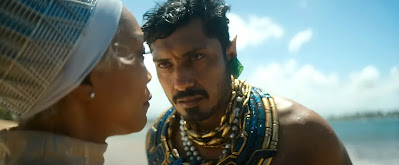
We get a sense of history in the ways the characters speak to each other, in their gestures and intentions, and as the frames push out into small, suggestive, murky glimpses of a fantastical setting. Coogler keeps his camera close to the characters, but pulls back just enough to give a sampling of worlds populated by unique peoples and cultures their rulers want to protect. The plot globe-hops in a way that feels expansive, and the stakes feel genuinely large. Turns out when you build conflict rooted in character and expressed through their emotional deliberations and deep lineages, you can suggest world-changing suspense without shooting a blue laser into the sky or summoning swarms of aliens or robots to punch for an hour at a time. The result is a comic book plot—complete with side-quests and living MacGuffins—that’s often warmly characterized. Wright, in contrast to the eager comic relief she played last time, is sunken with grief, and sees opportunity for connection with new characters before growing tempted by sorrowful vengeance. Bassett is strong regal suffering—a speech culminating in “Have I not given EVERYTHING!?” is a powerful expression of emotional pains. Returning supporting characters (Lupita N’yongo, Winston Duke, Danai Gurira) have slightly less to do, and I wish there was more attention paid to their moral dilemmas, but their presence is a warm reminder of what the first film did so well: building a community of characters whose words and deeds have consequences, and who relate to each other in ways that have actual weight.

Coogler, unlike most directors working for Marvel, has ideas and knows how to communicate them. His work—a day-in-the-life of a man murdered by police, Fruitvale Station; a celebration of an old franchise by reframing its perspective, Creed; and the original Black Panther—has consistently considered questions of what one can build for oneself while alive, and what one leaves behind for others once gone. He’s suited to make a film about an absence, about characters struggling to live up to a good example that’s been taking from them too soon. But this is also a movie that complicates this easy sadness. It’s earnestly committed to questioning violence and lamenting cycles of retribution. It comes by this honestly, engaged with issues of vengeance and victimhood, expectation and exploitation. Namor is never entirely in the wrong; Wakandans are never entirely right. This makes for good drama, with our heroes wrestling with a sense of morality, weighing what’s satisfying in the moment against what might be better long term. In the movie’s most exciting moments, the spectacle—a fun car chase with an instantly-compelling new character, a concussive water-bombing of Wakanda—runs hand-in-hand with a thrilling sense of wondering how these peoples can find a way to deescalate.

By the end, though, the movie has lost some track of these ideas, burying them in so much zapping and stabbing and chaos that’s atypically, for Coogler, and typically, for Marvel, unreflected upon. I found myself puzzling back through the chain of events and lamenting the shortcuts and sanding-down that had to happen to force a more typically Marvel climactic collision. Here’s a movie that pretty persuasively makes its own case against the formulaic stuff that’s weighing it down. It’s difficult to care about armies colliding, let alone the teases for future conflict, when the movie itself has made it clear it is about, and builds towards more characters realizing, that war does not make one great. Coogler has made an open-hearted franchise picture that’s often genuinely funereal and always interested in rebuilding its heroes’ broken hearts by helping them find new purpose. For the first couple hours, it’s alive and engaged and animated by interesting ideas beneath the fast vehicles, big explosions, and sparingly deployed quips. And in its final moments, it returns to a soft, quiet, tender spirit. That’s the stuff that will linger long after the noisy, simple, limp action of the finale fades.

Friday, March 6, 2020

Family Quest: ONWARD

Pixar spent the last decade mostly turning out sequels, some good (Incredibles 2) and many middling. Now the once great factory of fresh computer animated classics has given us its new standalone feature: Onward. Like the best of its recent original works — Coco, Inside Out, The Good Dinosaur — it’s a film about growing up, a coming-of-age scramble nestled inside a melancholy metaphor that pushes on the emotional pressure points of its audience. Here’s a movie about an elf-boy in a world that imagines the fantasy pasts of cheap paperbacks and roleplaying games is now our modern day — the wilds of wizards and castles and enchanted forests now suburbs and gas stations and highways, the magic of staffs and spells now smartphones and minivans. (As you might expect, the widescreen visual look of the world has its little delights and storybook charm.) The boy is missing his long-dead father acutely on this, his sixteenth birthday. Luckily, his dad left a present to be opened on this day: a spell that’ll bring him back for just one day. It goes slightly wrong, leaving only a pair of legs in father-fashion khakis and loafers. (There are some good gags made out of this, and the more upsetting details are assiduously ignored.) Now the son must find a phoenix jewel (rebirth and all) with the help of his oafish Dungeons & Dragons-style fanboy older brother, a quest that takes them out into the magic on the edges of society, while testing their prickly fraternal bond. So it’s also the vintage Pixar special: the buddy comedy. It’s as sprightly a chase as it is a jab in the tear ducts, somehow giving the audience something that’s at once overfamiliar and unexpected, warmly funny, easily appealing, and comforting even in its rougher edges.

The film is full of typical Pixar touches, though more modest in its effect and depth. Writer-director Dan Scanlon (of the strangely forgotten Monsters University) brings to the picture genre play that is featherlight, a gentle needling of fantasy tropes while wholeheartedly embracing the fetch quest construction. But for however simple the plot, the emotions do run deep and true. It may have the shape of a machine-tooled moving response machine — all levers and buttons flipped and pushed to shape the necessary payoffs — but the warm vocal performances of Tom Holland and Chris Pratt are loveably believable cartoonish brothers, and the ache of their need to connect with a father they barley knew is sometimes palpable. The ultimate conclusion is surprising and satisfying, though I wish the movie was better equipped to dig deeper and more cleverly into its premise. (What, exactly, is the relationship between the very real magic and the rest of society? No underground support group like the shark’s in Finding Nemo? And why doesn’t the boy’s mother (Julia Louis-Dreyfus) get to spend time with her husband’s legs?) Pixar of yore would’ve wrung every drop of wonder and delight out of its conceit, its premise, and its world. Imagine the airtight structure of Toy Story or the swooning accumulated details of WALL-E. Alas. Onward nonetheless points a way forward, reaffirming the studio’s commitment to new stories to tell in its typically detailed style and earnest emotive effort. The characters are just too sympathetic and the quest too pure to deny. A sequence where the lad prepares to step out over a bottomless pit is as good — suspenseful and charming — as any I’ve seen of late, and a fine metaphor for the company itself. I’d rather Pixar be taking that leap of faith than retreading past successes any day. Onward and upward.

Sunday, September 29, 2013

Talk it Out: ENOUGH SAID


If simply stated, the story of Nicole Holofcener’s Enough Said could sound like a movie that would lend itself to flailing misunderstandings in service of an Idiot Plot. In it, a middle-aged woman finds herself with a new friend and a new boyfriend and then proceeds to get herself in a situation in which she can’t tell one that she knows the other and vice versa. Now she must juggle the two new relationships without letting the one spoil the other. It’s a quandary that could easily be played with broad implausibility, but instead becomes both understandable and funny through the precision of the writing and performances. Holofcener’s script is smartly written, perceptive in the way it teases out characters’ worries and preoccupations without going too big or too small. It’s a film that’s just right.

As a writer-director, Holofcener has an easy, comfortably verbal way of exploring emotional terrains that feel relatively normal. Potential for high drama remains subdued and situations seemingly primed for broad comedy never quite ignites with silliness. Most of her characters here and in films like her debut Walking and Talking (1996) and her wonderful Please Give (2010) would rather not experience feelings that’d knock them too far beyond even keel. They just want to be happy, feel good about their positions in life, and have good relationships with friends and family. These films present this struggle to either stay there or get there in ways that feel natural. In Enough Said, Holofcener positions her main character, a divorced middle-aged masseuse played winningly by the great Julia Louis-Dreyfus, in the middle of changes to her life. Taking a night off from dealing with an emotionally distant 18-year-old daughter (Tracey Fairaway) who is going away to college soon, she goes to a party where she meets both a nice guy (the late James Gandolfini) who will become her boyfriend and a new client (Catherine Keener) who will become her friend. She’s happy, at first.

The film develops into a light, modest movie about adults having adult problems that arrive more or less believably and are resolved in patient and relatively mature ways. That’s a treat. Holofcener pushes situations forward with bright, sunny cinematography and dialogue that crackles with unhurried natural wit that never feels overwritten. The film is breezy and delicate in the ways it allows the actors to let situations develop and punchlines land harder for not seeming to be punchlines in the first place. There’s fine observation in the comedy that’s airy without seeming superfluous. Louis-Dreyfuss has such ease on camera playing a woman who is relatively confident, but finds her relationships taking on complications she didn’t expect. Her scenes with Gandolfini are the highlight of the picture. His performance is terrific, tender and warm with understated heft. They have an extraordinarily unforced chemistry that’s prickly and flirtatious without seeming overtly giddy or extreme. They’re simply two divorced middle-aged professionals slowly growing fond of each other date after date. It feels so very grown up, and all the more romantic for not trying to be romantic.

Not quite a romantic comedy, the focus is instead on Louis-Dreyfuss as she navigates her many relationships. As her new friend, Keener projects a kindness and a neediness beneath her earthy poet persona that makes it easy to see why she wouldn’t be a friend one would feel eager to lose. It’s important for the balance of the plot that we not care more about a romance with Gandolfini than a friendship with Keener, and it’s to the actors’ and Holofcener’s credit that these characters each feel important in their own ways. Elsewhere, Louis-Dreyfuss has great scenes with old friends (a bristly married couple played by Toni Collette and Ben Falcone) and her daughter’s best friend (Tavi Gevinson). That relationship is especially fascinating, as this teen pulls closer to her friend’s mom even as the daughter pulls away. As an ensemble, the cast feels cohesive, never distracting from the major performance at the center, but adding nicely sketched minor notes of richness. It is with this richness that Holofcener creates a smart comedy that is light, satisfying and so intelligently performed and skillfully written that it doesn’t feel as light as it is.

Thursday, August 8, 2013

Stuck on the Runway: PLANES


I’ve never found the world of Pixar’s Cars movies to be all that difficult to believe. It’s Earth, but every living thing is a vehicle. Of course the level of realism is close to nonexistent, but you know what else isn’t real? Talking cars. There comes a point where you aren’t picking away at the plausibility of a fantasy world and you’re just simply resisting the premise. When people wonder, say, how cars managed to build a cathedral or why they’d need farms, well, there’s no good answer other than “they just do.” Those questions simply don’t bother me because the world of Cars and Cars 2 is nothing more than a moderately clever spin on ours that’s only use is as a backdrop for fast-paced sequences of comedy and excitement vividly brought to life through Pixar’s typically virtuosic attention to animated detail and terrific sound effects. That they aren’t deep Pixar doesn’t mean they aren’t enjoyable in their own right. They’re cartoony and operate within their own cracked world perfectly. I choose to believe in it because I find them fun enough to avoid nitpicky questions.

Planes, on the other hand, is the movie that people who don’t like the Cars movies think they are. It’s a junk heap of cliché and distractingly haphazard approach to keeping the fantasy world making some sort of consistent internal sense. If nothing else, I hope it’ll help some Cars haters realize that, at the very least, those movies aren’t this bad. Pixar has had bad buzz around their recent sequels and prequels, as if follow-ups are inherently uncreative. I don’t think that’s the case. Nor do I think that they’re forced to make movies they don’t want to make. Proof is Planes, which is a spinoff of the Cars movies that was punted to their corporate sibling Disney Animation to cook up as a direct-to-DVD release. For some reason this on-the-cheap piece of rote animated family filmmaking has been deemed worthy of the big screen. Maybe Disney had an opening on the schedule they needed filling or hoped that it could cushion the blow of the mega-budgeted The Lone Ranger should it flop. (It did, but don’t let that stop you from seeing it if you haven’t. It’s very good.)

Watching Planes had me questioning aspects of this universe I’d never contemplated before. It’s the story of a crop-duster (Dane Cook) who’d really like to be a racing plane. With the encouragement of a fuel truck (Brad Garrett), a forklift (Teri Hatcher), and a World War II (really) fighter plane (Stacy Keach), he enters an international globetrotting race filled with lazy cultural shorthand for contestants and destinations. The crop-duster is laughed at until he starts to make progress and win friends with his good heart. But isn’t this world one with a great deal of predetermination? If you’re born a crop-duster, don’t you have some mechanical limitations that could never be overcome? If you’re born a train, a popemobile, or a jumbo jet, isn’t your job pretty much set? Cars finds a racecar learning to enjoy life in the slow lane, while Cars 2 finds a tow truck mistaken for a secret agent. But neither advocates them doing things they’re just not built to do.

I realize it doesn’t make a good kid’s film moral to say that these vehicles are built to do certain jobs and should be happy with their lot in life, but isn’t that what’s happening here? To claim otherwise is to promote willful ignorance about the way life in car-land is built. This world has a pretty rigid caste system. Why else would a forklift (Sinbad) and the other racers (Julia Louis-Dreyfus, John Cleese, Priyanka Chopra, Cedric the Entertainer, Carlos Alazraqui, and Roger Craig Smith) relentlessly mock the crop-duster for his God-given technical specifications? So what happens when a vehicle goes into the shop? Is it major surgery to improve the engine block? How about getting outfitted with shiny new aerodynamic wings? Plastic surgery or performance enhancement? There’s a deeply strange moment when the crop-duster is worried about removing his sprayer to improve his speed.

If there had been anything distinctive or enjoyable about this movie I probably wouldn’t have been stuck contemplating the underlying philosophy and countless technical details of this fantasy world. I also found myself asking why this world even needs crops, let alone crop-dusters and, in the vehicular World War II, what type of car was Hitler? A shot of the New York City skyline had me briefly wonder what happened in this world on 9/11. I realize these aren’t questions the target audience is likely to be asking, but I had to do something to keep my mind active. It’s not often a studio approves its own cheap knockoff, but here one is anyways. The animation is vanilla, the plotting achingly predictable and painfully simple, and the moralizing cheap, sentimental, and tone-deaf. (The only mildly enjoyable touch is the casting of Anthony Edwards and Val Kilmer as Top Gun fighter jets.) Director Klay Hall and screenwriter Jeffrey M. Howard (responsible for three direct-to-DVD Tinkerbell movies between the two of them) have made a movie that’s nothing more than a timewaster, a space-filler, and, worst-case scenario, a babysitter. Kids deserve better than this lame hunk of junk.