Friday, June 29, 2018

Home of the Grave: SICARIO: DAY OF THE SOLDADO

I'm sure we'll see worse films than Sicario: Day of the Soldado this year. But few will be as uncomfortable. Denis Villeneuve's original walked a tight line between exploitation and exasperation as a drug war thriller made of somber disillusionment and sorrowful contemplation of violence. Its sequel, having ditched Emily Blunt's conscience character, gestures in the direction of complicated cognitive dissonance from time to time, but is from beginning to end a total failure of moral and political imagination. Coming from the same screenwriter as the first, Taylor Sheridan's writing loses its suffusion of soul sickness. This is an incoherent text, effectively crafted for suspense and sick thrill of squibs and process, but building from ugly assumptions and getting a stomach-churning kick out of its bloody violence. Worst of all, there are passages of Sicario 2 that are as slobberingly racist as any you're every likely to see. It opens with a horrifying sequence: terrorists sneaking across the U.S./Mexican border and blowing themselves up in a Kansas grocery store. It's a Fox News fantasy vividly acted out, a drooling white supremacist daydream of bad brown people swarming over the border compelling a bloodthirsty response from the pasty suits and sunburned grunts ready to enact righteous violence. The movie is so thoughtfully, expertly constructed on a level of craft - director Stefano Sollima orchestrating tense firefights and car chases, crisply photographed by Dariusz Wolski - that its ill-considered content is all the flimsier, and unforgivable.

The film quickly hopscotches between Somalia and Mexico, tracing a returning DEA agent (Josh Brolin) on his circuitous path to pinning the act on a kingpin and receiving permission from the government to secretly cross the border and start an inter-cartel war. To do so, he calls in Benicio del Toro who walks in  as if from a better movie and threatens to make this one watchable. That the movie manages to claw itself to a stasis that's relatively compelling is quite a feat, but starting within a place of such nasty prejudice and fevered feeding of some of our country's most deplorable citizens' worst ideas forever marks the rest as inescapably incoherent. Sure, the agent played by Catherine Keener has a monologue where she snarls that the president is cowardly, and more worried about getting impeached than micromanaging targeted killings in foreign lands. And the plot proper kicks in when Del Toro saves a Mexican girl (Isabela Moner) who has been kidnapped from her father by the Americans as a pawn in a political game. But the entire thrust of the film is built on the backs of dead Mexicans, gunned down in each and every action sequence, the only expendable characters in the entire narrative. They're flung back with brutal splats, bodies left piled high. Other Latinx supporting characters - even a Mexican-American middle schooler who is almost entirely tangential to the story - have their entire purpose built in relation to crime. There's a perfectly fine, tense little suspense picture underneath all these stereotypes. But it is precisely these unexamined ideas, used here as mere fuel for summer entertainment, that have poisoned our society for so long.

Saturday, June 23, 2018

Dino Might: JURASSIC WORLD: FALLEN KINGDOM

Jurassic World: Fallen Kingdom has the unfortunate responsibility to carry over characters from its predecessor. If it hadn't, it could've saved itself a lot of tiresome hurry-scurry exposition explaining how the nothing characters played by Chris Pratt and Bryce Dallas Howard ended up back in the action this time around. I get it. Colin Trevorrow's Jurassic World was a huge financial success, but, forget how visually bland and narratively bunk that junk movie was for a moment and think of its heroes. You only remember them because they were played by recognizable actors. They are sub-cardboard creations, fictional people with no inner lives and certainly no coherent motivation. The new movie finds Pratt (he's playing a...zookeeper? Safari leader? Handyman? I honestly couldn't tell you) recruited by Howard, who used to run the now-defunct Jurassic World and is currently a dinosaur rights activist, to go back to the island and save the prehistoric beasts from a volcanic eruption that will wipe them all out. This is an unpopular opinion among many humans who saw what went down in the last movie and decided that maybe these scientific revivals are a bad idea. Nonetheless, off our nobody heroes go, ready to save the dinos. I couldn't be compelled to care. What's wonderful, then, is to discover director J.A. Bayona (the expert craftsman behind The Orphanage and The Impossible), working with a screenplay by Trevorrow and Derek Connolly, shakes off all this rigamarole setup to become something sleek, silly, and scary. It's also introducing honest-to-goodness characters -- still flimsy, but at least they're Rafe Spall, James Cromwell, Toby Jones, and Geraldine (!) Chaplin (!) -- and the most compelling sequel scenario this franchise has ever concocted (if only because it dares to be so big and so wild). Besides, the best way to enjoy any Jurassic Park sequel is to go in knowing it'll never be anywhere close to as good as Jurassic Park.

I dare not spoil the surprises in store that lead to a film that turns increasingly into a haunted Hammer homage with dinosaurs instead of ghosts or vampires. I'll just say there is: a big creepy mansion, a mad scientist, a room of ghoulishly rich people, an adorable and mysterious little girl (whose big secret is the wildest swing the movie has prepped), a basement full of cages, an ailing elderly patron, a shifty business manager, and much more! Bayona slides the camera around corners and catches shafts of light in full moody twinkle. As the finale roars to life on an actual dark and stormy night, the windows glisten and shake and lights flicker. Michael Giacchino's score works a swirling strain of Universal monster movie bombast. Creatures lurk down hallways and in dark shadows. Much use is made of dumb waiters as a convenient means of escape. Starkly lit evil monologues and crisply cross-cut scurrying are leavened by jolting jump scares and effective side characters whose quipping fears cut the tension. (I quite liked Daniella Pineda's scientist and Justice Smith's computer whiz, who are always good for a reaction shot.) It's nothing much like the duller early island-bound sections, which are dutifully scooping up after the last film and pushing the pieces in place for a new idea. Even there, though, Bayona finds wonderful little stylish turns, like a dinosaur schlepping down a concrete pipe, heard but unseen save for flashes of light thrown by spurts of lava. It's a movie caught between being silly nonsense and great trash, but luckily leans more to the latter. There's a spirited B-movie what-the-hell energy to its loud A-budget set-pieces, and a pleasant smallness to its back half, contained and even downright downbeat as it climaxes finding the Jurassic World taken to its logical extreme.

Friday, June 15, 2018

Marvelous: INCREDIBLES 2

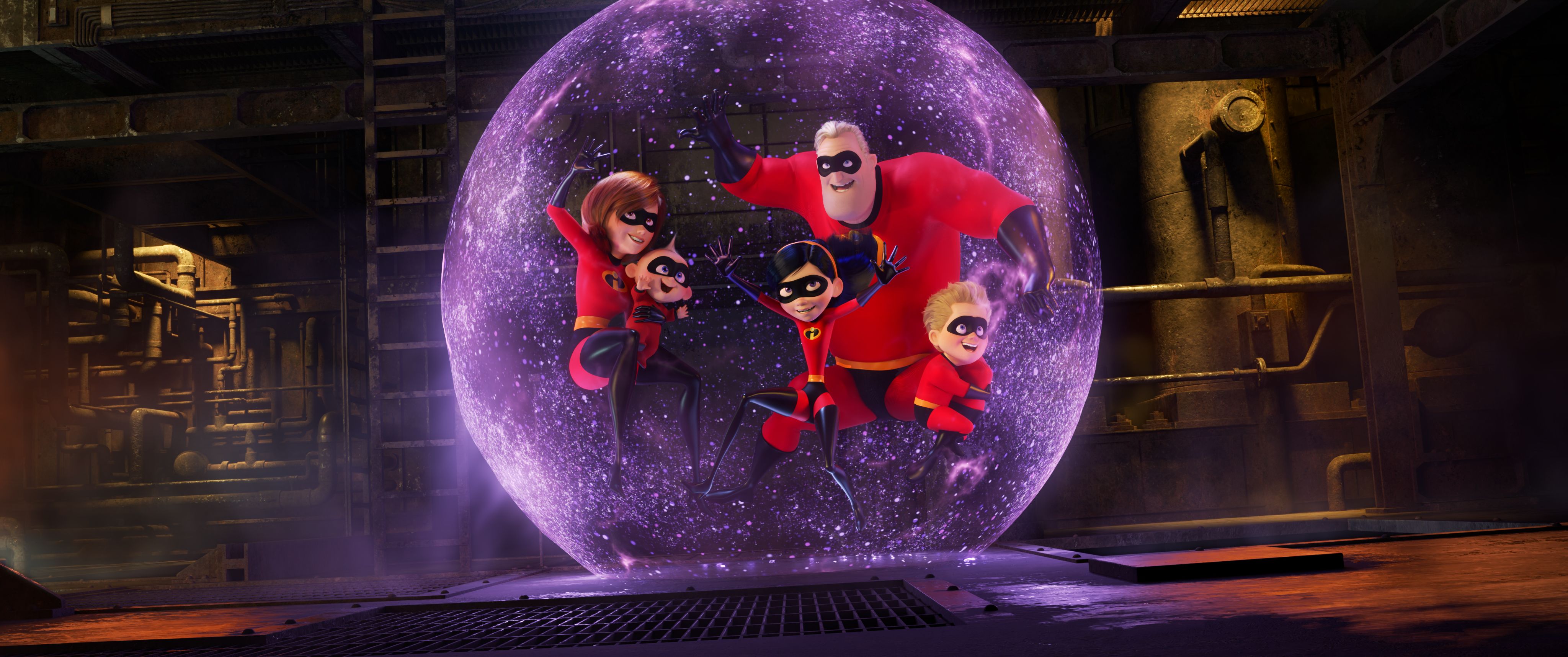
Brad Bird does something, well, incredible with Incredibles 2. Not only is it a worthy successor to his excellent original film -- and one 14 years old at that -- but it also restores honest-to-goodness comic book thrill to the superhero genre. Here is a movie that's so abundantly clever in its construction, so energetically creative in every beat of action involved, that it makes one wonder how we've managed to put up for so long with the turgid punching and cluttered effects explosions that bog down the live-action superheroics that've clogged our screens. For anyone whose mind has numbed to the waves of digital mayhem tumbling indiscriminately out of the last act of any Marvel movie or been lulled into a stupor by the senseless bombast of most DC ones, it's about time we got a reminder color and excitement can be found in putting the concept of a super hero to its best use. Bird knows how to build sequences and shape character, not just to contort them into whiz-bang calamities, but to mold a scene to maximum impact. Here is the story of a superhero family, putting both elements of that concept in full flowering display. It has deeply satisfying boom-pow action -- hurtling helicopters, collapsing urban infrastructure, crackling superpowers, with each sequence fully thought through for how each and every fantasy conceit could be wielded and combined in ever new and entertaining ways -- and a tenderly felt sense of human drama. Bird and his team of artists can build a great childish cartoony gag -- a spray-water-out-your-nose funny visual flourish -- with as much astonishing ease as a soft, talky, casual heart-to-heart between two grown-ups and make it all feel of one piece.


Picking up mere seconds after the 2004 classic ended, this sequel finds superheroes still banned from public life, and the newly formed family unit struggling with how to live up to their potential. How do they go about breaking the law to save it? How best to help kids learn to live in an often cruel and confusing world? It may be set in the past, but it also feels of-the-moment as these questions wrestle on the surface of Pixar's sparkling, swinging mid-century pseudo-60's cool. Elastigirl (Holly Hunter, perfect honey drip toughness) is offered a job by a high-powered technology company (led by pleasantly insinuating siblings voiced by Bob Odenkirk and Catherine Keener) who hope to make superheroes legal again. Mr. Incredible (Craig T. Nelson) struggles with finding the joy in parenting his cute and challenging super-kids (speedy tween (Huckleberry Milner), invisible teen (Sarah Vowell), and mind-bendingly multitalented baby) while letting his wife take center stage. The film is smart about married life, in finding dynamics between the two that reflect a healthy relationship that's nonetheless marked by internalized gender roles and egos only sometimes in check. The kids, too, are relatable in their troubles -- with math homework, with crushes, with TV and sugary cereals. Bird goes in on what could be standard sitcom tropes and imbues them with a sense of warmth and life, like any basically stable family unit buffeted by the everyday struggles of life. It just so happens their struggles entail a dastardly plot by a villainous Screenslaver, whose plan to destroy the reputation of superheroes once and for all leads inexorably to the most satisfying climax of superpower conflagration in ages. The film, grooving on Giacchino's brassy syncopation, is a rat-a-tat riot of heartfelt sentiments and rip-roaring action, staged with the smoothest, eye-boggling visual wit you'd ever hope to see. It's marvelous, and well worth the wait.

Friday, June 1, 2018

Hosting the Machine: UPGRADE

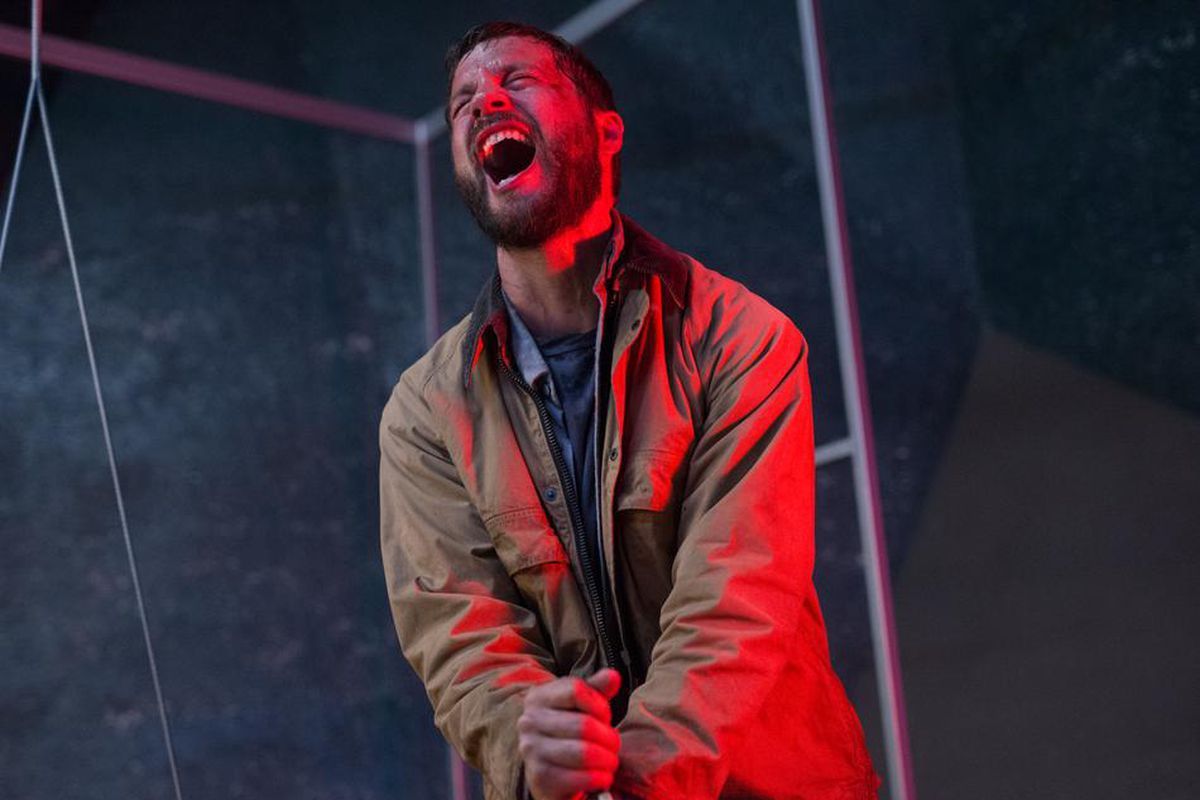
Upgrade is the cure for the common summer movie. It's a small, scrappy sci-fi action/thriller shot with energy and filled with creatively derivative ideas. Writer-director Leigh Whannell (who earns a hearty most-improved in my book after his dismal debut feature Insidious 3) keeps the stakes small, but the verve big. He builds a convincingly livable future world and uses the logic of its construction to twist standard old pulp revenge elements into something freshly compelling and immediate. It uses its relatively small budget smartly, styling imaginative action sequences with a visual flair built out of clever camera tricks and a marvelous lead performance that's trickier than it even looks. Logan Marshall-Green stars as a man left paraplegic after his wife's death at the hands of thieves who attack after a self-driving car accident. (Or was it an accident? The movie has all the cyberpunk noir uncertainty you'd want.) He's offered a chance to walk again by a shadowy tech billionaire (a perfectly sniveling pretty youth tycoon played by Harrison Gilbertson) and, seeing as the alternative is despair, he takes the chance. A tiny experimental computer is inserted into his spine, allowing energy to flow from his brain back to his limbs. It's a miracle. But there's a twist. There's now a voice in his head. It's the computer. It wants to help its host get revenge on his wife's killers. To do so, it wants control. Where the movie goes next is largely unsurprising, but deft and satisfying in the way it piles on complications and future-shock bio-tech ideas (like a baddie with a gun implanted in his arm like a Cronenberg design). 

A large portion of the appeal in the film's escalating entertainment is Marshall-Green's performance, as he becomes an alternately scared and emboldened bystander in his own body. As he heads out to find vigilante justice -- cross-cut with a determined detective (Get Out's Betty Gabriel) suspicious of the mounting body count that was her suspects -- the computer turns him into a kung fu master. The machine controlling him allows his body to anticipate attacks, systematically taking apart his combatants in dizzying flourishes of robotically fluid physicality. (Also, in the neatest trick of all, it helps him draw by having him grip a pencil, then moving his hand rapidly like an inkjet printer.) It's fun enough to watch well-choreographed punches and kicks mixed in with explosively gory uses of everyday objects. There's a whole other layer of delight when the man doing this action wears a look of overwhelmed surprise. The camera sticks close to the body, turning and pivoting and panning with smooth, eerily composed moves, as if the film itself is in sync with its hero's digitally enchanted reflexes. His face and his movements are eerily separated, and impressive feat of whole-body acting. As the techno-thriller reaches its conspiratorial fever pitch, it digs into its revenge element's prerequisite cautionary tale while dovetailing with technology run amuck paranoia. It's a sweet twofer. All this fun and done in barely over 90 minutes? What a blast, and what a nice surprise, to leave the multiplex's latest offering wanting more in a good way.

Friday, April 27, 2018

All Superheroes Go To Heaven: AVENGERS: INFINITY WAR


Of all the Marvel Cinematic Universe films so far, the latest, Avengers: Infinity War, is certainly the very loudest. I suppose it has a right to be. Billed as the Series Finale when anyone with a working brain knows it’s merely the biggest Season Finale yet, it’s the culmination of ten years of these things. Ever since Samuel L. Jackson’s Nick Fury stepped out in the post-credits scene of 2008’s relatively compact, swift, and charming Iron Man, promising to introduce that hero to a few others, it’s been an endless string of formulaic origins and meetups. At least the formula – 90 minutes of exposition, banter, and fun with character actors, followed by a 30-minute CGI shooting gallery – remains sturdy enough, and the performances roped in charismatic enough – that it rarely feels too much. They vary in quality. I prefer the looser hangouts where the action has a zing of screwball B-movie appeal (Iron Man 2, Avengers 2, Thor 2, Spider-Man Homecoming) or earnestness (Captain America 1, Black Panther) to the ponderous self-important ones (Captain Americas 2 and 3) with the ones in between tolerable, too. But generally they are completely disposable diversions. I enjoy them, and then they evaporate, leaving only vague impressions and the sense they should bring back Sam Rockwell someday. Infinity War is what all 18 films have built towards, the culmination of many Infinity Gem MacGuffins and Thanos references, as the purple titan himself (voiced with a growl by Josh Brolin, whose likeness stares back at us from soulful computerized eyes) comes crashing down to Earth looking for ultimate power, and two dozen heroes assemble to beat him back. 

This results in apocalyptic sequences as the characters are genuinely frightened for once in the franchise. Their quips pale in comparison to a man wielding an enormous gold gauntlet slowly studded with the glowing powers needed to wipe out half of existence in the snap of his fingers. When a ginormous whirring oval spaceship hovers over New York City, there are ominous stakes as Doctor Strange (Benedict Cumberbatch), Hulk (Mark Ruffalo), and Iron Man (Robert Downey Jr) mix worry into their determination. They all want to defeat Thanos – once they’re caught up on his plan, that is – but aren’t sure how to go about doing it. He’s already one of the galaxy’s most powerful beings, with an evil plot nigh incomprehensible in its universe-wide genocidal scope. What are a bunch of plucky knockabout do-gooders going to do in the face of that? Still, this is a Marvel movie, and the jokes fly fast and frequent, and, as directed by the Russo brothers and scripted by series’ regular writers Christopher Markus and Stephen McFeely, ably balances the tones. It also shuffles a massive cast in interesting ways, letting characters hitherto separated by time and space collide in fun exchanges and tenuous team-ups in bright, clear, IMAX cinematography.

Of course, it doesn’t hurt that it leans on its best features – letting Spider-Man (Tom Holland) earnestly tag along behind Stark and Strange, and ceding all of the film’s galactic plotting to the winning combination of the Guardians of the Galaxy (Chris Pratt, Zoe Saldana, Dave Bautista, et al) and Thor (Chris Hemsworth). (They are the funniest and, funnily enough, the most emotionally engaged, too.) It’s something of a screenwriting and editing marvel (oh, pun not intended, believe me, but now I’m sticking with it anyway) to keep something like 30 major speaking roles – all major players in their respective realms – and a couple different tonal modes balanced to such a successful extent. Part of it is the streamlined plot, subplots carried over mostly shunted to the side due to the enormity of the main dilemma, allowing the characters to focus on one goal. Part of it is giving different pieces of the goal to different smaller team-ups: a cosmic crew, an Earthbound squad (led by Captain America (Chris Evans), Black Widow (Scarlett Johansson), and a stay with T’Challa (Chadwick Boseman) in Wakanda), and one travelling between. It’s perfectly engineered to bounce between these groupings of heroes, giving each and every one a crowd-pleasing entrance and perfectly timed laugh line or action pose throughout.

These performers have a certain iconoclasm to their positioning in the roles by now, and it’s great fun watching them spar and quip and fight side by side. The action is largely satisfying, too. Not quite as deadening as usual, it has heft and design, some cleverness, and some big, booming consequences (that will inevitably be almost or entirely reversed next summer, but are still satisfying shock in the moment). Best of all are the applause-break splash panel moments – my favorite goes to a thrilling late-breaking electric return in the battle royale finale. It may be a big, dumb, violent cartoon, but improbably Marvel Cinematic Universe productions have accumulated affection and accrued pleasures that outweigh any individual film’s successes and flaws. It’s a high-budget, high-spirit corporate product. It’s blockbuster serialized filmmaking, a massive sporadic television production on the big screen. The only gamble is that we’ll want to see our favorite charming superhero buddies pummeled and bloodied and beaten down to their lowest point yet, and still clamor to see them bounce back again, and again, and again. As long as the movies are this passably satisfying, agreeably diverting, and leave the audience just curious enough to see what happens next, they will. Infinity War, indeed.

Saturday, April 21, 2018

Brute Force: YOU WERE NEVER REALLY HERE


So often revenge movies pretend to deal with its subject’s immoral consequences while dutifully revealing pleasure in action, action, action. It’s often self-defeating, albeit with a sick gratification as a kick of gore or a squib of blood acts as catharsis the movie might later have us question, however feebly. In the case of Lynne Ramsey’s You Were Never Really Here, though, it’s all consequences. She presents a typically grim and determined tale of a sad man of violence trudging his depressed mind, wounded soul, and lumbering body into an act of righteous chaos – saving a Senator’s daughter from a sex trafficking ring. However, we are spared the gory details, the explicit nastiness, the violence perpetrated to and on behalf of victims. It all happens off screen. The dripping wounds are seen only after the damage has been done. The centerpiece is the man (Joaquin Phoenix), a blunt force instrument whose shaggy beard, deliberate gait, and shlubby dress indicates a more normcore than hardcore action hero, proceeding through the villain’s lair room by room, hammer in hand. The camera cuts, fracturing the diegetic soundtrack as the view changes from one security camera-style angle to another, the bludgeoning already in progress if not finished. An anonymous threatening man is mostly or completely crumpled on the floor and out of the corner of the eye you can spy our protagonist slumping his way to the next obstacle.

Ramsey’s project of subjective interiority – voiced earlier with the child’s eye miserabilist whimsy in Ratcatcher and sorrowful red jolts of maternal nostalgia blending into trauma in We Need to Talk About Kevin – finds perhaps its finest expression here. Her loose adaptation of Jonathan Ames’ slim novel of the same name is a story about hurt people hurting people, as a haunted and wounded soul finds what little meaning he can in his off-the-books thuggish private investigator jobs. He can break skulls better than he can repair hearts, or his own mind. Ramsey sticks closely to his perspective, pinning him into precise frames of methodical routines, and intuitive flash frames of flashbacks jangling sparse evocative backstory of an abusive childhood (his elderly, ailing mother (Judith Roberts), similarly abused, lingers with him still) and vague military deployment overseas. Jonny Greenwood’s droning score filtering through the impressionistic, swirling sound design matches Thomas Townend’s cinematography of grainy glossy surfaces chopped into slices and fragments by Joe Bini’s deliberate, artful edits. At the center of it all is Phoenix’s taciturn bear of a performance, a grit-the-teeth determination with sunken, distant gaze and pained expression. He wears the burdens of his life’s trauma on his slumped shoulders. Even if and when the rescue of the angelically delicate lost girl (Ekaterina Samsonov) is within his reach, his sadness isn’t lifting any time soon. He moves through noir-ish developments as if underwater, the film's style treating him like Lee Marvin in Point Blank if he were a scraggly depressive. The picture as a whole casts this spell, a sort of artful pulp burned down to its bones that threatens to feel slight, but instead lingers like a hazy cold.