Showing posts with label Tom Holland. Show all posts

Sunday, March 6, 2022

Good Boys: UNCHARTED and DOG

I distinctly remember reading an article in Newsweek pretty much exactly 20 years ago bemoaning the lack of viable old fashioned Movie Star men. Back then, when we didn't know the Movie Star was on the way out, it was pretty easy, if unfair, to argue that the likes of, say, Matt Damon and Will Smith and Ben Affleck weren’t exactly Harrison Ford and Denzel Washington and Robert Redford. I liked all those guys at the time, but in retrospect, those younger stars actually were among the last of the great Movie Star men, right? We’d love to have someone of their charisma and popularity ruling the box office charts again, able to take a fandom with them to new standalone programmers and prestige projects and would-be franchises alike. That all of the above names are still working to some extent is further proof that we keep relying on the old at the expense of the new. Now, it seems, for a newer actor to reach that top tier, he needs to wed his persona to a superhero to keep the audiences flowing. Just glance at the grosses for a non-Marvel movie for a Marvel star and you’ll get the idea.

Even someone like Tom Holland, fresh off a Spider-Man movie so insanely popular that people were willing to get COVID to see it, is more of a media figure than a marquee star at this point. Audiences love Spider-Man in any iteration. And people like Holland as a social media figure—interviews with his current girlfriend Zendaya (an actual compelling star, the main reason he’s a tabloid staple) and that gender-blurring lip sync dance he did to Rihanna's “Umbrella” some years back are probably as shared as, if not more than, clips of his film work. (The latter’s more memorable and visually appealing, too.) But just put him alone in a cringe over-reaching crime picture like Cherry or half-baked (and off-trend) YA sci-fi Chaos Walking and hardly anyone shows up, while those who did aren’t exactly brewing the cult classic status. He’s a likable bloke, to be sure, with an on-screen energy that comes across as part Tom Cruise hustling charm, part Michael J. Fox smirking underdog. But if audiences don’t give those like him a chance to grow beyond popular characters into their own reliable stardom, we’ll be starved of stars of the future. So far, even Holland’s Spider-Man efforts recognize he’s not his own draw yet, pairing him in each with an actual movie star of some sort—Samuel L. Jackson, Robert Downey, Jr.—or another—Benedict Cumberbatch—or another—Jake Gyllenhaal—to carry the load.

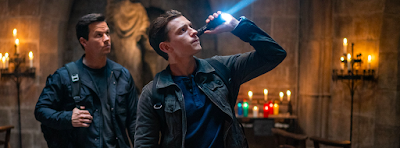
So now we have him in Uncharted, a long-gestating video game adaptation that’s sure to have Sony dreaming of sequels already. It pairs Holland as a boyish orphaned Magellan enthusiast with Mark Wahlberg as a jaded treasure hunter. Together, they each need the other to find a cache of lost gold before Antonio Banderas’ scheming rich guy does. The movie, directed with usual bright pop sturdiness by Ruben Fleishcher of Zombieland and Venom and scripted by a typical flotilla of writers, isn’t exactly reinventing the form. It’s an amiable globetrotting adventure with a bit of National Treasure family destiny, some Tomb Raider puzzle-solving, and a splash of Indiana Jones escalating stakes. But the combination makes for a diverting fetch quest, complete with faded maps, missing ships, interlocking MacGuffins, and preposterously elaborate centuries-old scavenger hunt clues. (I would’ve said an even less believable detail is a Papa John’s in Barcelona, but I googled it and, hey, there is one.) The plot has the usual good guys, bad guys, and some who go both ways, and action sequences that are just the right side of entertainingly outsized. I liked best a shootout in and out of a cargo plane, and later a climactic fight between two airborne pirate ships dangling from helicopters—my kind of modern spin on swashbuckling tropes. The whole production is simply a string of passably entertaining adventure sequences spackled together with pleasantly predictable plotting. And the whole thing hangs together on the decent buddy chemistry it whips up between the two leads, with an established star lending his appeal to bolster a fledgling one, a dynamic that mirrors the characters’. Wahlberg’s reluctantly affectionate gruffness balances out Holland’s relentlessly overeager puppy-dog acting, and gives their scenes a low-key charm. Sometimes that, amidst some busy action, is enough to get by.

Speaking of stars: Channing Tatum. He has that whole effortlessly-holding-the-screen thing down perfectly. Like the best Movie Stars past and present, he can simply exist in a frame and have our attention. He has unforced naturalism and shaggy off-handed charisma, the sensitive soul behind the muscled features, a melting heart in a block head. It makes him an interesting presence—and a surprisingly adaptable one. He works as a dancer from the wrong side of the tracks—Step Up—or an action figure—G.I. Joe—or an Olympic wrestler—Foxcatcher—or a Gene Kelly-type hoofer—Hail, Caesar!—or a stripper with a furniture-making hobby—Magic Mike. He hasn’t had a live-action role since 2017, so it’s a great welcome return to see him back on our screens with Dog, a movie built almost entirely around him. Tatum co-directs with his Mike screenwriter Reid Carolin and together they know just how to use what Tatum can do. Posed against a sunset, leaning on the hood of a pickup truck, beer bottle in hand, with his solider past haunting an uncertain future—he’s the complicated state of modern American masculinity at a glance. The character is an alcoholic brain-damaged vet desperate to get his life back on track. His former commanding officer offers a trade: a letter of recommendation in return for driving a troubled military dog to the pup’s deceased handler’s funeral. The idea is clear, the goal is plain, and the plainly framed, unshowy style Tatum brings to the look and feel is a straightforward showcase for what he does best.

The result is a simple, sentimental, and corny movie that finds Tatum and a Belgian Malinois on a road trip from Oregon to Arizona and back again. It’s a one man show, with meandering detours and episodic stops along the way at a variety of eccentric characters populated with quickly sketched character actors at work. Those vignettes never quite lift off the way they should, but the overarching emotional spine of the thing—a “who rescued who?” bumper sticker come to life—is sold entirely on the strength of Tatum’s performance. His humanity shines through, and it’d be hard not to feel for him as his tough exterior and in-his-own-head moping starts to sympathize with the poor dog’s troubles—war, after all, leaves these scars on all involved, man and beast alike. It’s a throwback to the sorts of movies that made stars in the middle of the last century, a simple concept hung on the appeal of a performer, and tailor-made for his skill set. There’s something to this wandering, sight-seeing, small-scale character piece that, even in its predictability, remains totally watchable. One wants to see how this isolated, lonely, frustrated, wounded jock can find his way to heal, even a little bit, by reconnecting to his buried emotional intelligence and recognizing something of himself in another—even if that other is a dog. You have to start somewhere.

Sunday, December 19, 2021

Tangled: SPIDER-MAN: NO WAY HOME

Here’s a Spider-Man movie about how much fun earlier Spider-Man movies were. Sure, it’s also about second chances (for Spider-Men) and learning from your (Spider-Man) mistakes and finding the people who truly love you for who you really are (Spider-Man). But I guess that makes it all the more a movie that begins and ends with nothing but Spider-Man and references to Spider-Man and cheap hits of nostalgia for Spider-Men we’ve loved and lost before. By the finale of Spider-Man: No Way Home, which brings together a cavalcade of cameos for web-swinging acrobatic action and pretends it built (or re-built) characters along the way, it made me, as someone who, I’ll admit, would call Spider-Man my favorite superhero, want the impossible: less Spider-Man.

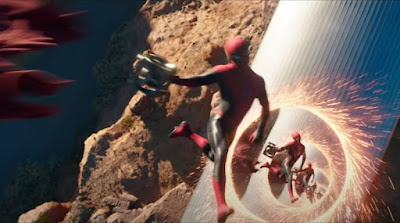
This oddly flat and clunky project, the latest in the ongoing Marvel Cinematic Universe, opens up a live-action Spider-Verse to tromp around in. Peter Parker (Tom Holland) asks Dr. Strange (Benedict Cumberbatch) to help the world forget he’s the friendly neighborhood superhero. The spells goes wrong and results in characters from previous Spidey pictures stumbling in disoriented and wondering what to do with themselves. There’s Doc Ock (Alfred Molina) and Green Goblin (Willem Dafoe) and Sandman (Thomas Haden Church) from the Tobey Maguire movies and Electro (Jamie Foxx) and Lizard (Rhys Ifans) from the Andrew Garfield ones. The movie’s best idea is also what saps it of energy: these guys are way too confused to be much of a real threat. Instead, Strange and Spidey argue over how best to solve the problem. The wizard doctor wants to zip-zap them back from whence they came where they’ll meet their doom, while good ol’ Peter thinks he can save them. They’re scientists, after all, victims of one misfiring experiment or another. (This movie thinks their villainous natures can be subsumed under the audience’s affection for the characters and performers.) Practically, however, it’s a movie going around in circles, hoping to keep an audience’s interest by trotting out these cameos and lingering long enough for applause breaks before giving each returning face pretty much nothing to do.

And, for how befuddled they should be, and are at first, about getting ripped out of their universe and into another, these villains quickly get pretty casual and blasé about the situation. In typical MCU fashion, there are long scenes of actors standing around trading quips, smirking and giggling at the outsized sci-fi suspense whipping up around them. There’s nothing so heavy—not even the death of a major character—that can pause the deflating jokes for too long. And these have to be the cheapest and emptiest cracks, as Peter’s pals picked to help present possible solutions to this whole mess—MJ (Zendaya) and Ned (Jacob Batalon)—find themselves scoffing in disbelief at names and powers from these inter-dimensional interlopers. It want to both play off how much people love the earlier Spider-Man iterations and set itself up as the best one. (That they start calling Holland “Spidey 1” gets a little funny in that regard when he’s literally sharing the screen with people whose movies worked way better than this one.) No Way Home wobbles between these two modes: reverent celebration of what came before, and goofy puncturing of any possible seriousness. The entire multiverse is threatening to collapse on itself, and it feels about as monumental as channel surfing. That leaves vast swaths of the movie to clunk along in scenes that aren’t shaped so much as plugged into place, and moments of real high drama played off so abruptly and drearily—there are deaths and magical amnesia that’d hit harder with better track laid for it—that one forgets these are supposed to be real characters to care about and not just action figures clattering around.

Worst has to be the movie’s total lack of interesting style. Much has been made of the MCU’s bland house style, closer to network procedurals than cinema spectacle during downtimes between animated action. The style can be pushed here and there—one could parse the fine gradations between a Johnson, Gunn, or Waititi and a Russo bro—but often settles into a bland TV-style over-the-shoulder conversational tone mixed with quick-cut action in sets that trend to muddy grey. (That this year has found the theatrical and TV sides of the universe ever more immeshed makes this homogenized smallness ever more apparent.) This one’s pretty ugly most of the time: photographed with rarely more than three or four actors in frame together, and dialogue often in alternating tight medium or close up shots. Maybe it’s the fact the whole thing was shot last fall taking COVID precautions, but the look ends up cramped—few extras, smallish sets, and tons of flat blocking that has performers so separated from each other that they might’ve been green-screened in separately. When it comes to Big Names swanning in trying to steal scenes in this airless environment, it feels all the worse.

This ill-fitting sense of where to put people in the frame and how to track their behavior extends to the larger sense that nothing much matters herein. When any character can be whatever the plot needs and come flying in on magic sparkle dust from any other movie of which they want to remind you, it doesn’t much matter what happens to them. There’s something hollow at the core, and no amount of emoting can fill it. There’s a silly scene where characters from three different universes seriously compare iterations of advice from dead mentor figures, all tearing up and nodding sagely and talking about how meaningful the franchise’s triplicate pop psychology is. It goes for heavy meaning, but instead piles up comic cliche until it triple-underlines the silliness because the story’s only connection to anything real or human in its movements are to what it means for Spider-Man. And the collision between different visions of the character ends up highlighting how directors Sam Raimi and Marc Webb, for whatever missteps one might concede, were making real movies with their earlier versions, and Jon Watts, on his third go around, is stuck making a product. When characters from the earlier pictures arrive it’s from a different world entirely—one where these superhero movies weren’t only about themselves and pitched for a blandest possible homogeneous outcome. They interact awkwardly with the MCU world because they carry with them messy tendrils of style and substance that can’t entirely get polished away by the shallowness they’re asked to play.

Saturday, September 19, 2020

Other People: THE DEVIL ALL THE TIME

Hell is, as Sartre tells us, other people, and that’s certainly the source of evil in Antonio Campos’ The Devil All the Time. Here’s a litany of human ugliness and violence consistently inflicted on and by a couple families over the course of a couple decades in small-town backwoods Appalachia in the middle of the last century. It’s just about as far north as you can take a Southern Gothic tale—the eccentric misery without the humid atmosphere. Based on a novel by Donald Ray Pollock, who also narrates in a nice honeyed tone that gives a layer of slightly wry literary gravitas to the dark goings-on, the film contains murders, suicides, poverty, con men, serial killers, animal cruelty, trauma, and madness, all drenched in a self-righteous pseudo-religiosity that’s the cause of and solution to their problems. Campos, whose films like his previous Christine or early breakout Afterschool have similar interests in violence and mental unravellings of one sort or another, treats the procession of this narrative with a grave seriousness. He regards his characters with the squirm-inducing attention to their terrible fates that one associates with a butterfly pinned in a display case. Lol Crawley’s elegantly textured cinematography, all blasts of sun and evocative shadow in a CinemaScope-sized frame, gives a tony prestige to the images, even and especially as the nastiness accrues. The cast is uniformly haunted: wide stares, pale skin, curling lips chewing over every gnarled line with pulpy accent work. There’s a WWII vet (Bill Skarsgård) scarred by his experiences and trying to start a family with a nice lady (Haley Bennett). There’s a creepy photographer (Jason Clarke) and his wife (Riley Keough). There are two different slimy preachers (Harry Melling and, later, Robert Pattinson). There’s a cop (Sebastian Stan), a devout young woman (Mia Wasikowska), and a couple of troubled orphans (Tom Holland and Eliza Scanlen). These lives collide in mostly tragic ways over the course of two plus hours, gaining a dreary monotony as each new sequence becomes a waiting game to see which character will exit the murdered and which will walk out the murderer. Either way, blood will be spilled. Few of the human characters walk out alive, and even a few of the animals end up strung up. In the end, it becomes a slog of fine filmmaking put toward a simple idea repetitively asserted: if hell is other people, then the devils are among us.

Friday, March 6, 2020

Family Quest: ONWARD

Pixar spent the last decade mostly turning out sequels, some good (Incredibles 2) and many middling. Now the once great factory of fresh computer animated classics has given us its new standalone feature: Onward. Like the best of its recent original works — Coco, Inside Out, The Good Dinosaur — it’s a film about growing up, a coming-of-age scramble nestled inside a melancholy metaphor that pushes on the emotional pressure points of its audience. Here’s a movie about an elf-boy in a world that imagines the fantasy pasts of cheap paperbacks and roleplaying games is now our modern day — the wilds of wizards and castles and enchanted forests now suburbs and gas stations and highways, the magic of staffs and spells now smartphones and minivans. (As you might expect, the widescreen visual look of the world has its little delights and storybook charm.) The boy is missing his long-dead father acutely on this, his sixteenth birthday. Luckily, his dad left a present to be opened on this day: a spell that’ll bring him back for just one day. It goes slightly wrong, leaving only a pair of legs in father-fashion khakis and loafers. (There are some good gags made out of this, and the more upsetting details are assiduously ignored.) Now the son must find a phoenix jewel (rebirth and all) with the help of his oafish Dungeons & Dragons-style fanboy older brother, a quest that takes them out into the magic on the edges of society, while testing their prickly fraternal bond. So it’s also the vintage Pixar special: the buddy comedy. It’s as sprightly a chase as it is a jab in the tear ducts, somehow giving the audience something that’s at once overfamiliar and unexpected, warmly funny, easily appealing, and comforting even in its rougher edges.

The film is full of typical Pixar touches, though more modest in its effect and depth. Writer-director Dan Scanlon (of the strangely forgotten Monsters University) brings to the picture genre play that is featherlight, a gentle needling of fantasy tropes while wholeheartedly embracing the fetch quest construction. But for however simple the plot, the emotions do run deep and true. It may have the shape of a machine-tooled moving response machine — all levers and buttons flipped and pushed to shape the necessary payoffs — but the warm vocal performances of Tom Holland and Chris Pratt are loveably believable cartoonish brothers, and the ache of their need to connect with a father they barley knew is sometimes palpable. The ultimate conclusion is surprising and satisfying, though I wish the movie was better equipped to dig deeper and more cleverly into its premise. (What, exactly, is the relationship between the very real magic and the rest of society? No underground support group like the shark’s in Finding Nemo? And why doesn’t the boy’s mother (Julia Louis-Dreyfus) get to spend time with her husband’s legs?) Pixar of yore would’ve wrung every drop of wonder and delight out of its conceit, its premise, and its world. Imagine the airtight structure of Toy Story or the swooning accumulated details of WALL-E. Alas. Onward nonetheless points a way forward, reaffirming the studio’s commitment to new stories to tell in its typically detailed style and earnest emotive effort. The characters are just too sympathetic and the quest too pure to deny. A sequence where the lad prepares to step out over a bottomless pit is as good — suspenseful and charming — as any I’ve seen of late, and a fine metaphor for the company itself. I’d rather Pixar be taking that leap of faith than retreading past successes any day. Onward and upward.

Friday, April 27, 2018

All Superheroes Go To Heaven: AVENGERS: INFINITY WAR


Of all the Marvel Cinematic Universe films so far, the latest, Avengers: Infinity War, is certainly the very loudest. I suppose it has a right to be. Billed as the Series Finale when anyone with a working brain knows it’s merely the biggest Season Finale yet, it’s the culmination of ten years of these things. Ever since Samuel L. Jackson’s Nick Fury stepped out in the post-credits scene of 2008’s relatively compact, swift, and charming Iron Man, promising to introduce that hero to a few others, it’s been an endless string of formulaic origins and meetups. At least the formula – 90 minutes of exposition, banter, and fun with character actors, followed by a 30-minute CGI shooting gallery – remains sturdy enough, and the performances roped in charismatic enough – that it rarely feels too much. They vary in quality. I prefer the looser hangouts where the action has a zing of screwball B-movie appeal (Iron Man 2, Avengers 2, Thor 2, Spider-Man Homecoming) or earnestness (Captain America 1, Black Panther) to the ponderous self-important ones (Captain Americas 2 and 3) with the ones in between tolerable, too. But generally they are completely disposable diversions. I enjoy them, and then they evaporate, leaving only vague impressions and the sense they should bring back Sam Rockwell someday. Infinity War is what all 18 films have built towards, the culmination of many Infinity Gem MacGuffins and Thanos references, as the purple titan himself (voiced with a growl by Josh Brolin, whose likeness stares back at us from soulful computerized eyes) comes crashing down to Earth looking for ultimate power, and two dozen heroes assemble to beat him back. 

This results in apocalyptic sequences as the characters are genuinely frightened for once in the franchise. Their quips pale in comparison to a man wielding an enormous gold gauntlet slowly studded with the glowing powers needed to wipe out half of existence in the snap of his fingers. When a ginormous whirring oval spaceship hovers over New York City, there are ominous stakes as Doctor Strange (Benedict Cumberbatch), Hulk (Mark Ruffalo), and Iron Man (Robert Downey Jr) mix worry into their determination. They all want to defeat Thanos – once they’re caught up on his plan, that is – but aren’t sure how to go about doing it. He’s already one of the galaxy’s most powerful beings, with an evil plot nigh incomprehensible in its universe-wide genocidal scope. What are a bunch of plucky knockabout do-gooders going to do in the face of that? Still, this is a Marvel movie, and the jokes fly fast and frequent, and, as directed by the Russo brothers and scripted by series’ regular writers Christopher Markus and Stephen McFeely, ably balances the tones. It also shuffles a massive cast in interesting ways, letting characters hitherto separated by time and space collide in fun exchanges and tenuous team-ups in bright, clear, IMAX cinematography.

Of course, it doesn’t hurt that it leans on its best features – letting Spider-Man (Tom Holland) earnestly tag along behind Stark and Strange, and ceding all of the film’s galactic plotting to the winning combination of the Guardians of the Galaxy (Chris Pratt, Zoe Saldana, Dave Bautista, et al) and Thor (Chris Hemsworth). (They are the funniest and, funnily enough, the most emotionally engaged, too.) It’s something of a screenwriting and editing marvel (oh, pun not intended, believe me, but now I’m sticking with it anyway) to keep something like 30 major speaking roles – all major players in their respective realms – and a couple different tonal modes balanced to such a successful extent. Part of it is the streamlined plot, subplots carried over mostly shunted to the side due to the enormity of the main dilemma, allowing the characters to focus on one goal. Part of it is giving different pieces of the goal to different smaller team-ups: a cosmic crew, an Earthbound squad (led by Captain America (Chris Evans), Black Widow (Scarlett Johansson), and a stay with T’Challa (Chadwick Boseman) in Wakanda), and one travelling between. It’s perfectly engineered to bounce between these groupings of heroes, giving each and every one a crowd-pleasing entrance and perfectly timed laugh line or action pose throughout.

These performers have a certain iconoclasm to their positioning in the roles by now, and it’s great fun watching them spar and quip and fight side by side. The action is largely satisfying, too. Not quite as deadening as usual, it has heft and design, some cleverness, and some big, booming consequences (that will inevitably be almost or entirely reversed next summer, but are still satisfying shock in the moment). Best of all are the applause-break splash panel moments – my favorite goes to a thrilling late-breaking electric return in the battle royale finale. It may be a big, dumb, violent cartoon, but improbably Marvel Cinematic Universe productions have accumulated affection and accrued pleasures that outweigh any individual film’s successes and flaws. It’s a high-budget, high-spirit corporate product. It’s blockbuster serialized filmmaking, a massive sporadic television production on the big screen. The only gamble is that we’ll want to see our favorite charming superhero buddies pummeled and bloodied and beaten down to their lowest point yet, and still clamor to see them bounce back again, and again, and again. As long as the movies are this passably satisfying, agreeably diverting, and leave the audience just curious enough to see what happens next, they will. Infinity War, indeed.

Thursday, July 6, 2017

Swing Shift: SPIDER-MAN: HOMECOMING


The latest product from the Marvel Studios factory is Spider-Man: Homecoming, a co-production with Columbia Pictures, that company making less an admission of failure and more a signal of strong showbiz jealousies. The Sony subsidiary hasn’t been able to make a Spider-Man feature as good as Sam Raimi’s since letting him go, but surely the powers that be were only interested in loosening the reins on their rights to the character when they saw the consistent huge grosses and quality control over at the Marvel Cinematic Universe. They didn’t want to do right by the character so much as do right by their producers and stockholders. Still, the result is precisely what you’d hope and expect from bringing in the people who brought us the whole Avengers product line. It’s brightly lit and full of good-humored banter, features a great cast of familiar faces playing colorful characters, and stops every so often for a dazzlement of colorful CG. Though the formula’s getting tired, this new entry manages a high degree of charm and fast-paced entertainment (and even a few genuine surprises). In addition to the predictable polish and routine beats of a Marvel plot machine, this widget has a sweetness and an energy that makes it slightly better than average. It’s good fun.

Picking up during the events of last year’s Captain America: Civil War, where this new interpretation of Spidey was first introduced recruited by Iron Man to be a potential second-string Avenger, Homecoming finds Peter Parker (Tom Holland) initially excited to be one of the gang. (This movie’s biggest uphill climb is having to bounce its continuity out of what was easily the MCU’s worst movie, a dull grey 147-minute slog.)  Alas, his dreams will not be coming true any time soon. Tony Stark (Robert Downey Jr.) gifts him a souped-up supersuit and tells him to stick to being a friendly neighborhood Spider-Man. The boy’s just fifteen, after all. There’ll be plenty of time to be a real hero when he’s older. This leaves the kid antsy and eager to prove himself, and allows the movie to stretch out with what’s always best about Spidey’s appeal: his average, every day, everyman problems. He has homework, an extracurricular academic challenge team, a cheerfully nerdy best friend (Jacob Batalon), an unrequited crush (Laura Harrier), a bully (Tony Revolori), a sweet prickly teammate (Zendaya), and a kind aunt (Marisa Tomei). He has a lot on his plate, plus the whole sneaking out every evening to patrol the streets, swinging from buildings to stop bike thieves and ATM bandits. 

Writer-director Jon Watts (of the small, tense, kids-in-over-their-heads thriller Cop Car) and his five co-writers understand the inherent charm of Spider-Man. They make him a relatable stressed-out teenager, just trying to fit in and do well at school while testing his powers. (They’re great, after all, and so, too, are his responsibilities.) With a bounce in its step, the movie makes like its hero and juggles the demands placed upon it quite skillfully. It weaves itself into the fabric of the MCU with better deftness than some of its inferiors, rooting its villain (The Vulture, played by Batman and Birdman himself, Michael Keaton) motivation in the aftermath of The Avengers. One of the more memorable villains in this mega-franchise, his backstory has him with a contract to clean up the damage from the alien battle, a lucrative deal that gets pulled when SHIELD classifies the high-tech debris. Now he’s flying in a makeshift jet-propelled wingspan, making his money on the black market, smuggling gadgets stolen from the various film’s climactic calamities (Winter Soldier’s D.C. craters, Ultron’s rattled fictional city, and so on). He and Peter – little guys hoping to make big marks – both have struggles proving themselves in this new outsized ecosphere of heroes and villains, which gives their clash a little charge. Keaton’s world-weariness plays nicely against Holland’s adorably boyish happy-to-be-here excitement, making for a compelling conflict.

Because the bad guy’s a local low-level troublemaker, he first shows up on Peter’s radar. Since the boy has trouble convincing Stark’s assistant (Jon Favreau) to take his calls, he feels obligated to put a stop to the mystery man’s bad deeds as he continually crosses paths with the evil plot. All this and the big dance, too. There’s the usual roster of fun character actors popping up to give the zippy plot some added wit and texture (Donald Glover, Bokeem Woodbine, Hannibal Buress, Angourie Rice, Martin Starr, and Michael Mando among the pleasant surprises popping up in tiny roles). They keep things pleasant and crackling with an agreeable comic charge between big splashy two-page spreads of action – leaping between buildings and off monuments, tussling with henchmen and saving civilians – that make for the usual superhero shenanigans. These are all suitably loud and explosive, but also swing with Spidey’s nimble acrobatics. Watts has managed to make a movie sparkling with enough fun and invention that its small piece pumps some life back to the larger franchise puzzle. It simply feels good to spend two hours with a character whose biggest conflict is wanting to contribute more positive impact in the world than he can manage. It’s easy to root for him.