Thursday, September 28, 2023

The Old Men and the Guns: EXPEND4BLES

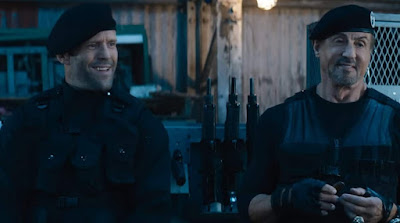
Expend4bles is running into all the usual problems that can dog an aging franchise limping back into theaters—diminished energy, effort, and interest. The title of the latest is its creative peak. This action series started as an aging action star ensemble picture. Not a bad idea to put a black-ops squad of oldsters together, a Grumpy Old Men with guns and gore. Sylvester Stallone lead the charge and, across three movies, supporting roles went to the likes of Dolph Lundgren and Arnold Schwarzenegger and Bruce Willis and Wesley Snipes and Jean-Claude Van Damme and Jet Li and Harrison Ford and Chuck Norris and Mel Gibson and dozens more. The token young guy was Jason Statham, then only a decade removed from his first breakout in the Transporter movies. Now, though, he’s less than a decade removed from Stallone’s age in the first Expendables. When Stallone was Statham’s current age, 56, he was already gearing up to play Rocky and Rambo in their elder years (for the first time). Statham isn’t wearing his age like that. He’s still in fighting form as the youngest regular guy on the squad, able to jump and leap and stab and parry and even sell a perfectly aimed gunshot from a moving motorcycle as it spins midair. He’s still got it. No matter how many junk pictures he pops up in, I’m never tired of him. This movie, however, is tired. This belated fourth Expendables entry has no good young blood to offer to bolster Statham’s spot. And it doesn’t have the deep bench of older actors willing to return with them. So it’s still the same guys, but with fewer older stars willing to return to joke around in a subpar spectacle that relies almost entirely on the throwback appeal of said stars. It’s an aging varsity team with most of the roster unavailable and no one on the JV squad to call up. The result is so low-key and lethargic I spent even the action scenes wondering when it’d pick up the pace.

The director this time is Scott Waugh, an action expert whose films are sometimes solid. His video-game-adaptation Need for Speed is a fun car chase flick, though his Act of Valor is torpid US military propaganda, while his most recent prior film, the long delayed Hidden Strike, is torpid Chinese military propaganda. He’s not the sort of director who can overpower another’s priorities, in other words. Here he’s dutifully serving star demands and franchise image, but with much more of the former and less of the latter. Some of his frames here have a plasticine energy that tries hard to whip up a sense of fun. But that’s undone by characterizations that are one-note stereotypes. Even in a movie as broad and slight as a dumb throwback actioner, there’s just nothing to hold onto. It’s bad enough returning characters are simple and repetitive. Statham is a confident rule-bender always serving Stallone, the unquestioned macho leader adored by his team. It’s what he wants to project as a Movie Star in his twilight. I don’t think that’s changed much since the first. It comes with the territory. But such thinness is worse when the characters are new and quickly reduced to nothing. Newcomer 50 Cent spends the movie vaguely grumpy and gets no cool action. Megan Fox careens between nagging girlfriend and pin-up-poster glamor commando. Then these nobody characters enlivened only by the spark of celebrity in their casting are sent into a tediously simple storyline involving just a handful of locations, some pro forma deck-shuffling conspiracy blather, a layer of macho posturing and military jargon, and some CG blood splatter. It doesn’t even do right by its ensemble, leaving most of the fighting to Statham alone. (I mean, I would, too, but I’m also not going to try out for the Expendables team anytime soon.) I almost wish this movie was enjoyably bad instead of just dull.

Tuesday, September 26, 2023

Antisocial Network: DUMB MONEY

Dumb Money is a movie based on the true story of what can’t be any more than the second most important American event of January 2021. It can’t reference the actual most important event because recognizing the conspiratorial mob mentality of the January 6th capitol riots would be too much complexity for a surface-level story of the other internet-abetted swarm of those days. Remember the amateur stock traders who, emboldened by the ease of an app, swooped in and inflated the stock of troubled video game store GameStop? They held on long enough for the hedge funds betting against the company to post massive losses and lean on the app to freeze trading until they could bail each other out. The movie’s best moment comes in its first needle-drop. These so-obvious-they-circle-back-around-to-surprising song choices are becoming something of a specialty for director Craig Gillespie, after his enjoyable I, Tonya and Cruella played with pop soundtracks to good effect. In this case, it’s a setting-appropriate blasting of the Cardi B and Megan Thee Stallion’s catchy, exuberantly profane “WAP.” As Seth Rogen and Nick Offerman’s fat cat characters stare in shock at their impending potential financial doom we hear the now-iconic opening sample: “There’s some whores in this house. There’s some whores in this house. There’s some whores in this house.” That juxtaposition could’ve set the stage for a vivid bit of agitprop with a point of view about stock market games and who’s whoring whom. But the movie is a slow deflation from there.

The rest is a dutiful docudrama retelling of the moment—a basement vlogger (Paul Dano) egging on day traders who push an under-valued stock sky high, gambling on a big payday if they can break the system. The story scatters across an ensemble of participants, from cash-strapped traders (America Ferrera, Anthony Ramos) to those Wall Street types and the tech bros (Sebastian Stan) playing both sides. This lets the movie go wide without getting deep. There’s a certain discount Social Network sheen to its wan digital aesthetic. (There’s the Ben Mezrich source material, too.) And there’s some clomping inevitability that creeps in around any movie that more about recreating a Wikipedia page than commenting on its moment in any meaningful way. That means the modern period picture leans on popular songs, but also the memes and the masks. As head-spinning as it is to see 2021 already feeling like a distinct historical moment despite still living in its immediate implications, it’s even weirder to leave feeling like you’ve seen little more than a reenactment of stuff you literally just finished reading about in the news 18 months ago. Gillespie places a lot of fine actors in decent scenes, but the movie’s point of view is little more than a shrugging, well, wasn’t that a thing? Its final title cards claim something big changed here, but the preceding movie doesn't exactly make that case.

Sunday, September 17, 2023

Dark and Stormy Fright: A HAUNTING IN VENICE

It’s fitting that such a theatrical ham of an actor as Kenneth Branagh, so good at making full course meals out of others’ words, would be drawn, as director, to inhabit others’ works. His directorial career is full of echoes and inhabitations both literary (Shakespeare, Shelley) and filmic (Hitchcock, Lean). This doesn’t always lead to a good movie, but he’s a man of ostentatious Good Taste in a jolly old English way as befits a graduate (and current president) of London’s Royal Academy of Dramatic Art. His latest work as filmmaker, A Haunting in Venice, is his third turn with an Agatha Christie novel, returning as director and star in the role of famous detective Hercule Poirot. It is the best of these three—after Murder on the Orient Express’s airless exercises and over-gilded energy, and Death on the Nile’s expansive melodrama and bitter undercurrent. Compared to those, it has the smallest ensemble (Tina Fey, Michelle Yeoh, Kelly Reilly, and a two-man Belfast reunion). But such spareness successfully builds on this series’ best assets: a sense of world-weary cynicism held back by a relentless cold detective logic that makes even the darkest edges and dreary deaths solvable with a sharp mind and steady investigation.

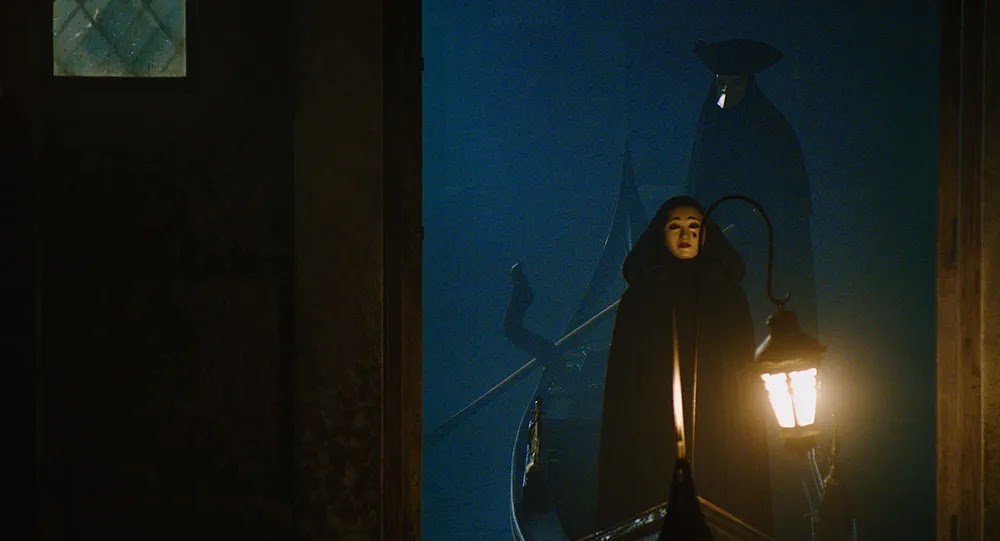
This one’s literally dripping in atmosphere. The setting is a damp Venetian palazzo on a dark and stormy night, the wind battering the windows, waves crashing into the walls, lights flickering, faucets dripping, interiors clammy and steps slippery. He films it like Welles might, in intense canted closeups reminiscent of Mr. Arkadin and snaky shadows like Touch of Evil. (To keep what Leonard Maltin might call the “Wellesian tomfoolery” going, a cut to a shrieking bird has to be a nod to Kane, and an early shot of a dramatic iron-gated gondola garage and a masked and robed figure is reminiscent of the only extant scene of Welles’ abandoned attempt at Merchant of Venice.) These surface pleasures are fun and potentially shallow, but Branagh finds plenty of percolating character beats and sneaky suspense to keep interest boiling with pop depths somberly intimated. In this locked-room mystery, Branagh is cranking up the spookiness and the sadness in equal measure, letting a blurry, bleary, midnight mood creep around corners and lurk in shadows.

As always in these stories, the murderer is in plain sight, and the cast of recognizable names stumble about in fear and suspicion, driven backwards into their frazzled psyches and paranoia as they try to survive the night. Christie’s sense of social status and class concerns takes a backseat to the tightening tensions and grief-stricken group. They were gathered for a seance: a mother who lost her daughter, a father damaged by war, a young son grappling with his father’s illness. (The seance itself is a fine, formulaic balance between sinister silence and sudden smashes.) Now they’re waiting out the storm while Poirot and his mustache must ask them enough questions to figure out the ghost of a clue. They’re as haunted by death and mystery as the film is by its influences—and its somehow a pleasing combination. For all the plot’s twists and turns, biggest surprise for me, though, was discovering that I’ve grown quite fond of Branagh’s broad take on Poirot with his puffed-up eccentricities and earnest melancholy. Beneath the starched facial hair and chewy accent there’s a real character there.

Wednesday, September 6, 2023

Teen Time: BOTTOMS and YOU ARE SO NOT INVITED TO MY BAT MITZVAH

The crude, snarky R-rated teen comedy Bottoms has ideas gesturing toward the concept of funny without ever really getting there. It’s the sophomore effort for writer-director Emma Seligman, whose anxiously amusing Shiva Baby was one of the better debuts in recent memory. That movie, a nerve-pinching stress-laugh comedy of manners, was a fine star turn for young comedian Rachel Sennott and a cast of character actors stuck in the most awkward funeral reception imaginable—or at least since Neil LaBute remade Death at a Funeral. Seligman is a talented writer of filthy sharp-tongued barbs and a capable director of cringing exchanges. Her latest does well to continue developing her reputation as a filmmaker with a distinctive voice. But there’s small delight to find Bottoms is the kind of unsuccessful movie only a talented filmmaker could cobble together. It’s an excessive, exaggerated goof on the usual oversexed heteronormative teen comedy. The leads, played by Sennott and The Bear’s Ayo Edebiri, are the typical awkwardly virginal dork protagonists this sort of picture often brings, but this time they’re lesbians. That gives a slightly fresh—albeit hardly original—spin to the expect flop-sweat antics as they try to get the hot popular girls’ attention. The duo is funny enough in their slack, improvisational dirtiness and all-elbows casual-insult friendship to carry a lot of silliness. Their school, though, is a bloodthirsty hyper-masculine football cult—complete with a phallic mascot and double entendres on every flyer. The team prowls around school like a wolf pack, intimidating and blustering with bullying thin-skinned toxicity. And so it makes perfect sense in that permissive environment that the leads’ irresponsible teacher (Marshawn Lynch) would allow them to start a school-sanctioned all-girls Fight Club. Sure, that might get some of the hot cliques’ attention. But if you wonder if that’d lead to a Project Mayhem-style conclusion—well, an exploding van would let you know the answer well before a climactic bloodbath on the football field. The characters all stand perpendicularly to reality in a place that’s parallel to ours—an amped-up nonsense world of sex and profanity and violence that sails beyond the usual excesses of the genre into a nowhere land. It’s not exactly a satire of its form; nor does it have any clear thematic concerns beyond goofing around with how far it can push and pull different tropes into its bloody aims. I’m sure one could make a sharp point juxtaposing casually normalized sexualized youth with crowds willing to shrug off bloody teenagers—the movie dances around topical concerns before settling on vague nothings—but Bottoms is more interested in coarse insults, cynically casual outrages, and the sort of half-baked world-building that leaves something real and interesting—and funny!—stranded in an unconvincing simulacrum of a teen comedy.

Much more to my teen comedy liking is You Are So Not Invited to My Bat Mitzvah. It’s cute and clever, as its broadness and obviousness and good humor are hammered home in comforting style like a pleasing pop song over a sitcom montage. But the emotions in it are deep and true and resonate, too. The movie is a totally charming work of comic empathy with high emotional stakes and small family dramedy. It’s also, maybe first and foremost, a love letter from Adam Sandler to his daughters, who here play his character’s daughters. There’s something genuinely moving about how much this picture plays off of Sandler’s love for his family. He takes a supporting role, while his younger daughter, Sunny, plays an awkward middle-schooler navigating the world of quarreling besties, dreamy boys, and mortifying menstruation. All this and a looming Bat Mitzvah, too? What’s a girl to do? The movie comes on like a modern-day Are You There, God? It’s Me, Margaret updated for the Snapchat and TikTok generation. It’s not nearly as annoying as that might sound. There’s some earnest tangling with ideas of young womanhood and religious awareness, as well as the requisite dramas of junior high social strife. The movie is juvenile enough to bubble over with the giddy, all-consuming importance of these milestones and mishaps alike, but wise enough to step back with a sense of perspective and proportion. That’s the fine double act of having both the adorable, high-energy commitment of the 14-year-old Sandler playing the adolescent drama, yearning, and confusion at full tilt, while the elder statesman Sandler (having aged into the most lovably paternal form of his screen persona) does his most shaggily charming wise-acre father act cutting the tension and wryly dropping in punchlines with ease. The movie’s colorful high-gloss look and generous ensemble of funny familiar faces adds to the comforting sitcom style, while its widescreen sheen and pounding pop music soundtrack gives it enough silver screen oomph to make every outsized emotion fill the space. It swoons and spurns and embraces and learns right along with its lead, and smiles knowingly at how these emotions are so big only because they’re all new to her. All this it accomplishes with a fine teen comedy flair, with the best Sandler mix of knowing irreverence tied to deep sentimental commitment. This is easily one of his most appealing films, and one of the most delightful teen comedies to come along in a long time.

Tuesday, August 29, 2023

Man Rehearses Machine: GRAN TURISMO

We’re so used to stories of man versus machine that there’s something peculiar about landing in a story that’s man merging with machine. That’s the uncanny element that made Neill Blomkamp’s sci-fi debut District 9 such a sensation, and his followups Elysium and Chappie so divisive and confounding. To see a human swallowed up by something alien or robotic, and to emerge the other side something altogether transformed, treated as ambivalent, and maybe even net positive, is a head-scratcher. Thus I find Blomkamp’s filmmaking alternately compelling and off-putting, especially as he takes such potentially cold ideas—all the more so when they’re juiced with viscera-splattering action sequences—and slathers on sentiment and quasi-pointed uplift within their mechanical hearts. There’s really nothing else quite like it, for better or worse.

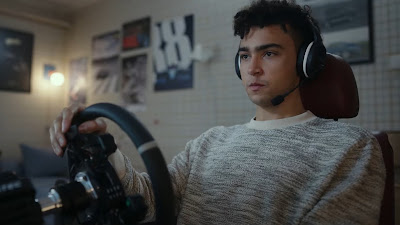
Somehow, though, in stepping away from sci-fi, one can find his personality still fits in a based-on-a-true-sports-story like Gran Turismo. Car racing is already a story of man melding with machine to do something greater than either could alone. This one adds the wrinkle of the eponymous video game. The narrative is loosely formed around real events in which the makers of the game convince Nissan and Playstation to bankroll an experiment by which the world’s best Gran Turismo players would get the chance to compete as real race car drivers. The movie casts its lead as a cute fresh-faced gamer and aspiring racer (Archie Madekwe) with a blue-collar dad (Oscar Nominee Djimon Hounsou) and mom (Spice Girl Geri Halliwell) who have their doubts as he leaps at this chance to live his dream. As we follow a pretty standard rise-fall-rise underdog story—would you believe the rich career drivers aren’t keen to share the track with an untested joystick jockey?—the young man is trained by an expert (David Harbour), boosted by a corporate climber (Orlando Bloom), and dogged by self-doubt.

The racing scenes are well-shaped and photographed for quick-paced car stunts. But the real charge in its heart comes from the way it allows the lead’s video game knowledge of tracks and tires to come in handy in real life. That’s the Blomkamp touch, letting the simulated dynamics of the game—down to the digital flourishes that visualize his memory of routes and alerts—turn into a thrill and an asset, as a real winner emerges from a melding with the machines. Even the real doubts, typified by a moving scene in which Hounsou and Halliwell watch a wreck on live TV and register the shock and uncertainty with only their eyes, fade in the midst of the momentum of the formulaically effective plotting. It’s selling a fantasy of man melding with machine that any number of gamers will find flattering, and makes for a sturdy car picture, a la such diverse pictures as Grand Prix and Ford v Ferrari and Talladega Nights, redone in a fresh coat of paint.

Friday, August 11, 2023

From Beneath: TEENAGE MUTANT NINJA TURTLES: MUTANT MAYHEM and MEG 2: THE TRENCH

The art of film appreciation is, to paraphrase Fritz Lang’s classic sci-fi silent Metropolis, a handshake agreement between the heart and the mind. We can find much to intellectually assess about any given picture, but inevitably the heart takes over, too. Thus it is that I think Teenage Mutant Ninja Turtles: Mutant Mayhem is a good movie, but one for which my enthusiasm is muted. Whereas Meg 2: The Trench is a bad movie, and yet it’s one with which, I must admit, I had a certain amount of fun. It comes down to this. Mutant Mayhem, the umpteenth Ninja Turtles project, is a good version of a thing I’ve never much cared about, and for which my ceiling of potential enjoyment is apparently much lower than the average audience. Meg 2, on the other hand, is a giddily stupid sequel that never once thinks it’s doing anything else but serving creature feature silliness larded up with all sorts of cheap paperback thriller plotting. Neither movie asks to be taken seriously, which is all for the better. They’re flip sides of the same goofy coin: putting silly characters and sloppy monsters on the big screen for us to gawk at and laugh with and walk out reasonably pleased. I imagine anyone willingly buying a ticket and walking into a movie called Teenage Mutant Ninja Turtles: Mutant Mayhem or Meg 2: The Trench will find exactly what they hope to see there.

Ninja Turtles is an animated feature that redoes an origin story for the ubiquitous amphibious karate teens. It’s a formulaic superhero tale that twins a toxic ooze catalyst for both heroes and villains. The latter is Superfly, a clear nod to blaxploitation down to the rumbling, street-tough Ice Cube voice performance. He’s a mutant bug who rallies his slimy siblings to steal lab equipment with the goal of assembling a machine to wipe out mankind. Luckily, the pack of plucky adolescent kung-fu tortoises in the sewers below have decided to surface and think they should stop him. They’re a gangly, likable bunch—largely indistinguishable but bubbling over with authentic teenage awkwardness, slang, and bravado. Anyone even vaguely aware of kids programming over the past four decades will recognize the shape of their style—the headbands, the ninja weapons, the love of pizza, the rat father. (He’s Jackie Chan now, and gets some appropriate fight choreography to match.) There’s something comforting enough to the fresh coat of paint slapped on a sturdy, predictable plot engine. Never once is the outcome in doubt. Of course the turtles will discover their powers and live up to their potential, while the bad guys will be defeated in a slam-bang fight downtown, and bigger baddies will lurk in the shadows to be teased in a mid-credits scene. But at least it looks neat and the squeaky cracking turtle performances have a real teen energy going. It’s nice to see them animated with a Spider-Verse-style scragginess, down to the wiggly penmanship, expressive line work, and layered visual jokes. It has a rat-a-tat rambling to the dialogue, and sequences stuffed with quick-witted gags and gooey sentimental heart you’d expect from a collaboration between Seth Rogen and a co-director on Mitchells vs the Machines. This might be as good as these turtle movies get.

Meg 2
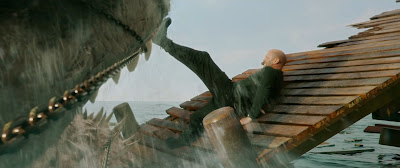
is objectively worse, but I sure didn’t mind it in the moment. Imagine a simpler, dumber Deep Blue Sea and you’re onto something. Jason Statham returns to outwit enormous prehistoric sharks that’ve eluded capture at a scientific outpost meant to contain them. There’s a slog of exposition up top, a lot of soggy business about an ensemble trapped in dive suits on the ocean floor in the middle, and then a chomping spectacle at a beach resort that ends things on a toothy grin. Along the way we get gun-toting villains with a duplicitous boss out of a bad Michael Crichton rip-off, as well as a tentacled deep-sea beastie and eel-like lizard things slithering around making extra variables for the sustained climactic action. I could describe all the flimsy characters and simple interpersonal dynamics and cheap attempts at emotional investment. But really all the movie has going for it is a brisk pace and a willingness to just go for it. The director is Ben Wheatley, who usually does unsatisfying indie horror movies—though his best was winking feature-length shoot-out Free Fire, and his worst was a dismal, instantly-forgotten remake of Hitchcock’s Rebecca for Netflix. Here he gets a chance to make a studio budget (boosted by an international co-production with Chinese backers and actors) colorful and bright and dripping in off-screen PG-13 gore. It’s so stupidly diverting I only wished it was even stupider. A little extra excess—and yes, I’m really saying a movie culminating in Statham stabbing a prehistoric jumbo-shark through the mouth with a broken-off helicopter propeller should be more excessive—could’ve made Meg 2 a classic of its kind. It’ll have to settle for agreeably crummy B-minus movie status instead.

Tuesday, August 8, 2023

Center Stage: THEATER CAMP

If Theater Camp doesn’t become a Drama Club classic, it’ll be another bad sign for the future of movies. It may not be an exemplar of the form, but its shaggy, underdog affection for its characters and milieu makes it all the more charming. I can’t image anyone who is now or has ever been a theater teen who’d be anything but charmed. As satire, it’s knowing, but very gentle. It comes on like a grainy mockumentary, setting up the eponymous locale as a financially strapped institution perched on the precipice of foreclosure. Its owner (Amy Sedaris in a whirlwind cameo) is in a coma, leaving the task of running the summer to her wannabe influencer son. (When told about the budget for “straight” plays, he earnestly asks what a “gay” play is. “Musicals,” the stage manager answers.) The staff is well-meaning, but silly at best and pretentious at worst. Honestly, their curriculum leaves a lot to be desired, too. But for all the above seems set up for mockery, the movie finds only sweetness. Everyone means well. Conflict is easily patched over. And even the unlikeliest participants will have their moment to shine.

The plot itself is developed sketchily, in scenes that play out as loose skits—goofy classes, camp complications, personality quirks. The adults get the bulk of the work, with the kids largely confined to reliable reaction shots. And despite starting their summer off with a long list of productions, the movie quickly focuses on just one. It narrows into a reliable old format—the let’s-put-on-a-show-and-save-our-beloved-space musical. Within that format, the movie finds an amiable, amusing approach that suits the affection it finds around every corner. It simply loves these ragtag theater kids and their teachers. There’s no interpersonal drama amid the campers, and the main problems the adults face are 1.) insufficient and/or misplaced confidence in their own talents, and 2.) outside financial problems from money minders who just don’t get artists’ goals. That doesn’t seem so difficult to overcome with some sparkles, jazz hands, original music, and a theatrical flair.

The loose, improvised feeling and communal spirit shine through the movie’s insistence that the show must go on. The fact that the main cast—Ben Platt, Molly Gordon, Noah Galvin—are also the co-writers (and also, in Gordon’s case, co-director) is surely what gives the project its pleasant sense of hanging around. And in the end, when it leans entirely on the audience buying the transformative power of theater, well, the magic of the stage got to me, too. When one character lets his inner drag queen into the spotlight, and another bravely comes out as straight, as everyone takes the stage for a rousing group number celebrating their favorite summer spot, why, it’s almost like Theater Camp has room for everyone.