Showing posts with label David Harbour. Show all posts

Wednesday, March 4, 2026

Talk to the Animals: GOAT and HOPPERS

I bet if you’re an aspiring animator looking to innovate these days, it’s Sony where you’d want to work. They’ve had the edge on style and cleverness lately. Twenty years ago, it was just the dense, imaginative, emotive Pixar against the scrappier, sarcastic DreamWorks. Now Pixar is struggling to find that striking originality, and DreamWorks is content to play around with textures on simple structures. That leaves room for Sony to emerge as the new freshness, despite lagging behind them for most of this century. It helps that at they’re best they’re a mix of the two competitors, the heart with the experimentation, the fresh with the sturdy. The tangled, zippy Spider-Verse pictures are a riotous hodgepodge of exciting comic book logic and The Mitchells vs the Machines is electric high-speed family sentimentality via wild sci-fi. Even the smaller personality-driven efforts like Lin-Manuel Miranda’s Cuban kinkajou musical Vivo and Adam Sandler’s class pet comedy Leo are a more standard, cuddlier, comfortable match for the talents of their stars. And they’ve hit pop culture gold with KPop Demon Hunters’ blend of catchy songs, cultural specificity, and genre tropes. The studio’s willingness to play around with style and tone has become an increasingly reliable force in the family film market. Their latest is Goat, a movie directed by Bob’s Burgers vet Tyree Dillihay and produced with basketball star Steph Curry. It’s set in a Zootopia-ish world that’s much like our own but all anthropomorphic animals. Set in a bustling urban setting composed of painterly backdrops, smeary colors, and jangled movement, their version of basketball is called Roarball. It’s dominated by enormous animals wielding their physicality: elephants, rhinos, ostriches, panthers. (They also have voices with great personality—Gabrielle Union, Aaron Pierre, David Harbour, Nick Kroll.) Can a scrawny goat (Caleb McLaughlin) make it in the big leagues? What do you think? The movie is extremely predictable sports movie cliche, but it’s shot through with a hyperactive, hyper-modern swagger—bumping hip-hop inflected scoring and a manic social-media flurry of notifications and plot swerves. And the wild slam dunk action is a gleefully exaggerated Space Jam pyrotechnic display of creativity. It’s every basketball-obsessed youngster’s wildest cartoon dreams. 

It’s quite a contrast with Pixar’s latest. Hoppers looks like a Pixar movie, moves like a Pixar movie, but feels less than a Pixar movie. It’s technically proficient, but just fine. It is well-structured, cutely designed, sometimes-funny, and warmly-voiced. It has a nice message about getting along and taking care of the natural world. And it has a spark of creativity to its concept. A college environmentalist discovers her professor has built a machine that allows her to inhabit a robotic beaver and study their environment. It also lets her talk to the animals. (It’s hand-waved with a reference to Avatar.) Of course the kid hijacks it to talk the critters into fighting the materialistic mayor’s plans to demolish their dam. At its best it has some of the clever rules and escalating action of vintage Pixar. Think of all those movies that end with a mad dash of most of their characters through some complicated world. But there’s something a little off about this one, a kind of haphazardness and shallowness to its world building, and a sense of obligation to its complication. One gets the sense that everything—from its dollops of sentimental familial sadness to its swerves into silliness—are a bit schematic and formulaic. Sure, the folks at Pixar are still terrific at rendering environments and balancing tones. But they can be pretty airless when the edges are all so totally rounded, and the fantasy muddled, the story at once too-familiar and overly complicated, and the supporting characters only one pixel deep. To be sure, Hoppers has some warm laughs and silly action and a few genuine dips into nastiness. (A surprise squishing of a bug is maybe the meanest thing this studio’s ever attempted, especially as a punchline.) It’s all likable enough. And it’s certainly no less predictable than Goat. But it speaks to such a decline in standards. Grown-up audiences used to be able to go to Pixar movies to see something that transcended. Lately if we see a Pixar production it’s out of habit. There are certainly less pleasant ways to pass the time. But they’ve been so much more. 

Friday, May 2, 2025

Partially Assembled: THUNDERBOLTS*

If you’re looking for signs of life in the Marvel Cinematic Universe, Thunderbolts* has you covered. It gets back to what these Marvel movies did best in the first place: gathering a fun ensemble of character actors, turning them loose on eclectic comic book characters, and making the audience care about their plight as they banter and battle through a simple set of genre set-pieces. The larger world-building post Avengers Endgame remains a muddle, but this one goes a long way towards righting the ship and establishing a new normal—before it’s probably exploded in the next Avengers, but that’s next summer’s problem. With this kind of interconnected storytelling, this entry’s needs for the stage cleared for a straightforward plot even go a long way toward explaining why Captain America: Brave New World had to be about mopping up loose ends from The Incredible Hulk and Falcon & the Winter Soldier (plus the most conspicuous one from Eternals). It doesn’t explain why that movie had to do that badly, but, hey, you can’t win them all. And anyway, Thunderbolts* is pretty fun. It leans into our ambient cultural suspicions that the MCU has lost its way by centering characters who’ve lost theirs. Best is Florence Pugh’s Yelena, a sad black-ops freelancer who hasn’t had a passion for her spycraft since the death of her sister. She was a bright spot in Black Widow, but here her light is dimmed. So says her father (David Harbour), a once-super hero now down in the dumps as a limo driver. They’ll be pulled back into the action as the story kicks in. It’s about a ragtag group of misfit antiheroes targeted for elimination who, to the surprise of the villain, instead team up to take their collective antagonist down.

It’s a typical Marvel group project with snarky asides and sentimental heart, collecting supporting villains from other projects—Winter Soldier (Sebastian Stan), Falcon’s U.S. Agent (Wyatt Russell), Ant-Man 2’s Ghost (Hannah John-Kamen), Widow’s Taskmaster (Olga Kurylenko)—and sets them through their paces of quick-cut, well-choreographed action. As proficiently and capably directed by Beef’s Jake Schreier, the characters bounce off each other well, physically and in prickly chemistry. The CG action doesn’t get too outsized, and accentuates the team dynamics without drowning them out in the third-act sci-fi threat that’s actually deployed cleverly. It helps that it is all done up in pop psychology, playing off metaphors for emotional repression and depression, with flashbacks in settings overtly labeled The Vault and The Void. It’s all rather neatly pulled off, light and suspenseful in the right proportions, with characters made improbably lovable and leave you wanting more. That used to be the MCU’s stock in trade. We’ll see if they can sustain that again, but this is a good (re)start.

Tuesday, August 29, 2023

Man Rehearses Machine: GRAN TURISMO

We’re so used to stories of man versus machine that there’s something peculiar about landing in a story that’s man merging with machine. That’s the uncanny element that made Neill Blomkamp’s sci-fi debut District 9 such a sensation, and his followups Elysium and Chappie so divisive and confounding. To see a human swallowed up by something alien or robotic, and to emerge the other side something altogether transformed, treated as ambivalent, and maybe even net positive, is a head-scratcher. Thus I find Blomkamp’s filmmaking alternately compelling and off-putting, especially as he takes such potentially cold ideas—all the more so when they’re juiced with viscera-splattering action sequences—and slathers on sentiment and quasi-pointed uplift within their mechanical hearts. There’s really nothing else quite like it, for better or worse.

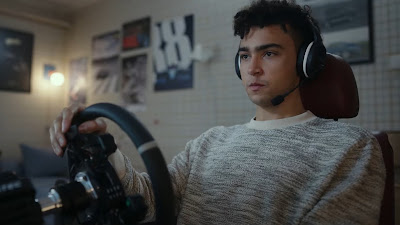
Somehow, though, in stepping away from sci-fi, one can find his personality still fits in a based-on-a-true-sports-story like Gran Turismo. Car racing is already a story of man melding with machine to do something greater than either could alone. This one adds the wrinkle of the eponymous video game. The narrative is loosely formed around real events in which the makers of the game convince Nissan and Playstation to bankroll an experiment by which the world’s best Gran Turismo players would get the chance to compete as real race car drivers. The movie casts its lead as a cute fresh-faced gamer and aspiring racer (Archie Madekwe) with a blue-collar dad (Oscar Nominee Djimon Hounsou) and mom (Spice Girl Geri Halliwell) who have their doubts as he leaps at this chance to live his dream. As we follow a pretty standard rise-fall-rise underdog story—would you believe the rich career drivers aren’t keen to share the track with an untested joystick jockey?—the young man is trained by an expert (David Harbour), boosted by a corporate climber (Orlando Bloom), and dogged by self-doubt.

The racing scenes are well-shaped and photographed for quick-paced car stunts. But the real charge in its heart comes from the way it allows the lead’s video game knowledge of tracks and tires to come in handy in real life. That’s the Blomkamp touch, letting the simulated dynamics of the game—down to the digital flourishes that visualize his memory of routes and alerts—turn into a thrill and an asset, as a real winner emerges from a melding with the machines. Even the real doubts, typified by a moving scene in which Hounsou and Halliwell watch a wreck on live TV and register the shock and uncertainty with only their eyes, fade in the midst of the momentum of the formulaically effective plotting. It’s selling a fantasy of man melding with machine that any number of gamers will find flattering, and makes for a sturdy car picture, a la such diverse pictures as Grand Prix and Ford v Ferrari and Talladega Nights, redone in a fresh coat of paint.

Saturday, December 3, 2022

Oh Ho No: VIOLENT NIGHT

Violent Night is for people who still think it makes them sound interesting to pretend they just noticed Die Hard is a Christmas movie. This hard-R actioner’s one innovation is to have the real Santa Claus (David Harbour) interrupt a home invasion. Alas, this is a noxiously pedestrian effort, lousy with gore and four-letter-words and filled with the unappealing, poorly sketched characters in the most routine plotting. It wants to be winking and transgressive. It tries really, really hard. How boring. It takes a real misanthrope or outsider to understand the undercurrents possible in a dark Christmas story. Put a Christmas Evil or Black Christmas or Dial Code Santa on and you’ll find a cozy Yuletide scumminess in harsher-edged stories of queasy intimate despair and real bloody danger. There’s always something bittersweet and sad about the holidays, a time to reflect on a fall from childhood innocence and domestic happiness. Even a more monstrous take—Rare Exports or Gremlins—plays up the Charlie Brown Christmas melancholy as it excavates clever ways to set scares against the setting. This one, with all its blandly blocked studio gloss, is just dull. It takes its idea’s surface and resolutely refuses to dig even one centimeter into its implications, senselessly colliding stupid fantasy with gooey gunplay over and over. And the thing stretches that thinness over two whole hours. Talk about a lump of coal.

The resulting forced frivolity leaves only mirthless misery where the action and comedy should be. It finds a horrible wealthy family trapped in their mansion on Christmas Eve when a paramilitary heist squad (led by John Leguizamo) shows up to take millions out of their vault. Turns out the family runs a black-ops contractor company and stole their stash from the US government by claiming it disappeared in the Middle East. Since we met the sweater-clad family (which includes Edi Patterson and Cam Gigandet and Beverly D’Angelo) vulgarly sniping at each other around a crackling fire, we aren’t exactly predisposed to like these crooked people. But the villains are never sympathetic either. And the movie lacks the moral or political clarity to actually make something of all that. So it’s just nasty for nasty’s sake. That’s an ain’t-I-a-stinker? move that runs straight into the movie’s actual attempts to make this all about The Spirit of Christmas. The horrible family has one bright spot: an innocent little girl (Leah Brady) brought by her reluctant mother (Alexis Louder). The tot still believes in Santa, and that belief in him will help save them all once Saint Nick himself ends up coming down the chimney and reluctantly reconnects with his Viking roots. Its approach to Claus lore is typically charmless. To see the jolly old elf himself sledgehammer and electrocute and behead the intruders, is, well, something, I suppose. This is all tiresomely tedious, and director Tommy Wirkola (Dead Snow), working from a screenplay by the Sonic the Hedgehog guys, lacks the chops to really make this mess of intentions cohere. The result is an ugly mixture of cringing empty holiday sentimentality and nasty artless violence.

Friday, July 9, 2021

Fighting with Her Family: BLACK WIDOW

After a decade spent hanging around the movies of other heroes in the Marvel Cinematic Universe, Black Widow gives Scarlett Johansson's action hero a movie all her own. It’s set between Civil War and Infinity War, but the best part is you don’t really have to know that. The movie is, as far as these things go, pretty self-contained, token Avengers references aside. It’s also smaller and with a bit more of a hard edge to the action; when people fall, they might break a leg, or at least take some ibuprofen and wrap a bandage before bouncing back into the fight. We knew Black Widow is a defector from a secret program of brainwashed women assassins. This story involves her discovery that her old captors (led by a glowering Ray Winstone) are still up to their nasty tricks. To help put a stop to them once and for all, she’s pulled back into the life of her sister (Florence Pugh) and parents, father a Russian super solider (David Harbour) and mother a scientist (Rachel Weisz). That they aren’t her real family, but were a family of Soviet spies given to each other as a cover story and then tearfully separated decades prior, makes this one weird reunion. This emotional spine of betrayal and reconnection gives slightly better than average rooting interest to her endeavors, and a desire to see the group actually find a way to belong to one another again helps to give some small amount of tension to the superheroics that are the inevitable endpoint here.

Because it takes a step back, and finds a potentially complicated globetrotting plot quickly and legibly sketched, there’s room to find nice character moments. The prologue is given over to a scene of childhood happiness torn asunder; later we’ll find room for an awkward family dinner as the years melt away to prickly banter around the table. It’s sweet, especially because the rest of the movie — think The Americans by way of Bourne with sci-fi Marvel touches, a comparison which wouldn’t surprise me to hear was on screenwriters Eric Pearson, Jac Schaeffer and Ned Benson’s cork board — is wall-to-wall action that’s about as good as Marvel can do it. The acrobatics and strategy play out comprehensibly, and the steady escalation of stakes and scale allows it to be the rare MCU property that gets a good climactic workout instead of mere repetitive CG glop. Director Cate Shortland leans into the strengths: the talented stunt team and her excellent cast, who bring satisfying personality to the scenes between chases and flips and kicks. What can I say? I cared about this family. Best in show has to be Florence Pugh, who has great plucky and teasing little-sister energy in her scenes with Johansson, and proves herself adept at navigating a role that’s equal parts comic relief and setup to a new hero we’ll definitely see return. That’s part for the course. But because the movie feels so tight, even at its just-over-two-hours runtime, the familiar never overstays its welcome, and finds a far more satisfying subtext — about autonomy and control — and backstory for Black Widow than what was only hinted before. If we have to have Marvel dominating our discourse and our screens, at least this entry is one of the better ones.

Tuesday, July 6, 2021

Out of Sight: NO SUDDEN MOVE

Steven Soderbergh’s small and satisfying No Sudden Move gets by on style and the sheer propulsive pleasure of plot. His filmmaking is so slick and precise that he can serve both at once. He’s a master of aesthetic detail — here a 50’s period piece shot with vintage anamorphic lensing and modern digital sheen — and of storytelling. Together the images pop with meaningful blocking and striking compositions, while the tight compelling story unfolds and unfolds and unfolds. The screenplay sets up an Elmore Leonard-style schemes-within-schemes Detroit crime caper that locates that town’s mid-century power structures: cops, cars companies, and mobsters. Then it watches as one little scam grows out of control simply because it pops off and cuts across all three lines of influence. We start with low-level criminals (Don Cheadle, Benicio del Toro, Kieran Culkin) hired to help watch the family of an accountant (David Harbour) as he’s forced at gunpoint to go to the office and take some car component designs out of a safe. It’s not so simple. The intelligence of Ed Solomon’s screenplay, beyond the clever wit to the dialogue and clockwork connections between people, is to catch all the characters in the middle of their own complicated lives, with unexpected interpersonal variables and cross-conflicts. This is just one more thing to throw a wrench into so many plans. Soon we have murder and infidelities and home invasion and bags of money and calls up the chain of command. Everyone needs to get their hands on this problem, ostensibly to solve it to their liking, but really to try to come out a little richer. 

Along the way, we get a little wiser to the corruption floating through Detroit at the time, and Soderbergh sharply draws our attention to the futility behind the characters’ competing goals. They scurry around, and there’s always someone higher up to swoop in to wave a gun, to make new deals, or to propose a better scam on top of the other scams. It’s the kind of crime picture that can introduce new big name actors to step in with a complication an hour or an hour and a half into the proceedings and it feels like yet another pleasurable twist. The large, well-cast ensemble — also including Brendan Fraser, Julia Fox, Jon Hamm, Amy Seimetz, Noah Jupe, Frankie Shaw, Bill Duke, and more surprises throughout — expertly navigates the twists and turns by being locked in on their own particular duties and struggles. Some show marvelous in-over-their-heads exasperation, while others are rattled and sidelined, and still more think they’re in total control. Maybe. Maybe not. Some are too smart for their own good; others can’t even grasp how behind they are. There’s no sudden move out of this when the motor city’s most corrupt are out to stop forward progress. This trust-no-one caper is briskly, crisply entertaining on a scene by scene level as it adds up to yet another of Soderbergh’s pleasurable genre experiments, and a recapitulation of his oft returned-to maxim: “When the person in charge won't get to the bottom of something, it's usually because they are at the bottom of that something.”

Friday, September 30, 2016

Blast from the Past: CRISIS IN SIX SCENES


Woody Allen’s latest production, Crisis in Six Scenes, has his best premise since Midnight in Paris. Set in the late 1960s, the social unrest of the times comes right into the house of a stuck-in-their-ways elderly couple. Their cozy home in upstate New York becomes a refuge for a radical when the daughter of an old friend breaks in. She’s wanted by the government for her membership in a left-wing protest group whose activities include, in addition to the usual demonstrations and rabble rousing, bomb building, cop wounding, and sedition fomenting. The elderly couple wants to help the poor girl out, the more open-minded marriage counselor wife (the wonderful Elaine May in her first role in 16 years) eager to keep her hidden, while the paranoid ad man husband (Allen) descends into a stubborn bundle of helpless nerves as the youthful firebrand (Miley Cyrus) slowly unravels their lives’ predictable patterns. It’s all a great excuse for Allen to explore his usual interest in intermingling relationship tangles with philosophical inquiry.

By far his longest narrative project – clocking in at well over two hours total – it is a six-part miniseries for Amazon. (The shift in form would seem more of a leap if the consistency of his filmmaking over decades – the repetitive themes, recurring character types, the regular font, the usual jazz scores – weren’t already a version of television’s comforting familiarity.) He introduces a large cast of characters with competing loyalties, like the conservative business major (John Magaro) who is smitten by the fetching fugitive, much to the dismay of his debutante fiancé (Rachel Brosnahan). And then there’s a cornucopia of familiar and fun faces as neighbors, patients, parents, cops, and protestors (Becky Ann Baker, Lewis Black, Max Casella, David Harbour, Nina Arianda, Christine Ebersole, Joy Behar, Michael Rapaport, and more). It’s stuffed with personality, but not every character comes to life with as much fullness as the time could permit, like soggy and underdeveloped romantic triangles amongst the younger characters.

There’s also the matter of political rhetoric, for as loaded and provocative as it could be it is instead cozy and comfortable fuzzy hindsight. The prickliest it gets is an early lament about how divisive and polarized the country’s politics are, a wry what-goes-around-comes-around smirk at our circular national crises and our inability to move past them. The great premise is just an excuse to knock contentedly humdrum characters into frazzled situations. I imagine such areas of thinness would be excused if this were a shorter feature. With so much time on his hands, though, there’s simply too much room here for dead air, stiff setups, tone-deaf teasing (a tossed off one-liner about a troubled adopted daughter lands poorly), and lackadaisical reaches for obvious developments. In order to go about stretching this tight little farce over so many segments the plot takes some meandering and the zip in the tension falls slack.

Then there is, of course, the slight stiffness and stodginess that’s crept into Allen’s filmmaking of late, a half-theatrically stilted, half-literary dustbin approach in which exposition is a little too plainly displayed and some zingers come wheezing to the punchline. But even when the writing gets a tad stale, the cast is so energetic and pleasantly amusing, it coasts along on comfortable charms and relaxed charisma. Allen is the quintessential Allen type, May is totally at ease playing the slightly frazzled upper-middle-class pseudo-intellectual (her comfort zone since her Nichols and May days), and Cyrus is just the right young, earnest, half-idealistic/half-cynical goof to send them spinning. Per usual, the right ensemble can carry over slightly below par Allen writing, and this one is overflowing with the exact right casting to elevate the downtimes, the patches that could’ve used another draft or two.

The stage is set for the characters’ conflicts to pile up quite swimmingly, and find occasion in the unevenness for some of the funniest scenes Allen has written in a while. May’s counseling sessions are perfect little sketches, and recurring scenes with her lovable, and increasingly politically rambunctious, little old ladies’ book club are a terrific throughline. Allen and Cyrus spar over food, consumerism, and communist ideals in agreeably prickly wars of words. There’s even a scene in which May scrambles over rooftops after a briefcase of contraband Cuban currency, so this is the sort of story that escalates in sometimes satisfyingly silly and unpredictable ways. Allen has some fun with the historical context, dusting off old quips about Vietnam, hippies, Nixon, Black Panthers, war protestors, and Latin American revolutionaries. (There’s an echo of Bananas there, I suppose.) By the final twenty minutes, which include a sustained and hilarious homage to the Marx brothers’ famous Night at the Opera stateroom sequence, the whole fitfully farcical storyline has arrived at a satisfying crescendo that’s well worth the wait.

Sunday, September 20, 2015

Bad Fellas: BLACK MASS


Black Mass is a true crime gangster picture that doesn’t have a perspective or opinion on the events it recounts. It is content to grimly reenact backroom power plays and violent hits without caring too much about what it meant to the people involved, let alone using the proceedings as windows into their psyches. Set in Boston during the reign of crime kingpin James “Whitey” Bulger, a man who muscled out the Italian mob to become the city’s main source of organized crime, the screenplay makes clear the ties of neighborhood loyalty. This allowed Bulger to enter a mutually beneficial relationship with an FBI agent who once was a schoolyard chum, feeding information about his rivals while receiving a blind eye to his own criminal enterprises. This, along with a senator for a brother, allowed him to remain untouched for decades.

Director Scott Cooper (Crazy Heart) and screenwriters Mark Mallouk and Jez Butterworth (Get on Up) start in 1975 and work their way to 1995, following Bulger from humble nastiness to king of crime before it all unravels for him. Perhaps assuming the target audience has seen some gangster stories play out before, the film is not particularly interested in the how or what of its characters’ schemes, and is never clear about the nature of his income. Instead, it features tight close-ups and slow zooms highlighting small shifts in negotiations and power plays. The recurring moments are either intimately creepy – Bulger staring down another person with intimidating intensity until they give him what he wants – or violent, with killings telegraphed beyond the point of surprise arriving with nonetheless brutal force. What are we to make of these murders? Only that they’re senseless, I suppose.

A large ensemble of reliable talents slurring through a variety of phony Boston accents keep things watchable and reasonably interesting on a moment by moment basis. Joel Edgerton is a slimy FBI agent too close to Bulger, protecting him from his law enforcement colleagues (Kevin Bacon, David Harbour, Adam Scott, Corey Stoll) and their suspicions they’re not getting appropriately valuable intel for all the damage caused. Jesse Plemons, Rory Cochrane, and W. Earl Brown are Whitey’s flunkies, who do a lot of the beating and killing, and drop in and out of the narrative. Benedict Cumberbatch is Bulger’s brother, affectionate but precious about keeping his office out of crime. And in this masculine environment of jockeying for power and speaking in deep whispers, a trio of female roles (for Dakota Johnson, Julianne Nicholson, and Juno Temple) exists to provide people who think this whole thing is dangerous but have no way of stopping it.

The proceedings are the sort of surface seriousness that coasts on the appearance of heavy subject matter without actually engaging with the thematic content that could exist under the surface. Cooper’s too interested in directing the logistics of the large ensemble, making sure everyone’s posing in the correct period detail and mushing their Rs into appropriate vaguely Bostonian sounds. The potentially fascinating story of corruption and crime is told through solid craft, Masanobu Takayanagi’s cinematography finely textured, David Rosenbaum’s editing steadily accumulating mild dread at the story’s most dramatic moments of threat. But there’s never a sense of what all the blood and backstabbing really means for the people involved beyond the simple facts of the case, and no foothold for either a formless “that’s life” truthiness or rigorous moralizing. It goes straight up the middle, ending up nowhere.

The mystery at the center remains the man himself, a presence and an instigator throughout the narrative who somehow remains stubbornly out of focus. How did he first rise to power? What made him the top Irish mobster? What did he think about what he did? We don’t know from this film. Here he seems to emerge fully formed from the shadows. Played by Johnny Depp at his least communicative and yet somehow as, if not more, affected than his Mortdecai or Mad Hatter, his countenance is entombed in artifice. Dead ice blue eyes pop against sickly pale skin, his face remolded out of makeup effects into something that’s always off-putting and unnatural. His Bulger is spooky, moving stiffly, holding his posture rigid, always frowning. He lurks in dark corners, most creepy when he stands hidden in an empty church nook, or when he interrupts a woman reading The Exorcist to calmly, threateningly run his hand along her face and neck.

Presenting the facts in a style synthesized and hollowed out from an amalgamation of every gangster picture that came before is one thing. But to plunk a performance like Depp’s in the middle of it – so artificial, so designed, so immediately signaling evil – is strange. It’s an interesting approach, more Karloff than DeNiro, more Michael Myers than Brando. He doesn’t seem like a real person. He looks like he should’ve been featured in Famous Monsters of Filmland fifty years ago. It makes impossible the notion we should take this seriously as a look into the face of real evil that men do. Besides, the movie’s too unfocused to even activate the Nosferatu qualities of Depp’s work. It’s a case of a project with a script, a director, and a lead performance working at cross purposes. It’s too shallow to be a weighty exploration of crime and punishment, too restrained to be pulpy fun, and too unwilling to follow an eccentric lead into a more overtly nightmarish direction. It’s competent enough to work scene by scene, but adds up to a missed opportunity all around.

Saturday, September 20, 2014

Truer Detective: A WALK AMONG THE TOMBSTONES


Scott Frank knows what he’s doing. He specializes in crime stories, heists and mysteries, serious-minded and skillfully puzzled out. With his scripts for the likes of Minority Report and Out of Sight and his 2007 directorial debut The Lookout, he crafts stories of dangerous, or at least resourceful, people trapped in unfortunate situations. A Walk Among the Tombstones, his latest film as writer and director, is hard and hardboiled, the stuff of typewriter clacks, bottles of brown liquor, and gristle. It’s a detective story about a man with deep psychological wounds who works quietly in the shadows. He doesn’t like what he does, but needs to do it as a way of working through his past mistakes.

Frank’s filmmaking craftsmanship is impeccable. There’s a classical restraint to the steady, crisply blocked stillness of the shots. It has throwback appeal in the patient setup and slow reveal of one clue after another. Based on a 1992 novel by crime fiction legend Lawrence Block, the film finds pleasures in the investigation, watching Detective Matthew Scudder think things through. Once a cop, he was in a bad incident resulting in the death of a little girl. Since then, he’s been haunted by that moment, eking out a living as an unlicensed private investigator. As the movie begins, he’s asked to find a kidnapper who snatched a drug trafficker’s wife, got ransom money, then killed her anyway.

Scudder, Block’s most famous creation, having appeared in 18 books since 1976, is here played by Liam Neeson, no stranger to the role of a calm, grieving, professional man of violence. He’s right for this kind of part because he’s so confident. We believe in his skill. We can see intelligence and thought in his eyes, the moral gravity of the situation resting on his broad shoulders. As he’s aged, Neeson has grown not restrained, but minimalist. He can suggest so much with a layer of gravel in his voice, a small shift of eyebrows, a tilt of the head. He’s still, solid, softly deploying his deep intonations until they calcify with deadly seriousness as he addresses bad men. He towers over others in a scene, and yet exudes a beguiling mixture of intimidating warmth, fierce intelligence and refreshing compassion equally sparingly deployed.

He’s reason enough to see the film. We watch as the gears turn in his head. He meets with the trafficker (Dan Stevens) and his brother (Boyd Holbrook), talks with witnesses, does research in the library (the film’s set in 1999), and casually scopes out crime scenes. Eventually, he’s paired with a sweet homeless teenager (Brian “Astro” Bradley) who loves Sam Spade and Phillip Marlowe as much as this film does. The kid likes the idea of being a private eye. The relationship he slowly develops with a reluctant Neeson isn’t cloying or sentimental, but positioned as a nice dim light in an otherwise grim experience.

Violence is brutal, sudden, and graphic in impact and implication, if not always shown. On occasion, Frank cuts to the depraved kidnapper (a pair of them, actually, played by David Harbour and Adam David Thompson) in flashbacks to prior murders and in present tense stalking of new targets. It’s unpleasant and unsettling, a grey mood of unrelenting menace. The ensemble is exclusively male, women left to be only objectified, wounded, imperiled, and chopped up into little pieces. We feel the weight of this danger, and as the stakes are raised it gets unrelentingly tense. Frank is certainly serious about the way he approaches this violence. It’s not a lark. It hurts. But the speaking parts are so fully ensconced in a masculine world, it’s more than a little disquieting to realize every female presence is only meat for the plot’s grinding.

But Neeson is so good, and the procedural mystery aspects so skillfully deployed, it manages to work despite this nagging imbalance. It’s compelling, the kind of tough, darkly effective detective movie we don’t often get these days. The film serves up all the usual red herrings and revelations you’d hope for. Frank’s script is terse and smartly plotted, playing fair by the various developments and actions. All the while, Neeson anchors the proceedings with his intense and welcome seriousness, as well as his dry humor and desire to keep his demons at bay. His humble struggle against the evil that men do is the lurid hook, but the throughline of his Alcoholics Anonymous meetings, threaded throughout, including a monologue intercut with the climax, makes it matter. He gives a complicated, soulful genre performance as much a throwback to detective stories of yore as the plotting. 

Saturday, September 22, 2012

Boys in Blue: END OF WATCH


In many ways a fairly standard cop movie, End of Watch follows two Los Angeles policemen through harrowing shifts in South Central, cutting glimpses into their personal lives between the episodic job-centric moments. That’s not a whole lot more than what you’d get on, say, an episode of the far-too-little-seen TNT show Southland, but this film differentiates itself by being violent and aesthetically muddy. It starts with the pretense that what we’re seeing is shot on consumer-grade video by the two men as part of one’s night school project. That’s dropped soon enough, though, hopping into conventional wobbly-cam style that still jumps into subjective shaking footage from time to time. The weaving, spinning camerawork charges right into every dangerous situation, moments that are filled with dread as sudden bloody messes can crop up around every corner.

Written and directed by David Ayer (he wrote Antoine Fuqua’s electrifying cop thriller Training Day, for which Denzel Washington won an Oscar), this film sticks to a ground level point of view. It’s narrow, filled with characters that are barely more than cliché on the page, but this visceral B-movie burrows into the chemistry between the two leads in a satisfyingly casual way. It’s convincing and occasionally riveting. The two cops at the center of it all are played with nice commitment from Jake Gyllenhaal and Michael Peña, who joke with each other commiserate about women, and tense up heading off on a new call. Ayer’s writing and the actor’s total ease in their roles leads to an absorbing sense of what it must be like to go to work each day not knowing if you’ll have a dull day of office hijinks and hanging out with a friend or if you’ll be in a situation where you’ll be wondering about the next horrible thing you’ll be witnessing.

It all seems scary and tense to me, but as two cops driving every day through rough neighborhoods, they’re kind of used to it. Though there are drive-by shootings, missing kids, fires, murders, and cops and criminals alike jostling for turf, this is essentially a hang out movie. We follow Gyllenhaal and Peña as they drive around, the camera sitting on the dashboard, pointing back at the two of them. They talk and joke and drive, waiting for the next call to action. They’re funny without being overwritten, flawed in relatable, human ways without becoming fascist monsters, crooked cops, or overzealous frat boy policemen. They’re just two ambitious, but unhurried, guys trying to do their jobs. They have fun being with each other, but they take their jobs seriously.

When they’re not working, we see their personal lives. Gyllenhaal’s sweet on his latest girlfriend (Anna Kendrick) while Peña and his wife (Natalie Martinez) are getting ready for the birth of their first child. There’s an instantly sympathetic portrait of duty and matter-of-fact romance in these scenes, a sense that these men are as committed to their relationships at home as they are to their relationships on the job. In addition to strong performances from the leads and their significant others, the film is much benefited by a supporting cast of co-workers (Frank Grillo, America Ferrera, David Harbour, and Cody Horn among them) that can quickly sketch in professionalism and world-weary banter that helps makes this world feel grounded. There’s a sense of reality to the way these characters behave and interact for which all the handheld camerawork in the world can’t substitute.

Unfortunately, Ayer stumbles on his way to a conclusion. Though entertaining and involving throughout, the episodic nature with discrete, unrelated moment police business, eschews a natural endpoint. Creating one can’t help but feel forced. Ayer has threaded throughout the picture a severely malnourished parallel story about dehumanized gang members who scowl and rant in Spanglish and glower at authority. Unlike the kindness with which the leads are drawn and the sympathy with which the somewhat-clichéd supporting characters are fleshed out, these criminals are cut-and-dried bad to the bone. It makes for a sense of dread that imbues the film’s final moments with white-knuckle sensation, but the visceral moment feels a little empty. It’s the emptiness of a promising movie ending in a conventional shootout.

That’s indicative of the whole experience, though. Ayer has created a film content to do routine things competently rather than stake out new territory of its own, serving up cop movie cliché with slight shadings through tense vignettes and capable acting. The film is often effective and affecting despite considerable drawbacks. It’s more emotion and sensation than pure narrative (which has a distinct feeling of been-there-done-that about it) and either way it’s grubbily told, but it’s narrow, small-scale approach and focused performances keep it from falling apart too much.

Sunday, January 16, 2011

Superhero Sting: THE GREEN HORNET

In theory the playfully fanciful French auteur Michel Gondry should be the perfect choice to direct a superhero movie. After all, it was similarly quirky cult favorite directors like Guillermo del Toro and Sam Raimi that helped make some of the genre’s best. Gondry’s take on The Green Hornet, star of a 1930’s radio serial who has also turned up in comics and TV shows in the intervening decades, is interesting, to say the least. He’s not given the possibility to go full masterpiece, like in his beautifully complicated Eternal Sunshine of the Spotless Mind, or even full on goofy and heartfelt, like in his sweet Be Kind, Rewind. Working with a script by Seth Rogen and his buddy Evan Goldberg, who have previously written Superbad and Pineapple Express, and doubtlessly shaped by market-driven forces, the movie is popcorn filmmaking that is stuck to the formula of the superhero origin story. Gondry makes it a rough-and-tumble film, though, a quick, brawling source of hit-and-miss hilarity and appealing action. It’s a thoroughly sweeded superhero flick, a chance for talented fans to take over and provide an energetic good time.

But wait, I can almost hear you asking yourself if it’s true that the idiosyncratic and charmingly phantasmagoric Gondry and the king of the R-rated comedy Rogen have collaborated on a film. Indeed it is, and it makes for an odd mix, at least at first. Gondry’s films have a loose specificity and a handmade feel, as if they were literally knitted or paper-mâché crafted into existence. Rogen’s scripts and performances, on the other hand, feel shaggy and improvised. The styles don’t quite gel at the film’s outset, though the film is also burdened with its exposition.

Rogen stars as Britt Reed, wild child heir to a prestigious newspaper mogul (Tom Wilkinson) who dies just minutes into the film. Bewildered while facing new responsibilities, he decides to do something with his life. He’s been wasting his potential and disappointing his father, a point that is belabored early and often with the overbearing work-a-holic Wilkinson juxtaposed with his party-all-the-time son. By the time an ex-employee of the father, a genius mechanic who goes by the name of Kato (Jay Chou), shows up to help Reed with his coffee machine, the movie starts to sputter to life.

For some half-believable set of reasons, Reed and Kato become quick friends and decide to take the city’s crime problem head on after they inadvertently stop a mugging that interrupts their plans of vandalism. Through a combination of newspapering and superheroics, their legend grows. At the paper, they start to spread the word about the Green Hornet, a masked menace. Head editor Edward James Olmos is wary about running what appear to be fluff pieces about an isolated incident, but secretary/criminologist Cameron Diaz finds herself intrigued. As the Green Hornet, Reed is part likeable goof, part fanboy. He leaves the heroics to Kato, who not only develops all of their gadgetry, but also flips about in super-cool Gondry-style kung-fu moves that fracture the frame and control the speed of time itself. All of these dubiously good deeds attract the attention of the local crime boss (Christoph Waltz, who is just fine here in an odd role that’s no Hans Landa) and the District Attorney (David Harbour).

At first, I wasn’t too thrilled by the movie, which has a hard time finding a persuasive or smooth way of introducing character and conflict, which leads to a messy opening act. While it never shakes its messily constructed frame, the awkward set up leads to a mostly successful payoff. The film has fun energy and conviction and by the time it enters its final third it had totally won me over. Rogen’s goofball hysterics and Gondry’s off-kilter whimsy fall into harmony and pile up into a building collection of slam-bang action set pieces that sing with delightful visual wit. The finale, an explosive encounter in a printing press, is an exuberant and inventive cacophony that left me with a smile. Though Rogen’s coarse banter and Gondry’s vivid cinematic imagination don’t seem the most natural fit, they end up melding to the well-trod formula of the superhero origin story with, despite some uneasy tonal shakiness and aimless plot convolution, some surprisingly effective excitement.

Wednesday, June 3, 2009

Revolutionary Road (2008)

Revolutionary Road is now available on DVD and Blu-ray.

Since 1961, when Richard Yates’ great novel Revolutionary Road was published, it has become thoroughly frequent to see “daring” artists scrape at the layers of happiness covering both suburbia and the 1950s and 60s to find the hopelessness and emptiness within. The biggest danger in adapting the book to film now is in failing to making what was original exciting once more. Director Sam Mendes fails for the most part. This is fairly routine stuff at times. The book’s greatest strength is its fluid prose which floats through character’s heads. We see motivation and emotion effortlessly woven and incorporated into character’s actions. As good as Leonardo DiCaprio and Kate Winslet are as performers, they don’t manage to convey the same intensity of purpose. For all the great histrionics of their acting they don’t dig into the roles. Here they become examples of Age-Appropriate-Dialogue-Delivery Devices, to use the astute nomenclature of the great Sam Van Hallgren.

But there are moments of visual perfection: a sea of top hats flowing into a subway station, a group of children staring at the television unaware of their father’s voice. But for every scene of effortless emotional twinge that the pictoral vision can evoke, even great early moments like the one that finds DiCaprio returning home from an affair in the city to be greeted by his children was done better by the TV show Mad Men. A curious thing about the movie, though, is that, although it starts by sputtering its engine, once it roars to life it has a pretty good roar.

The roar is due, in no small part, to the great supporting cast. David Harbour and Kathryn Hahn are perfect as a middle-class post-war all-American couple slowly colliding with the façade of the suburbs. Maybe they should have been the leads. But knocking everyone else in the cast out of the ballpark are Michael Shannon and Kathy Bates who are operating on another level altogether. They know just the way the material should be handled. Why didn’t anyone else (other than Harbour and Hahn) catch on? Even if the movie doesn’t, maybe even couldn’t, have the same wallop as the novel, the end still manages to deliver its plot twist with a satisfyingly sickening crunch – a sort of sick cinematic flip to the saccharine sacrifice that caps Kate and Leo’s Titanic. The extent that it does work I found a little surprising considering pessimism is much more relatable from the inside out and Mendes keeps the film firmly entrenched on the outside.

Sunday, April 19, 2009

State of Play (2009)

If a thriller is like a pot of water, State of Play is centered on the right burner, simmers satisfactorily for a while, and manages to boil a few times, even if it doesn’t have enough material to ever boil over. The film follows a pair of reporters, one a veteran (Russell Crowe), one a newbie and a blogger (Rachel McAdams). As a routine murder (suicide? accident?) story turns into a sex scandal and then a full blow conspiracy piece, the two of them are drawn into an endless web of intrigue. There’s a wide and diverse supporting cast that really shines. There’s Helen Mirren as the tough and biting editor and Robin Wright Penn as the wife of a senator. There’s also a great collection of shifty slimeballs engaging in the skullduggery the leads must sort out. Ben Affleck is quite good – I’ve never thought him to be as bad an actor as some have made him out to be – as a senator who finds himself in the middle of a scandal. Among the respectable and suavely sinister supporting cast, Jeff Daniels, Jason Bateman, and David Harbour are great in the handful of scenes they each are given.

This is a slick, solid film handled well by director Kevin Macdonald. Three screenwriters are credited, reason enough, I suppose, for the watered-down feel of the vision. Matthew Michael Carnahan (Lions for Lambs, The Kingdom), Tony Gilroy (the Bourne films, Michael Clayton, Duplicity), and Billy Ray (Shattered Glass, Breach) are all adept crafters of thrillers but this, an adaptation of a six-hour BBC miniseries (unseen by me, though now I want to give it a look), feels a little rushed and jumbled, almost exactly like three different yet similar takes on the material cobbled together and sanded down, but not quite a smooth integration. Even so, this is a well drawn film with fine performances from fine performers that results in fine drama that’s consistently engaging. This isn’t exactly innovative or distinctive filmmaking but there’s something oddly comforting about seeing an old reliable genre trotted out done well and done right. The script is filled with fun lines and a deep vein of wit, as well as sharp twists of ratcheting tension and wrenching reversals of information that shine new light on sleaze and thicken the plot to a pleasant pulp (and it only once reminded me of the similarly circular Coen comedy Burn After Reading).

And there’s something engagingly current about this film which is a bit of a simultaneous eulogy and appreciation for the art of the printed newspaper (there’s even a bit of homage to that classic journalist film All the President’s Men in the way the final headline types across the screen). The editor complains about the corporation that took control of the paper. A reporter nervously compares his status to that of the new blogging department; after all, they’re cheaper, faster, and have lower standards, or so he says. It’s a rather touching tribute to what Crowe’s character would call “damn fine reporting.” There is a valiant melancholy to the tone of the film that sends the reporters, those brave investigative journalists, off into an uncertain sunset.

This isn’t a great thriller but it’s a good one, the multiplex equivalent of a well-written airport novel. It’s long – but not too long – complex – but not too complex – and satisfyingly immersive with some genuinely unexpected twists and a compelling mystery. I settled back into my seat, sipped my soda, and thoroughly enjoyed having the world melt away for a little over two hours, even though it was only replaced by a hightened and simplified version of it.