Now movie audiences will have to confront the question that Broadway audiences have known for 20 years: how can Wicked have an Act 1 so solid, and an Act 2 so weak? It’s especially stark when the Acts have been split into individual movies separated by a year. That gave us time to appreciate the first half all the more. Introducing two big charismatic performances with Cynthia Erivo’s green-hued Elphaba and Ariana Grande’s tickled-pink Glidna allowed us to enjoy their antagonism slowly softening into friendship only to end in betrayal in one coherent story. They’re fully realized fantasy creations in an Oz that’s part Baum, part MGM, and all modern big-budget spectacle with sprawling CG landscapes behind backlots and impressively large sets in which catchy numbers spill out around every corner of the world-building. Sure, it ends in a cliffhanger, but after two hours of terrific musical theater sequences and fantasy gobbledegook, “Defying Gravity” has such incredible narrative, emotional, and melodic uplift that it makes the story so satisfying in and of itself that it’s no wonder the Broadway show had a problem of people leaving at the Intermission assuming that was the finale. (They presumably dance up the aisles with visions of Dorothy filling in the Act 2 in their minds.) Maybe that’s how it should be.
With Wicked: For Good, the filmmaking craft remains consistent. Director Jon M. Chu has the same cast in the same colorful, backlit sets, draped in the same dazzling Paul Tazewell costumes and strutting along to the same score. It’s still a grand spectacle, but it loses its spark in a jumble of character decisions and reversals that never quite make sense or add up to a logical emotional through line. By the time our leads belt out their big climactic duet, in which they claim because they knew each other they’ve been “changed for the better,” I found myself wondering how, exactly, they’ve been changed, and if it’s really for the good. Why give Elphaba, now an anti-wizard activist, a big early number in which she encourages Ozian dissidents to stay in Oz and fight the authoritarian Emerald City—there’s no place like home, after all—if she’ll end up exiling herself in the end? Why introduce a more compassionate Glinda, now a propaganda tool of the wizard, after a movie’s worth of push-and-pull between her best and worst moral choices if she’ll end up lying again in the end—albeit we’re supposed to approve of it being For Good. The story is loaded with dramatic reversals and decisions made just to rearrange characters and twist them into what the plot requires for any given moment. It even loses interest a few key supporting players along the way, though how they’re feeling about the climax would seemingly be of interest. The first Wicked film worked so well in expanding everything that worked about Act 1 on stage. This sequel dutifully doubles down on everything that’s so out of shape about Act 2.
A big part of the problem of all these twists and contradictions is that the plotting relies on the audience’s knowledge of The Wizard of Oz to fill in gaps of its own storytelling. Yet this is the case while having, in the process, changed so many of the classic characters and their dynamics that no existing version of The Wizard of Oz could function as we know it. Better to forge its own revisionist path down that yellow brick road, perhaps, than try to dance between and have it both ways. But although the results feel so sloppy, and have surprisingly little in the way of musical delights, I do appreciate the attempt to make a second act that critiques and complicates rather than just repeat. There’s some real emotional tension between the characters here, though it’s regularly undercut by adding up to such an incomplete picture. In the moments when it’s most alive, like numbers with Jeff Goldblum’s Wizard explaining his con man skills, or a romantic duet a wicked witch has with Jonathan Bailey’s Prince that slowly levitates, it’s emerging out of something rooted in the character conflicts established. Even the swooping fight scenes and stirring sentimentality tend to work because we care about these witches. Those performances are still comfortable and charismatic, playing to the rafters with every glance. Because of that grounding, and the effects swirling around them, watching the production unfold I had the sense of a grand spectacle almost working. No one scene is particularly bad, but the cumulative effect of its choices is to thrash these characters about just to arrive at unsatisfying, and pretty dysfunctional final moments. It fizzles right when it should explode. At least we’ll always have Part 1.
Showing posts with label Ariana Grande. Show all posts
Saturday, November 22, 2025
Sunday, November 24, 2024
Which One: WICKED
Director Jon M. Chu is a reliable steady hand behind the camera. He simply makes movies that work well with broad audiences. He honed his skills on two Step Up movies and a G.I. Joe effort, an underrated Jem and the Holograms pop musical, a couple Bieber concert docs, and an adaptation of rom-com novel Crazy Rich Asians. That he’s not strictly a big-budget franchise player allowed him to develop some skill with bodies in motion and human-scaled emotion. He clearly has an old-fashioned love of blocking and staging, but enough modern facility with digital embellishments to give it a contemporary unreality. Those efforts are often pretty appealing. But all of that made him especially situated to modulate his modes of filmmaking into adapting Broadway hits. They bring his skill to life in even more vibrant, earnest ways with clear passion for the material and the genre. These bottle up some extra passion in the sturdy professional polish. His version of Lin-Manuel Miranda’s In the Heights has a great sense of place and mood in a heightened block party appeal. Its best moments have a kind of rolling crescendo of dance and high spirits. That movie, about thwarted and kindled hopes and dreams for family and friends and careers and romances, has such a joyful expression of character and community that it’s hard to resist. It’s a mode to which his career’s been building.
And now Chu turns his attention to the biggest musical of the past couple decades: Wicked. It’s also his best movie yet. This is a big-hearted, well-crafted, crowd-pleasing spectacle of music, dance, humor, and pathos. He marries a potentially large canvas of a fantasy musical with something grounded in a simple character story of two women who grow to respect one another before getting torn apart by circumstance and politics and personalities. This Part 1 tackles just the first Act of this well-known reinterpretation of the Wicked Witch of the West and finds enough material for a full, satisfying experience in and of itself. Turns out it’s a great time to revive Winnie Holzman and Stephen Schwartz’s production in which young women experience prejudice, creeping fascism, and dawning political consciousness. That it is in the guise of Wizard of Oz fan fiction gives it a fantastical frisson, even as Chu deliberately steers away from the perfectly outlandish artifice of the 1939 classic inspiration and into something a little softer and more inflected with a rounded-edges pseudo-reality. It’s a little silly, and a little synthetic, but it’s such a wondrously big-hearted experience that believes in itself so fully that it’s easy to get pulled along. The proceedings take place in enormous sets—fake forests, palaces and schoolyards that are lush prosceniums ornately decorated—and find figures in costumes lavishly detailed in jewels and frills and flowing angles. There are some phony computer-generated animals and the usual over-cranked background enhancements movies of this size get these days. But throughout there’s a spirt of the stage to its staging, and even some Disney Renaissance to its wrangling of small crowds, big reactions, and lovely gestures—like skipping across a pond on a row of stones. (This is what all those dire live-action remakes wish they felt like.) It’s comfortably old-fashioned underneath its new-film shine.
Amid all this design, we meet the emerald-green Elphaba (Cynthia Erivo) as she arrives at the magical Shiz University. Her reluctant roommate is privileged blonde striver Glinda, who’ll one day be The Good Witch. She’s played by Ariana Grande in a sensational flouncy performance in which each line reading is deeply motived with both dramatic tensions and comic filigrees, sometimes in the same expression. Those choices flow out of her characterization and into song with a dazzling fluidity. It’d be a star making turn if she wasn’t already a pop star. It’s a performance built to contrast and support the striking stillness and deliberateness from Erivo as a deeply wounded outcast who slowly starts to imagine herself fitting into the mainstream only to be pushed back by said mainstream's callousness toward the marginalized. It’s a tricky role played for vulnerably and toughness, a self-actualization in the face of others assumptions about her used to manipulate and deceive until she takes command of her own power. This tension is embodied in the character conflicts—and then expressed through a fine ensemble of good performers as interesting characters who stir the pot, and inevitably join them in song and dance. Chu shoots these numbers with attention to choreography and finds neatly complicated and rousing ways to stage them, and draw them out with a uniquely cinematic form of theatricality. It’s feels all so casual and effortless as crowds move in sync or drift into moving solos—ballads both tenderly downbeat and triumphantly bellowed. As all good musicals do, these numbers spring out of deep wells of emotion mere dialogue is suddenly inadequate to express. It makes for a full and transporting experience if you give yourself over to it—and ends on such a perfect high that a 12-month intermission seems almost bearable.
And now Chu turns his attention to the biggest musical of the past couple decades: Wicked. It’s also his best movie yet. This is a big-hearted, well-crafted, crowd-pleasing spectacle of music, dance, humor, and pathos. He marries a potentially large canvas of a fantasy musical with something grounded in a simple character story of two women who grow to respect one another before getting torn apart by circumstance and politics and personalities. This Part 1 tackles just the first Act of this well-known reinterpretation of the Wicked Witch of the West and finds enough material for a full, satisfying experience in and of itself. Turns out it’s a great time to revive Winnie Holzman and Stephen Schwartz’s production in which young women experience prejudice, creeping fascism, and dawning political consciousness. That it is in the guise of Wizard of Oz fan fiction gives it a fantastical frisson, even as Chu deliberately steers away from the perfectly outlandish artifice of the 1939 classic inspiration and into something a little softer and more inflected with a rounded-edges pseudo-reality. It’s a little silly, and a little synthetic, but it’s such a wondrously big-hearted experience that believes in itself so fully that it’s easy to get pulled along. The proceedings take place in enormous sets—fake forests, palaces and schoolyards that are lush prosceniums ornately decorated—and find figures in costumes lavishly detailed in jewels and frills and flowing angles. There are some phony computer-generated animals and the usual over-cranked background enhancements movies of this size get these days. But throughout there’s a spirt of the stage to its staging, and even some Disney Renaissance to its wrangling of small crowds, big reactions, and lovely gestures—like skipping across a pond on a row of stones. (This is what all those dire live-action remakes wish they felt like.) It’s comfortably old-fashioned underneath its new-film shine.
Amid all this design, we meet the emerald-green Elphaba (Cynthia Erivo) as she arrives at the magical Shiz University. Her reluctant roommate is privileged blonde striver Glinda, who’ll one day be The Good Witch. She’s played by Ariana Grande in a sensational flouncy performance in which each line reading is deeply motived with both dramatic tensions and comic filigrees, sometimes in the same expression. Those choices flow out of her characterization and into song with a dazzling fluidity. It’d be a star making turn if she wasn’t already a pop star. It’s a performance built to contrast and support the striking stillness and deliberateness from Erivo as a deeply wounded outcast who slowly starts to imagine herself fitting into the mainstream only to be pushed back by said mainstream's callousness toward the marginalized. It’s a tricky role played for vulnerably and toughness, a self-actualization in the face of others assumptions about her used to manipulate and deceive until she takes command of her own power. This tension is embodied in the character conflicts—and then expressed through a fine ensemble of good performers as interesting characters who stir the pot, and inevitably join them in song and dance. Chu shoots these numbers with attention to choreography and finds neatly complicated and rousing ways to stage them, and draw them out with a uniquely cinematic form of theatricality. It’s feels all so casual and effortless as crowds move in sync or drift into moving solos—ballads both tenderly downbeat and triumphantly bellowed. As all good musicals do, these numbers spring out of deep wells of emotion mere dialogue is suddenly inadequate to express. It makes for a full and transporting experience if you give yourself over to it—and ends on such a perfect high that a 12-month intermission seems almost bearable.
Sunday, February 6, 2022
Falling Skies: MOONFALL and DON'T LOOK UP
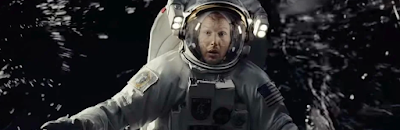
Moonfall is so perfectly awful I was almost charmed. In this high-gloss chintzy approximation of an A-level blockbuster 90s disaster picture, the moon has been knocked out of its orbit. Every time it circles the Earth, it gets closer. That thing’s bound to crash. It’s such total lunacy—and gets weirder by the reel—presented with casual pomposity stretching beyond its budget. It has a choppy opening hour that over-complicates every subplot and races through exposition as if it half-heartedly realizes we won’t care about its convolutions. As the ensemble is brought on stage and the moon looms larger, the vast cast is sketched in with shorthand and cliche. There’s disgraced astronaut Patrick Wilson and glamorous NASA chief Halle Berry and annoying pudgy British wannabe scientist John Bradley, each with a part of the solution as to how to get the moon restored to its proper place before it touches down. Also in the mix are the usual ex-wives, step-fathers, elderly mothers, conspiracy theorists, foreign exchange students, troubled adult sons, adorable moppets, and a general with a key to the nukes and a reluctant trigger finger. All the while, passable effects whip up CG floods as tides go wild, flooding cities of panicking refugees and looters before, during, and after the gravitational disruption kicks off earthquakes.
Where once these sort of big-screen natural disasters lingered on their big effects moments, now they can just wallpaper indiscriminately until it leaves little impact. It’s the kind of movie that relocates the top of the Chrysler building and barely blinks an eye. (The best moments are the most novel, in a crackpot derivative way: a space shuttle outracing an enormous gravity wave, or exploring the secret inner chambers of the moon.) But there’s an odd underplaying throughout, like when a son looks at his father, on the brink of potential apocalypse, at the moment a last-ditch plan has fallen through and shrugs: “I’m sorry that didn’t work out.” The second hour is a little zippier, and moderately wilder, as the apocalyptic stakes cut between a daring mission into the center of the moon, and a family trying to get what appears to be a mile or two down the road back on Earth. The imbalance is a little funny. Par for the course is when the general stares down a guy who wants to bomb the moon and says: “You can’t do that! My ex-wife’s up there!!”
So it’s good for a few laughs, and it might remind you passingly of better sequences in other movies like it. But that the production is helmed by Roland Emmerich, a king of the industrial-strength big budget ensemble disaster flick, having Independence Day, The Day After Tomorrow, and 2012 on his resume, gives it the distinct feeling of a director making his own knockoff. It hasn’t the balance between the spectacle and melodrama that the better versions of the disaster ensemble can pull off. Heck, even his own former co-writer Dean Devlin did a better spin on the all-star global calamity space-junk explode-o-rama with the under-appreciated gargantuan cheese wheel that was Geostorm a few years back. One of that movie’s stars, Gerard Butler, even did it well in a more serious register with the oddly affecting meteor-on-the-way thriller Greenland from Christmas before last. (It went VOD, like the bulk of that season’s offerings, so who knows how many actually saw it?) Just goes to show you we are in a little boom for talking our destruction to death. Gee, what could cause that? We can't expect every attempt to work well.
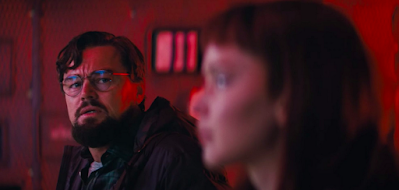
At least all of the above are better than Don’t Look Up. That movie imagines a world-ending calamity is on the way, and getting people to care about or even accept the reality of the situation, let alone examine possible solutions, is nigh impossible. Sounds familiar. Adam McKay wrote the movie as a climate change parable, but the intervening pandemic and its response surely fed into it as well. Here we open on two scientists at Michigan State University (Leonardo DiCaprio and Jennifer Lawrence) identifying a planet-killing meteor that’ll hit Earth in a matter of months. They try to alert the government, but the president (Meryl Streep) is too image-obsessed and election-focused to care and demands the information hidden. (The movie’s funniest joke is her son (Jonah Hill) insisting on double checking the info with experts from a better college. Ha.) So the scientists try to leak it to the media, but most outlets don’t care, and the best they can do is getting laughed off a morning show whose hosts (Cate Blanchett and Tyler Perry) can’t bring themselves to understand what their incongruously serious guests are trying to say. There’s clear anger in this telling, a well-intentioned ranting about humanity hurtling toward its doom and too ignorant and selfish to face it and fix it.
But as the movie spirals and complicates for over two hours, it stays on that grinding pitch of justified anger. It starts to seem less sharply targeted and more tiresomely mismanaged. The characters, no matter how well-acted by an all-star cast, are broad caricatures, and McKay’s rush to condemn doesn’t leave time to actually understand their motives. This is a bloated political cartoon stumbling backwards toward preordained conclusions. Compare it to, say, Dr. Strangelove, and you’ll see how Kubrick’s classic dark comedy of nuclear annihilation is a witheringly hilarious look at nightmarish Cold War logic precisely because it understands how fallible and specific personality types could stumble toward accidental apocalypse. Here, though McKay has understandable outrage at the prevailing forces of prevaricating pundits and the corrupt short-term individualism eroding all sense of common good, he’s made a movie that’s the equivalent of a “raising awareness” campaign. Yeah, I know, and I agree, somewhat, I think. But now what?
This sociopolitical comedy is still somehow McKay’s best of that sort, though this, Vice, and The Big Short are all considerable steps down from his Anchorman, Talladega Nights, and Step-Brothers heyday. He no longer makes exuberantly goofy comedies with serious subtext. Now he’s making self-serious political comedies where his Big Ideas are all on the surface where they won’t stop needling, jabbing, scalding, and condescending at the expense of entertainment and, just as deadly, a point that can get past the surface of the matters on display. Attacking shallowness with shallowness without even the deceptive nuance that, say, Verhoeven might bring, is awfully wearisome. He’s clearly an intelligent and passionate thinker—but when his works about Wall Street corruption or Dick Cheney flatten out the issue as they scream to the choir that it’s all our fault, too, well, if you’re going to think so little of your audience, at least you could actually be better than them. These movies are both contemptuous and scatter-brained. He really thinks he’s telling you something new and vital instead of repackaging common complaints. It looks at massive systemic issues and futilely wags its finger at the viewer. We’re all implicated, yes, but now what do I have to do about it?
As Don’t Look Up widens its lens, with some vigorous absurdities that sparkle here and there, it bogs itself down and clutters itself up with characters and plot lines all pushing in the same direction at the same grim pitch: our society is incapable of saving itself. Everyone’s pathetic and cringingly one-dimensional. There are red-meat military men (Ron Perlman) and weary astronomers (Rob Morgan) and social media celebrities (Ariana Grande and Scott Mescudi) and right-wing propagandists (Michael Chiklis) and progressive journalists (Himesh Patel) and a tech billionaire cutting a real Musky Zuckerbergian Bezoar (Mark Rylance), among others. No one can meet the moment. Of course there’s even a right-wing messaging movement to just avoid the issue entirely. “Don’t Look Up” becomes their rallying cry. (Years of “if climate’s changing, why do we have winter?” and “if masks and vaccines work, why is there still COVID?” make even that sadly believable.) To watch a government and society flailing in the face of overwhelming disaster is painfully familiar. That the movie is willing to condemn a shallow media, lying right-wing authoritarians, and neoliberal corporate shills is not nothing. But the cast is stranded in a movie with ugly blocking and clanking rhythms, scenes that feel hacked together and indifferently covered, unable to build up character or perspective beyond the movie’s insistence that all of these horrible, fallible people are worthy of our scorn.
Though there’s plenty of blame to go around, the movie ends up somehow too much and not enough. Yes, this is a close match to the lunacies we’ve seen lately, and it carries that out to its logical calamitous conclusion on an apocalyptic scale. But it’s not exactly a thrill to see a movie as mean and absurd and judgmental as those it’s trying to condemn. Its final image of cynical comeuppance—spoilers: a nude body double standing in for a beloved actress getting chomped by a CG creature—is the ultimate grotesquerie. By then, the whole final stretch of the film leading up to it, a wild mix of surprise unearned sentiment and nihilistic cynicism and cheap nasty gags, has already made it clear the movie has nothing meaningful to explore or suggest. What a bracingly stupid movie: whipping up a frenzy of ugliness to serve as a funhouse mirror of our current problems and expecting us to thank it for its meager insight. Hey, at least it has a couple laughs, too.
Subscribe to:
Posts (Atom)