Showing posts with label Roland Emmerich. Show all posts

Sunday, February 6, 2022

Falling Skies: MOONFALL and DON'T LOOK UP

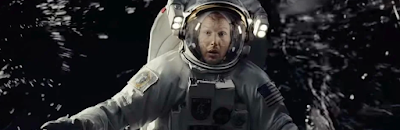
Moonfall is so perfectly awful I was almost charmed. In this high-gloss chintzy approximation of an A-level blockbuster 90s disaster picture, the moon has been knocked out of its orbit. Every time it circles the Earth, it gets closer. That thing’s bound to crash. It’s such total lunacy—and gets weirder by the reel—presented with casual pomposity stretching beyond its budget. It has a choppy opening hour that over-complicates every subplot and races through exposition as if it half-heartedly realizes we won’t care about its convolutions. As the ensemble is brought on stage and the moon looms larger, the vast cast is sketched in with shorthand and cliche. There’s disgraced astronaut Patrick Wilson and glamorous NASA chief Halle Berry and annoying pudgy British wannabe scientist John Bradley, each with a part of the solution as to how to get the moon restored to its proper place before it touches down. Also in the mix are the usual ex-wives, step-fathers, elderly mothers, conspiracy theorists, foreign exchange students, troubled adult sons, adorable moppets, and a general with a key to the nukes and a reluctant trigger finger. All the while, passable effects whip up CG floods as tides go wild, flooding cities of panicking refugees and looters before, during, and after the gravitational disruption kicks off earthquakes.

Where once these sort of big-screen natural disasters lingered on their big effects moments, now they can just wallpaper indiscriminately until it leaves little impact. It’s the kind of movie that relocates the top of the Chrysler building and barely blinks an eye. (The best moments are the most novel, in a crackpot derivative way: a space shuttle outracing an enormous gravity wave, or exploring the secret inner chambers of the moon.) But there’s an odd underplaying throughout, like when a son looks at his father, on the brink of potential apocalypse, at the moment a last-ditch plan has fallen through and shrugs: “I’m sorry that didn’t work out.” The second hour is a little zippier, and moderately wilder, as the apocalyptic stakes cut between a daring mission into the center of the moon, and a family trying to get what appears to be a mile or two down the road back on Earth. The imbalance is a little funny. Par for the course is when the general stares down a guy who wants to bomb the moon and says: “You can’t do that! My ex-wife’s up there!!”

So it’s good for a few laughs, and it might remind you passingly of better sequences in other movies like it. But that the production is helmed by Roland Emmerich, a king of the industrial-strength big budget ensemble disaster flick, having Independence Day, The Day After Tomorrow, and 2012 on his resume, gives it the distinct feeling of a director making his own knockoff. It hasn’t the balance between the spectacle and melodrama that the better versions of the disaster ensemble can pull off. Heck, even his own former co-writer Dean Devlin did a better spin on the all-star global calamity space-junk explode-o-rama with the under-appreciated gargantuan cheese wheel that was Geostorm a few years back. One of that movie’s stars, Gerard Butler, even did it well in a more serious register with the oddly affecting meteor-on-the-way thriller Greenland from Christmas before last. (It went VOD, like the bulk of that season’s offerings, so who knows how many actually saw it?) Just goes to show you we are in a little boom for talking our destruction to death. Gee, what could cause that? We can't expect every attempt to work well.
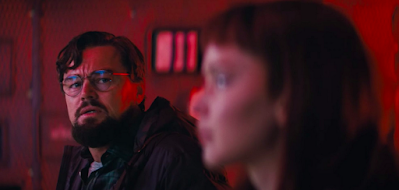
At least all of the above are better than Don’t Look Up. That movie imagines a world-ending calamity is on the way, and getting people to care about or even accept the reality of the situation, let alone examine possible solutions, is nigh impossible. Sounds familiar. Adam McKay wrote the movie as a climate change parable, but the intervening pandemic and its response surely fed into it as well. Here we open on two scientists at Michigan State University (Leonardo DiCaprio and Jennifer Lawrence) identifying a planet-killing meteor that’ll hit Earth in a matter of months. They try to alert the government, but the president (Meryl Streep) is too image-obsessed and election-focused to care and demands the information hidden. (The movie’s funniest joke is her son (Jonah Hill) insisting on double checking the info with experts from a better college. Ha.) So the scientists try to leak it to the media, but most outlets don’t care, and the best they can do is getting laughed off a morning show whose hosts (Cate Blanchett and Tyler Perry) can’t bring themselves to understand what their incongruously serious guests are trying to say. There’s clear anger in this telling, a well-intentioned ranting about humanity hurtling toward its doom and too ignorant and selfish to face it and fix it.

But as the movie spirals and complicates for over two hours, it stays on that grinding pitch of justified anger. It starts to seem less sharply targeted and more tiresomely mismanaged. The characters, no matter how well-acted by an all-star cast, are broad caricatures, and McKay’s rush to condemn doesn’t leave time to actually understand their motives. This is a bloated political cartoon stumbling backwards toward preordained conclusions. Compare it to, say, Dr. Strangelove, and you’ll see how Kubrick’s classic dark comedy of nuclear annihilation is a witheringly hilarious look at nightmarish Cold War logic precisely because it understands how fallible and specific personality types could stumble toward accidental apocalypse. Here, though McKay has understandable outrage at the prevailing forces of prevaricating pundits and the corrupt short-term individualism eroding all sense of common good, he’s made a movie that’s the equivalent of a “raising awareness” campaign. Yeah, I know, and I agree, somewhat, I think. But now what?

This sociopolitical comedy is still somehow McKay’s best of that sort, though this, Vice, and The Big Short are all considerable steps down from his Anchorman, Talladega Nights, and Step-Brothers heyday. He no longer makes exuberantly goofy comedies with serious subtext. Now he’s making self-serious political comedies where his Big Ideas are all on the surface where they won’t stop needling, jabbing, scalding, and condescending at the expense of entertainment and, just as deadly, a point that can get past the surface of the matters on display. Attacking shallowness with shallowness without even the deceptive nuance that, say, Verhoeven might bring, is awfully wearisome. He’s clearly an intelligent and passionate thinker—but when his works about Wall Street corruption or Dick Cheney flatten out the issue as they scream to the choir that it’s all our fault, too, well, if you’re going to think so little of your audience, at least you could actually be better than them. These movies are both contemptuous and scatter-brained. He really thinks he’s telling you something new and vital instead of repackaging common complaints. It looks at massive systemic issues and futilely wags its finger at the viewer. We’re all implicated, yes, but now what do I have to do about it?

As Don’t Look Up widens its lens, with some vigorous absurdities that sparkle here and there, it bogs itself down and clutters itself up with characters and plot lines all pushing in the same direction at the same grim pitch: our society is incapable of saving itself. Everyone’s pathetic and cringingly one-dimensional. There are red-meat military men (Ron Perlman) and weary astronomers (Rob Morgan) and social media celebrities (Ariana Grande and Scott Mescudi) and right-wing propagandists (Michael Chiklis) and progressive journalists (Himesh Patel) and a tech billionaire cutting a real Musky Zuckerbergian Bezoar (Mark Rylance), among others. No one can meet the moment. Of course there’s even a right-wing messaging movement to just avoid the issue entirely. “Don’t Look Up” becomes their rallying cry. (Years of “if climate’s changing, why do we have winter?” and “if masks and vaccines work, why is there still COVID?” make even that sadly believable.) To watch a government and society flailing in the face of overwhelming disaster is painfully familiar. That the movie is willing to condemn a shallow media, lying right-wing authoritarians, and neoliberal corporate shills is not nothing. But the cast is stranded in a movie with ugly blocking and clanking rhythms, scenes that feel hacked together and indifferently covered, unable to build up character or perspective beyond the movie’s insistence that all of these horrible, fallible people are worthy of our scorn.

Though there’s plenty of blame to go around, the movie ends up somehow too much and not enough. Yes, this is a close match to the lunacies we’ve seen lately, and it carries that out to its logical calamitous conclusion on an apocalyptic scale. But it’s not exactly a thrill to see a movie as mean and absurd and judgmental as those it’s trying to condemn. Its final image of cynical comeuppance—spoilers: a nude body double standing in for a beloved actress getting chomped by a CG creature—is the ultimate grotesquerie. By then, the whole final stretch of the film leading up to it, a wild mix of surprise unearned sentiment and nihilistic cynicism and cheap nasty gags, has already made it clear the movie has nothing meaningful to explore or suggest. What a bracingly stupid movie: whipping up a frenzy of ugliness to serve as a funhouse mirror of our current problems and expecting us to thank it for its meager insight. Hey, at least it has a couple laughs, too.

Friday, June 24, 2016

World's End (Again): INDEPENDENCE DAY: RESURGENCE


Independence Day: Resurgence is a big, dumb, simplistic summer spectacle. And on that level – and that level alone – it’s mostly satisfying. Like its predecessor, the biggest hit of 1996, it is modernized 50’s pulp flying saucers sci-fi done up in storms of cutting-edge effects and an unfailingly direct corny affect. They’re the sort of movies that bring gigantic UFOs to hover menacingly over the Earth before spewing forth malevolent destruction. They don’t come in peace, so humans must fight back. There’s no great metaphor at work, innovative speculative alien designs on display, nuanced character development, or provocative subtext. It’s just straight to the point: loud, outsized ray gun shoot-‘em-ups as revenge for large-scale landmark destruction. It is what it is, and I suspect anyone going to see this would know what they’re in for, especially with Roland Emmerich (he of the original, as well as The Day After Tomorrow, 2012, and White House Down) at the helm.

With a twenty-year gap between the original and this sequel, Resurgence takes the opportunity to imagine an alternate universe. It removes some of the modern day what-if?-scenario frisson from the build-up, but serves to turbo-charge the action with faster ships and zippier weapons. The movie opens surmising that the aftermath of its precursor caused an era of international harmony. There was no time to fight each other while people were too busy mopping up remaining aliens, studying massive crashed spacecraft, building a planetary defense force, and appropriating extraterrestrial tech into our own. That’s why travel is faster, weapons are more powerful, and Skype signals are so strong. (An earthling video chats with a man on the moon with no lag. No wonder there’s world peace.) Alas, as humanity regrouped, so did the aliens. Guess what? They’re back, and this time they’re meaner, bigger, and more prepared. Surprise, surprise.

Emmerich stages the proceedings as a reiteration of the original’s plot in a larger, newer package. Alien beasties swarm out to attack. Cities are leveled. Humanity appears on the brink of destruction until – eureka! – we have a plan to strike back. That’s familiar. What’s new this time around is the size of the spectacle. Now filled up with CG filigree where the first was one of the last big hurrahs for model work, there’s room to blow up more of the Earth, leading to one of the great hilarious B-movie exchanges in the picture when the alien craft is landing. “It’s touching down over the Atlantic!” “Which part?” “All of it.” Yes, just like that all cities bordering the Atlantic are smashed and flooded. It’s such an overwhelmingly, incomprehensibly large swath of destruction, no time for teasing down one famous place at a time, it’s hard to feel. At least it shows the intergalactic attackers have improved on their plan and just smashed us all to pieces right away.

Of course the fate of the world rests in the hands of small group of stereotypes. It’s one of those disaster movies packed to the gills with no character arcs, just threadbare subplots and a cast that’s half comic relief and half stock types. All surviving cast members return (minus Will Smith), notably Bill Pullman as the former president and Jeff Goldblum as a prominent scientist. It’s nice to see them headlining a major motion picture again, especially one that leans into the nuttiness of its premise. There’s a moment where an alien-fighting expert African warlord (Deobia Oparei) wants to board an emergency trip to the moon. Goldblum calmly looks at him and says, in a dry eccentric line reading only he can conjure, “This is off limits to…uh…ah, ah…warlords.” (He’ll later be happy the intimidating guy packs his machetes and hitches a ride despite the objection.) Elsewhere there’s a president (Sela Ward), a general (William Fichtner), a psychologist (Charlotte Gainsbourg – what a cast!), and a passel of attractive twenty-something fighter pilots (Liam Hemsworth, Maika Monroe, Jessie T. Usher, Angelababy) representing a new generation with somehow less personality than the old.

There’s something familiar and hollow, but routinely diverting, about all this space invaders hullabaloo. Watching cities get decimated, people trapped in bunkers planning their responses, fighter jets scrambling, and laser guns zapping is just a regurgitation of a regurgitation. But at least the movie is shamelessly itself, simple and a little loopy. There’s a tonal mismatch between the devastation and the general lightness. London and D.C. are exploded. Families are torn apart. Untold millions die off screen. And also a man (Brent Spiner) wakes up from a two-decade coma and runs around Area 51 with goofball zeal, a frustrated human flips off a monster while urinating on an alien flight deck, and two lovebirds discuss their real estate options. (They’re going to buy their dream house, “if it’s still there.”) It’s a movie that includes a huge desert melee against massive tentacled critters lurking out of Green Slime, squishy cannon fodder, and a giant queen Kaiju rampaging while the humans finagle a magic cure-all MacGuffin orb into helping them save the planet. Then it gives a school bus full of kids (and Judd Hirsch) ringside seats for the finale

Somehow this added up to light dopey fun in my mind, a passable sound-and-light show. It’s apocalyptic and harmless, high stakes and totally inconsequential. And Emmerich is enough of an old pro to know it. He and his co-writers (like his old collaborator Dean Devlin) are specialists in crafting gleaming half-serious silliness. They throw in a handful of self-aware lines winking at the goofiness of the whole endeavor, including having two different characters say, “That’s definitely bigger than last time.” And they have the right components to build their frivolous popcorn craft. When the battles begin, the swirling effects have a fun adventure spirit, and throughout Markus Förderer’s cinematography feels properly industrial-strength clear, making the film’s abundance of murky and confined sets appropriately glassy steel and dim mood. The plot’s convolutions pass by with the excitement of a 12-year-old recounting the events in a bargain bin sci-fi paperback. The thing is just as formulaic as you’d suspect, and a crassly commercial attempt to cash-in on a 90’s nostalgia property. It's not entirely successful, and yet it does what Jurassic World and Fuller House couldn’t (an admittedly low bar). It finds just enough reason to exist and pulls off a return with some skill. I didn’t even mind the final shot where characters practically turn to the camera and say with a grin, “How about we make this a trilogy? Whaddya say?”

Sunday, June 30, 2013

Die Hard or Something Like It: WHITE HOUSE DOWN


Jamie Foxx cuts an Obama-ish figure as President Sawyer in White House Down, the second of two Hollywood action films this year to put the Die Hard template in the White House. Unlike Olympus Has Fallen, the terrible spin on this scenario from earlier this year which found an unlikely group of rogue North Koreans simply shooting their way into the building, this picture finds a far more insidious coalition of bad guys with richer and marginally more believable resonance. The president’s under literal attack here by an organized team of villains made up of hawks, Islamophobes, white supremacists, right-wing conspiracy theorists, and threatened corporate interests. They start by quite literally exploding apart the deadlocked legislative branch as a distraction before quickly moving to take over the White House, holding the cabinet secretaries and an unfortunate tour hostage.

But they didn’t count on one of the tourists being an off-duty capitol policeman played by Channing Tatum. He was there with his political junkie 11-year-old daughter (Joey King), but now he’s loose with the president, trying their best to make it out alive and regain control of the country. The script by James Vanderbilt borrows liberally from the Die Hard template, from the crisp setup that quickly moves the everyman lawman and team of villains (Jason Clarke, Jimmi Simpson, and more) into place, to the family member amongst the hostages, to the escalating stakes, time spent clambering up and down elevator shafts, a henchman who likes Beethoven music, and an only sometimes helpful collection of agents, officials and policemen (James Woods, Maggie Gyllenhaal, Richard Jenkins, Lance Reddick, Michael Murphy) communicating via walkie talkies and cell phones. Unfortunately, the sense of destruction feels slightly out of proportion for the rather modest little action film that’s developing.

It’s not as bloody and ugly as Olympus, but seeing thousands of rounds of ammunition expended during a rather silly car chase on the lawn of the White House dulls the impact of the violence. It’s one thing to see the dome on the Capitol Building collapse, an event that feels too real in presentation, but then why back into punches and punchlines then cut away to linger on an unseemly shot of an airplane disintegrating? It’s so often so juvenile and small it feels insensitive to ratchet up the massive damage elsewhere. The stakes often feel very real and personal, but the excessive bombast of it all distracts. But excessive bombast is what director Roland Emmerich is all about. It works in his big splashier disaster movies like 2012 and The Day After Tomorrow and here he proves that he can still scale things back to a more contained set piece when he wants to do so.

But it's hard for him to stay small with a script like this. The film is patently preposterous right down to its literal flag-waving conclusion and Emmerich’s such a straight-faced spectacle showman that it almost works. He blew the whole White House up with one swift alien blast in Independence Day. Now he returns to the scene of the crime to spend over two hours torturing the poor place. Grounding the film is Foxx and Tatum, who keep the ridiculous on some recognizably human terms as they race around the house engaging in an almost-all-business relationship that has time for both bonding over the hardships of fatherhood and firing off the occasional snappy one-liner. They’re charming actors and the chemistry between them is natural, easy, and appealing, which is good, since they spend most of the movie alternately hiding from and shooting back at bad guys together. In a nice touch, Foxx puts on his reading glasses before shooting down his first bad guy. It’s like what might’ve happened if Reginald VelJohnson was stuck in Nakatomi Plaza with Bruce Willis instead of stranded outside.

I liked White House Down best when it gave in to its dumbest, broadest impulses, letting reasonably diverting action or genial banter carry it all along. At one point during the climactic action, a big red countdown clock reads 8 minutes until Very Bad Things happen, but characters scramble around for what felt like easily twice that length while the clock slowly ticks down its eternal seconds. That’s funny in an enjoyable stupid blockbuster way. But every time we get bogged down in the increasingly apocalyptic stakes outside the building, some energy gets sucked out of the plotting. Add to that the constant need to yo-yo Tatum’s daughter in and out of danger and the back half of the film grows increasingly grating and uncomfortable.

Around the 100-minute mark I would’ve been ready to enjoy a cathartic climax, but after another half hour ticks by, I was just ready to leave. I was rolling with the ridiculous, but every time I was asked to take the events seriously, I felt myself sinking in my seat. I did like how the inciting incident of the plot seems to be the president’s proposal of peace in the Middle East, the prospect ironically getting all the baddies riled up, but so much of the film is playing with politics in awkward ways that get blown all out of proportion by the damage on display. A shorter, less trigger-happy version of the film would’ve been better, but at least in its current form it’s still the year’s best Die Hard movie in a year that had an actual Die Hard movie. That’s less of a compliment than it sounds.


Thursday, November 19, 2009

The Sky is Falling! And the Seas! And the Mountains! And theaaah!


Back in the 1970s, when Irwin Allen was the master of disaster, filmmakers regularly trotted out the same old creaky tropes by grouping together a hodgepodge of celebrities, of varying renown and talent, and then throwing them in harm’s way. The formula didn’t always work, but it did work often enough for moviemakers to keep trying. Allen produced two of the best examples of the disaster film with these tropes: the capsized-ship story The Poseidon Adventure, and, my favorite, the burning skyscraper story The Towering Inferno. Those two films are prime examples of expertly crafted cheese and the reasons that I have such a goofy affection for the entire disaster movie genre. I love the way the varied cast members interact amidst the effects, especially Inferno’s parallel plotlines starring Paul Newman and Steve McQueen that build to the inevitable meeting of these two very cool men. To this day, I get excited when I see one of those posters with the line of little portraits revealing the cast in peril.

Since the mid-1990s Roland Emmerich has been making big-budget explosion films that are mostly of the disaster persuasion, staking out a corner of contemporary cinema that looks an awful lot like Allen’s 70s pad. But Emmerich has been wildly inconsistent. There’s the passable Independence Day (1996), which, despite its exploding landmarks, is actually more of an alien-invasion movie. He followed that with Godzilla (1998), a horrible half-hearted movie. But somewhere around the middle of this decade, Emmerich went full-disaster with The Day After Tomorrow (2004), a flawed but enjoyable popcorn flick that found weather raining down destruction on New England (elsewhere too, but our ensemble is exclusively East Coast). Now, with 2012, Emmerich has used a misreading of the Mayan calendar as the jumping point to top all of his movies, and all disaster movies, in premise, not always in quality. He exploits the same kind of whiplash-inducing “thousands are dying, but save the dog!” mentality that has long served peddlers of schlock well, and here it is done very well. Forget escaping a boat. Forget putting out the fire. Forget staying warm. There’s nowhere to run when the whole world is coming to an end. (But don’t worry too much; some of the cast will still have a happy ending).

Speaking of the cast, it’s an odd mix that’s suitably eclectic, with two very likable actors, John Cusack and Chiwetel Ejiofor, as a sci-fi writer and a scientist, respectively, doing most of the earnest heavy-lifting. (It’s nice to think that someone, somewhere, might think Cusack and Ejiofor could be our Newman and McQueen). Ultimately we need to think that the problems of the small ensemble cast do amount to at least a hill of beans on this hemorrhaging planet and Emmerich was lucky enough to get an ensemble that would work hard to elevate the horrendous dialogue that he co-wrote with his composer, Harold Kloser. There’s Amanda Peet, as Cusack’s ex, and Tom McCarthy as her new man. There’s Danny Glover as the U.S. president and Thandie Newton as his daughter. There’s Woody Harrelson as a kooky conspiracy-nut and Oliver Platt as a slimy bureaucrat. There's also some cute child actors and a little dog. Even George Segal shows up in an extraneous subplot, but then again, anything that isn’t a crumbling landmark is sort of extraneous.

Let’s get back to the disasters. Earthquakes! Volcanoes! Tidal waves! There’s nothing but destruction happening here and it’s played out with incredible special-effects that are sometimes scary, sometimes silly, but always enjoyable. Emmerich has perfected a kind of industrial-strength filmmaking here in an entertaining blend of silliness and suspense from the ominous title card to the perfect deep-fried cheese that is the end-credit-caterwauling of Adam Lambert. Other than a lame half-hearted nod towards a social conscience, the movie proceeds with a determined desire to let us marvel at the effects, to let us revel in his amiably dumb light-and-sound show. I was never bored, occasionally thrilled, and often amused. Emmerich finds a good spot between camp and cool and rides it for two-and-a-half hours.