Showing posts with label Halle Berry. Show all posts

Sunday, February 6, 2022

Falling Skies: MOONFALL and DON'T LOOK UP

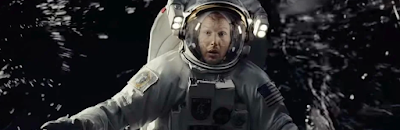
Moonfall is so perfectly awful I was almost charmed. In this high-gloss chintzy approximation of an A-level blockbuster 90s disaster picture, the moon has been knocked out of its orbit. Every time it circles the Earth, it gets closer. That thing’s bound to crash. It’s such total lunacy—and gets weirder by the reel—presented with casual pomposity stretching beyond its budget. It has a choppy opening hour that over-complicates every subplot and races through exposition as if it half-heartedly realizes we won’t care about its convolutions. As the ensemble is brought on stage and the moon looms larger, the vast cast is sketched in with shorthand and cliche. There’s disgraced astronaut Patrick Wilson and glamorous NASA chief Halle Berry and annoying pudgy British wannabe scientist John Bradley, each with a part of the solution as to how to get the moon restored to its proper place before it touches down. Also in the mix are the usual ex-wives, step-fathers, elderly mothers, conspiracy theorists, foreign exchange students, troubled adult sons, adorable moppets, and a general with a key to the nukes and a reluctant trigger finger. All the while, passable effects whip up CG floods as tides go wild, flooding cities of panicking refugees and looters before, during, and after the gravitational disruption kicks off earthquakes.

Where once these sort of big-screen natural disasters lingered on their big effects moments, now they can just wallpaper indiscriminately until it leaves little impact. It’s the kind of movie that relocates the top of the Chrysler building and barely blinks an eye. (The best moments are the most novel, in a crackpot derivative way: a space shuttle outracing an enormous gravity wave, or exploring the secret inner chambers of the moon.) But there’s an odd underplaying throughout, like when a son looks at his father, on the brink of potential apocalypse, at the moment a last-ditch plan has fallen through and shrugs: “I’m sorry that didn’t work out.” The second hour is a little zippier, and moderately wilder, as the apocalyptic stakes cut between a daring mission into the center of the moon, and a family trying to get what appears to be a mile or two down the road back on Earth. The imbalance is a little funny. Par for the course is when the general stares down a guy who wants to bomb the moon and says: “You can’t do that! My ex-wife’s up there!!”

So it’s good for a few laughs, and it might remind you passingly of better sequences in other movies like it. But that the production is helmed by Roland Emmerich, a king of the industrial-strength big budget ensemble disaster flick, having Independence Day, The Day After Tomorrow, and 2012 on his resume, gives it the distinct feeling of a director making his own knockoff. It hasn’t the balance between the spectacle and melodrama that the better versions of the disaster ensemble can pull off. Heck, even his own former co-writer Dean Devlin did a better spin on the all-star global calamity space-junk explode-o-rama with the under-appreciated gargantuan cheese wheel that was Geostorm a few years back. One of that movie’s stars, Gerard Butler, even did it well in a more serious register with the oddly affecting meteor-on-the-way thriller Greenland from Christmas before last. (It went VOD, like the bulk of that season’s offerings, so who knows how many actually saw it?) Just goes to show you we are in a little boom for talking our destruction to death. Gee, what could cause that? We can't expect every attempt to work well.
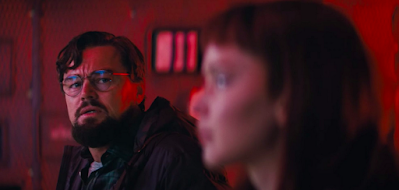
At least all of the above are better than Don’t Look Up. That movie imagines a world-ending calamity is on the way, and getting people to care about or even accept the reality of the situation, let alone examine possible solutions, is nigh impossible. Sounds familiar. Adam McKay wrote the movie as a climate change parable, but the intervening pandemic and its response surely fed into it as well. Here we open on two scientists at Michigan State University (Leonardo DiCaprio and Jennifer Lawrence) identifying a planet-killing meteor that’ll hit Earth in a matter of months. They try to alert the government, but the president (Meryl Streep) is too image-obsessed and election-focused to care and demands the information hidden. (The movie’s funniest joke is her son (Jonah Hill) insisting on double checking the info with experts from a better college. Ha.) So the scientists try to leak it to the media, but most outlets don’t care, and the best they can do is getting laughed off a morning show whose hosts (Cate Blanchett and Tyler Perry) can’t bring themselves to understand what their incongruously serious guests are trying to say. There’s clear anger in this telling, a well-intentioned ranting about humanity hurtling toward its doom and too ignorant and selfish to face it and fix it.

But as the movie spirals and complicates for over two hours, it stays on that grinding pitch of justified anger. It starts to seem less sharply targeted and more tiresomely mismanaged. The characters, no matter how well-acted by an all-star cast, are broad caricatures, and McKay’s rush to condemn doesn’t leave time to actually understand their motives. This is a bloated political cartoon stumbling backwards toward preordained conclusions. Compare it to, say, Dr. Strangelove, and you’ll see how Kubrick’s classic dark comedy of nuclear annihilation is a witheringly hilarious look at nightmarish Cold War logic precisely because it understands how fallible and specific personality types could stumble toward accidental apocalypse. Here, though McKay has understandable outrage at the prevailing forces of prevaricating pundits and the corrupt short-term individualism eroding all sense of common good, he’s made a movie that’s the equivalent of a “raising awareness” campaign. Yeah, I know, and I agree, somewhat, I think. But now what?

This sociopolitical comedy is still somehow McKay’s best of that sort, though this, Vice, and The Big Short are all considerable steps down from his Anchorman, Talladega Nights, and Step-Brothers heyday. He no longer makes exuberantly goofy comedies with serious subtext. Now he’s making self-serious political comedies where his Big Ideas are all on the surface where they won’t stop needling, jabbing, scalding, and condescending at the expense of entertainment and, just as deadly, a point that can get past the surface of the matters on display. Attacking shallowness with shallowness without even the deceptive nuance that, say, Verhoeven might bring, is awfully wearisome. He’s clearly an intelligent and passionate thinker—but when his works about Wall Street corruption or Dick Cheney flatten out the issue as they scream to the choir that it’s all our fault, too, well, if you’re going to think so little of your audience, at least you could actually be better than them. These movies are both contemptuous and scatter-brained. He really thinks he’s telling you something new and vital instead of repackaging common complaints. It looks at massive systemic issues and futilely wags its finger at the viewer. We’re all implicated, yes, but now what do I have to do about it?

As Don’t Look Up widens its lens, with some vigorous absurdities that sparkle here and there, it bogs itself down and clutters itself up with characters and plot lines all pushing in the same direction at the same grim pitch: our society is incapable of saving itself. Everyone’s pathetic and cringingly one-dimensional. There are red-meat military men (Ron Perlman) and weary astronomers (Rob Morgan) and social media celebrities (Ariana Grande and Scott Mescudi) and right-wing propagandists (Michael Chiklis) and progressive journalists (Himesh Patel) and a tech billionaire cutting a real Musky Zuckerbergian Bezoar (Mark Rylance), among others. No one can meet the moment. Of course there’s even a right-wing messaging movement to just avoid the issue entirely. “Don’t Look Up” becomes their rallying cry. (Years of “if climate’s changing, why do we have winter?” and “if masks and vaccines work, why is there still COVID?” make even that sadly believable.) To watch a government and society flailing in the face of overwhelming disaster is painfully familiar. That the movie is willing to condemn a shallow media, lying right-wing authoritarians, and neoliberal corporate shills is not nothing. But the cast is stranded in a movie with ugly blocking and clanking rhythms, scenes that feel hacked together and indifferently covered, unable to build up character or perspective beyond the movie’s insistence that all of these horrible, fallible people are worthy of our scorn.

Though there’s plenty of blame to go around, the movie ends up somehow too much and not enough. Yes, this is a close match to the lunacies we’ve seen lately, and it carries that out to its logical calamitous conclusion on an apocalyptic scale. But it’s not exactly a thrill to see a movie as mean and absurd and judgmental as those it’s trying to condemn. Its final image of cynical comeuppance—spoilers: a nude body double standing in for a beloved actress getting chomped by a CG creature—is the ultimate grotesquerie. By then, the whole final stretch of the film leading up to it, a wild mix of surprise unearned sentiment and nihilistic cynicism and cheap nasty gags, has already made it clear the movie has nothing meaningful to explore or suggest. What a bracingly stupid movie: whipping up a frenzy of ugliness to serve as a funhouse mirror of our current problems and expecting us to thank it for its meager insight. Hey, at least it has a couple laughs, too.

Friday, March 15, 2013

Hold the Phone: THE CALL


I could never be a 911 operator. I don’t have the emotional stamina for the job. On the other end of the switchboard is an unpredictable deluge of human misery, waves of terrified and traumatized callers reporting their lives’ greatest horrors, sometimes inconsequential, sometimes matters of life and death. I have nothing but admiration for those who work calmly and professionally through these calls, sending help to the right locations, expediting responses to emergencies. The modest thriller The Call gets a lot of mileage out of this work environment. Its protagonist, a tough, professional operator played by Halle Berry, answers a call from a teenage girl (Abigail Breslin) who has been attacked and now finds herself trapped in a trunk. Berry can’t get a lock on the location and so together with the girl they work out a way to find clues to the location of the car and the identity of her kidnapper.

The bulk of the film is devoted to this titular call. It’s like the inverse of the unfortunately forgotten 2004 David R. Ellis thriller Cellular, the first movie to really milk the then-newer technology of the cell phone to get nonstop genre chills and spills out of it. That movie had Chris Evans getting a call from a hostage who managed to hotwire a broken telephone to dial a random number. Much fun is made out of moments like a mad scramble for a phone charger, what with having to keep the connection while Evans dashes about trying to get clues and get help for the mystery caller. This time around, the hostage is on the move. In trembling close-ups, we cut between Berry and Breslin, talking through the nerve-wracking scenario. The operator, with little information, tries to gather up what she can and send help to the appropriate spot. One fun trick involves kicking out a taillight and sticking a hand through the hole, hoping that another driver will notice and call in to 911. The sight of a pale arm awkwardly waving through a hole in a dark red trunk is vivid genre imagery.

In terse crosscutting, we follow Berry’s cop boyfriend (Morris Chestnut) as he provides the plot with the necessary role of a protagonist on the move. With information fed to him by Berry, he leads the charge in sending police to and fro, picking up on the trail of breadcrumbs left by the various clues. Director Brad Anderson shoots things with a no-nonsense simplicity that keeps the plot moving along tensely and efficiently. I usually find him to be a director whose films kick up fine mood, but tend to seem awfully undercooked on the level of character and narrative. In films like Session 9 and Vanishing on 7th Street, I find myself wishing that he could push his neo-Twilight Zone narrative tendencies further into abstraction, leaving the pesky clumsiness of his storytelling behind.  In The Call, as in his best film, the icy train-set twister Transsiberian, he has a nice, simple premise to work with, matching mood with action in a way that’s largely satisfying for much of the runtime.

It's too bad that the script by Richard D’Ovidio (his first produced screenplay since the remake of Thirteen Ghosts over a decade ago) has a howler of a climax, a sustained sequence of one character acting outside the law, setting off on a secretive investigation that’s filled with all kinds of reasons to exclaim “Don’t go in there!” “Watch out behind you!” and “What do you think you’re doing?” It’s a particularly icky form of exploitation revenge and a sour note on which to end an otherwise trim and crisp thriller.  It doesn’t help that the more we learn about the kidnapper, the more he seems to be nothing more than a generic creep of the kind you could see on any TV procedural any night of the week. Come to think of it, though The Call is ultimately only a slightly-better-than-mediocre B-movie, it’d have made a fine pilot. (Perhaps not-so-coincidentally, Anderson has done his best work on TV, especially in his handling of 12 episodes of the paranormal investigation procedural Fringe.) Wouldn’t you want to watch a detective series about Halle Berry taking 911 calls and sending Morris Chestnut to investigate? I know I would. There’s even an ideologically interesting hero shot of Berry towards the end of the film, a low angle image that captures an American flag billowing in the background. The filmmakers have ahold of something intriguing with this premise and they come close to pulling it off.


Monday, October 29, 2012

What is Any Ocean but a Multitude of Drops? CLOUD ATLAS


Starting with nothing less than a Homeric incantation in which a white-haired old man stares into a crackling fire and seems to summon the fiction into being, Cloud Atlas, an ambitious adaptation of David Mitchell’s tricky novel, is the kind of movie that’s easy to recommend and admire, if for no other reason than that nothing quite like it has ever existed and is unlikely to come around again any time soon. It wobbles at times, but luckily it’s ultimately better than the sum of its gimmicks. This is a complicated film about simple truths: love, ambition, knowledge, power. A major motif is a musical composition that one of the characters writes called “The Cloud Atlas Sextet.” It’s a lush, haunting piece of music that winds its way through the soundtrack and, by its very nature, echoes the major structural conceit of the film. A sextet is a piece of music to be played by six musicians. This film – like the novel before it – contains six stories, any one of which could easily expand into its own film, but together combine into one gorgeous whole.

Spanning centuries and genres, the film breaks apart the book’s chronological and mirrored presentation and instead places the six stories parallel to each other, cutting between the stories with a gleeful, witty, dexterous montage that recalls D.W. Griffith’s 1916 feature Intolerance in the way it so skillfully weaves in and out of varying plotlines. A massive undertaking, three directors, Tom Tykwer (of Run Lola Run and Perfume: The Story of a Murderer) and Lana and Andy Wachowski (of The Matrix films and Speed Racer) split the six sections among them, adapting and directing separately but from a shared common vision so that the story flows both stylistically and emotionally. Like some strange geometric object with many sides and layers, the film grows all the more epic by expanding outwards through time and space.

It takes us to the Pacific Ocean in the nineteenth century aboard a ship sailing towards America. Then, we’re in Europe in the 1930s, following a disinherited, but ambitious and talented, music student to the home of an elderly composer. Next, we’re in 1970s America, following an intrepid reporter into a conspiracy at a new nuclear power plant. On to the present, where we find a publisher who is the victim of a mean brotherly prank and stuck in an unexpected place. Then we’re to the future, where a clone slave describes her story of finding awareness of the consumerist dystopia she lives in. Finally, to the far future, where we find a post-apocalyptic world that has returned to clannish living in the wilderness, where the peaceful people are terrorized by a tribe of aggressive cannibals. Tykwer and the Wachowskis present each setting with handsomely realized production design and detailed special effects. Moving between them is anything but disorienting; it’s, more often than not, invigorating.

Almost too much to handle in one sitting, this film is a rush of character and incident, themes and patterns, echoes upon echoes, all distinctive melodies that fade and reoccur time and again. Some sequences play more successfully than others, but the film is largely fascinating and generally gripping as it becomes a symphony of imagery and genre, returning again and again to mistakes humankind makes, the benefits and constraints of orderly society, and the way underdogs try to find the right thing to do against all odds. The themes play out repeatedly in a flurry of glancingly interconnected genre variations. What appears as drama later plays as comedy, as action, as mystery, as tragedy. Tykwer and the Wachowskis have put the film together in such a way that the editing escalates with the intensity of each plotline, bouncing in an echoing flurry during rhyming plot points (escapes, reversals of fortune, setbacks, reunions) and settling down for more languid idylls when the plots simply simmer along. By turns thrilling, romantic, disturbing, suspenseful, and sexy, there’s a fluidity here that makes this a breathless three-hour experience. The film moves smoothly and sharply between six richly imagined stories that connect more spiritually and metaphysically than they do literally, and yet artifacts of one story may appear in another, sets may be redressed for maximum déjà vu, characters in one story may dream glimpses of another. This isn’t a puzzle to be solved, but rather a stylish assertion that people are inescapably connected to their circumstances and to those who lived before and will live after.

In order to underline its insistence upon the connectedness of mankind then, now, and always, the film features the same cast in each story, making it possible to get a sense of the progression of a soul through time, each reincarnation living up (or down) to the example of earlier experiences and choices. Through mostly convincing makeup, actors cross all manner of conventions, playing not just against type, but crossing race, gender, age, and sexual orientation in unexpected ways. (Some of the biggest pleasant surprises in the film are in the end credits, so I’ll attempt to preserve them.) For example, Tom Hanks appears as a crackpot doctor, then again as a thuggish wannabe writer, then again as a haunted future tribesman, among other roles. This is a large, talented and eclectic cast with Halle Berry, Jim Broadbent, Hugo Weaving, Keith David, Doona Bae, Jim Sturgess, Ben Whishaw, James D’Arcy, David Gyasi, Susan Sarandon and Hugh Grant delivering strong performances, appearing over and over, sometimes obviously, sometimes unrecognizably or for only a moment. This allows the filmmakers to dovetail the storylines even further, for what is denied in one (lovers torn apart, say) may be given back in the space of an edit (lovers, not the same people, but played by the same performers, reunited).

Though some will undoubtedly be turned away by its earnest (if vague) spirituality and messy philosophical bombast, this is the kind of film that, if you let it, opens up an endless spiral of deep thoughts. You could think it over and spin theories about what it all means for hours. To me, that’s part of the fun. It’s a historical drama, a romance, a mystery, a sci-fi epic, a comedy, and a post-apocalyptic fantasy all at once. In placing them all in the same film and running them concurrently Tykwer and the Wachowskis have created a moving and exciting epic that seems to circle human nature as each iteration finds characters struggling against societal conventions to do the right thing. The powerful scheme and rationalize ways to stay on top; those below them yearn for greater freedom and greater meaning. There’s much talk about connection and kindred spirits; at one point a character idly wonders why “we keep making the same mistakes…” It accumulates more than it coheres, and yet that’s the bold, beautiful mystery of Cloud Atlas, that it invites a viewer into a swirl of imagery, genre, and character, to be dazzled by virtuosic acting and effective filmmaking, to get lost amongst the connections and coincidences, to enjoy and perhaps be moved by the shapes and patterns formed by souls drifting through time and space.