Showing posts with label Barry Keoghan. Show all posts
Sunday, November 26, 2023
Cruel Bummer: SALTBURN
After two films, writer-director Emerald Fennell’s signature appears to be staging social satires with only a glancing understanding of society, ending in twists that call into question what in the world the earlier commentary was supposed to be setting up in the first place. Her Promising Young Woman had such a promising premise—a woman vigilante-style shaming male misbehavior—completely sunk by a choppy execution, complete with following up a take-down of systemic prejudice leaning on said system to solve things in its climactic surprises. What? Now here’s Saltburn, a much better movie on the whole, if only because it has more enjoyable surface pleasures of gleaming craftsmanship and gutsy arch performances. But that doesn’t mean it makes the points it thinks It’s making. I’ll get into that later. The movie comes on strong as sensual and prickly, and self-consciously arty with its grainy squared-off images, elliptical cutting, and woozy pop-heavy soundscapes, as it sets up a clear, Brit-focused, dark and dripping class comedy. It grooves on its cruel streak spectacle for a while, as a lower-class university student (Barry Keoghan) is invited to spend vacation at the palatial estate of a rich classmate (Jacob Elordi). A whole host of quirky, pampered, indulgent characters live there—from an icy mother (Rosamund Pike) to a dotty dad (Richard E. Grant), a teasing sister (Alison Oliver), a sassy quip machine family friend (Carey Mulligan), and a butler (Paul Rhys). We see Keoghan’s pathetic character obviously lusting after their privilege as he worms his way into their lives. Usually this sort of class commentary uses the allure of riches to shame the rich for their obliviousness, and/or the poor for coveting such worldly treasures. Here Fennel flips the script, for a movie that ultimately seems to say, gee, the rich sure are eccentric with their hollow parties and conspicuous consumption, but it is the sneaky underclass for which you have to watch out. There’s a reason why that’s not the thrust of these stories. It’s almost a shame, then, that so many seductive shallow thrills are sent in pursuit of such a flawed premise. You can swoon on those surfaces—the shine of the images, the venal bon mots, the performances of charm and charisma, and physical beauty lit like a perfume commercial. Keoghan, especially, finds new fearless ways to put himself on display—never more than his impressively bare final scene that leaves quite an impression. All that can be fun on a moment by moment basis. But it’s all for naught if the foundation on which these enjoyable details are built is so fundamentally cracked.
Sunday, December 11, 2022
Why Can't We Be Friends: THE BANSHEES OF INISHERIN
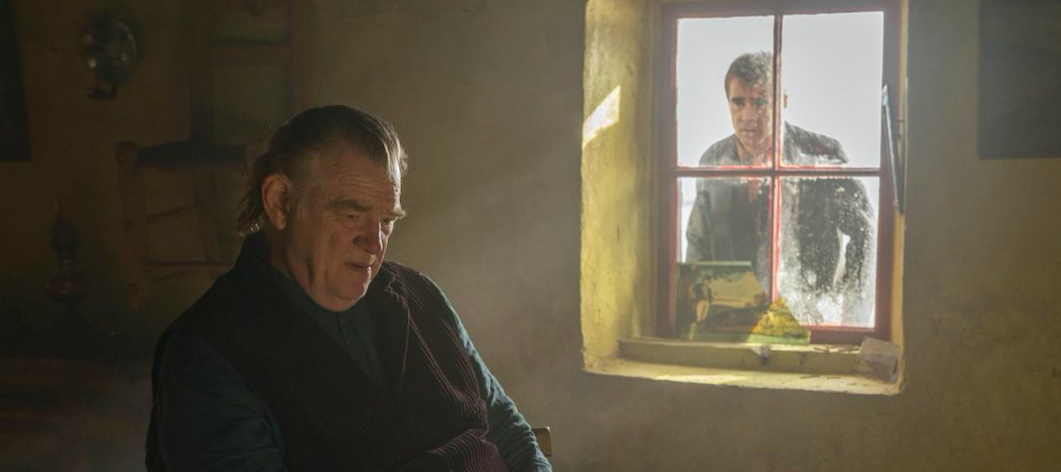
It can be difficult to make friends in adulthood, and even more difficult losing one. Sometimes that prospect can result in a friendship coasting on routine, someone you hang around just because, well, you have for too long to stop it now. And what would happen if you did? That’s the emotional crux of Martin McDonagh’s The Banshees of Inisherin. It’s set in 1923 on a small island off the coast of Ireland. Not a lot of options for socializing there, so the locals take what they can get. Sometimes they can hear cannon fire on the mainland—the Irish Civil War. That distant rumbling is a fine underlining of the story’s main civil strife: one man (Brendan Gleeson) suddenly deciding he doesn’t want to be friends with another (Colin Farrell). He doesn’t really have a reason. He just doesn’t want to talk with him anymore. For years, they’ve met every afternoon at the pub for a drink and a chat. But now, it’s abruptly over, and the man doesn’t even feel he owes a reason. From this simple—almost adolescent playground—declaration, this falling out is gossiped about and talked over by the whole tiny town. Word travels fast. But the facts of the case rest most heavily on Farrell’s befuddled loss. He’s desperate for his friend back, or at least an explanation.
McDonagh, the playwright-turned-filmmaker whose In Bruges was also a good blackly comic showcase for these two actors, gives this sure-footed narrative the purity of a folksy tale. It’s gnarled with colloquialisms and a straight-faced dark humor. And it’s carried along by a slow-rolling matter-of-fact shock—a then-he-did-what?—as the men’s interactions escalate. At one point Gleeson calmly says that if Farrell talks to him again, he’ll go home and cut off one of his own fingers, just to prove how serious he is. Unmoored from their only meaningful friendship, they both drift off into middle-aged melancholy. And McDonagh balances the story’s sympathies as it becomes a portrait of this kind of loneliness of adulthood, where connections can strain and fall flat or grow mercenary. Where time starts to weigh heavily through sheer inertia of habits, a dawning awareness of time slipping away every day creeps in with a sense of waste. The windswept fields and dirt paths and icy ocean views make a stark backdrop for this romantic—in the classic intensity of emotion sense—ennui, and the chattering daily grind of whispered rumors and stormy escalations. The characters are often separated by windows and walls, or going for long walks across chilly landscapes, and always fumbling to ruminate over the mysteries of their lives.
We get a sense that the smallness of life in the vastness of the terrain is brewing an insular despair. In this town, there’s an abusive constable and mean old ladies and well-meaning bartenders and docile animals and the town idiot and a firm-but-fair sister. Barry Keoghan and Kerry Condon, as those last two, are especially sharp counterpoints to Farrell’s befuddled pity. Gleeson, for his part, plays one long exasperated sigh, as a man whose depressive clanging against the bars of his own mortality drags out his potential harm to himself and others. With this steady orchestra of personalities, McDonagh creates a grimly generous work, then, with a bleakly Irish ending. It reaches a logical conclusion like a short story that snaps shut with the most pleasingly logical ambiguity. The potent sadnesses and frustrations at the core aren’t exactly exorcised, but, like a local legend retold and embellished, they have revealed something real and true about the darkness lurking for the unfulfilled and the unsatisfied. That’s why it’s nice to have a friend. And nicer still to keep one.
McDonagh, the playwright-turned-filmmaker whose In Bruges was also a good blackly comic showcase for these two actors, gives this sure-footed narrative the purity of a folksy tale. It’s gnarled with colloquialisms and a straight-faced dark humor. And it’s carried along by a slow-rolling matter-of-fact shock—a then-he-did-what?—as the men’s interactions escalate. At one point Gleeson calmly says that if Farrell talks to him again, he’ll go home and cut off one of his own fingers, just to prove how serious he is. Unmoored from their only meaningful friendship, they both drift off into middle-aged melancholy. And McDonagh balances the story’s sympathies as it becomes a portrait of this kind of loneliness of adulthood, where connections can strain and fall flat or grow mercenary. Where time starts to weigh heavily through sheer inertia of habits, a dawning awareness of time slipping away every day creeps in with a sense of waste. The windswept fields and dirt paths and icy ocean views make a stark backdrop for this romantic—in the classic intensity of emotion sense—ennui, and the chattering daily grind of whispered rumors and stormy escalations. The characters are often separated by windows and walls, or going for long walks across chilly landscapes, and always fumbling to ruminate over the mysteries of their lives.
We get a sense that the smallness of life in the vastness of the terrain is brewing an insular despair. In this town, there’s an abusive constable and mean old ladies and well-meaning bartenders and docile animals and the town idiot and a firm-but-fair sister. Barry Keoghan and Kerry Condon, as those last two, are especially sharp counterpoints to Farrell’s befuddled pity. Gleeson, for his part, plays one long exasperated sigh, as a man whose depressive clanging against the bars of his own mortality drags out his potential harm to himself and others. With this steady orchestra of personalities, McDonagh creates a grimly generous work, then, with a bleakly Irish ending. It reaches a logical conclusion like a short story that snaps shut with the most pleasingly logical ambiguity. The potent sadnesses and frustrations at the core aren’t exactly exorcised, but, like a local legend retold and embellished, they have revealed something real and true about the darkness lurking for the unfulfilled and the unsatisfied. That’s why it’s nice to have a friend. And nicer still to keep one.
Saturday, November 6, 2021
Almighty Then: ETERNALS
The first thing we see in Eternals, before the first sequence and even before the Marvel Studios logo, are the words “In the beginning…” Lifting from the Bible for an opening info dump sure sets a tone. You can tell right away this is a superhero movie of unusual hubris. Here we find the creators of the Marvel Cinematic Universe, high off the smash culmination of their first multi-franchise finale, 2019’s absurdly popular Avengers Endgame, starting to mistake their comic book lore for actual mythology and take it as seriously as the ancients did.
The result is a centuries-spanning story following immortal beings sent to Earth to guide humankind’s development by protecting people from carnivorous computer-generated critters until such time that enormous intergalactic celestial masters send for their return. They’ve mostly done that job, and are in their 500th year of waiting for the next assignment, when the Eternals must confront an apocalyptic threat of which only they are aware, since the seeds of this destruction have been incubating since prehistoric times. So, although the main thrust of the movie is the far-flung members of the mostly-disbanded team wandering around collecting their compatriots one at a time to confront this crisis, the movie begins with the dawn of the Bronze Age and contains numerous flashbacks to a number of ancient cultures and modern historical moments. The mix of real myth and history with Marvel’s filigrees is sometimes fun—I liked how the Eternals are an explanation for gods and heroes of yore (Athena, Gilgamesh, and so on)—but just as often it is slathered with a phony religiosity that amplifies the sometimes chintzy visual thinking and cliched writing on display. It’s a cosmic leap with an anvil tied to its feet.
Inspired by characters from Jack Kirby, the movie lacks his spark of divine madness in dashing out incomprehensible intergalactic gods and monsters. But it does have ambition I want to admire. It stretches across time and space, concerns itself with the birth and death of the universe and the alien midwives of solar systems. That’s potentially profound nonsense. The movie is at its best when it deals casually with the intersection of the mortal and immortal. Some of their kind seems to float above it all—Angelina Jolie and Salma Hayek dimming their bright star-power to intone exposition and disappear into muddy colors. But others are in direct collision between their ageless powers and human fragility. Leader Sersi (Gemma Chan) tentatively romances a mortal teacher (Kit Harington). Kingo (Kumail Nanjiani) has enjoyed being every member of a Bollywood dynasty, hiding his finger-gun powers for a song-and-dance screen heroism. A perpetually-preteen Sprite (Lia McHugh) has some pathos derived from never growing older. (There are also some odd questions about her the movie just barely skirts around.) Technologically inclined Phastos (Brian Tyree Henry) laments what humans have done with his gifts to them, while the mind-controlling Druig (Barry Keoghan) wishes he could just zap the minds of the masses and quell all conflict. (Worth a shot, right?) The movie gazes at their conflicts from an inhuman remove, but the camera hovers close to their whispered melodrama and angst. We can see why they haven’t done more to help stop humanity’s problems—they’re too busy moping around about it. They love us from afar, distant gods shaking their heads and wandering away for awhile.
The movie perches this massive idea on the usual Marvel mechanics—super-beings on a MacGuffin quest in route to a final effects reel—and writing. The gears turn. The simple story is told complicatedly to preserve meager surprises. The balance is all out of whack, cosmological woo-woo cut with a soupçon of deflating quips. As the team assembles for the climactic showdown, they banter and quip and feel sorry for the state of humanity and themselves. The apocalypse is well on its way, and the only way to stop it is for them to take drastic action on the margins of our awareness. Somehow the movie gathers both real portent and dopey interpersonal japes. There are some lovely or amusing character beats bubbling up in what’s otherwise drowned in the po-faced pseudo-spirituality draped over the sunlit hero shots and awestruck sentimentality. The film comes to us from writer-director Chloe Zhao, who has so often been good at that exact balance, a neo-Malickian flair for star personas set against quotidian beauty of her cultural tourism. But here it lacks the poetic gleam that animated her indie character studies against the backdrop of the American West, like The Rider or her Oscar-winning Nomadland. It does film most of its big sequences outdoors, which does lend the images a different texture than the usual Marvel green-screen, parking-lot blandness.
Small pleasures in an enormous, occasionally confused bore is par for the course with this mega-franchise lately, but this one wrestles over it more than most. The issue sits in the unbalanced approach, spinning wildly, if cheaply, to humanize characters who are themselves entirely apart from us. The usual Marvel cutting-down-to-size works with heroes who deal with real human emotion. Here, though, we’re in the realm of myth, and the lightness sometimes clangs. So, too, the attempts to stare up at these deities, which is the more interesting cosmic philosophical tussling—faint echoes of Snyder’s DC approach. (Interestingly Superman and Batman are referenced as often as Iron Man and Captain America in this movie.) It literalizes the latent authoritarianism that sits uncomfortably beneath the MCU’s worst impulses of the sort that assure us the powerful have our best interests at heart and we should just let them take unilateral action on our behalf. (It still chafes that Civil War made this argument flat out.) Eternals wrestles with the idea, with a calamity that truly only these heroes could address, and makes the villain ultimately think bringing about the end of the world will benefit him personally. (He must vote Republican.) But it also goes easy on its Eternals, with obvious decisions to make amid jokes and juggling tones that cheapens the film’s fleeting ideas. The machinery doesn’t let the movie express its philosophy visually, dumping it into the cast’s poses and monologues before making them just another set of action figures to move around the board. It ends as they all do, with last-minute rescues, slam-back fisticuffs, swirling pixels, and a chain of teases for future MCU projects. So it goes.
The result is a centuries-spanning story following immortal beings sent to Earth to guide humankind’s development by protecting people from carnivorous computer-generated critters until such time that enormous intergalactic celestial masters send for their return. They’ve mostly done that job, and are in their 500th year of waiting for the next assignment, when the Eternals must confront an apocalyptic threat of which only they are aware, since the seeds of this destruction have been incubating since prehistoric times. So, although the main thrust of the movie is the far-flung members of the mostly-disbanded team wandering around collecting their compatriots one at a time to confront this crisis, the movie begins with the dawn of the Bronze Age and contains numerous flashbacks to a number of ancient cultures and modern historical moments. The mix of real myth and history with Marvel’s filigrees is sometimes fun—I liked how the Eternals are an explanation for gods and heroes of yore (Athena, Gilgamesh, and so on)—but just as often it is slathered with a phony religiosity that amplifies the sometimes chintzy visual thinking and cliched writing on display. It’s a cosmic leap with an anvil tied to its feet.
Inspired by characters from Jack Kirby, the movie lacks his spark of divine madness in dashing out incomprehensible intergalactic gods and monsters. But it does have ambition I want to admire. It stretches across time and space, concerns itself with the birth and death of the universe and the alien midwives of solar systems. That’s potentially profound nonsense. The movie is at its best when it deals casually with the intersection of the mortal and immortal. Some of their kind seems to float above it all—Angelina Jolie and Salma Hayek dimming their bright star-power to intone exposition and disappear into muddy colors. But others are in direct collision between their ageless powers and human fragility. Leader Sersi (Gemma Chan) tentatively romances a mortal teacher (Kit Harington). Kingo (Kumail Nanjiani) has enjoyed being every member of a Bollywood dynasty, hiding his finger-gun powers for a song-and-dance screen heroism. A perpetually-preteen Sprite (Lia McHugh) has some pathos derived from never growing older. (There are also some odd questions about her the movie just barely skirts around.) Technologically inclined Phastos (Brian Tyree Henry) laments what humans have done with his gifts to them, while the mind-controlling Druig (Barry Keoghan) wishes he could just zap the minds of the masses and quell all conflict. (Worth a shot, right?) The movie gazes at their conflicts from an inhuman remove, but the camera hovers close to their whispered melodrama and angst. We can see why they haven’t done more to help stop humanity’s problems—they’re too busy moping around about it. They love us from afar, distant gods shaking their heads and wandering away for awhile.
The movie perches this massive idea on the usual Marvel mechanics—super-beings on a MacGuffin quest in route to a final effects reel—and writing. The gears turn. The simple story is told complicatedly to preserve meager surprises. The balance is all out of whack, cosmological woo-woo cut with a soupçon of deflating quips. As the team assembles for the climactic showdown, they banter and quip and feel sorry for the state of humanity and themselves. The apocalypse is well on its way, and the only way to stop it is for them to take drastic action on the margins of our awareness. Somehow the movie gathers both real portent and dopey interpersonal japes. There are some lovely or amusing character beats bubbling up in what’s otherwise drowned in the po-faced pseudo-spirituality draped over the sunlit hero shots and awestruck sentimentality. The film comes to us from writer-director Chloe Zhao, who has so often been good at that exact balance, a neo-Malickian flair for star personas set against quotidian beauty of her cultural tourism. But here it lacks the poetic gleam that animated her indie character studies against the backdrop of the American West, like The Rider or her Oscar-winning Nomadland. It does film most of its big sequences outdoors, which does lend the images a different texture than the usual Marvel green-screen, parking-lot blandness.
Small pleasures in an enormous, occasionally confused bore is par for the course with this mega-franchise lately, but this one wrestles over it more than most. The issue sits in the unbalanced approach, spinning wildly, if cheaply, to humanize characters who are themselves entirely apart from us. The usual Marvel cutting-down-to-size works with heroes who deal with real human emotion. Here, though, we’re in the realm of myth, and the lightness sometimes clangs. So, too, the attempts to stare up at these deities, which is the more interesting cosmic philosophical tussling—faint echoes of Snyder’s DC approach. (Interestingly Superman and Batman are referenced as often as Iron Man and Captain America in this movie.) It literalizes the latent authoritarianism that sits uncomfortably beneath the MCU’s worst impulses of the sort that assure us the powerful have our best interests at heart and we should just let them take unilateral action on our behalf. (It still chafes that Civil War made this argument flat out.) Eternals wrestles with the idea, with a calamity that truly only these heroes could address, and makes the villain ultimately think bringing about the end of the world will benefit him personally. (He must vote Republican.) But it also goes easy on its Eternals, with obvious decisions to make amid jokes and juggling tones that cheapens the film’s fleeting ideas. The machinery doesn’t let the movie express its philosophy visually, dumping it into the cast’s poses and monologues before making them just another set of action figures to move around the board. It ends as they all do, with last-minute rescues, slam-back fisticuffs, swirling pixels, and a chain of teases for future MCU projects. So it goes.
Monday, January 22, 2018
Family Plot: THE KILLING OF A SACRED DEER
Yorgos Lanthimos is out to mess you up. Even if you haven’t
squirmed through the Grecian filmmaker’s international breakthrough Dogtooth – an intensely disturbing story
of siblings unknowingly held captive by their own parents – or gritted your
teeth through The Lobster – a cruel
fantasy comedy that many seemed to like, but lost me as it ground a good
fanciful premise into pessimistic repetition – you’d know right off that the
writer-director of The Killing of a
Sacred Deer wants to provoke intense reactions. The film sits on a black
screen, soft and dramatic classical music playing underneath. Then: a smash cut
to an extreme close-up of open heart surgery. I gasped. Then I squirmed as the
shot holds. Then I looked away, repulsed but grinning. Oh, Lanthimos, at it
again, up to his audience provoking jolts, his unflinching camera staring.
After this startling opening statement, the build up to the next disturbing
disruption is a long, soft timpani roll of suspense, the score doing its best
to rumble under the imposing blocking and unflinching austere framing which
turns every normal Cincinnati street and gleaming hospital corridor into a
close cousin of Kubrick’s Overlook hotel. The film is a sustained creepy
thriller with tension slowly simmering and clasping underneath every scene.
Empty space and cavernous silence in the cold sets and pulsing grainy cinematography leaves room for disquieting suspicions as unfathomable escalating
moral and karmic confusion ripples across an already-brittle family’s life.
Lanthimos directs his cast into performances of carefully
modulated awkwardness and softly tripping monotones, their eerie implacability
adding to a sense of wrongness that slowly builds. The film demonstrates its
own twisted logic step by step as a surgeon (Colin Farrell), his wife (Nicole
Kidman), and two kids (Sunny Suljic and Tomorrowland’s
Raffey Cassidy) are slowly, subtly, and increasingly absurdly drawn into the
plot of an unusual and insinuating interloper (Barry Keoghan, his quietly menacing face miles
from the sweet innocence of his Dunkirk role).
The young stranger is the son of a man who died on the operating table. The
surgeon has tried to show him sympathy, striking up a vaguely paternal
mentorship, maybe out of guilt. Big mistake. The boy wants to make the surgeon
hurt. Suddenly, this creepy guy is the nexus of mysterious illness that spreads
through the family. The kids are struck with paralysis that’s seemingly incurable,
and completely inexplicable to a small army of medical experts. It only gets
worse from there, including both inducement to murder and an awkward attempt by
the boy to get his mom (Alicia Silverstone, never sadder) to watch Groundhog Day with his victim. With no
shortage of disturbing emotions and plot developments roiling under every scene
that follows, characters squirm intensely under pressure. Lanthimos keeps the
proceedings darkly absurd, austerely terrifying, a deeply eccentric mix of the
lurid and placid, the preposterous (a halting nervous laughs masking deep horror)
and tense ethical quandaries stirring up grippingly sustained suspense. It’s
all the more upsetting for being so inscrutable, for offering up no answers
other than a desire to see brittle people break, even as they’re forced to confront
their mortality, morality, and contradictions therein.
Subscribe to:
Posts (Atom)


