When Stephen King first published The Long Walk and The Running Man in 1979 and 1982, respectively, they played as broad, heightened extrapolations of contemporary ills through classically satirical sci-fi pessimism. They’re stories about a callous American culture that sells its youth and its underclasses false hopes and delivers only violence. They’re stories about a society desensitized to cruelty and allergic to sincerity. They’re stories about a series of dead ends. It’s perhaps a sign of our increasingly dystopian present that as these stories return to us on the big screen in 2025 they seem a little less far-fetched. The movies preserve King’s sense of finely sliced pulp, with their origins in his shorter, more energetically nasty works under the pen name Richard Bachman. But they also cannily update their sense of doom. The former leans toward futility and despair. The latter gets a charge out of revolutionary violence. Both end up with endings that try to have it every which way, but they are totally earnest about the difficulty of exiting a social structure when every system is calibrated to keep you down.
The Long Walk is the drearier of the two. It’s set in a desolated American landscape that looks grey and brown and dingy as far as the eye can see. A group of young men are called up to participate in the eponymous game. It’s a yearly contest done for propagandistic purposes. A grizzled military man (Mark Hamill) who carries about him a parody of tough masculinity barks out the rules. They’ll walk at a 3 mile per hour pace across the country. The last person walking wins. The others will die, shot in the head for the crime of pausing, or slowing, and giving up. If the idea of an annual death march sounds like a pulp fiction extrapolation of Shirley Jackson’s “The Lottery” or an embryonic form of the themes that’d later come into fuller flower in Suzanne Collins’ Hunger Games, you’re on the right track. That this film comes from director Francis Lawrence, best known for adapting Collins’ series in several excellent dystopian thrillers, completes the comparison. This movie has none of that franchise’s impulses toward the epic or to revolution. Instead it’s a deliberate trudge, as an ensemble of young male actors (with such likable leads as Cooper Hoffman and David Jonsson, looking for all the world like a pair of sad-eyed, round-faced puppies) is ruthlessly winnowed down to a tragic final few. Because they’ve come to share some camaraderie with each other, it’s all the more gripping and gutting when they, and we, know all but one will lie dead in the street before the credits roll. It’s a look at the dark heart of a society’s anesthetizing fear of violence. In its original context it’s a clear Vietnam War allegory. Now it hooks into free-floating anxieties about state power and our willingness to give ourselves up into the gears of the machine in fleeting hope for a better life. It’s a bloody bummer.
More vibrant pop art action thrills are to be found in Edgar Wright’s take on The Running Man. Even the added participle in the title ought to signal the speed it has over the Walk. This one finds a bustling, glowingly dirty futuristic America that’s lost the fight against oligarchic takeover. Here the government and media conglomerates are basically joined in one corporate state. A permanent underclass looks toward exploitative game shows as the only way out, whether as mind-numbing entertainment or as a shot at fluke riches. The same basic premise made for a thuddingly obvious Schwarzenegger picture in the 80s. This new picture finds Glen Powell’s charms as a sly lunk giving the proceedings a more empathetic and energetic tone, a lightness of touch despite its grinning manipulations and toothsome media satire. He plays a desperate unemployed father with a sick child. Against his wife’s wishes, he tries out to be a contestant on any show and ends up sorted into The Running Man, a contest in which he must survive thirty days on the run from the show’s paramilitary hunters and the general public, too. Snarling producer Josh Brolin and slimy host Colman Domingo hype up the propaganda, hoping to get the audience at home hating Powell by smearing him as a criminal. But his runaway tour of action sequences through the backstreets and backwoods of New England finds eccentric helpers every step of the way, from a black market tech guy (William H. Macy) to a conspiracy theorist (Michael Cera) to an extremely reluctant hostage (Emilia Jones). The have-nots love to assist him in running; it’s the snitching haves he needs to watch out for. Wright doesn’t overwhelm the movie with his usual rhythmic editing and snappy transitions, nor does he push the pedal to the metal on his verbal cleverness or pounding pop soundtracks, a la his Shaun of the Dead or Baby Driver. Instead, that’s just a light pulse of personality in a totally proficient piece of genre craftsmanship that’s a little zippier and brainer than it needs to be, popping with color and movement and a cheeky sense of punk revolt. It doesn’t quite know how to get out of its crass, exploitative cultural mess of social issues with a satisfactory conclusion, but then again, we don’t either.
Showing posts with label Cooper Hoffman. Show all posts
Tuesday, November 18, 2025
Saturday, January 29, 2022
Road to Somewhere: LICORICE PIZZA
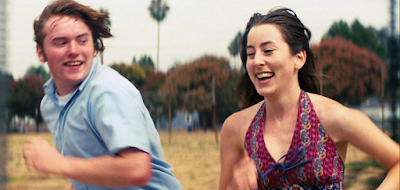
The main characters in Paul Thomas Anderson’s Licorice Pizza are a couple of young people constantly on the move. They seem to operate with the unspoken assumption: why walk when you can run? They’re running heedlessly into their futures on an abundance of youthful energy and naive restlessness. One, Gary Valentine (Cooper Hoffman), is a sweaty teenage boy with a crush. The other, Alana Kane (Alana Haim), is a twenty-something woman on whom he’s crushing. The fact that they are played by relatively fresh newcomers—he’s Philip Seymour’s son; she’s in the band Haim with her sisters, who play her sisters here, too—gives the movie a genuine sense of fumblingly appealing youthful discovery and charisma. The two of them fall into a funny friendship, finding themselves simpatico in the ways his precociousness (he’s a child actor using his money to start dubious entrepreneurial ventures) and her failure to launch (she still lives at home with her parents) meet. There’s a charge of attraction on his part, but she holds him at a distance from that. They simply enjoy their time together as friends, roaming around California’s San Fernando Valley in the early 1970s. He’s a wheeler-dealer, 15 going on 50, falling into one attempted money-making scheme after the next. She’s not sure what she wants to do with her life, so happily falls into his orbit.
Anderson unfolds their converging and diverging stories through a loose collection of shaggy anecdotal episodes. It’s a movie about that awkward time between when high school seems hopelessly juvenile, but the adult world is still held at a remove of skepticism. As is so often the case with young people, they test their sense of self in every moment, adjusting based on circumstances, comparing to people around them, blustering and bluffing to get by, or receding in the face of a more dominant adult presence. Here is a string of events—by turns funny, yearning, oddball, and suspenseful—that brings these young people’s sense of self more and more into focus for themselves. It’s a process still in motion as they run to the final credits. Through them we meet agents, actors, casting directors, teachers, teenagers, producers, politicians, chaperones, hosts, assistants, parents, siblings, salesmen, restaurateurs, photographers and more.
This assemblage of interesting faces and eccentric personality types is warmly carried out by a wide-ranging ensemble of character actors and marquee names (including Bradley Cooper, Tom Waits, Sean Penn, Christine Ebersole, John Michael Higgins, and Mary Elizabeth Ellis). We see each new situation with these various complicated and problematic adult figures through the eyes of our leads. Anderson situates them in a world of flawed or otherwise half-formed aspirations as they scramble toward maturity in the shadows of showbiz. Despite centering the couple, there’s an egalitarianism to the various sequences, a sense that every character on screen is a full, rich, interesting figure in and of themselves. Even people appearing for one or two scenes carry the sense that we could follow them off into an equally enjoyable film all their own. This gives the movie a full sense of lives in motion—pushing forward through emotions and encounters that our leads are working through to get to…somewhere. They’re figuring it out as they go along.
This loose, shaggy one-thing-after-another Anderson gives the proceedings matches his project—from Boogie Nights and There Will Be Blood through The Master and Inherent Vice—of treating intimate character pieces with the sweep and detail of a historical epic. The twinned comings-of-age here also fits in with Anderson’s other awkward, inscrutable relationship semi-comedies, like Punch-Drunk Love and Phantom Thread, although that’s also a common thread through his films. I suppose that might make Licorice Pizza a quintessential Anderson effort. It has a long-lens close-up approach, a dazzling specificity of character foregrounded amid casually perfect period recreations that fill the frames around the central focus. Here the 70s swagger of vintage tech and indoor smoking, of burgeoning pop culture happenings and gasoline shortages, is just a fact of life for the characters who try to find their way into who they’ll become. There’s an aimless free-spiritedness to the hustle—and a squinting toward possibility that never quite arrives.
Anderson gives the movie that touch of Altman—long noted as one of his favorite inspirations—with whipping up an ensemble of controlled chaos. Sequences in schools and restaurants, parties, shops, and offices spill rough natural jumbled life out of relaxed wide frames that are casually composed. And yet their filmic beauty effortlessly guides an audiences’ eye with a steady hand and a generosity of spirit. There’s a sun-dappled grainy romanticism of the past, carried aloft on a steady stream of vintage records, and a cool-eyed present-tense perspective knowing these characters are as-yet unformed. The characters may not know where life will take them, but there’s fun to be had in watching them drift through it. In one of the film’s most exhilarating sequences, a delivery truck runs out of gas mid-trip, so the leads white-knuckle their way downhill, gritting teeth as they plunge through intersections and take tight turns. It is a movie, after all, about the exhilaration of coasting.
Anderson unfolds their converging and diverging stories through a loose collection of shaggy anecdotal episodes. It’s a movie about that awkward time between when high school seems hopelessly juvenile, but the adult world is still held at a remove of skepticism. As is so often the case with young people, they test their sense of self in every moment, adjusting based on circumstances, comparing to people around them, blustering and bluffing to get by, or receding in the face of a more dominant adult presence. Here is a string of events—by turns funny, yearning, oddball, and suspenseful—that brings these young people’s sense of self more and more into focus for themselves. It’s a process still in motion as they run to the final credits. Through them we meet agents, actors, casting directors, teachers, teenagers, producers, politicians, chaperones, hosts, assistants, parents, siblings, salesmen, restaurateurs, photographers and more.
This assemblage of interesting faces and eccentric personality types is warmly carried out by a wide-ranging ensemble of character actors and marquee names (including Bradley Cooper, Tom Waits, Sean Penn, Christine Ebersole, John Michael Higgins, and Mary Elizabeth Ellis). We see each new situation with these various complicated and problematic adult figures through the eyes of our leads. Anderson situates them in a world of flawed or otherwise half-formed aspirations as they scramble toward maturity in the shadows of showbiz. Despite centering the couple, there’s an egalitarianism to the various sequences, a sense that every character on screen is a full, rich, interesting figure in and of themselves. Even people appearing for one or two scenes carry the sense that we could follow them off into an equally enjoyable film all their own. This gives the movie a full sense of lives in motion—pushing forward through emotions and encounters that our leads are working through to get to…somewhere. They’re figuring it out as they go along.
This loose, shaggy one-thing-after-another Anderson gives the proceedings matches his project—from Boogie Nights and There Will Be Blood through The Master and Inherent Vice—of treating intimate character pieces with the sweep and detail of a historical epic. The twinned comings-of-age here also fits in with Anderson’s other awkward, inscrutable relationship semi-comedies, like Punch-Drunk Love and Phantom Thread, although that’s also a common thread through his films. I suppose that might make Licorice Pizza a quintessential Anderson effort. It has a long-lens close-up approach, a dazzling specificity of character foregrounded amid casually perfect period recreations that fill the frames around the central focus. Here the 70s swagger of vintage tech and indoor smoking, of burgeoning pop culture happenings and gasoline shortages, is just a fact of life for the characters who try to find their way into who they’ll become. There’s an aimless free-spiritedness to the hustle—and a squinting toward possibility that never quite arrives.
Anderson gives the movie that touch of Altman—long noted as one of his favorite inspirations—with whipping up an ensemble of controlled chaos. Sequences in schools and restaurants, parties, shops, and offices spill rough natural jumbled life out of relaxed wide frames that are casually composed. And yet their filmic beauty effortlessly guides an audiences’ eye with a steady hand and a generosity of spirit. There’s a sun-dappled grainy romanticism of the past, carried aloft on a steady stream of vintage records, and a cool-eyed present-tense perspective knowing these characters are as-yet unformed. The characters may not know where life will take them, but there’s fun to be had in watching them drift through it. In one of the film’s most exhilarating sequences, a delivery truck runs out of gas mid-trip, so the leads white-knuckle their way downhill, gritting teeth as they plunge through intersections and take tight turns. It is a movie, after all, about the exhilaration of coasting.
Subscribe to:
Posts (Atom)