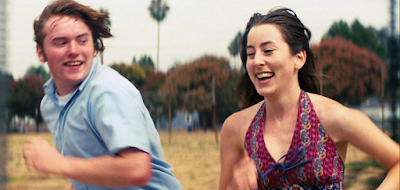
The main characters in Paul Thomas Anderson’s Licorice Pizza are a couple of young people constantly on the move. They seem to operate with the unspoken assumption: why walk when you can run? They’re running heedlessly into their futures on an abundance of youthful energy and naive restlessness. One, Gary Valentine (Cooper Hoffman), is a sweaty teenage boy with a crush. The other, Alana Kane (Alana Haim), is a twenty-something woman on whom he’s crushing. The fact that they are played by relatively fresh newcomers—he’s Philip Seymour’s son; she’s in the band Haim with her sisters, who play her sisters here, too—gives the movie a genuine sense of fumblingly appealing youthful discovery and charisma. The two of them fall into a funny friendship, finding themselves simpatico in the ways his precociousness (he’s a child actor using his money to start dubious entrepreneurial ventures) and her failure to launch (she still lives at home with her parents) meet. There’s a charge of attraction on his part, but she holds him at a distance from that. They simply enjoy their time together as friends, roaming around California’s San Fernando Valley in the early 1970s. He’s a wheeler-dealer, 15 going on 50, falling into one attempted money-making scheme after the next. She’s not sure what she wants to do with her life, so happily falls into his orbit.
Anderson unfolds their converging and diverging stories through a loose collection of shaggy anecdotal episodes. It’s a movie about that awkward time between when high school seems hopelessly juvenile, but the adult world is still held at a remove of skepticism. As is so often the case with young people, they test their sense of self in every moment, adjusting based on circumstances, comparing to people around them, blustering and bluffing to get by, or receding in the face of a more dominant adult presence. Here is a string of events—by turns funny, yearning, oddball, and suspenseful—that brings these young people’s sense of self more and more into focus for themselves. It’s a process still in motion as they run to the final credits. Through them we meet agents, actors, casting directors, teachers, teenagers, producers, politicians, chaperones, hosts, assistants, parents, siblings, salesmen, restaurateurs, photographers and more.
This assemblage of interesting faces and eccentric personality types is warmly carried out by a wide-ranging ensemble of character actors and marquee names (including Bradley Cooper, Tom Waits, Sean Penn, Christine Ebersole, John Michael Higgins, and Mary Elizabeth Ellis). We see each new situation with these various complicated and problematic adult figures through the eyes of our leads. Anderson situates them in a world of flawed or otherwise half-formed aspirations as they scramble toward maturity in the shadows of showbiz. Despite centering the couple, there’s an egalitarianism to the various sequences, a sense that every character on screen is a full, rich, interesting figure in and of themselves. Even people appearing for one or two scenes carry the sense that we could follow them off into an equally enjoyable film all their own. This gives the movie a full sense of lives in motion—pushing forward through emotions and encounters that our leads are working through to get to…somewhere. They’re figuring it out as they go along.
This loose, shaggy one-thing-after-another Anderson gives the proceedings matches his project—from Boogie Nights and There Will Be Blood through The Master and Inherent Vice—of treating intimate character pieces with the sweep and detail of a historical epic. The twinned comings-of-age here also fits in with Anderson’s other awkward, inscrutable relationship semi-comedies, like Punch-Drunk Love and Phantom Thread, although that’s also a common thread through his films. I suppose that might make Licorice Pizza a quintessential Anderson effort. It has a long-lens close-up approach, a dazzling specificity of character foregrounded amid casually perfect period recreations that fill the frames around the central focus. Here the 70s swagger of vintage tech and indoor smoking, of burgeoning pop culture happenings and gasoline shortages, is just a fact of life for the characters who try to find their way into who they’ll become. There’s an aimless free-spiritedness to the hustle—and a squinting toward possibility that never quite arrives.
Anderson gives the movie that touch of Altman—long noted as one of his favorite inspirations—with whipping up an ensemble of controlled chaos. Sequences in schools and restaurants, parties, shops, and offices spill rough natural jumbled life out of relaxed wide frames that are casually composed. And yet their filmic beauty effortlessly guides an audiences’ eye with a steady hand and a generosity of spirit. There’s a sun-dappled grainy romanticism of the past, carried aloft on a steady stream of vintage records, and a cool-eyed present-tense perspective knowing these characters are as-yet unformed. The characters may not know where life will take them, but there’s fun to be had in watching them drift through it. In one of the film’s most exhilarating sequences, a delivery truck runs out of gas mid-trip, so the leads white-knuckle their way downhill, gritting teeth as they plunge through intersections and take tight turns. It is a movie, after all, about the exhilaration of coasting.
Showing posts with label John Michael Higgins. Show all posts
Saturday, January 29, 2022
Friday, October 14, 2016
Sidelined: MASCOTS
Christopher Guest’s Mascots
introduces us to plucky weirdos driven to get in big foam costumes and
wiggle around to delight and excite a crowd. There’s a husband/wife team (Zach
Woods and Sarah Baker) who play a turtle and an octopus for a low-rent baseball
team, a chipper Brit hedgehog for a soccer team (Tom Bennett), a loopy arts’
college armadillo (Parker Posey), a football teams’ oversized plumber
(Christopher Moynihan), and a grouchy Irishman (Chris O’Dowd) who dresses as a
giant fist for hockey games. They’re all driven to find success, powering
forward with boundless positivity and love of the game in the pursuit of a
silly dream: the grand prize at an annual mascot convention. If this sounds
like it’s falling into Guest’s formula, you’re correct. It’s another of his
mockumentaries involving an affectionately teased subculture. But unlike his
great earlier comedies and their targets, Waiting
for Guffman’s community theater, Best
in Show’s dog competition, and A
Might Wind’s folk music revival, Mascots
lacks crucial specificity. Trying too
hard to whip up eccentricities, it’s a flat, dull attempt at resuscitating a
form that’s past its sell-by date.
Superficially, Mascots
has everything that made earlier Christopher Guest movies great. It has the
subculture. It has the large ensemble of funny people, including many of the performers
who populated Guest’s earlier works and some welcome additions. (Present and
accounted for are Jennifer Coolidge, John Michael Higgins, Michael Hitchcock,
Fred Willard, Bob Balaban, Jane Lynch, Ed Begley, Jr., and others.) It has the
bright, flat mockumentary style allowing for the humor to loosely arrive at tossed-off
lines. It’s has the casually ridiculous spoken with only a hint of bemusement
and straight-faced silliness unfolding for an unemphatic camera. It’s
agreeable. But, wow, is it not funny. Maybe it rises to the level of gently
amusing from time to time, and the whole picture never quite tanks into
something totally contemptible, but that’s certainly a far cry from the best
Guest can do. This is his first movie in a decade, and the problem is partly
what happened to the comedy landscape while he was away.
Firstly, the mainstream mockumentary style was more
refreshing and novel when he took the form from the classic This is Spinal Tap, in which he co-starred,
and applied it to his own silly trilogy. With Guffman and the rest, there was the spark of invention in seeing
big, funny ensembles improvise their way to hilarious, endlessly quotable
dialogue in scenes assembled with verite
deadpan and plot pushed along by interviews with the characters. Now, after two
versions of The Office, Parks & Rec, Modern Family, Popstar:
Never Stop Never Stopping and so on and so on, the style has been wrung
out. Add to it Mascot’s
half-heartedness with which it deploys the gimmick – with many scenes including
cuts to impossible camera angles – and it just feels tired. Besides, at least
those other mockumentaries were plausibly exaggerated looks at actual groups.
The extrapolated and invented mascots and their rivalries and competitions here
simply isn’t a culture with much connection to the real world. It’s not a
parody of a real group of people; it’s simply goofing around based on a sliver
of recognizable interest. (And if you think the plot is overfamiliar
diminishing returns, wait’ll you see how Guest revives his memorable Corky St.
Clair to flatlining results.)
Secondly, the improv style has also come to dominate the
comedy film scene. From the Apatow productions – which expand their runtimes
with long, loose scenes of characters cracking each other up – to every comedy
that pauses its action for punchline roulettes in which the cast takes turns
throwing out insults. (These have long stopped seeming like scenes and are more
a matter of spitting a bunch of possible jokes and hoping one lands hard enough
to excuse the rest. It’s coverage, not choices.) The shaggy scenes in which
talented people find their way to a naturally funny bantering chemistry is no
longer unfamiliar territory. And when it’s handled so carelessly as it is with Mascots it just feels sad. As a big fan
of his earlier work, seeing Guest’s formula returning in such a diminished
state is dispiriting. Sure, there are fleeting moments of good humor – like a
hotel with a “John Wayne suite” downgrading a disappointed guest to the “Slim
Pickens” – but there’s otherwise a desperation in scenes devoid of interest and
missing laughs. I smiled a few times, chuckled a few more, but was otherwise
thoroughly bummed out by how pale an echo of old favorites it is. Compared to
other modern comedies, at least it’s not unendurable or ugly. It’s watchable.
But the dead air is deafening.
Friday, May 15, 2015
Sing It On Again: PITCH PERFECT 2
Pitch Perfect 2
has a winning sense of pleasant reunion. The sequel to the surprise hit a
capella college comedy from a few years ago carries with it a delight to be
back. Surely no one expected that sloppy but likable little comedy to do well
enough to support a follow up, but here we are. It returns to the world of the
Barton Bellas, an all-female a capella group made up of unlikely misfits last
seen winning the national title. Picking up three years later, Becca (Anna
Kendrick), Chloe (Brittany Snow), Fat Amy (Rebel Wilson), and the rest (Ester
Dean, Hana Mae Lee, Alexis Knapp, Chrissie Fit) are on the verge of graduating,
but find their final year off to a bad start with an embarrassing performance in which one of
their members accidentally moons the Obamas. This gets them kicked out of the
world of a capella, setting up another underdog scenario to be overcome by
winning the World Championship to get reinstated. Once again, the young women
must learn to work together and create a great routine, all the while dealing
with their individual eccentricities.
Luckily, screenwriter Kay Cannon isn’t content to repeat the
structure of the first movie. In fact, she seems to realize generic let’s-put-on-a-show
and campus comedy plotlines were holding the otherwise amiable predecessor
back. She knows for an encore the audience just wants to hang out with likable
performers doing their shtick in between good music. The result is a movie
that’s looser, longer, sillier, with more music and funnier lines. It’s the rare
comedy sequel that’s actually an across-the-board improvement instead of a safe
repeat of a known formula. The need to win the big championship is a climactic
goal, but everything leading up to it is simply excuses for pleasant banter, funny
supporting roles, silly gags, cameos, and fun musical numbers, featuring everything
from Beyoncé and Miley Cyrus to Sir Mix-a-Lot and Kris Kross.
Making her
directorial debut, Elizabeth Banks (who also, with John Michael Higgins,
returns as a color commentator) moves the proceedings with a good pace and fine
eye for smooth pop filmmaking. It’s episodic, with plenty of digressions
including romances (Skylar Astin and Adam DeVine make appearances) and
professional concerns (Keegan-Michael Key shows up as a record producer). But
it never drags as the bright, bouncy, colorful, and consistently amusing movie
zips along on slick competence providing good-natured, high-spirited,
undemanding entertainment. We see a series of misadventures, from clashes with
the terrifyingly perfect German group Das Sound Machine to a new freshman
recruit (Hailee Steinfeld) struggling to fit in, and an underground a capella
battle held in a rich fan’s basement (featuring everyone from Reggie Watts to
John Hodgman to a few Green Bay Packers).
It could be scattered, but there’s a nice emotional
throughline involving female friendships and the group’s importance to its
members that gets a heartwarming payoff in their final performance. Along the
way, Banks and her cast find funny bits of business in every scene. Whether
we’re with Snoop Dogg recording a Christmas album or camping in the woods on a
team-building exercise, it’s enjoyable enough to be worth the detour. It’s only
a matter of time before Wilson crashes in with a loopy one-liner, Kendrick gets
a flustered retort, or one of the supporting players pipes in with a goofy
barb. The movie plays to everyone’s strength in that way, before drawing all
the voices together in beautiful harmony for ensemble numbers that really sing.
They work well together, and as a result it’s fun to be around them no matter
where the plot takes them. With a favorable hit-to-miss joke ratio, this is a
big crowd-pleasing comedy that’s essentially nice and easy to like.
Saturday, October 6, 2012
Sing it On: PITCH PERFECT
Pitch Perfect is a
light, inconsequential comedy about college a cappella groups. That’s, as the
movie is quick to tells us again and again, when people perform fully
orchestrated songs with only their mouths. The movie is basically wall-to-wall
music; even the Universal logo’s theme gets a dramatic vocal spin before the
movie begins. The whole thing is peppy, bouncy, and scattered. It has a
collision of standard plotlines: the let’s-put-on-a-show, the
underdog-team-of-misfits and the follow-your-dreams, as well as some standard
college comedy and rom com material. And yet, on some level it works. With the
sheer likability of the cast and the strength of the melodies, it just about gets
by, a little bit nerdy, a little bit sassy, and a little bit dirty.
We follow adorable Anna Kendrick as a too-cool-for-school
aspiring D.J. who wants nothing to do with Barden University’s down-on-its-luck
all-girls group. But wouldn’t you know it? She joins anyways. The leaders of
the group (Anna Camp and Brittany Snow) are unhappy after a disastrous performance
at last year’s a cappella finals and don’t think this year’s applicants bode
well for their chances this time around. Aside from Kendrick, the girl with talent
even she doesn’t quite realize, this is a ragtag group of weirdoes with
standard goofy traits, roughly sketched. The one real comedic gem of the bunch
is Fat Amy. As she explains, she calls herself that so skinny girls don’t have
to say it behind her back. She’s played by Rebel Wilson (you might remember her
as Kristen Wiig’s roommate in Bridesmaids),
who brings a committed confidence to her very strange character.
As it so happens, the girl group has a heated rivalry with
last year’s winners, an all-boy group who, surprise, surprise, attend the same
college. That the two best a cappella groups in the country come from the same
school is funny, but I don’t think it’s supposed to be a joke. It’s just narratively
convenient. The leader of the boys (Adam DeVine) is a real jerk, but there’s a
sweet guy among them too. He’s played by Skylar Astin and it’s quickly apparent
that he’ll be paired off with Kendrick for the duration of the film, first as
endearingly antagonistic competitor, then as buddy, then as…well take a wild
guess. Anyways, the two groups march through the qualifying rounds with a
routine inevitability. There’s no tension to the competition sequences. (They’re
not funny either, despite John Michael Higgins and Elizabeth Banks playing what
is essentially Fred Willard’s role from Best
in Show.) Of course both teams will make it. We’ve got to keep hearing them
sing.
Much like Bring It On,
the Kirsten Dunst cheerleading comedy from, sheesh, over a decade ago, did for
its chosen extracurricular activity, Pitch
Perfect is a movie that makes much out of its easily recognizable, but
somewhat insular, world, coining the kinds of phrases that will be surely
quoted in school choir rooms and a cappella groups for years to come. (“A-ca-what?”
That sort of thing.) The plot of the movie is largely interested in watching
the students practice routines, argue about song choices, clash with rivals, grow
closer together through singing, and performing. It’s a good thing that these
songs are well done. They’re easy to listen to and often brought a smile to my
face and a tap to my toes. The actors are all fine singers (and/or were dubbed
or auto-tuned to perfection) and bring some fine charisma to their characters’
stage presences.
But let me be clear. This is a sloppily made movie. It is
basically a distended sitcom pilot, and not even a particularly good sitcom
either. Director Jason Moore and screenwriter Kay Cannon are both making their
feature debuts after working for years in television, so it’s somewhat
understandable if not entirely excusable. The movie is visually indifferent
with a large ensemble that remains mostly background as the leads act out
standard plots and relationships that don’t quite pay off. There’s even a
little joke late in the game in which two mostly anonymous supporting
characters are forced to remind one of the main characters that they’ve “been
here the whole time.” The personalities may sell a lot of the zippy jokes, but
other times, like in a particularly gross scene involving a big puddle of
vomit, the writing feels miscalculated.
A handful of key moments between characters seem to happen unseen
between scenes and a large part of the middle of the storyline contains scenes
that could probably be shuffled in any order and still work (or not) just as
well. I’m sure there are endless alternate takes and deleted scenes on the proverbial
cutting room floor with this one. Still, I must say I found myself enjoying it
slightly more often than not. And judging from the loud giggling I heard
in the theater throughout the entirety of the movie, I’ll bet it’ll find a spot
in many slumber party viewing rotations for at least the next few years.
Thursday, June 30, 2011
Bad Movie: BAD TEACHER
Elizabeth Halsey (Cameron Diaz) is mean, deceitful, and superficial. She enters each and every social situation with only one goal: getting out with whatever will benefit her the most. She’s also a middle-school teacher, the kind that sleeps behind the desk and shows movies everyday. She is the eponymous Bad Teacher. When she’s not skating by, doing the bare minimum required, she’s romantically pursuing the hot substitute with a rich family (Justin Timberlake) while being pursued by the sweet, kind of dumpy gum teacher (Jason Segel).
This sounds like a high-quality setup for a comedy, especially with this usually charming cast, but it’s just not funny. In Elizabeth Halsey, Cameron Diaz, who can be a great comedienne, gets a part that is certainly a more inherently interesting character than she usually gets to sink her teeth into. The problem is the central miscalculation that we'll care about this character just because she's unrepentantly bad, dressing provocatively, swearing, drinking, doing drugs, behaving recklessly. I don't care that she misbehaves because she goes about it for entirely unremarkable reasons.
First, she wants to get a breast augmentation and decides to save up for it, embezzling and lying her way into more cash. Then, she decides to go after the rich sub. Then, she hears about a bonus for the teacher with the class with the highest test scores, so she wants to become a great teacher long enough to get the cash prize. With all these competing selfish motivations laid out in a flat, unremarkable way it’s hard to get a hold of any one tangible reason to care.
The plot's just a shambles that can't be saved by the actors who are given thin unconvincing characters to play. Supporting characters appear and disappear with oddly inconsequential wispiness despite funny work being done by Phillis Smith, Lucy Punch, John Michael Higgins, Thomas Lennon, and Eric Stonestreet. They drop in and out of the plot with alarming unpredictability. Where do they go when they aren’t showing up to do their required bits? There’s no sense that any of these characters have lives that exist outside the frame.
If the tone weren’t as messy as the plot, I’d be more inclined to cut it some slack. The screenplay by Gene Stupnitsky and Lee Eisenberg, of The Office, is neither mean enough nor sweet enough. They want to have their bile and excuse it away too. This is a particularly strange flaw since director Jake Kasdan usually gets the balance right, like in his underrated teen comedy Orange County, underseen showbiz satire The TV Set, or his biopic parody Walk Hard, which manages the difficult feat of mocking while still finding ways to be moving. Bad Teacher just doesn’t work, which is all the more disappointing since it seems to have all the raw materials of a movie that would actually be funny.
Subscribe to:
Posts (Atom)


