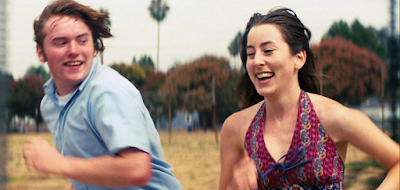
The main characters in Paul Thomas Anderson’s Licorice Pizza are a couple of young people constantly on the move. They seem to operate with the unspoken assumption: why walk when you can run? They’re running heedlessly into their futures on an abundance of youthful energy and naive restlessness. One, Gary Valentine (Cooper Hoffman), is a sweaty teenage boy with a crush. The other, Alana Kane (Alana Haim), is a twenty-something woman on whom he’s crushing. The fact that they are played by relatively fresh newcomers—he’s Philip Seymour’s son; she’s in the band Haim with her sisters, who play her sisters here, too—gives the movie a genuine sense of fumblingly appealing youthful discovery and charisma. The two of them fall into a funny friendship, finding themselves simpatico in the ways his precociousness (he’s a child actor using his money to start dubious entrepreneurial ventures) and her failure to launch (she still lives at home with her parents) meet. There’s a charge of attraction on his part, but she holds him at a distance from that. They simply enjoy their time together as friends, roaming around California’s San Fernando Valley in the early 1970s. He’s a wheeler-dealer, 15 going on 50, falling into one attempted money-making scheme after the next. She’s not sure what she wants to do with her life, so happily falls into his orbit.
Anderson unfolds their converging and diverging stories through a loose collection of shaggy anecdotal episodes. It’s a movie about that awkward time between when high school seems hopelessly juvenile, but the adult world is still held at a remove of skepticism. As is so often the case with young people, they test their sense of self in every moment, adjusting based on circumstances, comparing to people around them, blustering and bluffing to get by, or receding in the face of a more dominant adult presence. Here is a string of events—by turns funny, yearning, oddball, and suspenseful—that brings these young people’s sense of self more and more into focus for themselves. It’s a process still in motion as they run to the final credits. Through them we meet agents, actors, casting directors, teachers, teenagers, producers, politicians, chaperones, hosts, assistants, parents, siblings, salesmen, restaurateurs, photographers and more.
This assemblage of interesting faces and eccentric personality types is warmly carried out by a wide-ranging ensemble of character actors and marquee names (including Bradley Cooper, Tom Waits, Sean Penn, Christine Ebersole, John Michael Higgins, and Mary Elizabeth Ellis). We see each new situation with these various complicated and problematic adult figures through the eyes of our leads. Anderson situates them in a world of flawed or otherwise half-formed aspirations as they scramble toward maturity in the shadows of showbiz. Despite centering the couple, there’s an egalitarianism to the various sequences, a sense that every character on screen is a full, rich, interesting figure in and of themselves. Even people appearing for one or two scenes carry the sense that we could follow them off into an equally enjoyable film all their own. This gives the movie a full sense of lives in motion—pushing forward through emotions and encounters that our leads are working through to get to…somewhere. They’re figuring it out as they go along.
This loose, shaggy one-thing-after-another Anderson gives the proceedings matches his project—from Boogie Nights and There Will Be Blood through The Master and Inherent Vice—of treating intimate character pieces with the sweep and detail of a historical epic. The twinned comings-of-age here also fits in with Anderson’s other awkward, inscrutable relationship semi-comedies, like Punch-Drunk Love and Phantom Thread, although that’s also a common thread through his films. I suppose that might make Licorice Pizza a quintessential Anderson effort. It has a long-lens close-up approach, a dazzling specificity of character foregrounded amid casually perfect period recreations that fill the frames around the central focus. Here the 70s swagger of vintage tech and indoor smoking, of burgeoning pop culture happenings and gasoline shortages, is just a fact of life for the characters who try to find their way into who they’ll become. There’s an aimless free-spiritedness to the hustle—and a squinting toward possibility that never quite arrives.
Anderson gives the movie that touch of Altman—long noted as one of his favorite inspirations—with whipping up an ensemble of controlled chaos. Sequences in schools and restaurants, parties, shops, and offices spill rough natural jumbled life out of relaxed wide frames that are casually composed. And yet their filmic beauty effortlessly guides an audiences’ eye with a steady hand and a generosity of spirit. There’s a sun-dappled grainy romanticism of the past, carried aloft on a steady stream of vintage records, and a cool-eyed present-tense perspective knowing these characters are as-yet unformed. The characters may not know where life will take them, but there’s fun to be had in watching them drift through it. In one of the film’s most exhilarating sequences, a delivery truck runs out of gas mid-trip, so the leads white-knuckle their way downhill, gritting teeth as they plunge through intersections and take tight turns. It is a movie, after all, about the exhilaration of coasting.
Showing posts with label Christine Ebersole. Show all posts
Saturday, January 29, 2022
Friday, September 30, 2016
Blast from the Past: CRISIS IN SIX SCENES
Woody Allen’s latest production, Crisis in Six Scenes, has his best premise since Midnight in Paris. Set in the late
1960s, the social unrest of the times comes right into the house of a
stuck-in-their-ways elderly couple. Their cozy home in upstate New York becomes
a refuge for a radical when the daughter of an old friend breaks in. She’s
wanted by the government for her membership in a left-wing protest group whose
activities include, in addition to the usual demonstrations and rabble rousing,
bomb building, cop wounding, and sedition fomenting. The elderly couple wants
to help the poor girl out, the more open-minded marriage counselor wife (the
wonderful Elaine May in her first role in 16 years) eager to keep her hidden,
while the paranoid ad man husband (Allen) descends into a stubborn bundle of
helpless nerves as the youthful firebrand (Miley Cyrus) slowly unravels their
lives’ predictable patterns. It’s all a great excuse for Allen to explore his
usual interest in intermingling relationship tangles with philosophical
inquiry.
By far his longest narrative project – clocking in at well over
two hours total – it is a six-part miniseries for Amazon. (The shift in form
would seem more of a leap if the consistency of his filmmaking over decades –
the repetitive themes, recurring character types, the regular font, the usual
jazz scores – weren’t already a version of television’s comforting familiarity.)
He introduces a large cast of characters with competing loyalties, like the conservative
business major (John Magaro) who is smitten by the fetching fugitive, much to
the dismay of his debutante fiancĂ© (Rachel Brosnahan). And then there’s a
cornucopia of familiar and fun faces as neighbors, patients, parents, cops, and
protestors (Becky Ann Baker, Lewis Black, Max Casella, David Harbour, Nina
Arianda, Christine Ebersole, Joy Behar, Michael Rapaport, and more). It’s
stuffed with personality, but not every character comes to life with as much
fullness as the time could permit, like soggy and underdeveloped romantic triangles
amongst the younger characters.
There’s also the matter of political rhetoric, for as loaded
and provocative as it could be it is instead cozy and comfortable fuzzy hindsight.
The prickliest it gets is an early lament about how divisive and polarized the
country’s politics are, a wry what-goes-around-comes-around smirk at our
circular national crises and our inability to move past them. The great premise
is just an excuse to knock contentedly humdrum characters into frazzled
situations. I imagine such areas of thinness would be excused if this were a
shorter feature. With so much time on his hands, though, there’s simply too
much room here for dead air, stiff setups, tone-deaf teasing (a tossed off
one-liner about a troubled adopted daughter lands poorly), and lackadaisical
reaches for obvious developments. In order to go about stretching this tight
little farce over so many segments the plot takes some meandering and the zip
in the tension falls slack.
Then there is, of course, the slight stiffness and
stodginess that’s crept into Allen’s filmmaking of late, a half-theatrically
stilted, half-literary dustbin approach in which exposition is a little too
plainly displayed and some zingers come wheezing to the punchline. But even
when the writing gets a tad stale, the cast is so energetic and pleasantly
amusing, it coasts along on comfortable charms and relaxed charisma. Allen is
the quintessential Allen type, May is totally at ease playing the slightly
frazzled upper-middle-class pseudo-intellectual (her comfort zone since her
Nichols and May days), and Cyrus is just the right young, earnest,
half-idealistic/half-cynical goof to send them spinning. Per usual, the right
ensemble can carry over slightly below par Allen writing, and this one is
overflowing with the exact right casting to elevate the downtimes, the patches
that could’ve used another draft or two.
The stage is set for the characters’ conflicts to pile up
quite swimmingly, and find occasion in the unevenness for some of the funniest
scenes Allen has written in a while. May’s counseling sessions are perfect
little sketches, and recurring scenes with her lovable, and increasingly
politically rambunctious, little old ladies’ book club are a terrific
throughline. Allen and Cyrus spar over food, consumerism, and communist ideals
in agreeably prickly wars of words. There’s even a scene in which May scrambles
over rooftops after a briefcase of contraband Cuban currency, so this is the
sort of story that escalates in sometimes satisfyingly silly and unpredictable
ways. Allen has some fun with the historical context, dusting off old quips
about Vietnam, hippies, Nixon, Black Panthers, war protestors, and Latin
American revolutionaries. (There’s an echo of Bananas there, I suppose.) By the final twenty minutes, which
include a sustained and hilarious homage to the Marx brothers’ famous Night at the Opera stateroom sequence,
the whole fitfully farcical storyline has arrived at a satisfying crescendo
that’s well worth the wait.
Subscribe to:
Posts (Atom)

