James Cameron approaches a Billie Eilish concert like he does deep sea creatures or the Titanic wreckage. He’s gone to see it and wants to tell us: huh, would you look at that? The cinematographic curiosity ends at the level of procuring the footage. His documentaries—Aliens of the Deep, Ghosts of the Abyss, and now this—are chronicles of interesting sights presented with cutting edge technology. In the case of Billie Eilish: Hit Me Hard and Soft: The Tour (Live in 3D), it’s a pretty standard concert movie in form. We see her perform songs largely uncut, with lights and lasers and pyrotechnics and, of course, her own charismatic performance in the center of the dazzle. These are intercut with lots of obtrusive closeups of weeping fans, and sequences that cut away to behind-the-scenes moments that are interesting only as far as a skimming the surface of the rigamarole of modern stardom can be. Eilish is undeniably a great stage presence and her music is largely catchy and earnestly felt, whether upbeat dance bangers or slow-tempo confessional ballads. What Cameron does in the film’s best moments is set up his tech and let it capture her in action. He shot in the high frame rate 3D he’s been developing with his Avatar movies. Here that format’s hyper-detailed deep focus and lack of motion blur somehow looks natural. Concert movies are perhaps its ideal use case. Paired with booming sound the crystalline images take on a real immediacy. It captures every sweep of the light show and climaxes with a dazzling dimensional clarity to the typical end-of-concert confetti blizzard.
If the movie fails to cohere much as a movie per se—the interviews are too shallow, the behind-the-scenes too sparing, the focus a little too scattered, the performances a little too chopped up—it’s still quite a tech demo, and a decent look at a star in this particular moment of her career. For a more in-depth view of her story and personality along with musical performances, there’s R.J. Cutler’s documentary Billie Eilish: The World’s a Little Blurry. For a more straightforward concert movie, there’s Robert Rodriguez’s Happier Than Ever. (Now having worked with both Cameron and Rodriguez, one wonders if she’d like to make Alita: Battle Angel 2 happen.) This particular movie simply shows why she’s one of our most appealing pop stars. She has great songs sung well, and great stage swagger, comfortable in her typical Kevin Smith-style jersey and shorts. And the movie’s at least a little bit about the parasocial dynamic of modern music fans. It looks at the tearful fans who talk about her with unrestrained awe—pure and earnest. One boy says she’s better than therapy. At the end a girl is crying as the camera pushes in on her. From off screen we hear Cameron’s chipper question: “How’d you like the show?” Duh.
A scarier look at modern pop stardom is in the spooky, folkloric Mother Mary. Writer-director David Lowery takes his penchant for making movies that feel like eerie campfire stories and turns it on a diva in crisis. She’s Mother Mary, played by Anne Hathaway in a startlingly complicated portrayal that’s both imperious showbiz razzle-dazzle surface and deeply wounded vulnerability churning beneath. In need of a new dress right away, she attempts to reconcile with an old friend (Michaela Coel) who used to be her chief designer and visual collaborator before some unspoken falling out, or maybe betrayal. But it turns out the wound in their friendship has come to haunt them both in the intervening years. The movie proceeds as a two-hander between the women as they talk it out in a cold, dim, drafty barn, spending their time alternately needling and needing each other. Their conversation, bleeding inevitably toward magical realism, is interrupted for elaborate concert flashback sequences that exist with blinding spotlight on Mother Mary in impressive regal headdress and sequined bodysuits, surrounded by impressive implication of screaming fans in the dark, illuminated by flashing lights.
The whole production is a cohesive design. The songs are euphoric modern pop at its best. These could be Swift or Gaga or Eilish. They’re catchy and pulse-pounding and match the darkness in her character. Written by producer Jack Antonoff, responsible as anyone for the sound of the last decade, and Charli XCX, whose party-girl brattiness is also a key tone for hit modern music, the songs’ verisimilitude goes a long way toward selling the movie’s gnarled low-key fantasy. But they wouldn’t work so well if not for Hathaway’s performance. She’s credible as a pop star toggling between performative persona and raw interpersonal nerve. And this performance bounces so perfectly off of Coel’s steely wounded pride and confident control. Together their shared haunting winds its way to inevitable surrealist metaphors that threaten to overwhelm the simplicity with literalness cloaked as ambiguity (and vice versa). But this is a Lowery film through and through. He makes Hollywood pictures shaped like art house films (The Green Knight, A Ghost Story, Ain’t Them Bodies Saints), compelling hooks populated with movie stars told with a slow-drip mood. And he makes art house films inside Hollywood pictures (Pete’s Dragon, The Old Man and the Gun, Peter Pan & Wendy), broadly appealing movie star movies with a sadder, slower mode inside. Mary is more the former. It’s a talky, haunted, elliptical movie about the psychosis of stardom.
Showing posts with label James Cameron. Show all posts
Sunday, May 10, 2026
Friday, December 16, 2022
Ocean Eyes: AVATAR: THE WAY OF WATER
The great Umberto Eco once reminded us: “Two clichés are laughable. A hundred clichés are affecting.” He was writing about Casablanca, but he might as well have been discussing the films of James Cameron. He’s a filmmaker whose love of towering piles of cliche is the very thing that resolves his contradictions. He’s a precise, technical director drawn to writing sloshing human melodrama. He’s a hard-edged action director with a soft-hearted love of family and romance. He makes gripping, and often intense, genre pictures that turn on protective parents and the warmth of motherhood and True Love. He’s a conceptual, even experimental, hand at pushing the nuts-and-bolts craft behind the camera. (Here, to his use of 3D, he’s added a variable frame rate that’s sometimes distracting, and sometimes enveloping.) And yet he loves pushing this tech in the context of broad, crowd-pleasing, to-the-rafters satisfaction. To do all this at once, and to keep getting away with it at such a high level of success, he simply must make these appealing epics—the Terminators, Titanic, and, yes Avatars that capture an audience’s imagination with the sheer commitment of their tellings, and the total control of one man’s complicated vision. Those cliches that pile up are our way in, and hold us in their thrall, deeper into the earnest plights of the characters on display. To borrow another phrase from Eco, “When all the archetypes shamelessly burst in, we plumb Homeric depths.”
So here we are with Avatar: The Way of Water, a long-awaited sequel to the 2009 original. It picks up over a decade after that one left off, in the far future, with ex-Marine Jake Sully (Sam Worthington) transmogrified into the body of a Na'vi, the blue giants indigenous to the world of Pandora. In that body, he turned against humankind and fought to repel corporate colonists looking to exploit the lush jungles for the minerals beneath the Na’vi’s sacred trees. Quite a feat for Cameron, making a whole new world full of culture and creatures and geography and spirituality, and then staging a rock-‘em-sock-‘em battle that had audiences hooting and hollering for the death of capitalist overlords. But that was then. Now Sully’s a family man, with half-human, half-alien teenagers, two sons and two daughters, he’s raising with his Na’vi warrior wife (Zoe Saldana). There’s also an abandoned human boy (he grows up to be played by newcomer Jack Champion) who dons an oxygen mask and leaps around in a loincloth as an adopted member of the tribe. They all clearly love each other, and enjoy their humble lives mastering their terrain and honoring their cultural traditions. You can tell right away that this is a sequel more intimate and tender, with a smaller interest in a family unit worth preserving even as the larger machinations of their world (and Cameron’s storytelling) are inevitably going to pull them back into the action.
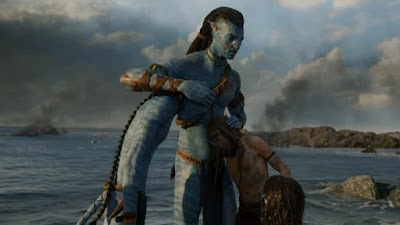
So when the humans arrive for a second attempt at taking the land and its resources, Sully has even more reason to fight. And yet, after all the fighting that settled this issue in the first film, the heroes are reluctant to do it all again. Here’s a sequel about how the heroes would rather not do a sequel, what with life having moved on to more precious concerns. Alas, conflict imposes, and the villains are literal clones of the last ones. And so, what begins as an attempted insurgency becomes an attempt to hide—this time among the water Na’vi who commune with whale-like creatures—even as powerful forces amass to lure them out for the killing. Three acts: Run. Hide. Fight. Simple enough. Cameron knows how to pump up a conflict, stage memorable character moments, and pace a simple story so cleanly and clearly that we are once more drawn into the emotional investment of the world before we even realized that was happening. Of course we want the vulnerable to stay safe, the heroic to prove their worth, and the dastardly to receive comeuppance. There are those archetypes shamelessly bursting in. But Cameron also knows winding them up and letting them go in a fantastical location is enough to get the blood pumping with the earnest emotions and pleasures of the best pulp sci-fi. If you’re going to paint with a broad brush, you need a broad canvas, too.
There’s clear love for this fictional planet in a film that luxuriates in the world Cameron has imagined. First it gets exposition out of the way in the first hour or so. That’s all plot mechanics catching us up on the state of Pandora and its conflict. The middle hour simply wanders the ocean, meeting new tribespeople (Cliff Curtis and Kate Winslet) and creatures while learning their ways. I especially liked the whales that understand sign-language and whose murmurs are subtitled. That’s where Cameron once more surfaces his ecological concerns and real empathy for the environmental erosion that accompanies corporate oppression on the march. As he sees the displaced Sully family try to integrate in this potentially safe space, we see the inextricable ties between these people and their home. And it’s communicated through fluid sequences that dance across and underneath the water that generously allow the audience to study the topography and the tides, the flora and the fauna. Watching these Na’vi swim around their tropical paradise, I found myself remembering the Avatar super-fans who reportedly experienced real depression and withdrawal upon exiting the theater after repeat viewings of the original. They were distraught knowing this wonderful planet wasn’t a place they could actually visit. Here’s a movie that’ll repay that interest, dwelling in that long central passage of pure vibes, setting, and design.
I was also so bought-in to the artifice of it all—the motion-capture performances of the bewitching blue characters, the all-encompassing depth and detail to the landscape and the way the sunlight breaks across a clear blue sea—that I would occasionally step out of myself and remember, with real awe, that I was basically watching animation for vast stretches. It’s an impressive technical achievement. But none of that vivid imagination—a cleanly designed comic-book fantasyland excursion—would matter if the story itself, and the characters within it, didn’t come to life, too. That’s the final Cameron contradiction to consider: the elaborate falseness, the enormous machine-tooled fakery, bringing forth ideas of sensitive smallness. Here’s a big-budget business casting its eye on the joys of close community with others and with nature, the restorative pleasures of family, the spiritual sustenance of the wilderness, and the nobility of standing against the calculating profit motive and doing the right thing. So once more he’s made a concussive epic concluding with explosions and gunfire—and this time includes a self-quoting climactic sinking ship to amp up the watery danger—but he’s populated it with such patient archetypical love for nature and these fantasy people that those depths are worth plumbing. Homer, it’s not. But Cameron’s good enough to fill the screen with spectacle straight from the heart of this ocean.
So here we are with Avatar: The Way of Water, a long-awaited sequel to the 2009 original. It picks up over a decade after that one left off, in the far future, with ex-Marine Jake Sully (Sam Worthington) transmogrified into the body of a Na'vi, the blue giants indigenous to the world of Pandora. In that body, he turned against humankind and fought to repel corporate colonists looking to exploit the lush jungles for the minerals beneath the Na’vi’s sacred trees. Quite a feat for Cameron, making a whole new world full of culture and creatures and geography and spirituality, and then staging a rock-‘em-sock-‘em battle that had audiences hooting and hollering for the death of capitalist overlords. But that was then. Now Sully’s a family man, with half-human, half-alien teenagers, two sons and two daughters, he’s raising with his Na’vi warrior wife (Zoe Saldana). There’s also an abandoned human boy (he grows up to be played by newcomer Jack Champion) who dons an oxygen mask and leaps around in a loincloth as an adopted member of the tribe. They all clearly love each other, and enjoy their humble lives mastering their terrain and honoring their cultural traditions. You can tell right away that this is a sequel more intimate and tender, with a smaller interest in a family unit worth preserving even as the larger machinations of their world (and Cameron’s storytelling) are inevitably going to pull them back into the action.
So when the humans arrive for a second attempt at taking the land and its resources, Sully has even more reason to fight. And yet, after all the fighting that settled this issue in the first film, the heroes are reluctant to do it all again. Here’s a sequel about how the heroes would rather not do a sequel, what with life having moved on to more precious concerns. Alas, conflict imposes, and the villains are literal clones of the last ones. And so, what begins as an attempted insurgency becomes an attempt to hide—this time among the water Na’vi who commune with whale-like creatures—even as powerful forces amass to lure them out for the killing. Three acts: Run. Hide. Fight. Simple enough. Cameron knows how to pump up a conflict, stage memorable character moments, and pace a simple story so cleanly and clearly that we are once more drawn into the emotional investment of the world before we even realized that was happening. Of course we want the vulnerable to stay safe, the heroic to prove their worth, and the dastardly to receive comeuppance. There are those archetypes shamelessly bursting in. But Cameron also knows winding them up and letting them go in a fantastical location is enough to get the blood pumping with the earnest emotions and pleasures of the best pulp sci-fi. If you’re going to paint with a broad brush, you need a broad canvas, too.
There’s clear love for this fictional planet in a film that luxuriates in the world Cameron has imagined. First it gets exposition out of the way in the first hour or so. That’s all plot mechanics catching us up on the state of Pandora and its conflict. The middle hour simply wanders the ocean, meeting new tribespeople (Cliff Curtis and Kate Winslet) and creatures while learning their ways. I especially liked the whales that understand sign-language and whose murmurs are subtitled. That’s where Cameron once more surfaces his ecological concerns and real empathy for the environmental erosion that accompanies corporate oppression on the march. As he sees the displaced Sully family try to integrate in this potentially safe space, we see the inextricable ties between these people and their home. And it’s communicated through fluid sequences that dance across and underneath the water that generously allow the audience to study the topography and the tides, the flora and the fauna. Watching these Na’vi swim around their tropical paradise, I found myself remembering the Avatar super-fans who reportedly experienced real depression and withdrawal upon exiting the theater after repeat viewings of the original. They were distraught knowing this wonderful planet wasn’t a place they could actually visit. Here’s a movie that’ll repay that interest, dwelling in that long central passage of pure vibes, setting, and design.
I was also so bought-in to the artifice of it all—the motion-capture performances of the bewitching blue characters, the all-encompassing depth and detail to the landscape and the way the sunlight breaks across a clear blue sea—that I would occasionally step out of myself and remember, with real awe, that I was basically watching animation for vast stretches. It’s an impressive technical achievement. But none of that vivid imagination—a cleanly designed comic-book fantasyland excursion—would matter if the story itself, and the characters within it, didn’t come to life, too. That’s the final Cameron contradiction to consider: the elaborate falseness, the enormous machine-tooled fakery, bringing forth ideas of sensitive smallness. Here’s a big-budget business casting its eye on the joys of close community with others and with nature, the restorative pleasures of family, the spiritual sustenance of the wilderness, and the nobility of standing against the calculating profit motive and doing the right thing. So once more he’s made a concussive epic concluding with explosions and gunfire—and this time includes a self-quoting climactic sinking ship to amp up the watery danger—but he’s populated it with such patient archetypical love for nature and these fantasy people that those depths are worth plumbing. Homer, it’s not. But Cameron’s good enough to fill the screen with spectacle straight from the heart of this ocean.
Thursday, January 7, 2010
At Last: Avatar
In a year that brought us giant robots, living museum pieces, mutants, super-soldiers, and guinea pig spies and had them all be endlessly dull clattering noises and nonsensical spectacle, Avatar feels like a breath of fresh air. Here’s a story with real characters and arcs that matter. Here’s special effects that have real impact in a plot that has peaks and valleys and room to breathe. Of course, it’s a shame that the plot is a hodgepodge of other sci-fi extravaganzas with a bit of Dances with Wolves and Pocahontas thrown in for good measure, not to mention its sledgehammer metaphors for modern ailments, but at least it’s shaped and developed in a cohesive way. I’m not exactly sure how every aspect of the world operates, and some of it gets a little silly, but here’s a movie that sets out to excite and entertain and actually accomplishes it.
The first thing we see is a too-good-to-be-true jungle as we glide across the canopy, the branches whisking past our faces. The 3D is hardly revolutionary; movies just this year like Up and A Christmas Carol used the technology in similar ways to similar effects, deepening the landscape with a more fluid technique arising from their animated nature. The live action nature of Avatar achieves something closer to the multi-plane animation of early Disney works where the foreground, background, and everything in between look like they exist on separate plates creating a convincing illusion of depth. But because of this 3D technology the movie, to my eyes, looked pretty much 2D. After all, regular movies are perceived to possess depth as well by simply showing us an image that represents the real world as we see it. A normal image doesn’t appear to flatten the background into the foreground, does it? Throwing 3D in to the mix only distracts here, especially because Cameron isn’t interested in throwing things into the audience, the trick 3D does best. For most of Avatar I felt like I was watching a 2D movie while wearing an extra pair of glasses. Now that the disappointment with the most trumpeted revolutionary aspect of the film can settle in, we can get back to the plot.
After the jungle soars by, we meet the man who will guide us into the story, Jake Sully played by Sam Worthington, the young Australian actor who stole Terminator Salvation right out from under Christian Bale. Worthington’s not quite as good here, but his role is just as intriguing. Sully is an ex-marine who is forced to take his brother’s place on a corporation’s mission to a planet called Pandora. His brother had been trained to control an avatar grown with his DNA mixed with that of the natives of Pandora, the Na’vi, a race of blue bipedal felines. This avatar is, well, I’m not exactly sure what it is. Is the creature a separate being that Sully can control or is it an empty biological vehicle that he merely drives? Oh, well. Cameron doesn’t stop to tell us. Whatever it is, the fake Na’vi is controlled by Sully, who uses a wheelchair but when he enters his avatar he has control over a fully functioning, albeit alien, body. It’s an escape but one that leads Sully to end up being torn between Sigourney Weaver’s sassy scientist who wants to use the avatar program to learn about the peaceful natives and Stephen Lang’s brutish ex-military company man who wants to use the avatars to learn how to relocate the natives in order to get at the rich deposits of futuristic minerals.
Luckily, all of this is set up within the first act of the film, allowing for us to ignore the plot for much of the middle portion of the film, which finds the big blue Na’vi Sully interacting with the natives, especially the one played by a motion-capture Zoe Saldana who begins to take a romantic interest in the strange outsider. It’s a somewhat compelling romance, but luckily the true love story is between Cameron and the fantastical world he’s showing us. The film wanders through the jungles of Pandora and, make no mistake, it is some kind of spectacular. There are floating mountains and glowing moss, dizzying drops and lush fields. There are plants that glow when tread upon and a holy tree that can read your mind. It’s a rich and detailed exercise in world building and it’s a delight to explore as it unfolds on screen, every little detail satisfying. Well, that holy tree is kind of hokey, but other than that this is a satisfying sci-fi universe.
The movie zips right along and, despite nagging problems with the details of the plot, I was caught up in the action. There’s a devastating moment of mass destruction that hits about two-thirds of the way through the film that jolted me, surprising me with how much I cared about this world. The movie may not have the relentless forward momentum of Cameron’s Terminator or Aliens, but it does have a comfortable pacing that allows the spectacle to settle in before the massive all-action finale that sends creatures and technology hurtling into each other in a slick and awesome cacophony as good as a Star Wars battle or the kind of comic book panel that feels so packed with carefully choreographed motion and detail that it should probably be a centerfold. Even in 2D, this epically satisfying climax would be totally enjoyable.
So, is Avatar a groundbreaking, jaw-dropping motion picture event unlike any we have seen since maybe Star Wars or even The Jazz Singer? In short, the answer is no, and it doesn’t matter how groundbreaking Cameron thinks it is. Instead, the movie is just a well paced, entertaining, special-effects extravaganza. It has a derivative plot and some thin characters, but I kind of cared about them, and I certainly cared about the planet Pandora. When some in Hollywood seem to have lost the ability to make us care about thin characters in fantastical situations, it’s nice to see a blockbuster that’s actually worth the blocks it’s busting.
Subscribe to:
Posts (Atom)