

Showing posts with label Javier Bardem. Show all posts
Showing posts with label Javier Bardem. Show all posts
Tuesday, July 22, 2025
Need for Speed: F1

Monday, May 29, 2023
Sea Again: THE LITTLE MERMAID
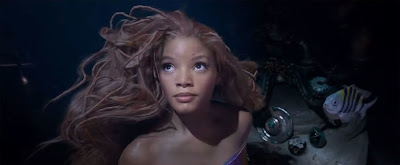
It seems to me that if someone’s going to remake Disney’s The Little Mermaid, they’d better get that exactly right. In the case of the company’s newest live-action adaptation of an animated classic, they get it right. Halle Bailey is in the lead role, and sells that need from the inner-most soul, her open, expressive face and reaching body language—paired with her lovely singing voice—communicate that combination of stifled curiosity and hopeful tension. Once that number happens, we’re on her side no matter what. The rest of the movie happens about how you’d expect, with her father King Triton (Javier Bardem, sleepily paternal) lashing out at her human curiosity, which sends her into the devious tentacles of Ursula the Sea Witch (Melissa McCarthy, in a passable karaoke performance). She’s gifted human form to woo the prince of her dreams (Jonah Hauer-King, handsomely anonymous). But the bad deal sends her ashore without her voice, leading to a romantic silent flirtation and much silliness from animal sidekicks, before it’s all resolved on a dark and stormy night. The adaptation lacks in surprise, and extends the story with a few new songs and added texture to the surface dwellers’ characters. But because it’s anchored so firmly to Ariel’s yearning, it maintains a certain dignity and investment.
The movie is, taken on its own terms, a fine fantasy musical. It has a sympathetic lead, a decently appealing romantic interest, and a handful of the best songs ever written for the screen. And yet, it’s difficult to take on its own terms, as difficult as it is to take any of these live action remakes of animated Disney musicals as an individual work of moviemaking. The former wouldn’t exist in this form if not for the latter. That makes it harder to look at the relatively lackluster staging of “Under the Sea” and, instead of enjoying the swirl of photo-realistic anemones and tortoises wriggling to the beat while the vaguely cartoony crab Sebastian (Daveed Diggs) croons, unconsciously compare it to the ecstatic joys of the zippy, gag-filled, color-explosion chorus number that is the original. Still, one can’t entirely resist the charms of such buoyant musical material, even at three-quarters the energy. (At least romantic classic "Kiss the Girl" has better staging.)
Director Rob Marshall, Chicago aside, usually bungles movie musicals—sorry, Mary Poppins Returns and Into the Woods and Nine, which have their moments, but generally flounder. Here, though, he manages to keep the bland aquamarine sogginess of his underwater visuals out of the way of the focus on the simple fairy tale logic and that core of emotion. Bailey’s Ariel carries it, partly because she gets that great number to get us caring, and partly because she is able to bring something like an inner life to her mute longing. Besides, the new screenplay by David Magee (of Life of Pi), when not dutifully redoing the original, has done some reasonably smart balancing, using a longer run time to flesh out the role of Prince Eric and the kingdom on land a bit. He’s now an explorer, too, and his interests harmonize well with Ariel’s. We can see all the more fully why they’re meant for each other—a good thing, too, since the movie runs nearly a full hour longer than the original. If we’re going to spend more time with it, we might as well believe it. I was brought along by the sturdy structure, and, when Ariel finally finds a way to be part of our world, well, I’m not made of stone.
Wednesday, December 8, 2021
Word Crimes:
THE TRIAL OF THE CHICAGO 7 and BEING THE RICARDOS

Take last year’s The Trial of the Chicago 7. It’s based on the real circus of a court case following protests at the 1968 Democratic Convention that were violently broken up by a bludgeoning police presence. A group of leading leftist activists were targeted by the newly elected Nixon administration to make an example of them. The judge ended up a loony attention seeker who made all kinds of questionable decisions—like ordering Bobby Seale, a leader in the Black Panthers, bound and gagged—while the defendants, many previously unknown to each other, often used the massive press interest in their plight as a soapbox on which to make important points about the state of the country. (They also used it as an excuse to poke prankish fun at the authorities who were in the process of overreaching.) Sorkin sees in this case good reason to comment on our present right-wing lunacies and various social movements protesting them. But he puts too much spin on the ball in each sequence. Characters are practically explaining this connection to us as monologues and jostling debates are carried out with musty pseudo-historical perspective.
Not helping matters, the flat staging from Sorkin as director tends to undercut the few good moments he’s written.With Trial he somehow can’t pull off the courtroom sparring he crafted so well as screenwriter for A Few Good Men's "you can't handle the truth," or the Social Network depositions. Here it’s self-consciously, and badly, theatrical, with a host of fine actors in full showy character mode (Sacha Baron Cohen, Jeremy Strong, Eddie Redmayne, Michael Keaton, Frank Langella, John Carroll Lynch, Yahya Abdul-Mateen II) chewing over flashy phrasing as the camera pushes plainly and shafts of light falls simply and dramatically. One wonders what a better visual sense would’ve shaped out of these lumpy scenes. But then I recall how Sorkin’s shaping of the pages pushes the real events toward big fake movie climaxes that are somehow flatter and less surprising than the actual events. Just when he builds up a head of self-righteous steam and winds up a character to let them go, it rings the falsest. The best scenes are the smallest, and the simplest, where an old pro like Keaton can underplay the overwritten and end up, on balance, just fine. Strangely, for a writer prized for his verbal pyrotechnics, the court sequences are somehow less outrageous and dramatic and hilarious and suspenseful than the actual court transcripts. Those have been used as the basis for a fine animated documentary from a dozen years back—Brett Morgen’s Chicago 10—and are available for free online. Those are the better way to experience the trial.

Sorkin’s brand of pushy cleverness fits a great cast of actors playing performers and other creative types. Here Nicole Kidman becomes a Lucy who’s ambitious, steely, hugely talented, and knows what she wants. She is clearly in charge of the show, and really won’t back down from insisting being a Communist used to be considered a valid option for supporting the workers of the country. Javier Bardem plays Desi as a chipper man constantly tending to his ego, but with real love for Lucy. (He also doesn’t suffer fools, such as one well-meaning producer who tries to convince him he’s the “I” who “Loves Lucy” and therefore the top-billed title character.) His Cuban roots make him a bit more uncomfortable with her politics. (There Sorkin tries a smidge too much for phony both-sides balance.) The main couple is, as on the show, surrounded by a sharp-tongued supporting cast. Nina Arianda’s Ethel and J.K. Simmons’ Fred are great inhabitations with sly side-eyed commentary on, challenges to, and support for the main pair. And the show’s crew features Tony Hale, Alia Shawkat, Jake Lacy, Clark Gregg and more hustle through the stages, wardrobe department, and writing rooms. It’s a fine feat that mixes the sort of clever darting dialogue and blunt force messaging that a great cast can sell if Sorkin serves it up well.
There’s a kind of gleaming soft-focus romanticism to its approach, a weren’t-the-olden-days-grand? gloss to the sometimes-reductive smushing of so much social upheaval and conflict into one heavy week. (It spackles it over, somewhat, by having fake documentary talking heads from actors playing older versions of the writers’ room act as a Greek chorus of sorts.) And the writing sometimes tries too hard to make the ideas fit our modern context. Would Lucy really have accused someone of “Gaslighting” her? Nonetheless, it’s has the kind of fizz and pop that’s pleasing to the ear and flies by in a flash. Sorkin’s direction stays out of his writing’s way, and has a fine eye for the difference between on- and off-stage antics. I found it a satisfying and entertaining look at making a show in a time with an actual blacklist bouncing entertainers out of the business for their politics, when sexual mores were tamped down and repressed and not to be discussed, and when women and people of color weren’t to be treated as equals on or behind the screens. And yet, through making one of the greatest television comedies (who doesn’t know the chocolate factory sequence?), here’s a couple that manages to push on the edges of those societal constraints at a time when it could’ve resulted in a show going off the air. Now that’s cancel culture.
Saturday, October 23, 2021
Spice World: DUNE

Villeneuve sets the stage well. His pivot from the heavy thrillers that brought him to Hollywood (Prisoners, Sicario) to ponderous science fiction (Arrival, Blade Runner 2049) has been a productive one. His eye for cold majesty and ear for terse genre dialogue is the keen balance of cinematic poetry and prose that makes for some fine stunning vistas of imagination. Here we get something like and yet unlike other space operas. There’s a love of grand takes offs and landings, watching the gears turn on enormous dragonfly-winged helicopters and monolithic ships, and the sliding doors on the side of New Age ziggurats rising out of the desert like something in a nouveau-ancient-Egyptian-revival. He knows how to accumulate detail and give it the undertow of inevitable tragedy. He creates a world of awe-filled spectacle, balanced between dread and drama while playing off its sense of having returned from an alien future world with the kind of attentive visual splendor you’d find in a Biblical epic or Shakespearean tragedy. One might think of L.P. Hartley’s famous line claiming “The past is a foreign country: they do things differently there.” So, too, the future. Here we are dropped into a tangle of ongoing political machinations, colonial strife, religious prophecies and rituals, and cut-throat capitalist ceremony, and watch as various factions—draped in flowing robes and bedazzled headpieces, skin-tight battle suits and protective gear—intone gravely about all they fear is to come. We learn the various groups’ traditions and values, their rituals and hopes, and then watch them all collide and blow apart.
The result is a grand introduction that may or may not go anywhere. It leaves the sense of feeling incomplete. As it trudges along so seriously and full of grave pronouncements, Chalamet contemplates the heavy crown of his future, while the others strut and pose and fret in cavernous sets. It gets a bit monotonous from time to time. I found myself spending the last thirty minutes or so wondering on what cliffhanger it would end more than I was wrapped up in the narrative. Maybe the whole thing would play better after a second feature, cut together as one five-hour sprawl. Because it has the soul of a Ten Commandments (maybe the best comparison point, if you bled it of its overtly colorful camp qualities) straining to escape and go on and on and on. Instead it finds every thread and arc halted abruptly with a cut to black while somehow still stretching to fill its space. (The last line: “this is only the beginning.”) So it’s half a movie. But it’s an intriguing one, full of striking design and heavy soundscapes. It’s a feast of bit parts for a huge eclectic ensemble of familiar actors crowding around the margins—Josh Brolin, Javier Bardem, Charlotte Rampling, Stephen McKinley Henderson, Jason Momoa, Zendaya—who are prepared to chew around expositional jargon with perfect gravity. It has images that tower with the most literally awesome of any Hollywood epic, and sound that rumbles and quakes with import. Clearly everyone involved cared. It’s an experience, compelling with every wide shot and sonic flourish. But it’s hard to feel too excited when it hits an inciting incident and then peters out.
Friday, September 15, 2017
Requiem for a Scream: mother!

Darren Aronofsky’s latest film, mother!, is a jangled, claustrophobic freakout, a Polanski-esque
picture of domestic tension refracted into close, uncomfortable, intimate horror.
It’s about miscommunication, a fundamental flaw in a relationship escalating
into insurmountable obstacle as the situation grows into one out of control.
The couple at its center live in a dreamy house in the middle of a forest
clearing, with no road or driveway or any obvious means of escape. It’s mid-renovation,
courtesy of the young wife (Jennifer Lawrence) who spends her days refurbishing
the home. The older husband (Javier Bardem) is a writer we see poised with pen
at the ready, but who never seems to write a word, or at least at first. As the
film moves forward, their parallel mental states diverge, he a seemingly
unstoppable obsessive people-person lit up with an almost divine (or devilish,
perhaps?) zeal and she an increasingly vulnerable paranoiac understandably
unsettled by a loss of control driven by her husband’s paradoxically
uncommunicative openness. (It put me in mind of Aronofsky’s other works – Noah married to Black Swan, I suppose.) The film sticks closely, exclusively, to the
wife’s perspective, pushing in with uncomfortable close-ups as her face
reflects confusion, then stress, then mental anguish, and finally a complete
and total breakdown. It’s understandable every step of the way, though seems to
add up to less and less the longer it goes.
The whole thing is shot in grainy, tremulous, shaky, close
angles, maneuvering with maximum discomfort. We sit right up close to the
boiling chaos about to erupt in this marriage, though the context for the leads’
personalities is sketched simply, hollowly, a clangorous and multipurpose
metaphor. It’s clear from the beginning something is dangerously off about the
couple, she far too patient and generous for his brooding dismissiveness. How
often do we see her earnestly offer plain-spoken assertions of her wants and
desires only to be rebuffed by his gruff selfishness? By the time a strange man
(Ed Harris) shows up in the middle of the night coughing and smoking and asking
if they have a spare room, it’s a sort of darkly funny laugh of recognition –
an “of course he would” – to find the
husband immediately agrees without consulting his wife. When their unannounced
guest’s wife (Michelle Pfeiffer, dripping with the dark comedy of a
contemptible houseguest, but oddly underused) turns up at the doorstep, she’s
invited in, too. Then their grown sons are ringing the bell and one thing leads
to another and it’s like the Marx brothers’ classic stateroom bit ran headlong
into Repulsion. Lawrence plays
relatable notes of total confusion, a sense of her world spinning out of
control while everyone else acts like she’s the crazy one. Why are all these
people piling into her house? What’s going on here?
Flowing with shock sensation – dripping blood, heartbeats in
walls, crumbling architecture – the movie gets schlockier and nuttier as it
goes, to the point where the wild sustained climax – I dare not spoil its shape
or scope, but, boy howdy, does it take the inevitable progression of its plot
to the farthest reaches of its insanity – had me thinking to myself, “what am I
watching?” Aronofsky commits to the intensity of it all, building on the
foundation of one sparsely characterized couple a muddled outsized allegory. Sure,
Lawrence plays pained sweet homemaker, and Bardem plays smoldering artiste, but
beyond that small flimsy bit of emotional scaffolding there’s nothing by way of
personality or characterization to hold onto. (It’s one of those movies where
the characters are unnamed, listed in the credits as simply Man and Woman and
so on.) We only have pure shapeshifting symbolism (fitting for our current
Mystique) – the twisted progression linking up inevitably with thoughts of
domestic violence, societal misogyny, and cycles of abuse (both intimate and environmental),
as well as the chaos that can follow in the wake of a tortured artist unable to
handle fame. These grand ideas float through, but Aronofsky mostly highlights
rattling unease and escalating abstract terror. This movie’s stressful, eventually
howling with screams and fire and death in increasingly brutal effects.
Aronofsky’s a master at marshalling filmmaking techniques – precise sound
design, intuitive cutting, thick filmic cinematography, intense performances –
to push buttons, but here it’s at or near its most fruitless. It’s technically
dazzling and utterly exhausting.
Friday, May 26, 2017
Abandon Ship: PIRATES OF THE CARIBBEAN:
DEAD MEN TELL NO TALES

The fifth in a series that once represented welcome
freshness in the blockbuster formula, Pirates
of the Caribbean: Dead Men Tell No Tales is only enjoyable insofar as it
can occasionally remind you of how much more fun you had at the other ones. Gore
Verbinski managed to revitalize the old pirate swashbuckler with 2003’s Curse of the Black Pearl, a perfectly
structured adventure movie let loose with an endlessly charming cast and its
director’s elaborate visual imagination – cursed seafarers turning into
skeletons by moonlight, and funny visual gags involving sinking ships,
subverting expectations, and Buster Keaton-ish choreography. Then there was, of
course, the loopy, unpredictable mannerisms of the ditzy, tipsy, rascally
scoundrel Jack Sparrow, played by Johnny Depp in the most wholly successfully
enjoyable performance of his career, bringing in great eccentric surprise from
the margins of every scene. The rest of the trilogy allowed Verbinski to go
wilder with his terrific eye for spectacle, then a fourth – a coda for which
the director and some of the main cast didn’t return – managed to eke out its
charms by not spoiling the affection built up by its predecessors. This time
around, though, what once felt like a new approach to an old subgenre is now
waterlogged and predictable itself.
Once again, we’re introduced to a band of ghost pirates
intoning about curses and revenge. This time it’s a Spanish crew led by Javier
Bardem (speaking incomprehensibly through a mouthful of black bile) who are
undead, trapped on their zombie ship in a cave. They crave freedom to sail the
seas and slay the pirate who left them for dead. Wouldn’t you know it? That
pirate was Jack Sparrow. Depp slurs in, playing the once-fun character as the
drunkest and loopiest he’s ever been. His timing is off, the mannerisms are
twitchier, and the charm is mostly gone. Now he’s not flirty and sly; he’s
leering and grotesque. Still, there are times when he stirs from his stupor
long enough to pull off a fun bit of action, like a fantastic slice of dark
comedy involving an intricately choreographed guillotine gone wrong. To assist
in filling out an adventure plot around this decaying caricature is a new
fresh-faced hero, a young chap we’re told is the child of the trilogy’s stars,
Will Turner and Elizabeth Swann. (That Brenton Thwaites is a pretty man who
looks like the exact midpoint between Orlando Bloom and Keira Knightley helps
sell the parentage.) There’s also a young lady scientist accused of being a
witch (Kaya Scodelario). They meet crossing paths in pursuit of Poseidon’s
Trident, an ancient device that controls all sea curses or whatever. It’s
always something.
The new filmmakers at the helm are Norwegian directors
Joachim Rønning
and Espen Sandberg, whose Kon Tiki is
just the sort of straight-down-the-middle foreign film that gets you a
Hollywood job. With a blandly competent anonymous style, they steer the
franchise through choppy waters – a screenplay that’s pulling apart at the
seams, old performances rapidly diminishing their appeal, and a tangle of
convoluted new mythos that labors under its nonsensical approach to continuity.
The aesthetics merely recycle what’s worked before – crumbling undead, soggy
ships, sharp period costume – mixing in a few new sights – ghost sharks, a
jewel-encrusted island. The action alternates between big and memorably stupid
(a sort of restaging and one-upping of Fast
Five’s bank vault finale, but on
horseback) and big and boring (gloopy CG waterfalls and incoherent swordplay). As
for navigating the series’ tonal balance or managing tricky performances, that’s
where the movie falls flat the most. It flows out as a procession of incidents
involving vacant figures, played with an exaggerated insistence on forced
frivolity. There’s simply no consistent emotional tug or easily comprehensible
motivation pulling it along when the movie must remind us of the stakes in
increasingly desperate explanations.
It’s bad enough Jeff Nathanson’s screenplay is constantly
repeating itself, introducing every bout of exposition at least three times and
throwing the characters into each scrape – jail cells, double crosses, hidden
islands, and so on – at least twice. But for the new leads to remain only
vaguely attractive blanks filled in with the scantest motivation and the old characters to appear reduced
to barely more than moving Colorforms of their former selves? That’s where the
movie’s total lack of tension, chemistry, and energy really starts to drag. There’s
little about the movie that follows naturally out of what came before it in its
predecessors’ continuity, making this at this point a series dragged out only
for the sake of profit and not for invention of even a meager sort. Even the
nods to old MacGuffins are convoluted and forced. There are fleeting moments of
fun spectacle, that familiar stirring score, and a few choice cameos. But that
it has its passably diverting moments only makes the soggy slog around it more
tediously disappointing.
Subscribe to:
Posts (Atom)
