Showing posts with label Yahya Abdul-Mateen II. Show all posts

Saturday, April 9, 2022

Siren Song: AMBULANCE

I’ve never been disappointed in a Michael Bay car chase. Even when the movie around it is one of his lesser pictures, there’s nothing like the way he films the grit of the road, the burning rubber, the squealing turns, the crunching crashes, bone-rattling speeds, spraying debris, and geysers of fire and explosions. He takes low angles with a moving camera that goes faster and closer than you’d think possible, hurtling beyond or behind or spinning between the moving elements, filling the frame with light and motion, cutting so fast you just barely get your bearings. Think his debut Bad Boys or its outsized sequel sending cop cars careening through one obstacle after the next, or his sci-fi escape actioner The Island flinging a literal ton of construction equipment off the back of a trailer to slice apart vehicles crossing their concrete-slamming trajectories. Is it any wonder, then, that his enormous Transformers movies are something like an apotheosis of this style? What better protagonists than the cars themselves, all oil and spark and motion contorting around fleeting human interests. There’s always something exhilaratingly mechanical about Bayhem, where flesh and blood meet the cold logic of parts and gears—animated by the passion for obliterating the senses in aesthetic reverie of all of the above.

His latest, Ambulance, is an answer for anyone who ever wondered what an all-chase Bay movie could be. After a brisk setup, the action starts and never lets up. Just a few minutes in, I found myself asking: is this one of Bay’s very best efforts? The rest of the movie just keeps answering: yes, yes, yes. Somehow it flies by, but never loses its rooting interests, every image a gleaming, forceful work of propaganda for itself. The story hits the ground running, with an unemployed veteran (Yahya Abdul-Mateen II), in need of lots of cash after his insurance denies coverage for his wife’s surgery, secretly meeting up with his bank robber brother (Jake Gyllenhaal) for a loan. Turns out, the criminal bro is just about to leave with his crew on a big heist, but they do need a driver. So off they go. This is cross-cut with an introduction to a paramedic (Eiza Gonzalez). We meet her saving the life of a little girl impaled on a railing that rammed through her mother’s car in an accident. The jaws of life spark, she cries as the EMT grips her hand, then the camera drifts down from high above the ambulance like a guardian angel as they spirit her toward the nearest ER. (Maybe it's the movie equivalent of the early pandemic days, when people would bang pots and pans out their windows in tribute to first responders.) You can tell right away that Bay’s giving this material an extra fluid grace, and some real tenderness, too. We also saw a glimpse of the brothers as children in an intuitive wordless flashback at the start, two innocents wandering down a sun-dappled Los Angeles street. All this sentimental rooting interest is sketched in with hard-charging shorthand in immediate gripping visualization. We get it instantly, the better to care just enough as the action picks up speed.

The bank robbery goes badly, a cop is shot, and the brothers escape by hijacking the ambulance that arrives for him. (Guess whose.) The rest of the movie, then, is in the same vein as Jan de Bont’s Speed or Tony Scott’s Unstoppable—wow, that’d be a triple-feature to make you hyperventilate—as a vehicle just can’t stop, can’t slow down, is always on the move. The movie doesn’t merely zoom by; it smashes, careens, swerves, drifts, and dips. We’re taken on a tour of LA at top speeds, as law enforcement assembles (Garret Dillahunt wrangles the team of cars and trucks and guns and helicopters with gruff cowboy charm) and the ambulance keeps eluding their grasp. (One imagines the screenplay could’ve been written by driving around town wondering: what would it be like to go really fast through here, or what if a car fell off that?) Bay goes all in on blue-collar process, balancing the cops’ procedures with the robbers’ clever quick thinking. He trusts his actors to sell the immediacy of the moments. Gyllenhaal is a live-wire, while Abdul-Mateen is sturdily in-over-his-head, and Gonzalez is probably Bay’s best heroine, capable and steady and thinking, defined entirely by being professional and skilled while never drooled over. We want her to survive, while the movie does a tricky two-step in keeping Gyllenhaal more purely villainous while letting Abdul-Mateen remain relatively more sympathetic. We want them to escape for his sake, but clearly see someone needs to stop them. It’s a situation out of control.

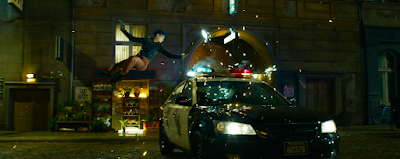
This is brute-force exhilaration and industrial-strength sentimentality wedded together in Bay’s typical eye-popping frames zipping past in pulse-scattering editing. The appeal, then, is entirely in the way the variables keep spinning around them all the way through the explosive ends. The camera is swooping and swirling, freed to hurtle along every which way, flying top-speeds along highways and under overpasses and around tight corners, peering up at the concrete canyons or spraying through puddles and fires. This is Hollywood action impressionism, a work of blurry momentum and movement in which each image is crystal clear and every shot swarms with visual interest, cut together in a smear of sparks and sounds. This is Bay at his most indulgent and yet contained, more of a piece with his early films (he winks at them in the early going as characters name-drop a couple) than the gargantuan spectacles of shape-shifting cars from outer space. He’s still excessive, but his excess (aside from a cartel gangster subplot that rides an awfully thin line of stereotypes) is committed to amping up the concept and the characters—its as out of control as its central vehicle and the guys behind the wheel. We’re hanging on for dear life like the hostages in the back. I watched it with the realization that the 57-year-old director has now passed from being a shock of the new, through a high-gloss studio pro, into something like an old master of the form.

Thursday, December 23, 2021

Version Control: THE MATRIX RESURRECTIONS

There’s something romantic amid The Matrix Resurrections’ bafflements—a grasping, yearning, swooning desire for connection—that might surprise those who remember the original trilogy mostly for its trench coats, machine guns, mind-bending reveals, and nu-metal soundtrack. But wasn’t this always a series about learning to reconcile the parts of oneself, and one’s world, and to hold close those whose love holds the key to The Truth? Like so many franchise pictures these days, Resurrections is a reboot about reboots, a movie about itself. But unlike other properties doomed to grow ever-more airless and walled off from real emotion, here’s one that explodes out the emotional world of its predecessors in big, bold, busy ways, growing more overtly expressionistic and sentimental. Writer-director Lana Wachowski lovingly, yet not uncritically, returns solo to the world she and her sister Lilly created over twenty years ago and finds that it’s changed in passionate, provocative, and confusing ways.

She, co-writing with screenwriter Aleksandar Hemon and novelist David Mitchell, decided that Neo (Keanu Reeves), the self-sacrificing hero of the super cool, genre-busting, paradigm-shifting originals has found himself, post-death, recreated and plugged back into The Matrix. He doesn’t remember the events of those movies, or rather remembers them incorrectly, or rather thinks of them in the wrong category entirely. Almost. That’s when it’s clear Wachowski is making no mere remake or legacy sequel only drifting off nostalgia, although it is. Even more it’s a recreation and refutation, a continuation and complication. Once again characters are separated from their true selves, and true loves, and true worlds. Machines strain against their coding and people struggle to reconcile the paradoxes of a buggy program called life. Thus the movie’s thrillingly dense and bafflingly never quite what you think it’ll be, steering hard into philosophical and psychological dilemmas that always formed the structure of this series’ sensational action spectacle. It makes for a heady trip.

You see, instead of Neo once again learning that what we think is reality is, in fact, a digital construct fed to us by a ruling class of advanced robots to keep humans captive in pods of goo that are their energy source, he’s a coder for a tech company who thinks that story is the plot of their most famous games. A trilogy of them. What better way to make a people forget that they’re in that simulation than make them think The Truth is mere fiction? When Neo’s boss  (Jonathan Groff) calls him in to say the moneymen want to exploit the I.P. again he’s told “Warner Brothers is making Matrix 4 with or without” them. Here’s a sequel spinning games within games, in which a focus group is called in to stand in for Matrix fans discussing theories about what it was all about, man. It’s about trans self-actualization; or it’s about simulation theory; maybe it’s all about the bullet time. All of the above, Wachowski says. And wait’ll you see where it goes from there. Neo’s therapist (Neil Patrick Harris) is concerned that his patient’s reality is blurring—we see flashes of the earlier movies, echoes of sequences past that rattle around in moments of tingling deja vu. There’s something real and unreal at the same time, ripples from conflicts and debates in the so-called real world shaking the foundations of the green lines of code.

Neo is more lost than ever, imbued with the knowledge he needs yet all the more resistant to the truth for having buried it in plain sight. Trinity (Carrie-Anne Moss), his soul mate in kung-fu, and love, is also resurrected in the Matrix. But she’s been pushed even deeper into the computer’s fiction. As they find themselves drawn by destiny, by programming, by happenstance, by fate to reconnect with each other and themselves, a host of returning characters and new faces (coolest has to be the blue-haired Jessica Henwick as rogue freedom-fighter Bugs—“like Bunny,” she quips) and some returning characters in new faces (Yahya Abdul-Mateen II, making a habit of that sort of thing) line up along scrambled battle-lines leftover from the old revolution. The proceedings get ever more complicated. But even in the long stretches where I wasn’t quite sure what was happening or what outcome to root for, there’s that central yearning. That’s what makes it romantic—that strong surge of emotion, that plaintive push toward greater understanding of oneself and one’s loved ones. Reeves and Moss haven’t missed a step from their earlier performances, slipping easily into the human avatars of the fake world and the broken real humanity beneath—synthesized in the eventual uneasy steps back toward digital superheroes. It’s still a world of point-and-click prophecy and computerized spirituality, of shifting perspectives and cyclical conflicts. And Wachowski clearly loves her characters—and wants to see them reawaken to their full potential as much as we do.

The result is just as much a knotty puzzle of a head-fake, mind-bender as the originals—but woolier and more static, with a meandering central drive that’s sometimes as lost as its characters. In its long scenes of exposition spoken intently by the large cast, it pays off the intense, long-lived conversations from those who undertook the amateur field of Matrix studies seriously those decades ago. (Remember the philosophers’ commentaries from the DVDs? I hope that roundtable is reconvened for this one.) The movie can be playfully meta-textual, and even knowingly self-parodic, as it relentlessly plays with expectations. I didn’t always find it as immediately gripping or legible as the originals. It’s less self-consciously cool and stingier in action, but it’s still rich in ideas and has swelling heartfelt expressions of human (and inter-human) connection, and shot with a warm energy in sumptuous light and slick effects. And some stuff blows up. When in motion, the movie’s a shock of recognition but, successfully and unsuccessfully, chopped up, remixed, edited to ribbons, and smoothed out in new and bewildering ways. It may not always be legible, and lacks the immediacy and palpable visual pleasures of its progenitors, but its heart is in the right place.

This is the distinctive work of a filmmaker who has stylishly, entertainingly drawn out these ideas—of humans caught in a system built to grind them down, and who assert their passions and humanity against all odds—with her usual co-writer/director sister through Speed Racer’s masterpiece of hyperactive anime homage, Cloud Atlas’s six-fold cross-cut reincarnated melodramas, and Sense8’s dazzlingly sensual sci-fi poly-psychic mind-blender series. So it should be no surprise to find her returning to The Matrix with a totally earnest extension of the originals’ cyberpunk Plato’s cave. It meets our moment of accelerated techno-dystopian alienation and confusion with its own, and lets some love shine through the cracks. How romantic.

Wednesday, December 8, 2021

Word Crimes:
THE TRIAL OF THE CHICAGO 7 and BEING THE RICARDOS

An Aaron Sorkin screenplay comes in one of two modes: too much, and way too much. I love the former, but the latter can clang and grate and scrape across my patience. He’s such a wordy, witty writer, capable of soaring rhetoric and juicy monologues. His ear for embedding characterization in the pithiest of comebacks and most garrulous walk-and-talks is a good match for his interest in high-wire halls-of-power and behind-the-scenes tensions. His characters are often people with inflated egos or self-important positions of influence. He must understand them so well because he’s one of them. When he’s on, he’s one of our best. The too-muchness of his writing makes a perfect match for material. His The Social Network, so sharply perceptive about Facebook’s founding conflicts, balanced with beautifully clinical David Fincher direction, remains one of the finest scripts in recent memory. But when he’s off—taking his tendencies to overwrite his subtext until it spills out as just plain text like in howlingly clunky tone-deaf attempts like media-matters dramas The Newsroom or Studio 60—it curdles fast. When you’re an artist who thrives when high on your own supply, it’s easy to get way too much out of each moment.

Take last year’s The Trial of the Chicago 7. It’s based on the real circus of a court case following protests at the 1968 Democratic Convention that were violently broken up by a bludgeoning police presence. A group of leading leftist activists were targeted by the newly elected Nixon administration to make an example of them. The judge ended up a loony attention seeker who made all kinds of questionable decisions—like ordering Bobby Seale, a leader in the Black Panthers, bound and gagged—while the defendants, many previously unknown to each other, often used the massive press interest in their plight as a soapbox on which to make important points about the state of the country. (They also used it as an excuse to poke prankish fun at the authorities who were in the process of overreaching.) Sorkin sees in this case good reason to comment on our present right-wing lunacies and various social movements protesting them. But he puts too much spin on the ball in each sequence. Characters are practically explaining this connection to us as monologues and jostling debates are carried out with musty pseudo-historical perspective.

Not helping matters, the flat staging from Sorkin as director tends to undercut the few good moments he’s written.With Trial he somehow can’t pull off the courtroom sparring he crafted so well as screenwriter for A Few Good Men's "you can't handle the truth," or the Social Network depositions. Here it’s self-consciously, and badly, theatrical, with a host of fine actors in full showy character mode (Sacha Baron Cohen, Jeremy Strong, Eddie Redmayne, Michael Keaton, Frank Langella, John Carroll Lynch, Yahya Abdul-Mateen II) chewing over flashy phrasing as the camera pushes plainly and shafts of light falls simply and dramatically. One wonders what a better visual sense would’ve shaped out of these lumpy scenes. But then I recall how Sorkin’s shaping of the pages pushes the real events toward big fake movie climaxes that are somehow flatter and less surprising than the actual events. Just when he builds up a head of self-righteous steam and winds up a character to let them go, it rings the falsest. The best scenes are the smallest, and the simplest, where an old pro like Keaton can underplay the overwritten and end up, on balance, just fine. Strangely, for a writer prized for his verbal pyrotechnics, the court sequences are somehow less outrageous and dramatic and hilarious and suspenseful than the actual court transcripts. Those have been used as the basis for a fine animated documentary from a dozen years back—Brett Morgen’s Chicago 10—and are available for free online. Those are the better way to experience the trial.

With that in mind, one might think the new Sorkin picture, a behind-the-scenes of I Love Lucy in a moment of high-stakes drama, would pale in comparison to simply watching the still-brilliant original episodes of the classic sitcom. Of course it does. But that’s where I was pleasantly surprised to be wrong that it wouldn’t be fun enough on its own terms. I was quite taken with Being the Ricardos for playing up the ways in which it stacks up historical conflicts into one stuffed week. Lucille Ball is accused of being a communist (which she was, once) at the heights of the Red Scare. Desi Arnaz is tagged as a philanderer (which he was) at one of many periods of peak tabloid power. And, if the sponsors or the network don’t pull the plug for either or both of those scandals, the power couple behind the program are determined to use Lucy’s real life pregnancy for her character, too. (One suit bristles at the idea that it’ll make viewers think about…you know…how that happened. They sleep in twin beds, he reminds.) That Sorkin’s invention places these tricky moments all in the same short period of time—the structure is all showbiz hustle, as the movie starts with a table read and ends with a taping—gives the movie a pressure cooker of competing interests. His script weaves in and out of the various conflicts and keeps the ensemble a plate-spinning act of worries and wants. It successfully cross-breeds the let’s-put-on-a-show zippiness with an earnest grappling with the people behind-the-scenes and What It All Meant.

Sorkin’s brand of pushy cleverness fits a great cast of actors playing performers and other creative types. Here Nicole Kidman becomes a Lucy who’s ambitious, steely, hugely talented, and knows what she wants. She is clearly in charge of the show, and really won’t back down from insisting being a Communist used to be considered a valid option for supporting the workers of the country. Javier Bardem plays Desi as a chipper man constantly tending to his ego, but with real love for Lucy. (He also doesn’t suffer fools, such as one well-meaning producer who tries to convince him he’s the “I” who “Loves Lucy” and therefore the top-billed title character.) His Cuban roots make him a bit more uncomfortable with her politics. (There Sorkin tries a smidge too much for phony both-sides balance.) The main couple is, as on the show, surrounded by a sharp-tongued supporting cast. Nina Arianda’s Ethel and J.K. Simmons’ Fred are great inhabitations with sly side-eyed commentary on, challenges to, and support for the main pair. And the show’s crew features Tony Hale, Alia Shawkat, Jake Lacy, Clark Gregg and more hustle through the stages, wardrobe department, and writing rooms. It’s a fine feat that mixes the sort of clever darting dialogue and blunt force messaging that a great cast can sell if Sorkin serves it up well.

There’s a kind of gleaming soft-focus romanticism to its approach, a weren’t-the-olden-days-grand? gloss to the sometimes-reductive smushing of so much social upheaval and conflict into one heavy week. (It spackles it over, somewhat, by having fake documentary talking heads from actors playing older versions of the writers’ room act as a Greek chorus of sorts.) And the writing sometimes tries too hard to make the ideas fit our modern context. Would Lucy really have accused someone of “Gaslighting” her? Nonetheless, it’s has the kind of fizz and pop that’s pleasing to the ear and flies by in a flash. Sorkin’s direction stays out of his writing’s way, and has a fine eye for the difference between on- and off-stage antics. I found it a satisfying and entertaining look at making a show in a time with an actual blacklist bouncing entertainers out of the business for their politics, when sexual mores were tamped down and repressed and not to be discussed, and when women and people of color weren’t to be treated as equals on or behind the screens. And yet, through making one of the greatest television comedies (who doesn’t know the chocolate factory sequence?), here’s a couple that manages to push on the edges of those societal constraints at a time when it could’ve resulted in a show going off the air. Now that’s cancel culture.

Sunday, August 29, 2021

Urban Legend: CANDYMAN

Nia DaCosta’s Candyman movie takes the 1992 original’s subtext and flattens into the surface text. Gone are the creeping insinuations and curling undertow of a ghost story about a lynched Black man lurking as an urban legend in a Chicago housing project. (Say his name five times and he’ll haunt you, drive you mad, or maybe slaughter you with his hook-hand.) The new film just states flat out that it’s all about the lingering aftereffects of racism’s traumas, and the ongoing wound-prodding the constant reminders and recapitulations of them with which we live are. What the earlier film allowed to bubble up from the depths of its horrors, this new one uses as dialogue to be repeated over and over as the didactic thematic design of an otherwise simple slasher trajectory in which all of the character start alive and most end up dead. It opens with a painter (Yahya Abdul-Mateen II) and his gallerist girlfriend (Teyonah Parris) moving into a fancy new apartment in the recently gentrified neighborhood that was the housing projects where the first film took place. There’s a discussion about the ethics of such a move, and some gentle ribbing from the woman’s realtor brother (Nathan Stewart-Jarrett) who retells the story of a grad student (Virginia Madsen) who lost her mind investigating the Candyman there three decades earlier. (Astute viewers might quickly piece together the movie’s other Big Connection to its inspiration well before the surprise is sprung.) Intrigued, the boyfriend ends up using the story as material for his upcoming art show, sending him spiraling into artistic obsession that lets the Candyman back into the world. I liked his first idea: a mirror that opens onto paintings of lynchings. He calls it "Say My Name," a doubled reference to the activist urgency of remembering victims of police brutality and the lore of the Candyman. That’s the sort of mirroring where the picture’s at its best.

But then the movie is going about making its points flatly and obviously. Even as DaCosta films each scene with artful intent and striking images—I most appreciated Lotte Reiniger-style silhouette animation used to dramatize supernatural events in flashbacks, and establishing shots of upside-down Chicago streets, especially eerie when the tops of the distinctive Marina City towers plunge downwards into an overcast sky—the script undercuts them with declarative and repetitive plot explanations and thematic expostulation. The cast’s charisma—I didn’t even mention the great Colman Domingo as one of the few selling a flimsy supporting role—nearly carries it anyway, but it’s an uphill battle. The film’s politics are admirable—as is its craft—but the story stumbles. Its supporting cast is there to state the themes, provide exposition, and (usually) die. (Worst has to be a smarmy art guy or a sniffy critic, both drawn in such obvious villainy you’re just itching for comeuppance until their deaths are doled out with strange restraint.) Most disappointingly, some of the late reveals muddle its message, and on a scene-by-scene level the scares never quite hit. Elsewhere some curious gaps of logic open up. Cuts to black obscure some holes, while off-screen dialogue papers over others. The movie is full of the sort of things that might not bother me if it was otherwise working, but when my investment is slowly leaking away, it’s all I can focus on. Interesting how the truly great horror movies are simply unreproducible regardless of how many sequels try. Somehow the original is scarier, and more effectively topical, than the new one, no matter how insistent it is about contemporary concerns. It’s a good effort, but a dissatisfying result.