Showing posts with label John Ortiz. Show all posts

Wednesday, March 16, 2022

Kids These Days: THE SKY IS EVERYWHERE
and THE FALLOUT

It’s a shame the bottom fell out of the theatrical Young Adult books adaptation cycle as it was moving away from supernatural and dystopian metaphors and into more quotidian lived experiences. If it’s valuable for teenagers to see their emotions and concerns blown out into allegorical genre dimensions—and, at their best, the Twilights and Hunger Games and Divergents of the world hook into those with a sugar-high power—then surely it’s also worth exploring those same mindsets in something closer to real life. Somehow it’s been eight years since The Fault in Our Stars found bittersweet love between teen cancer patients, and got big box office in return. The years since have given us just a handful of similar efforts to take something serious teens might face in their actual lives and put them on screen. As good as something like The Hate U Give—about police brutality—or The Miseducation of Cameron Post—set at a gay conversion camp—can be, the majority of mainstream teen screen stories are now cheap Netflix rom-com programmers or distended cable series with preposterous coked up shock value. Sure, kids these days also have their flood of digital noise on TikTok and Snapchat, but those can be as unreal, and mind-numbing. I miss feature films that treat a young adult audience as, well, young adults.

Luckily Josephine Decker brings us The Sky is Everywhere, a picture of a grieving teenager that creates a close emotional association with its lead’s mental state. Here an artistic, musical, creative teenager (Grace Kaufman) misses her recently departed older sister like a phantom limb. She aches for her presence. They’d been living with their grandmother (Cherry Jones) since the death of their mother some years prior. She asks her uncle (Jason Segel), her mother’s brother, if grief ever goes away. He looks at her warmly and answers: I don’t think so. Here’s a movie that’s honest about its situations, even as the screenplay, adapted by Jandy Nelson from her novel, loads itself up with YA turns of dramatic and romantic complications. There’s a cute new boy in school (Jacques Colimon). There’s her sister’s ex-boyfriend (Pico Alexander). There are friends to chat and classes to attend and futures to plan. It leaps between these peaks of teen drama and finds the shadow valleys of mourning between.

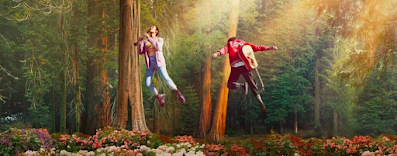
But what keeps the movie above the routine of such things is Decker’s commitment to visualizing her main character’s active mind. Like in her previous pictures—the loose artistic tension of Madeline’s Madeline and the stormy grit of Shirley—style follows from psychological cues. When the lead moves into her flights of fancy, colors are over-cranked, backgrounds can turn into dioramas, montage might become magical realism, flourishes of dance or poetry performance can fill the frame. Befitting her musical abilities, the score might be intrusive, or fade away. This makes for a movie that’s not overstuffed with quirk, but instead fancifully interior, an outpouring of precocious passionate imagination and surging adolescent curiosities and urges. It wisely meets its lead and its prospective audience where they are, and then, through its ability to add shading and texture to its side characters—Jones especially has a moving moment of perspective-bringing near the end—help them grow beyond.

Another new movie that’s a picture of teenage grief is The Fallout. A finely realized debut feature for writer-director Megan Park, heretofore best known for a role on ABC Family’s The Secret Life of the American Teenager, the movie is less dreamy and sad than Decker’s. Instead, it’s teetering on an edge with depression and despair. But it’s so tenderly observed and warmly sympathetic to its characters that it understands all-too-well the difficulties they have readjusting to something like normal in the wake of a tragedy. One gets the sense in the opening scenes that it would be an appealing, low-key high school coming-of-age dramedy if not for the swerve into an unexpected awful event. Isn’t that always the case with these moments? It begins with a teenage girl (Jenna Ortega) talking with her sister (Lumi Pollack) and parents (John Ortiz and Julie Bowen), with friends and acquaintances and teachers (Will Ropp, Christine Horn). It’s the start of a normal day. She ends up in the restroom during class—avoiding class, really—and talks to a more popular classmate (Maddie Ziegler). That’s when they hear gunfire in the hallway. Screams. Slams. They hide. It seems to last forever, but then…that’s it. It’s over. They survived. Their school, their classmates, themselves, are now just another statistic.

The school shooting movie has, sadly, become something of a tradition now. It reflects the way this has been allowed to become a grim fact of life. In our politics, we hear an awful lot of whining about the supposedly deleterious effects of something like wearing a mask to go to school during a global pandemic. These complaints are usually coming from the same people who have never had anything meaningful to say about the far worse effects of getting shot to death in school. So here it is in the movies. Gus Van Sant’s floating camera in 2003’s Elephant and Denis Villeneuve’s grainy black-and-white 2009 Polytechnique make intense in-the-moment works of dread and violence. Last year’s Mass was a talky, probing look at parents grappling with deaths of this nature years later. Recent documentary Bulletproof shows the preparation for the possibility of such events—lockdown drills, kevlar backpacks or hoodies, potential classroom fortifications—as just another back-to-school routine, cut into its flowing montage of teacher trainings, band practices, sports drills, and assemblies. How sad that we’ve had over twenty years of reactions to mass deaths like these and protests against the very gun laws that encourage such destruction, and yet little has changed. What The Fallout brings to the conversation is not the violence, which is largely implied, but a softer touch and intimate detail, keyed into its leads’ numbed aimlessness in the aftermath.

Ortega takes center stage in tight focus for a character who is convincingly drawn. She expertly plays teen angst as a sort of normal acting out refracted through her vulnerable and raw post-trauma days and weeks as she claws back to a sense of self. There’s something convincing when she throws a thrashing little “God, mom!!!” flailing fit, and in the way she and Ziegler become friends bonded by their survival. They clung to each other as the chaos boomed outside; now they cling together to make it through. They’re contrasts—Ortega loose and swimming in baggy clothes, Ziegler clenched and poised in tight outfits as an Insta glamour princess—but connected. An early scene in which they text back and forth late at night is expert at conjuring that sort of intimacy—a flurry of closeups of eyes, fingertips, ellipses. And then they’re back to school, back to friends, trying to find their way in a string of episodic moments. By turning the mechanisms of a gentle Hollywood slice-of-teen-life style on the wake of a mass shooting, it makes a bitter sting of grief and hopelessness all the more affecting.

The film sees how the tragedy works its way through the community of characters, and watches as its impact shifts dynamics, closes off some old habits, and opens up new avenues of potential harm and growth alike. Bowen and Ortiz bring good detail to shaken, frustrated, and loving parents, while the other young actors sell a wide range of responses. Most telling, perhaps, are a few scenes where Ortega visits a sympathetic counselor played by Shailene Woodley. Aside from making viewers of a certain age feel old that this former Fault and Secret Life star has now aged enough to play one of the grown-ups, there’s an interesting disconnected connection Woodley and Ortega forge, with one’s insistence that things might get better personally, and the other’s looking at society around her with justified suspicions. I hope the potential young audience for this movie takes away some of these visions of humanity, and recognize something true in it.

Friday, March 10, 2017

The Kong Who Would Be King: KONG: SKULL ISLAND


At least the latest big-budget creature feature, Kong: Skull Island, works where it really counts: the creatures. It presents an island full of creepy crawlies and monster mashes, not merely the expected ginormous ape, but also: towering water buffalo, massive birds, a gargantuan octopus, and a family of creepy skull-faced lizards so humungous they’d leave even the biggest, meanest dinosaur trembling in their shadows. It may not have much in the way of character or personality, either for its actors to inhabit or for its filmmaking to display – it’s all borrowed from other, better, inspirations and thinned out in the process – but the effects department earned its budget and then some. It may have the colorful aesthetic gloss of an expensive A-level picture, but its heart has more in common with the junky B-movie big monkey Kong rip-offs than the lean and mean 1933 original or the epic melancholy of Peter Jackson’s 2005 remake.

Moving at an impossibly rushed clip – though to what end I don’t know, as there’s not much worth hurrying to that taking time to settle into the dread and fear couldn’t improve – the movie hurtles a large cast onto Skull Island. We’re told it is hidden behind a perpetual storm system, and the film is set in an analog 1973, a double explanation as to how the place has remained uncharted. The expedition helicopters over and almost immediately runs into the main attraction. This movie’s Kong is the size of a skyscraper. If he tried to climb the Empire State Building he’d crush it in a single stomp. (But though his enormity has grown, his personality, and the movie, is second rate to earlier Kings.) He quickly thrashes the interlopers, killing all the extras and leaving the Movie Stars to fend for themselves amongst the jungle beasties. Would that any of them be allowed a sliver of personality beyond audience recognition from previous roles. It’s hard to be dazzled by the destruction when Samuel L. Jackson’s stubborn colonel, John Goodman’s crackpot explorer, Tom Hiddleston’s tracker, and Brie Larson’s photographer, are merely there to pose in the pulp. They’re asked to sell unsellable empty roles, and thus hard to care about when juxtaposed with the senseless noise around them.

Also along for the ride are Shea Whigham, Toby Kebbel, Jiang Tian, Corey Hawkins, Jason Mitchell, Thomas Mann, and John Ortiz. It’s a huge cast with little to do. What the film lacks in character in makes up in characters, splitting them up, sending them hither and thither across Skull Island, wandering aimlessly into one creature’s den after the next. When they encounter, say, a gargantuan log with eyes, their first instinct is to open fire. There’s no curiosity or awe here, only bloodlust. This extends to the lack of gravity given to the imagery, monsters treated as frivolous animal foes instead of creatures in their own right. Director Jordan Vogt-Roberts, plucked from Sundance to helm this Hollywood undertaking, loves watching the tech and the explosions and the bloodshed – and he likes seeing Kong the MMA brawler – but gives it none of the patient dazzlement of Gareth Edwards’ 2014 Godzilla. There is only the grubby beauty of the jungle landscapes – crudely standing in for Vietnam in the cinematic equivalent of mumbling your way through a muddled metaphor – and the drooling beasties as ILM dumps out their design book into the wilds of the frame.

Still, no matter how inane and inert the film often is, it crackles to life when John C. Reilly stumbles into the picture as a WWII pilot lost on the island for decades. He plays up the disorientation and madness of his character with unpredictable Brule-like spasms of awkward intensity and exasperation. He brags about his Kong lore, but is quick to admit he’s never actually spoken it aloud before. Single-handedly stealing the movie out from under the most talented cast assembled for something so frivolous in a long time (since, what, National Treasure: Book of Secrets or something?), Reilly offers up personality to spare. He upstages Kong, no mean feat when the sometimes-gentle giant’s every step rattles the subwoofers (except, of course, for the scene where he is suddenly in front of Larson in an open field despite what should’ve been an inescapably long, loud walk). The rest of the movie is just empty 70’s dress up run through a copycat Kaiju playbook, with whack-a-mole monsters and crudely manipulated archetypes. We’re supposed to thrill to the fussy visual touches around the edges – a crashing helicopter from the point of view of a bobble head on the dashboard; explosions seen reflected in sunglasses; a giant octopus slurped up like Kong-sized noodle soup – and forget we’re watching much less than meets the eye.

Saturday, January 30, 2016

Watership Down: THE FINEST HOURS


Like a Norman Rockwell painting poured over The Perfect Storm, The Finest Hours is a sturdy, old-fashioned picture. Based on the true story of a 1952 Coast Guard rescue of a tanker split in two by horrendous winter weather, the film tells its tale in a rather conventional way. We meet a stubborn do-gooder guardsman (Chris Pine) and the sweet girl (Holliday Grainger) who’d like to marry him. Then the storm hits, the tanker is in trouble, and the man’s commanding officer (Eric Bana) sends him out on a small boat with a small crew (Ben Foster, Kyle Gallner, and John Magaro) to do the impossible. Their boat is tossed about by the waves and winds, equipment malfunctions, and the sun sets. Meanwhile, the men on the tanker (over 30 of them, including Casey Affleck and John Ortiz) are struggling to stay afloat, with no way to make contact, and thus no way of knowing if help is even on the way. It’s a simple story, but the story is simply engaging.

A live action Disney movie, it looks and feels more or less like it would if the company made it in 1956, 66, 76, 86, 96, or 2006, modern tech aside. There’s a fine layer of timeless Hollywood gloss over it, and a proficient element of spectacle as special effects buffet the boats out in the storm and softly falling snow coats the coast in a sparkling snow globe lighthouse look. And in the midst of this is a dependable cast playing people who are largely identifiable types, but given just enough personality and interior lives for rooting interest beyond making it out alive, and to suggest a reality beyond the big studio lights on the sets and CG. The situation is inherently dramatic – true life-or-death stakes, with survival hinging on how well these people can do their jobs, and on the whims of nature. The screenplay (by The Fighter’s Eric Johnson, Scott Silver, and Paul Tamasy) is smart not to undercut the proceedings. It crests perilous waves of cliché to find clear sailing to the heartstrings.

It borders on corny, but it never quite gets there, kept afloat by its forward momentum and reliably sturdy construction. Who’d have thought Craig Gillespie, the director of the Ryan-Gosling-in-love-with-a-RealDoll movie Lars and the Real Girl and the fun Fright Night remake, would turn into a decent helmer for Disney based-on-a-true-story fare? With Finest Hours he improves on his dull sports movie Million Dollar Arm, this time telling an interesting and compelling narrative with good clarity for its process and perspective. We follow each boat’s progress through the storm, cutting between them, and some judicious glimpses of those fretting on the shore, hoping against hope that their guys will make it back alive. There’s a chaste romance at stake, and a couple dozen souls stranded in a rapidly failing craft. That’s plenty heart-tugging drama to get invested in, and a cast willing to play it earnestly.

The sequences on the listing half-tanker are the strongest, Javier Aguirresarobe’s camera and Tatiana S. Riegel’s editing crisply following a committed cast of character actors chewing on accents and sloshing around a convincingly dangerous waterlogged set, coming to terms with the long odds confronting them. The film is full of towering waves, howling winds, groaning bulkheads, straining chains, swinging beams, straining rudders, whirring propellers, and spasms of sparks and smoke. Gillespie focuses on these tactile details, in sharp, routine frames constructed to show off the heroic efforts taken by various crewmembers to save as many lives as they can. It’s a film that feels the movement of the bobbing waves, the strain on an engine as a boat takes on weight, and the taxing whir of overpowered pumps slowly letting water creep higher up the engine room. It’s an engaging film of sturdy craftsmanship, the sort of feel-good inspirational fact-based family film I’m glad Disney hasn’t entirely given up on making in the shadow of their mega-blockbuster fantasies.

Tuesday, January 20, 2015

Hack to the Futures: BLACKHAT


Blackhat is a very good thriller from a master of the form. Michael Mann’s been crafting sleek, propulsive films for decades now, and this high-tech whodunit is among his most accomplished. Like his 1995 cops-and-robbers Heat or 2006 procedural reimagining Miami Vice (possibly his best), he here takes a crime drama setup that could easily be routine – a bad hacker is causing havoc, so he must be found and stopped – and goes about filling it with artful, elliptical moodiness glowing with glamorous framing and grim dangers. It’s another of his terse and exciting men-at-work movies, flowing with jargon and tech as people at the height of their chosen professions pit their skills against formidable opponents. There’s energy in his intelligence, and the romanticism he finds in human connections, and the frayed nerves of people forced to choose between their relationships and their missions.

But the added digital element, in which real world consequences can zip anonymously (or nearly so) through a web of interconnected devices, adds a tangible, dangerous, element to the relationships charted. It begins with a mysterious hacker who overloads a Chinese nuclear power plant with a strategically deployed malware and a few swift keystrokes. Mann plays out this sequence with procedures forcefully visualized, starting on a monitor, then zooming into a microscopic view of shimmering data zipping through microchips and fiberoptic cable, before pulling up at another keyboard on the other side of the world. The digital journey viewed so closely looks like the usual beauty of a nighttime Mann skyline viewed through a trip through a wormhole. It’s routine and scary, devastating effects from the tiniest mysterious machinations.

The dangerous hacker becomes a serial cyber-attacker when he manipulates commodities prices in Chicago. Authorities are afraid those attacks are only the beginning. Needing to sort through the noise to find digital breadcrumbs that lead to their suspect, a brilliant Chinese security expert (Leehom Wang) agrees to a joint taskforce with FBI agents (Viola Davis, John Ortiz, and Holt McCallany), so long as his old MIT roommate (Chris Hemsworth) can be let out of prison to help. He’s a fit, genius hacker, the kind who’d read Foucault in between pushups, and the one who wrote the source code for the software this unknown cyber-assailant hijacked for nefarious purposes. The Americans reluctantly agree to the terms. Old friends are reunited, tenuous alliances are made with reluctant colleagues, and a romance burgeons between the convict and his friend’s sister (Wei Tang), also a computer whiz helping the investigation. In typical Michael Mann style, these dramas of human connection are sublimated in the propulsive plot, tense melodrama expressed through action.

This is every bit a Mann film, and all the pleasures that implies. He makes a lean script by Morgan Davis Foehl into beautiful pulp. It’s shot in gorgeously textured cinematography, stormy skies and grainy blackness, pale city lights and bleach white sun. (To see what director of photography Stuart Dryburgh does with digital cameras here is to make bleary digital productions look all the worse.) The chase picture plotting hunts down a mystery through a globetrotting search for clues mixed with a paranoid high-tech hackathon, the rapid pace told through artful images and granular specificity. Whole sweeping emotions are told in a tossed off frame, a man free from prison taking an extra beat to stare across an open tarmac, a dying woman looking up, her last sight a skyscraper casting pale light upon the night sky. Meanwhile, details pile up around them, keys clacking, phones tracking, gunshots carrying oomph and variety.

Here is a movie that respects its audience's intelligence, rarely slowing down for info dumps. It’s juggling a complicated storyline and a fine ensemble while working through intersecting multi-step conspiracies. Instead of telling us what’s happening, it simply lets the goings on go on. We join stories midstream, watching characters behave and react, piecing together plans and histories as they unfold gesture by gesture. It’s a film on the move with twists and sudden violence, but also the patience to envelop the proceedings with a mood, lamenting missed interpersonal connections, celebrating small moments of intimacy, alternately exhilarated and worried when confronted with the scope of virtual damage in the real world. It’s a thriller that’s entertaining, yes, but also hits hard with intoxicating style and tension, action and emotion as intertwined as the real world and the digital.