Showing posts with label Maddie Ziegler. Show all posts

Wednesday, March 16, 2022

Kids These Days: THE SKY IS EVERYWHERE
and THE FALLOUT

It’s a shame the bottom fell out of the theatrical Young Adult books adaptation cycle as it was moving away from supernatural and dystopian metaphors and into more quotidian lived experiences. If it’s valuable for teenagers to see their emotions and concerns blown out into allegorical genre dimensions—and, at their best, the Twilights and Hunger Games and Divergents of the world hook into those with a sugar-high power—then surely it’s also worth exploring those same mindsets in something closer to real life. Somehow it’s been eight years since The Fault in Our Stars found bittersweet love between teen cancer patients, and got big box office in return. The years since have given us just a handful of similar efforts to take something serious teens might face in their actual lives and put them on screen. As good as something like The Hate U Give—about police brutality—or The Miseducation of Cameron Post—set at a gay conversion camp—can be, the majority of mainstream teen screen stories are now cheap Netflix rom-com programmers or distended cable series with preposterous coked up shock value. Sure, kids these days also have their flood of digital noise on TikTok and Snapchat, but those can be as unreal, and mind-numbing. I miss feature films that treat a young adult audience as, well, young adults.

Luckily Josephine Decker brings us The Sky is Everywhere, a picture of a grieving teenager that creates a close emotional association with its lead’s mental state. Here an artistic, musical, creative teenager (Grace Kaufman) misses her recently departed older sister like a phantom limb. She aches for her presence. They’d been living with their grandmother (Cherry Jones) since the death of their mother some years prior. She asks her uncle (Jason Segel), her mother’s brother, if grief ever goes away. He looks at her warmly and answers: I don’t think so. Here’s a movie that’s honest about its situations, even as the screenplay, adapted by Jandy Nelson from her novel, loads itself up with YA turns of dramatic and romantic complications. There’s a cute new boy in school (Jacques Colimon). There’s her sister’s ex-boyfriend (Pico Alexander). There are friends to chat and classes to attend and futures to plan. It leaps between these peaks of teen drama and finds the shadow valleys of mourning between.

But what keeps the movie above the routine of such things is Decker’s commitment to visualizing her main character’s active mind. Like in her previous pictures—the loose artistic tension of Madeline’s Madeline and the stormy grit of Shirley—style follows from psychological cues. When the lead moves into her flights of fancy, colors are over-cranked, backgrounds can turn into dioramas, montage might become magical realism, flourishes of dance or poetry performance can fill the frame. Befitting her musical abilities, the score might be intrusive, or fade away. This makes for a movie that’s not overstuffed with quirk, but instead fancifully interior, an outpouring of precocious passionate imagination and surging adolescent curiosities and urges. It wisely meets its lead and its prospective audience where they are, and then, through its ability to add shading and texture to its side characters—Jones especially has a moving moment of perspective-bringing near the end—help them grow beyond.
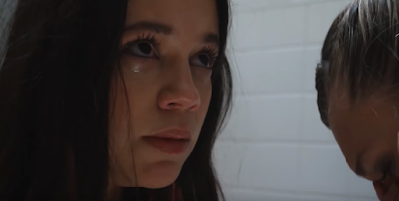
Another new movie that’s a picture of teenage grief is The Fallout. A finely realized debut feature for writer-director Megan Park, heretofore best known for a role on ABC Family’s The Secret Life of the American Teenager, the movie is less dreamy and sad than Decker’s. Instead, it’s teetering on an edge with depression and despair. But it’s so tenderly observed and warmly sympathetic to its characters that it understands all-too-well the difficulties they have readjusting to something like normal in the wake of a tragedy. One gets the sense in the opening scenes that it would be an appealing, low-key high school coming-of-age dramedy if not for the swerve into an unexpected awful event. Isn’t that always the case with these moments? It begins with a teenage girl (Jenna Ortega) talking with her sister (Lumi Pollack) and parents (John Ortiz and Julie Bowen), with friends and acquaintances and teachers (Will Ropp, Christine Horn). It’s the start of a normal day. She ends up in the restroom during class—avoiding class, really—and talks to a more popular classmate (Maddie Ziegler). That’s when they hear gunfire in the hallway. Screams. Slams. They hide. It seems to last forever, but then…that’s it. It’s over. They survived. Their school, their classmates, themselves, are now just another statistic.

The school shooting movie has, sadly, become something of a tradition now. It reflects the way this has been allowed to become a grim fact of life. In our politics, we hear an awful lot of whining about the supposedly deleterious effects of something like wearing a mask to go to school during a global pandemic. These complaints are usually coming from the same people who have never had anything meaningful to say about the far worse effects of getting shot to death in school. So here it is in the movies. Gus Van Sant’s floating camera in 2003’s Elephant and Denis Villeneuve’s grainy black-and-white 2009 Polytechnique make intense in-the-moment works of dread and violence. Last year’s Mass was a talky, probing look at parents grappling with deaths of this nature years later. Recent documentary Bulletproof shows the preparation for the possibility of such events—lockdown drills, kevlar backpacks or hoodies, potential classroom fortifications—as just another back-to-school routine, cut into its flowing montage of teacher trainings, band practices, sports drills, and assemblies. How sad that we’ve had over twenty years of reactions to mass deaths like these and protests against the very gun laws that encourage such destruction, and yet little has changed. What The Fallout brings to the conversation is not the violence, which is largely implied, but a softer touch and intimate detail, keyed into its leads’ numbed aimlessness in the aftermath.

Ortega takes center stage in tight focus for a character who is convincingly drawn. She expertly plays teen angst as a sort of normal acting out refracted through her vulnerable and raw post-trauma days and weeks as she claws back to a sense of self. There’s something convincing when she throws a thrashing little “God, mom!!!” flailing fit, and in the way she and Ziegler become friends bonded by their survival. They clung to each other as the chaos boomed outside; now they cling together to make it through. They’re contrasts—Ortega loose and swimming in baggy clothes, Ziegler clenched and poised in tight outfits as an Insta glamour princess—but connected. An early scene in which they text back and forth late at night is expert at conjuring that sort of intimacy—a flurry of closeups of eyes, fingertips, ellipses. And then they’re back to school, back to friends, trying to find their way in a string of episodic moments. By turning the mechanisms of a gentle Hollywood slice-of-teen-life style on the wake of a mass shooting, it makes a bitter sting of grief and hopelessness all the more affecting.

The film sees how the tragedy works its way through the community of characters, and watches as its impact shifts dynamics, closes off some old habits, and opens up new avenues of potential harm and growth alike. Bowen and Ortiz bring good detail to shaken, frustrated, and loving parents, while the other young actors sell a wide range of responses. Most telling, perhaps, are a few scenes where Ortega visits a sympathetic counselor played by Shailene Woodley. Aside from making viewers of a certain age feel old that this former Fault and Secret Life star has now aged enough to play one of the grown-ups, there’s an interesting disconnected connection Woodley and Ortega forge, with one’s insistence that things might get better personally, and the other’s looking at society around her with justified suspicions. I hope the potential young audience for this movie takes away some of these visions of humanity, and recognize something true in it.

Friday, June 16, 2017

Write and Wrong: THE BOOK OF HENRY


Now three films into his career, it’s safe to say the defining feature of a Colin Trevorrow picture is an unfamiliarity with actual human behavior. With irritating high-concept indie dramedy Safety Not Guaranteed and thunderously tone-deaf Jurassic World, he exhibited both basic competency behind the camera and a total lack of understanding as to how any consistent or recognizable human characteristics might develop in front of it. This led to some painful movies, potentially fun scenarios completely undermined and undone by a feeling like they’re movies made by someone only aware of other movies, endless regurgitations of tropes and ideas (and problematic perspectives) from better inspirations with no concept of why they were evocative in the first place. But his latest, The Book of Henry, takes such painful artificiality to new heights that I couldn’t help but admire its oddball overflowing grab bag of sentimentality, manipulation, and unpredictability. It got me. This might not be a good movie, dripping as it is in knockoff Amblin 80’s polish and driven by characters and decisions that strain credulity at many turns. But I found it to be an entertaining and involving one. It’s all of a piece. Here Trevorrow is making a strange B-movie, but hardly seems to know it, so smothers it in A-level, high-gloss mushiness, feel-good soppiness, and mechanical tear-jerking. This very tension, combined with the plot’s unpredictability, had me invested in discovering what could possibly happen next. 

As it begins, introducing a precocious 11-year-old (Jaeden Lieberher), the movie looks to be setting up a Very Special Kid narrative. He delivers a wordy extemporaneous paragraph in class, to which his teacher says in a transparently expository way, “Remind me again why we can’t put you in a gifted school?” Never mind that he doesn’t appear to be too terribly advanced for his grade level, he’s coded as brilliant. He helps his single mom (Naomi Watts) keep track of her finances. (They have no money problems despite her part-time waitressing job, with only tossed off references to stocks to explain it away.) He makes Rube Goldberg inventions. He reads incessantly. He indulges in some child’s play with his adorable little brother (Jacob Tremblay). He has a crush on the withdrawn, mostly silent dancer next door (Maddie Ziegler), and banters with his mom’s sarcastic alcoholic co-worker (Sarah Silverman). It treats him as unbelievably intelligent and persuasive, but at least the movie knows enough to make its ultimate plot resolution hinge on a key character reminding herself that no matter how brilliant an 11-year-old may be, that child should not be making life-and-death decisions for adults. 

All seems quirky family film well, but then the movie shifts into darker territory as the boy Rear Window-style spies a neighbor (Dean Norris) do something truly terrible. He secretly starts planning a way to take the man down. See what I mean by a B-movie in disguise lurking under the twinkling Michael Giacchino score and John Schwartzman’s crisp autumnal cinematography? Watch it with the sound off and you’d think you were watching a high-budget Hallmark card, not a pint-sized revenge-by-proxy movie. That’d be enough for some features, but the screenplay by Gregg Hurwitz (a thriller novelist in his feature debut) piles on more: a sudden disease diagnosis, a mild Psycho protagonist shift, a mysterious notebook, an elaborate posthumous plan, and a procession of sequences that, if you squint a little, make Movie Logic sense, but leave little room for how actual humans would process them. Characters instead cohere as collections of plot needs and design details. There’s heightened cloying button-pushing happening, with teary-eyed close-ups and dramatic flourishes built out of raw emotions used as phony grist for turning the gears of a treacly family drama with disturbing content kept slyly aloft from their full impacts.

Why, then, did it work for me? I chalk it up to the consummate professionalism on display by the craftspeople – this is one handsome movie – and the actors – Watts’ maternal warmth, Tremblay’s sympathetic cuteness, Norris’ subtle menacing gravity. They manage to hold it together, finding emotional continuity despite the plot’s best efforts. Its story lurches, but the tone doesn’t falter, like everyone involved had no idea how odd it is. I didn’t stop to ask questions, because I was pulled along by the movie’s heartfelt artificiality and was engaged by the likable performers who must be good, because I only noted the frayed edges and logical leaps to pull apart after the fact. I was in the moment. The movie stumbles and strains, but strides so confidently through its twists and turns and straight-faced improbabilities that I couldn’t help but be charmed by its very existence. As unlikely as it grows – each development more so than the last, right up to a climax intercutting a school talent show with, on the other side of town, a stalking sniper – I was entertained. It’s so blatantly artificial and earnestly manipulative, I didn’t mind going along.