It’s a shame the bottom fell out of the theatrical Young Adult books adaptation cycle as it was moving away from supernatural and dystopian metaphors and into more quotidian lived experiences. If it’s valuable for teenagers to see their emotions and concerns blown out into allegorical genre dimensions—and, at their best, the Twilights and Hunger Games and Divergents of the world hook into those with a sugar-high power—then surely it’s also worth exploring those same mindsets in something closer to real life. Somehow it’s been eight years since The Fault in Our Stars found bittersweet love between teen cancer patients, and got big box office in return. The years since have given us just a handful of similar efforts to take something serious teens might face in their actual lives and put them on screen. As good as something like The Hate U Give—about police brutality—or The Miseducation of Cameron Post—set at a gay conversion camp—can be, the majority of mainstream teen screen stories are now cheap Netflix rom-com programmers or distended cable series with preposterous coked up shock value. Sure, kids these days also have their flood of digital noise on TikTok and Snapchat, but those can be as unreal, and mind-numbing. I miss feature films that treat a young adult audience as, well, young adults.
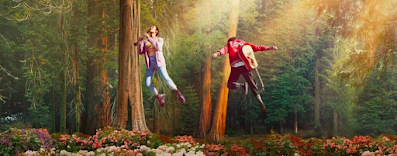
Luckily Josephine Decker brings us The Sky is Everywhere, a picture of a grieving teenager that creates a close emotional association with its lead’s mental state. Here an artistic, musical, creative teenager (Grace Kaufman) misses her recently departed older sister like a phantom limb. She aches for her presence. They’d been living with their grandmother (Cherry Jones) since the death of their mother some years prior. She asks her uncle (Jason Segel), her mother’s brother, if grief ever goes away. He looks at her warmly and answers: I don’t think so. Here’s a movie that’s honest about its situations, even as the screenplay, adapted by Jandy Nelson from her novel, loads itself up with YA turns of dramatic and romantic complications. There’s a cute new boy in school (Jacques Colimon). There’s her sister’s ex-boyfriend (Pico Alexander). There are friends to chat and classes to attend and futures to plan. It leaps between these peaks of teen drama and finds the shadow valleys of mourning between.
But what keeps the movie above the routine of such things is Decker’s commitment to visualizing her main character’s active mind. Like in her previous pictures—the loose artistic tension of Madeline’s Madeline and the stormy grit of Shirley—style follows from psychological cues. When the lead moves into her flights of fancy, colors are over-cranked, backgrounds can turn into dioramas, montage might become magical realism, flourishes of dance or poetry performance can fill the frame. Befitting her musical abilities, the score might be intrusive, or fade away. This makes for a movie that’s not overstuffed with quirk, but instead fancifully interior, an outpouring of precocious passionate imagination and surging adolescent curiosities and urges. It wisely meets its lead and its prospective audience where they are, and then, through its ability to add shading and texture to its side characters—Jones especially has a moving moment of perspective-bringing near the end—help them grow beyond.
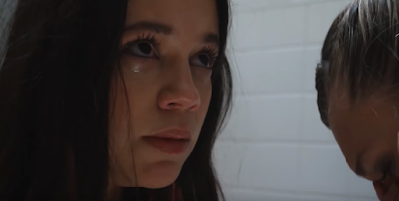
Another new movie that’s a picture of teenage grief is The Fallout. A finely realized debut feature for writer-director Megan Park, heretofore best known for a role on ABC Family’s The Secret Life of the American Teenager, the movie is less dreamy and sad than Decker’s. Instead, it’s teetering on an edge with depression and despair. But it’s so tenderly observed and warmly sympathetic to its characters that it understands all-too-well the difficulties they have readjusting to something like normal in the wake of a tragedy. One gets the sense in the opening scenes that it would be an appealing, low-key high school coming-of-age dramedy if not for the swerve into an unexpected awful event. Isn’t that always the case with these moments? It begins with a teenage girl (Jenna Ortega) talking with her sister (Lumi Pollack) and parents (John Ortiz and Julie Bowen), with friends and acquaintances and teachers (Will Ropp, Christine Horn). It’s the start of a normal day. She ends up in the restroom during class—avoiding class, really—and talks to a more popular classmate (Maddie Ziegler). That’s when they hear gunfire in the hallway. Screams. Slams. They hide. It seems to last forever, but then…that’s it. It’s over. They survived. Their school, their classmates, themselves, are now just another statistic.
The school shooting movie has, sadly, become something of a tradition now. It reflects the way this has been allowed to become a grim fact of life. In our politics, we hear an awful lot of whining about the supposedly deleterious effects of something like wearing a mask to go to school during a global pandemic. These complaints are usually coming from the same people who have never had anything meaningful to say about the far worse effects of getting shot to death in school. So here it is in the movies. Gus Van Sant’s floating camera in 2003’s Elephant and Denis Villeneuve’s grainy black-and-white 2009 Polytechnique make intense in-the-moment works of dread and violence. Last year’s Mass was a talky, probing look at parents grappling with deaths of this nature years later. Recent documentary Bulletproof shows the preparation for the possibility of such events—lockdown drills, kevlar backpacks or hoodies, potential classroom fortifications—as just another back-to-school routine, cut into its flowing montage of teacher trainings, band practices, sports drills, and assemblies. How sad that we’ve had over twenty years of reactions to mass deaths like these and protests against the very gun laws that encourage such destruction, and yet little has changed. What The Fallout brings to the conversation is not the violence, which is largely implied, but a softer touch and intimate detail, keyed into its leads’ numbed aimlessness in the aftermath.
Ortega takes center stage in tight focus for a character who is convincingly drawn. She expertly plays teen angst as a sort of normal acting out refracted through her vulnerable and raw post-trauma days and weeks as she claws back to a sense of self. There’s something convincing when she throws a thrashing little “God, mom!!!” flailing fit, and in the way she and Ziegler become friends bonded by their survival. They clung to each other as the chaos boomed outside; now they cling together to make it through. They’re contrasts—Ortega loose and swimming in baggy clothes, Ziegler clenched and poised in tight outfits as an Insta glamour princess—but connected. An early scene in which they text back and forth late at night is expert at conjuring that sort of intimacy—a flurry of closeups of eyes, fingertips, ellipses. And then they’re back to school, back to friends, trying to find their way in a string of episodic moments. By turning the mechanisms of a gentle Hollywood slice-of-teen-life style on the wake of a mass shooting, it makes a bitter sting of grief and hopelessness all the more affecting.
The film sees how the tragedy works its way through the community of characters, and watches as its impact shifts dynamics, closes off some old habits, and opens up new avenues of potential harm and growth alike. Bowen and Ortiz bring good detail to shaken, frustrated, and loving parents, while the other young actors sell a wide range of responses. Most telling, perhaps, are a few scenes where Ortega visits a sympathetic counselor played by Shailene Woodley. Aside from making viewers of a certain age feel old that this former Fault and Secret Life star has now aged enough to play one of the grown-ups, there’s an interesting disconnected connection Woodley and Ortega forge, with one’s insistence that things might get better personally, and the other’s looking at society around her with justified suspicions. I hope the potential young audience for this movie takes away some of these visions of humanity, and recognize something true in it.
Showing posts with label Julie Bowen. Show all posts
Wednesday, March 16, 2022
Sunday, July 20, 2014
Flight Improvement: PLANES: FIRE & RESCUE
A professional racer is told by his doctor to take it easy.
Looking to put his new free time to good use, he agrees to help his tiny
hometown by leaving home and getting his fire rescue certification. He ends up
spending the summer at a mountaintop resort, finding new firefighter friends
and getting his training in while helping them prep for forest fire season.
It’s a sweet, simple, predictable little story with safe, easy lessons about
being selfless, helping others while being true to yourself and other gently
affirming stuff. I sort of enjoyed it, at least whenever I could half-forget
that all of the characters were planes.
This is Planes: Fire
& Rescue, a sequel to last year’s Planes,
a spin-off of Pixar’s Cars movies.
That pretty dumb and awfully flimsy movie was produced by DisneyToon, Disney’s
direct-to-video arm, but got promoted to a theatrical release, presumably
because someone at the studio thought it was good enough to do so. Or maybe
there was a blank spot on the schedule that had to be filled quickly and cheaply.
Either way, there it was, a bland regurgitation of Cars plot points and cheaply animated pap. Families bought tickets.
Now it’s eleven months later and we have a sequel.
Maybe because director Roberts Gannaway and screenwriter
Jeffrey M. Howard knew they were aiming for the big screen from the beginning,
the movie has a wider scope, rather lovely and detailed backgrounds, and that
aforementioned predictable-but-likable story. The forest is lush and leafy,
fires ripping through with convincingly rendered snap and flicker bleeding
ominous reds and oranges through the picturesque greens and browns of the
secluded resort area. The story about a group of professionals taking a newbie
under their wing and teaching him the ropes is made up of stock parts, but
plays reasonably well. The problem, and it’s kind of a big one, is the planes.
I liked the Cars
movies. They had a certain charm and moved fast enough to outrace logical
questions about how a world in which all living things are vehicles operates in
any way. Sure, I idly wondered about questions like, “where do baby cars come
from?” But the movies moved quickly, had Pixar’s trademark visual wit and
emotional intelligence, and just plain knew not to steer the plot directly into
areas that would immediately confront the core nonsense of the fantasy world’s
workings. Not so Planes, which
operated at a cheaper, thinner level, but worst of all foregrounded the
nonsense. That’s a pattern that continues with Fire & Rescue.
It’s a movie that spends more time than necessary (that is
to say, any at all) focusing on the planes’ bodies. A major plot point is a
plane who is told he has a failing gearbox that can’t be replaced because “the
factory discontinued the parts.” What!? You mean to tell me in this world of
anthropomorphized vehicles there is a factory that can declare a death sentence
for a whole type of being (species? product line?) by declaring them
obsolete? How horrible! At one
point the camera zooms into the plane’s inner workings and watches as gears
turn and spark. I don’t want to think about this! Throughout we get cutaways to
dashboard gauges and knobs. Why are they there? Who is looking at them?
The movie’s obsession with the planes’ mechanical processes
reveals only the failure to imagine the fictional world in any detail beyond
the surface jokiness. It’s simply unworkable. What does work on some modestly
engaging level is the story, which would be a humble charmer if someone were to
rewrite it to star human beings. Whenever I could forget that Dusty Crophopper
(Dane Cook) and his new firefighting pals (voices of Ed Harris, Julie Bowen,
Curtis Armstrong, Wes Studi, Regina King, and more) were planes, it has a
mildly diverting kid-friendly flow. The fire and rescue of the title is treated
seriously enough to come with a dedication to real firefighters. That’s nice.
So is the crackling danger that the planes fly through in visually appealing
ways.
What’s not so nice are the nagging implausibilities and
backfiring wit. I don’t want to think about a small-town bar named “Honkers”
where a hybrid rebuffs a pickup truck’s pick-up line. Or an elderly fire truck
voiced by Hal Holbrook complaining about his “rusty, blistered bumper.” Or a
pair of elderly RVs who over-share that they “wore down their [tire] treads on
their honeymoon…with all that driving.” Or a helicopter who is a broad
offensive Native American stereotype who speaks in a pantomime of Native sayings.
Why this simple little kids’ movie insists on playing around
in its most distracting, baffling corners while poking along at a pace that
makes sure we have plenty of time to ponder its nonsense is beyond me. It’s not
even close to even the worst of either Cars,
but at least it’s an improvement over its immediate predecessor. Fire & Rescue is totally watchable,
with better animation, design, characters, and story, and with fewer lame
jokes. It’s not so bad, pleasant enough, but fundamentally preposterous.
Saturday, May 14, 2011
Love is All They Need?: JUMPING THE BROOM
Jumping the Broom is the kind of warm comic drama in which personalities can clash and long-held secrets can be exposed but all is ultimately forgiven for the sake of a wedding. In this case, the bride’s family is a wealthy family with a mansion on the beach at Martha’s Vineyard while the groom comes straight out of Brooklyn. They’re madly in love but – surprise, surprise – their families aren’t.
The bride (Paula Patton) and groom (Laz Alonso) recede into the background of their own story. There’s the typical last minute fighting and cold feet and declarations of love for the two of them to act out, but the movie is smart to find much reason to showcase the eccentric families. With a movie this comfortably predictable, it’s a pleasure to find that the ensemble is stuffed with enjoyable performers. They’re given far too little to do, but they fill out the gaps in the humor and pathos far better than you’d expect.
Angela Bassett and Loretta Devine are the dueling matriarchs presiding over all sorts of wedding related silliness while the wedding’s guests include the likes of Mike Epps (a reliable source of humor), DeRay Davis, Tasha Smith, Romeo, Megan Good, and Valarie Pettiford. All the while, the uptight wedding planner (Julie Bowen) finds herself in a perpetual state of cultural confusion. This is a mild farce with characters sent careening into each other in the typical fashion of both wedding movies and culture clash movies in which big social events are cause for people to find new love and, just maybe, new ways to think about others.
The movie is broad and drawn in quick strokes. It’s stretched thin, rambling across any number of themes (race, economics, religion, sexuality) without much depth given over to any one of them. I suppose it would be too much to ask for such a feather-light comedy to be a serious commentary on the state of modern America, and that’s not what I was expecting. But the nods towards deeper subjects in the screenplay by Elizabeth Hunter and Arlene Gibbs serve to hobble a picture that’s otherwise blandly sweet and not exactly nuanced, making it feel like it’s playing it a bit safe.
There’s a simple likability to Jumping the Broom but neither the comedy nor the families’ dramas are pushed far enough. It's not altogether unagreeable, it’s just slightly less than good. The director, Salim Akil, is a veteran sitcom director and it shows. I don’t have anything against the form; I enjoy good sitcom work, but I wouldn’t want to watch one in a theater. Akil, drawing on that experience, capably directs the traffic involved with having such a large cast and he keeps the movie moving along with a nice, bright polish. I didn’t exactly have a good time but I didn’t have a bad one either, and by the time the credits rolled I found myself entirely unaffected by the experience.
Subscribe to:
Posts (Atom)


