A few dozen movies and TV shows in, the Marvel Cinematic Universe of colorful heroes and interconnected can-kicking narratives has basically nothing to do with anything recognizably human. It goes all the more awry when a project wants to nod back in the direction. Hence Thor: Love and Thunder. He was heretofore one of the MCU’s most consistently entertaining characters—his appearances in first two Shakespeare-by-way-of-Jack Kirby entries (or vice versa), his goofier Guardians of the Galaxy-lite Ragnarok, and best-in-show appearances in multiple Avengers pictures. Star Chris Hemsworth always provides him an appealing gym-bod arrogance in an oblivious goofball beneficence, a boisterous buffoonery that can still kick out the action when called upon. But that force of personality alone can’t lift a movie completely miscalculated from the jump. This new Thor movie is a near-stupefyingly ill-considered collection of inanities and tropes broken up by the most rankly manipulative sentiments.
Writer-director Taika Waititi, whose distinctively silly style from early genre-benders like What We Do in the Shadows worked well enough for Thor last time, shamelessly trots out cheap buttons to push. Here there’s a supporting character with cancer—nothing specific, just “cancer”—that’s used as mawkish motivation when it’s important and dropped entirely for antics when not. (As fine an actress as Natalie Portman is, she can’t get something from nothing.) Here there are kids in danger—kidnapped and held in a dark cave by a murderous villain who himself is motivated by the senseless death of his only child. We see the latter in a raw moment of mourning in a stark prologue. Christian Bale, as the grieving father, is almost too good at making us want to see him succeed in taking out his anger on the gods who remain indifferent to the suffering of the common man. The movie’s endless violence, indifferently handled seriousness, and badly calibrated humor merely prolongs the suffering for us all.
After all, the movie’s villain pokes holes in growing MCU blindspots, problems that have reached a nadir here. When the heroes skirt past consequences in order to continually churn new installments, nothing matters. The life of a normal person must be terribly unsettled—to be at the whims of these larger-than-life super-beings. How awful. Love and Thunder is an especially cluttered and confused outgrowth of this problem. It’s flatly imagined and deadened by its blunt pathos steamrolled by the studio’s house style of weightless gloop, bad blocking, and cheap wisecracks. Waititi opens his movie with a character angry when gods laugh at his pain, and then makes a movie in which characters constantly laugh off pain—giggling at dangers and hand-waving murders. This flippancy is self-defeating. It robs the potential for real character depths—not that the movie’s dull repetition of previous Thor arcs, like learning humility and forging a makeshift family, is anything to mine for such—by treating everything with the heaviest-handed light touch imaginable.
Somehow both thin and overcomplicated, the story takes forever to get nowhere, and grates with its wildly uneven stumbling through inscrutable digital noise and incomprehensibly cheap staginess. (There are whole sequences where it’s difficult to tell who’s doing what to what effect to whom.) It gathers up the requisite cameos, crowds the sloppy frame with little moments for a dozen characters to shuffle on stage, get off a joke that flops, and limp away. Even an evocative villain, and a potentially witty foil in a fatuous Zeus (Russell Crowe in a lisping Grecian accent), are used for little and, ultimately, naught. Of course the gods must be crazy—and careless—to kick off the story of a man who wants revenge on them. But the movie lacks the courage of its premise’s convictions, completely refuses to engage with its implications, and feels all the emptier and annoying for it. The villain is inadvertently proven right. This is nihilism togged up as forced frivolity. It says, yes, the gods don’t care, the world is devoid of hope for mere mortals, but, hey, at least Thor joked around with his pals before the love of his life kicked the bucket to inspire him.
Better heroism with a sense of style and perspective can be found in The Princess, a 20th Century Studios movie ignominiously sent straight to Hulu. (Sheesh, is it a bummer than Disney has turned that once-great studio into a feeder for its streaming services. Even a modestly received theatrical run still boosts a movie’s profile more than these straight-to-digital premiere.) It stars Joey King as a princess whose castle has been taken over by snarling villains. Their leader (Dominic Cooper) wants to marry her and take her kingdom. He’s locked her in a tower and menaces her parents and younger sister in the palace below. Good thing she knows how to fight back. This R-rated action flick, overseen by Vietnamese director Le-Van Kiet, becomes a rollicking rolling action sequence bursting with kicks and punches, whips and chains, tumbles and tangles as she has to fight down the tower, through layers of goons, to save the day. It’s neatly composed and briskly choreographed, rarely pausing for breath, or much psychological complexity.
But its simplicity is its own asset, allowing it to focus narrowly on its strengths. It sure has personality, and the kind of bristling no-sweat casual feminism that its premise implies. King is a fine physical presence and fits the demands of the hard-charging role, playing up the exertion and panting effort of each move. And the supporting cast—key sidekicks for both good (Veronica Ngo) and bad (Olga Kurylenko)—is well-chosen in complementary skills with neat bladed weaponry and reasonably believable relationships to the leads. Here’s a movie that’s perched on the point where a teenage feminist fairy tale—The Princess Saves Herself in This One—meets vertical action levels—Die Hard meets The Raid. It knows what it wants to do, gets the job done, and leaves quickly before outstaying its welcome. The result is a slender and modestly satisfying genre effort.
Sunday, July 24, 2022
Sunday, June 26, 2022
If He Can Dream: ELVIS
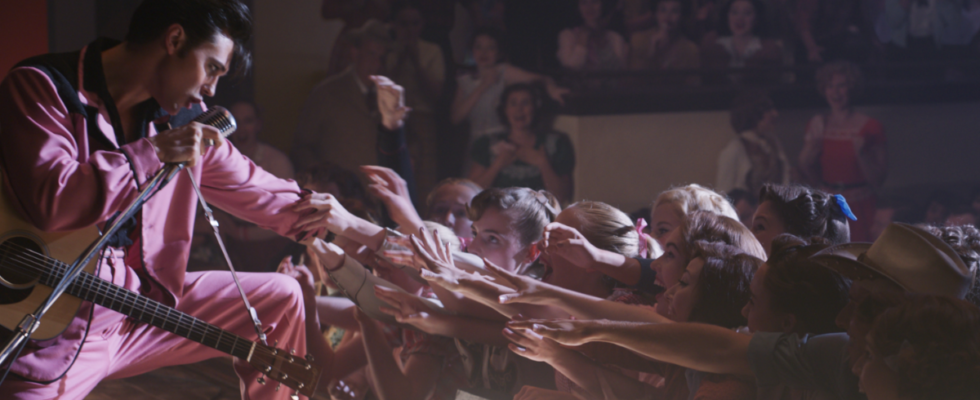
Baz Luhrmann’s Elvis is made with an energetically heightened reality that bursts through the cliches of the rock ’n roll biopic and the overfamiliar caricature that is its subject. It restores life and vitality to both, making something enormous and earnest and enveloping. This is a perfect match of filmmaker and subject. Luhrmann has a brand of cinematic theatricality in which wall-to-wall music covers a visual feast. Every shot is a riot of movement and color, frames are filled with flashing lights and flashy design, and every performance is goaded higher and higher until most gestures are big and broad. Elvis Presley, for his part, was a shock to the system. He defined the mold that continues to mint music stars as part of a wave of midcentury entertainers who began to scramble ideas of race, sex, and gender for the mainstream. His life, too, was as outsized as his stardom. Every facet of it has passed into iconography and a cartoon of fame: his mansion, his marriage, his movies, his scandals, his eccentricities. The modern version of celebrity culture is yet another element of our world he was at the right place and time to pioneer. This movie is a huge, swaggering tour of the familiar stages of Elvis’ life and career. It goes on for nearly three hours and doesn’t dig deeper into arcane trivia or thornier contradictions. But what it does instead is recreate the sensation of the shock of the new, and the societal and showbiz tensions the shaped and destroyed him. Luhrmann’s excesses match this mood, and this project: to build a shining monument to an icon of Americana—and to see how the darkness surrounding his becoming swallowed him whole.
The result is a rock opera and historical panorama that sells the intensity and immediacy of Elvis’ impact and the titanic complicated edifice of his legacy. Shot like a diamond-studded kaleidoscope’s view, this three-hour music montage flows from one number to the next, chopped and remixed and covered and tracked, amped up, stripped down, or played straight. When it lingers on a specific performance—his first big break winning over an audience with his rhythmic wiggling on stage; a triumphant comeback with lush orchestrations and pounding crowd-pleasing stamina—it is electrifying. So often these musical biopics tell us a moment was important by assuming we’ll know it was by the recognizable hit covered by its lead. Here, Luhrmann actually makes us understand 1.) how much hard work it takes to make that sort of impact, and 2.) why his subject was a huge deal. Austin Butler plays Elvis with pretty looks and expert timing, often drenched in sweat on stage, hair flopping, legs twitching, hips plunging. We feel the exertion of putting on a show, and also can get swept up in it. All the smash-zooms in on screaming young women—partly hollering for their fresh crush, but also in surprise at the reaction they’re having—and erupting crowds in dizzying editing or split-screens doesn’t come across as parody, but genuine live-wire enthusiasm. You’d think 2007’s great poison-pen satire of the sub-genre, Walk Hard, would’ve killed these stories dead. But watching Butler come alive on screen, inhabiting the appeal of this star so fully and convincingly, one might realize it’s worth grinding through all the bad versions of these movies just to get to one this remarkable.
In Butler’s compelling performance we see anew why Elvis became who he was. He’s surrounded by Black artists as he grows up, but his whiteness gets him chances they don’t. This is partly why he courts controversy from the segregationists of the time—and one wonders how the racists right-wingers of our time won’t see themselves in the portrait of sniveling politicians complaining about how he’s exposing their white children to ideas of blackness. He’s a white man performing rhythm-and-blues, a bridge between jazz and country as he helps forge a whole new style on the backs of those who get less credit, less fame, less money. But he’s a racially ambiguous figure over the radio, and in live performance is also playing on some unspoken androgynously provocative visual appeal. He’s a hip-thrusting young man at once forceful and smooth, pulsing staccato guitar strumming with loose-limbed pleasure in his own talents, singing in a sensitive baritone timbre from soft, delicate features. (A great evocative moment finds a nasty senator’s teenagers in front of the TV, lost in desire for this new figure of lustful interest.) Subsequent rock stars would blur these lines in more overt and outrĂ© ways; but here’s a movie that restores the sexual and racial fault lines of his times in order to bolster its argument for why his stardom was such a lightning rod.
That’s the benefit of Luhrmann providing a movie that’s gloriously artificial and reverently specific as it sloshes around. He’s so good at movies that drip performative sex appeal and sexual tension, of high-gloss spectacle, loud music that resonates in the chest, expressive complicated camera moves you can hardly take in at once, and emotional dynamics you can believe in an instant. He’s also fond of tragic romantics destroyed by the troubles of their times. In his Romeo + Juliet and Moulin Rouge! and The Great Gatsby we see swooning melodrama, preening showmanship, and bombastic glamour. That’s where he loads in the opulent period style, gilded cages remixed with anachronistic fervor. And locked in the center are these tortured beautiful people who want to love and be loved. Here it’s Elvis, who searches in his family and his lovers and his audiences and, yes, even his sneaky, villainous manager (Tom Hanks) for that approval, that what he’s doing matters and will last. He’s a sensitive and artistic young man taken in, lifted up and exploited by a charismatic scheming promoter into the life of an international superstar. Hanks acts chummily threatening from within layers of makeup and a fat suit, speaking with a marble-mouthed accent and wielding a cane with a snowman top. His narration flows through the picture as well, a frustrated unreliable narrator who can’t quite prove he’s not the bad guy here. He’s a clear contrast with Elvis, the business side of the singer’s show. Somehow, they need each other, even if it will leave them worse off, too.
The movie is totally swallowed up in Elvis’ life and times. It argues that, far from being the Singular Great Man, Elvis was a product of his culture and his collaborations, forged by forces beyond his control and the contributions of others. He’s constantly surrounded by family, friends, business people, audiences, cops, politicians, and hangers-on. In the few dark, quiet moments of empty solitude—stewing in a suite, or lonely in a spotlight on an empty stage—he’s surrounded by doubt. Here’s a celebrity biopic that vigorously sells the spectacle and excitement of such a life—and the fundamental unknowability of such a man, even to himself. What a show! What a cost.
The result is a rock opera and historical panorama that sells the intensity and immediacy of Elvis’ impact and the titanic complicated edifice of his legacy. Shot like a diamond-studded kaleidoscope’s view, this three-hour music montage flows from one number to the next, chopped and remixed and covered and tracked, amped up, stripped down, or played straight. When it lingers on a specific performance—his first big break winning over an audience with his rhythmic wiggling on stage; a triumphant comeback with lush orchestrations and pounding crowd-pleasing stamina—it is electrifying. So often these musical biopics tell us a moment was important by assuming we’ll know it was by the recognizable hit covered by its lead. Here, Luhrmann actually makes us understand 1.) how much hard work it takes to make that sort of impact, and 2.) why his subject was a huge deal. Austin Butler plays Elvis with pretty looks and expert timing, often drenched in sweat on stage, hair flopping, legs twitching, hips plunging. We feel the exertion of putting on a show, and also can get swept up in it. All the smash-zooms in on screaming young women—partly hollering for their fresh crush, but also in surprise at the reaction they’re having—and erupting crowds in dizzying editing or split-screens doesn’t come across as parody, but genuine live-wire enthusiasm. You’d think 2007’s great poison-pen satire of the sub-genre, Walk Hard, would’ve killed these stories dead. But watching Butler come alive on screen, inhabiting the appeal of this star so fully and convincingly, one might realize it’s worth grinding through all the bad versions of these movies just to get to one this remarkable.
In Butler’s compelling performance we see anew why Elvis became who he was. He’s surrounded by Black artists as he grows up, but his whiteness gets him chances they don’t. This is partly why he courts controversy from the segregationists of the time—and one wonders how the racists right-wingers of our time won’t see themselves in the portrait of sniveling politicians complaining about how he’s exposing their white children to ideas of blackness. He’s a white man performing rhythm-and-blues, a bridge between jazz and country as he helps forge a whole new style on the backs of those who get less credit, less fame, less money. But he’s a racially ambiguous figure over the radio, and in live performance is also playing on some unspoken androgynously provocative visual appeal. He’s a hip-thrusting young man at once forceful and smooth, pulsing staccato guitar strumming with loose-limbed pleasure in his own talents, singing in a sensitive baritone timbre from soft, delicate features. (A great evocative moment finds a nasty senator’s teenagers in front of the TV, lost in desire for this new figure of lustful interest.) Subsequent rock stars would blur these lines in more overt and outrĂ© ways; but here’s a movie that restores the sexual and racial fault lines of his times in order to bolster its argument for why his stardom was such a lightning rod.
That’s the benefit of Luhrmann providing a movie that’s gloriously artificial and reverently specific as it sloshes around. He’s so good at movies that drip performative sex appeal and sexual tension, of high-gloss spectacle, loud music that resonates in the chest, expressive complicated camera moves you can hardly take in at once, and emotional dynamics you can believe in an instant. He’s also fond of tragic romantics destroyed by the troubles of their times. In his Romeo + Juliet and Moulin Rouge! and The Great Gatsby we see swooning melodrama, preening showmanship, and bombastic glamour. That’s where he loads in the opulent period style, gilded cages remixed with anachronistic fervor. And locked in the center are these tortured beautiful people who want to love and be loved. Here it’s Elvis, who searches in his family and his lovers and his audiences and, yes, even his sneaky, villainous manager (Tom Hanks) for that approval, that what he’s doing matters and will last. He’s a sensitive and artistic young man taken in, lifted up and exploited by a charismatic scheming promoter into the life of an international superstar. Hanks acts chummily threatening from within layers of makeup and a fat suit, speaking with a marble-mouthed accent and wielding a cane with a snowman top. His narration flows through the picture as well, a frustrated unreliable narrator who can’t quite prove he’s not the bad guy here. He’s a clear contrast with Elvis, the business side of the singer’s show. Somehow, they need each other, even if it will leave them worse off, too.
The movie is totally swallowed up in Elvis’ life and times. It argues that, far from being the Singular Great Man, Elvis was a product of his culture and his collaborations, forged by forces beyond his control and the contributions of others. He’s constantly surrounded by family, friends, business people, audiences, cops, politicians, and hangers-on. In the few dark, quiet moments of empty solitude—stewing in a suite, or lonely in a spotlight on an empty stage—he’s surrounded by doubt. Here’s a celebrity biopic that vigorously sells the spectacle and excitement of such a life—and the fundamental unknowability of such a man, even to himself. What a show! What a cost.
Labels:
Austin Butler,
Baz Luhrmann,
Tom Hanks
No comments:
Friday, June 24, 2022
Wrong Number: THE BLACK PHONE
There’s something particularly unseemly about a horror movie that dredges up deeply upsetting imagery and ideas only to let them wither without a scare in sight. I don’t mind, and even sometimes love, when this genre can be nasty, lascivious, mean-spirited. I can even excuse a poorly developed horror picture if it hits the right marks with enough pizazz. But to want us to care about the most vulnerable among us, in a grindingly simple scenario jerry-rigged with convenient outs and lazy logic to maximize syrupy sentiment over their pain, was too much for me. The Black Phone is unsuccessful, not because it’s too intense, but because it doesn’t know what to do with its bungled intensity. It should be better, given its potentially high-voltage concept. The movie traffics in imagery of brutally murdered children and an unfortunate mincing menace of a killer, and fumbles making from it frights of any sort, fruitful, frivolous, or at all.
It’s about a 13-year-old boy (a capable Mason Thames) who is abducted off his suburban street by a mysterious masked figure known around town as The Grabber. We’ve seen he drives a rattling black van, lurks in a billowy magicians’ outfit holding black balloons, and stares out of a devilishly grinning death head mask. (That it’s sometimes a frowning mask is a neat subtle touch that proves he has an underutilized flair for the dramatic.) The bulk of the movie finds the kid locked in a basement where a disconnected black phone occasionally rings with the ghostly voices of the kidnapper’s previous victims. (This is totally a Stephen King-like blend of childlike whimsy, suburban danger, and quotidian drama—ironic since C. Robert Cargill’s screenplay is based on a short story by King’s son, Joe Hill.) That should be haunting stuff, but director Scott Derrickson, who can certainly go for the throat, like with his career-best ghostly-snuff-film chiller Sinister, is here too much of a sentimentalist to let the unsettling ideas surface with any snap or bite. It’s ultimately as wispy and uninterrogated as the villain himself, played by Ethan Hawke with such vivid mystery that it’s a deflation to realize that he’s hardly a character at all. He’s just an obstacle in a movie where everything is exactly as simple as it appears.
The movie becomes a plain self-actualization parable wrapped in a simple A to B escape room mystery box, with each call giving the boy new objects and strategies to plot escape while his captor lurks around as a malevolent, but distant, presence. There’s also a queasy equivalence drawn between this criminal and the boy’s drunken abusive father (Jeremy Davies), with both eagerly using a belt as a whip. He goes from a home trapped in cycles of abuse to being literally trapped by a far worse figure of danger. This unsteady metaphor is further elaborated by the way the boy has a kind of psychic connection with his sister (Madeleine McGraw). Her dreams seem to come true, and she prays for clues in her visions to save her brother. (It’s an excuse for fuzzy, fleeting flashbacks to the other victims from the sister’s perspective, a crass juicing of the underdeveloped story.) These twinned ideas of children in danger wobble with a melancholy that never quite activates. So it becomes a movie about a broken home and growing up, but shot through with a kind of lust for redemptive violence that doesn’t resolve well. We’re just waiting around until the dead boys drop enough hints for our lead to not just escape when he has the chance, but linger long enough to snap The Grabber’s neck, too. It’s sick, and not in a good way. It uses the deaths of children as mere impetus for a coming-of-age metaphor about responsibility for a final boy, and draws the deadening conclusion that an ability to create violence of your own—“standing up for yourself”—is a justifiable, and maybe even necessary, part of growing up. Now that’s scary.
It’s about a 13-year-old boy (a capable Mason Thames) who is abducted off his suburban street by a mysterious masked figure known around town as The Grabber. We’ve seen he drives a rattling black van, lurks in a billowy magicians’ outfit holding black balloons, and stares out of a devilishly grinning death head mask. (That it’s sometimes a frowning mask is a neat subtle touch that proves he has an underutilized flair for the dramatic.) The bulk of the movie finds the kid locked in a basement where a disconnected black phone occasionally rings with the ghostly voices of the kidnapper’s previous victims. (This is totally a Stephen King-like blend of childlike whimsy, suburban danger, and quotidian drama—ironic since C. Robert Cargill’s screenplay is based on a short story by King’s son, Joe Hill.) That should be haunting stuff, but director Scott Derrickson, who can certainly go for the throat, like with his career-best ghostly-snuff-film chiller Sinister, is here too much of a sentimentalist to let the unsettling ideas surface with any snap or bite. It’s ultimately as wispy and uninterrogated as the villain himself, played by Ethan Hawke with such vivid mystery that it’s a deflation to realize that he’s hardly a character at all. He’s just an obstacle in a movie where everything is exactly as simple as it appears.
The movie becomes a plain self-actualization parable wrapped in a simple A to B escape room mystery box, with each call giving the boy new objects and strategies to plot escape while his captor lurks around as a malevolent, but distant, presence. There’s also a queasy equivalence drawn between this criminal and the boy’s drunken abusive father (Jeremy Davies), with both eagerly using a belt as a whip. He goes from a home trapped in cycles of abuse to being literally trapped by a far worse figure of danger. This unsteady metaphor is further elaborated by the way the boy has a kind of psychic connection with his sister (Madeleine McGraw). Her dreams seem to come true, and she prays for clues in her visions to save her brother. (It’s an excuse for fuzzy, fleeting flashbacks to the other victims from the sister’s perspective, a crass juicing of the underdeveloped story.) These twinned ideas of children in danger wobble with a melancholy that never quite activates. So it becomes a movie about a broken home and growing up, but shot through with a kind of lust for redemptive violence that doesn’t resolve well. We’re just waiting around until the dead boys drop enough hints for our lead to not just escape when he has the chance, but linger long enough to snap The Grabber’s neck, too. It’s sick, and not in a good way. It uses the deaths of children as mere impetus for a coming-of-age metaphor about responsibility for a final boy, and draws the deadening conclusion that an ability to create violence of your own—“standing up for yourself”—is a justifiable, and maybe even necessary, part of growing up. Now that’s scary.
Tuesday, June 21, 2022
Lab Rats: SPIDERHEAD
The animating tension of Spiderhead is in the friction between its surface and its undertow. The setting is an ocean front compound on a remote island, a research facility that looks more like a high-tech resort, with lots of wide-open communal spaces and clean architectural lines. It is photographed in bright, clean frames with lots of light and soft colors. The furniture looks like upscale Ikea, and the diegetic soundtrack is slick with all the smoothest jams of 80s pop rock. Ah, but the content and intent of this place is menacing, chilled with moral quandaries, and driving toward a bad end that’s inevitable from frame one. Here prisoners (like Miles Teller and Jurnee Smollett) have volunteered to live as test subjects for a devious billionaire (Chris Hemsworth) who chummily lives among them. He’s fitted them with chemical packs on their backs which he operates from an app on his phone, able to dial up emotional states and biological urges with the flick of his finger. He runs them through tests—can he make them laugh at tragedy, find industrial waste beautiful, want to make love to an unappealing partner? This can’t be going anywhere good.
The film carefully keeps the prisoners’ crimes as backstory to be doled out later, the better to front-load their inherent humanity. We see who they are without the distraction of that emotional scale-tipping, and when we hear their tragic circumstances and decisions that sent them here, we can all the more clearly understand that no one deserves to be forced into this system. It’s torture disguised as comfort. They’re threatened with return to a normal penitentiary if they don’t consent to each new dose. Some are starting to suspect they’d be better off leaving. That they stay is credit to their wickedly charming warden, an athlesuire-wearing faux-chummy tech bro who talks to them like buddies and co-conspirators more than prisoners. He makes them feel a part of the team, like they’re doing valuable work. Why, he’s wearing a pack of chemicals, too. Hemsworth, projecting a whirling confidence and slick shrewdness, plays him as a perfectly slimy brand of modern billionaire. As suspicions about this guy and his project grow, Teller dials into a stoic sorrow, slowly crumbling under the pressures of being made to feel against his will. He’s trying to drown out the sorrows of his past, unable and unwilling to forgive himself for what he’s done. Smollett, too, is keeping her distance from who she was, forging new connections in this gilded prison. (They’re warm to each other, humanity among the inhumane.) They thought they were doing good. But at what cost?
That this simple wire-frame plotting, courtesy Zombieland and Deadpool screenwriters Rhett Reese and Paul Wernick exercising unusual restraint adapting a heady George Saunders short story, plays out so effectively is the work of director Joseph Kosinski. (A fluke of pandemic scheduling means the film he shot over three years ago, Top Gun: Maverick, is ruling the summer box office while this project, made mid-pandemic, is ready for release mere weeks later. What a time to demonstrate his range!) He gives the film a restrained style—as slick as the tunes echoing from the compound’s speakers—gliding along and pinned down in surveillance angles doubling or tripling the views from the control room. He lets his characters squirm, lab rats stuck in a maze, while we can pick out the whole picture well in advance. He’s expert at building out the architecture of a plot in conjunction with its setting, housing the emotional appeals in handsome surfaces. Think the vast digital loneliness of Tron Legacy, the windswept empty landscapes of Oblivion, the crackling Arizona wilds' fire dangers of Only the Brave, the high-velocity aerial combat and cozy homefront of Top Gun 2. Here it’s the deceptive comfort wrapped around total heartlessness, victims cooped up and slowly driven mad. It keys into our reflective understanding that the government will willingly abdicate its responsibilities to care for citizens it sees as disposable. If it can privatize prisons, why not emotions and biological urges, too? Here’s a fun little thriller that sees that obviously bad idea to its logical conclusion.
The film carefully keeps the prisoners’ crimes as backstory to be doled out later, the better to front-load their inherent humanity. We see who they are without the distraction of that emotional scale-tipping, and when we hear their tragic circumstances and decisions that sent them here, we can all the more clearly understand that no one deserves to be forced into this system. It’s torture disguised as comfort. They’re threatened with return to a normal penitentiary if they don’t consent to each new dose. Some are starting to suspect they’d be better off leaving. That they stay is credit to their wickedly charming warden, an athlesuire-wearing faux-chummy tech bro who talks to them like buddies and co-conspirators more than prisoners. He makes them feel a part of the team, like they’re doing valuable work. Why, he’s wearing a pack of chemicals, too. Hemsworth, projecting a whirling confidence and slick shrewdness, plays him as a perfectly slimy brand of modern billionaire. As suspicions about this guy and his project grow, Teller dials into a stoic sorrow, slowly crumbling under the pressures of being made to feel against his will. He’s trying to drown out the sorrows of his past, unable and unwilling to forgive himself for what he’s done. Smollett, too, is keeping her distance from who she was, forging new connections in this gilded prison. (They’re warm to each other, humanity among the inhumane.) They thought they were doing good. But at what cost?
That this simple wire-frame plotting, courtesy Zombieland and Deadpool screenwriters Rhett Reese and Paul Wernick exercising unusual restraint adapting a heady George Saunders short story, plays out so effectively is the work of director Joseph Kosinski. (A fluke of pandemic scheduling means the film he shot over three years ago, Top Gun: Maverick, is ruling the summer box office while this project, made mid-pandemic, is ready for release mere weeks later. What a time to demonstrate his range!) He gives the film a restrained style—as slick as the tunes echoing from the compound’s speakers—gliding along and pinned down in surveillance angles doubling or tripling the views from the control room. He lets his characters squirm, lab rats stuck in a maze, while we can pick out the whole picture well in advance. He’s expert at building out the architecture of a plot in conjunction with its setting, housing the emotional appeals in handsome surfaces. Think the vast digital loneliness of Tron Legacy, the windswept empty landscapes of Oblivion, the crackling Arizona wilds' fire dangers of Only the Brave, the high-velocity aerial combat and cozy homefront of Top Gun 2. Here it’s the deceptive comfort wrapped around total heartlessness, victims cooped up and slowly driven mad. It keys into our reflective understanding that the government will willingly abdicate its responsibilities to care for citizens it sees as disposable. If it can privatize prisons, why not emotions and biological urges, too? Here’s a fun little thriller that sees that obviously bad idea to its logical conclusion.
Sunday, June 19, 2022
Mad World: MAD GOD
In the beginning of Mad God, an eye is wide open in extreme close-up. In the end, it closes. This is an inversion, since what passes in between these shots is a pure, unadulterated nightmare. That it explicitly asks for our eyes to be open for these visions is a request that we stay alert to behold its wild imagination. It is a vision of decay and violence, of cycles of oppression and exploitation. It follows a small figure—wrapped in a thick coat and a tightly-fitted gas mask—making its way through hellish tableau and surrealistic dangers with only a crumbling map as a guide. This is a world in decay, disrepair, active conflagration, and brain-melting disorder and despair. It has been intricately and intuitively imagined by Phil Tippett, a long-time special effects wizard behind such memorable works as Star Wars, Dragonslayer, Willow, RoboCop, Honey, I Shrunk the Kids, and Jurassic Park. Here as writer-director-animator he’s made something of a stop-motion masterwork, pulling every trick of the trade over the course of several decades to build up this mad vision of a world falling to pieces.
This is a largely wordless excursion, an ink-blot test of wild mad visuals and sound effects. The images are murky and muddy, full of smoke and fog, fire and sparks. The detailed tableaux descend into dark depths and extend back into the frame in frightening shadows. It’s a post-industrial wasteland riven with war, with unseen crowds cheering dismemberments and clay figures marched into kilns. Scientists squish around in guts like butchers. Creatures are barnacled with seeping growths or slaughtered with whirring machines or sliced apart like a wriggling gym sock full of raw meat. There are a few human actors in the machinery of this place—notably cult filmmaker Alex Cox who pulls levers and peers deeply into the darkest recesses of the world. As the plot slowly comes into focus, it’s never the driving force. There’s no solving this world. Instead, this is for sure a movie you watch in disbelief, awed at the imagination it took to create these images, pulled along by its nightmare logic. I tried tracking the other artists and projects these images reminded me of: Hieronymus Bosch, the I Spy picture books, Saw, Terry Gilliam, David Cronenberg, the Brothers Quay, all in a blender. Mad is right. This is a world distinctively its own. One can stare at it wondering if it is dream or premonition, history or haunting, fantasy or warning. All of the above. All it asks is an open eye.
Friday, June 17, 2022
A Buzz Flight: LIGHTYEAR
I should not have doubted the good folks at Pixar’s ability to go beyond. I walked into Lightyear, sold as a high-flying sci-fi adventure, fully prepared for a cynical brand extension. They’ve hyped it up as Andy’s favorite movie, a story of the real Buzz Lightyear character behind the figure he had in Toy Story. (That some entertainment writers have performed confusion about what that might mean is a sorry state of affairs. Anyone with half a thought can tell it’s an excuse to spin off in a new storytelling world as a separate action franchise.) If that makes it a bit of a prefab conception, well, so be it. The result is a clever and concise sci-fi spectacle with a big heart and a clockwork sense of story. Set in a distant future on the far-flung wilds of the galaxy, the movie finds Space Ranger Buzz Lightyear (Chris Evans in full white-bread hero mode) responsible for an accident that maroons an enormous exploration vessel on an alien planet. He doggedly sets out to right that wrong by test-piloting fuels that will get them home, but each failed jump that takes only minutes for him is years for the people for whom he keeps trying. That’s a compelling emotional core, and the story team uses it well as grist for the gears of a tightly-constructed tale. By the time he’s reluctantly assembling a ragtag team to save them all from the evil Zurg and find their way to a new normal, it soars with the sputtering engines of experimental spaceships and whirring steps of robots, and zip-zap of laser guns.
The fun new crew of characters—Space Rangers and rookies, scientists and commanders, a villain with a surprising backstory, and an incredibly cute and helpful robot cat—are immediately lovable creations, imbued with some humanity in their stock positions. And the hurrying-around, getting-supplies, and making-plans of the story dovetails sweetly with the emotional journey on which it sends Buzz. It also manages to make a new character out of one we already loved. He’s the same but different. Buzz the toy’s identity crisis naturally isn’t present here. But director Angus MacLane and team manage to retain his sense of self-doubt mixed with loyalty and determination to protect his found family of friends. Although there are some subtle reuses of lines the toy speaks in the first Story—moviegoers of my generation and younger, who’ve surely memorized its script, will spot them—in new contexts, it’s entirely a new character journey to get involved in here. As Buzz grows in his ability, and responsibility, it’s exciting to see him become the hero he’s meant to be, a team player and a man who can make up for his mistakes. The others, too, learn and grow at just the right pace, as well. Somehow it feels familiar and fresh at the same time.
So, too, the look, which has a glossy fantasy sheen and whirring tech love in its pulp-paperback Cinemascope aesthetics. The animation is full of the typical expert textures and contours, sparkle and sparks, and something like soulful expressions behind the eyes. And in the vehicles and suits, every button and tool is expertly deployed and explained so we can understand the stakes and mechanics of the characters’ plans and problems. That makes it all the more enjoyable when turned loose to work, or not, in enjoyable action sequences that continue to inform character throughout. It’s altogether a skillful deployment of Pixar’s practically patented airtight plotting, where every bit is a logistical or emotional setup or payoff that clicks into perfect place at precisely the proper time for maximum audience satisfaction. It works because we care—quickly, easily, and fully—for the cast, and can get involved in the pleasing jumble of genre tropes expertly mixed and remixed for a new sensation. That may not end up the most moving or complicated of this studios’ insights, but it’s such bustling blockbuster fun, with nary a moment to waste, that it’s all the more enjoyable for being sharply done. If we’re going to have recapitulations and re-imaginations of brands we already know and love by heart, it might as well be this much fun, and actually reward our interest this well. By the time the end credits popped up, I was feeling like when David Letterman was blown away by his Late Show musical guest, saying, “I’ll take all of that you got.”
The fun new crew of characters—Space Rangers and rookies, scientists and commanders, a villain with a surprising backstory, and an incredibly cute and helpful robot cat—are immediately lovable creations, imbued with some humanity in their stock positions. And the hurrying-around, getting-supplies, and making-plans of the story dovetails sweetly with the emotional journey on which it sends Buzz. It also manages to make a new character out of one we already loved. He’s the same but different. Buzz the toy’s identity crisis naturally isn’t present here. But director Angus MacLane and team manage to retain his sense of self-doubt mixed with loyalty and determination to protect his found family of friends. Although there are some subtle reuses of lines the toy speaks in the first Story—moviegoers of my generation and younger, who’ve surely memorized its script, will spot them—in new contexts, it’s entirely a new character journey to get involved in here. As Buzz grows in his ability, and responsibility, it’s exciting to see him become the hero he’s meant to be, a team player and a man who can make up for his mistakes. The others, too, learn and grow at just the right pace, as well. Somehow it feels familiar and fresh at the same time.
So, too, the look, which has a glossy fantasy sheen and whirring tech love in its pulp-paperback Cinemascope aesthetics. The animation is full of the typical expert textures and contours, sparkle and sparks, and something like soulful expressions behind the eyes. And in the vehicles and suits, every button and tool is expertly deployed and explained so we can understand the stakes and mechanics of the characters’ plans and problems. That makes it all the more enjoyable when turned loose to work, or not, in enjoyable action sequences that continue to inform character throughout. It’s altogether a skillful deployment of Pixar’s practically patented airtight plotting, where every bit is a logistical or emotional setup or payoff that clicks into perfect place at precisely the proper time for maximum audience satisfaction. It works because we care—quickly, easily, and fully—for the cast, and can get involved in the pleasing jumble of genre tropes expertly mixed and remixed for a new sensation. That may not end up the most moving or complicated of this studios’ insights, but it’s such bustling blockbuster fun, with nary a moment to waste, that it’s all the more enjoyable for being sharply done. If we’re going to have recapitulations and re-imaginations of brands we already know and love by heart, it might as well be this much fun, and actually reward our interest this well. By the time the end credits popped up, I was feeling like when David Letterman was blown away by his Late Show musical guest, saying, “I’ll take all of that you got.”
Friday, June 10, 2022
Age of Extinction: JURASSIC WORLD DOMINION
Used to be, when you got to the Part 6 of your movie series it was a bunch of random nonsense with basically no one from the original involved. Now it has to be styled as a Grand Finale with as many original cast members as possible, and lots of talk playing at the idea that this convoluted culmination was a logical possibility all along. It weighs a movie down, forcing it to contrive moments like a character from 1 and 3 sitting down with a character from 5 and acting like she knew her when she was a baby. Okay. Used to be, when you made a dinosaur picture, you kept things fairly simple—somehow, dinosaurs have returned. And now people have to deal with that. You don’t even have to go back to Harryhausen or King Kong for that beautiful simplicity. That was enough for the first few Jurassic Parks. (To that point, Spielberg’s original remains such a paragon of tightly crafted and visually astute big budget thrills, that we’ve long since stopped hoping a sequel could ever match it.) Now, though, this prehistoric creature feature has to be engaged in deep lore, connected through a dozen little references, and building to a potential End Of Life As We Know It. Ah, apocalypse, that old standby of what feels like every blockbuster of the last dozen years. It makes a movie like Jurassic World Dominion overstuffed and, not under-baked, but so over-baked and under-stirred that instead of a smooth, tasty blend, you somehow taste every component ingredient as you chew it over.
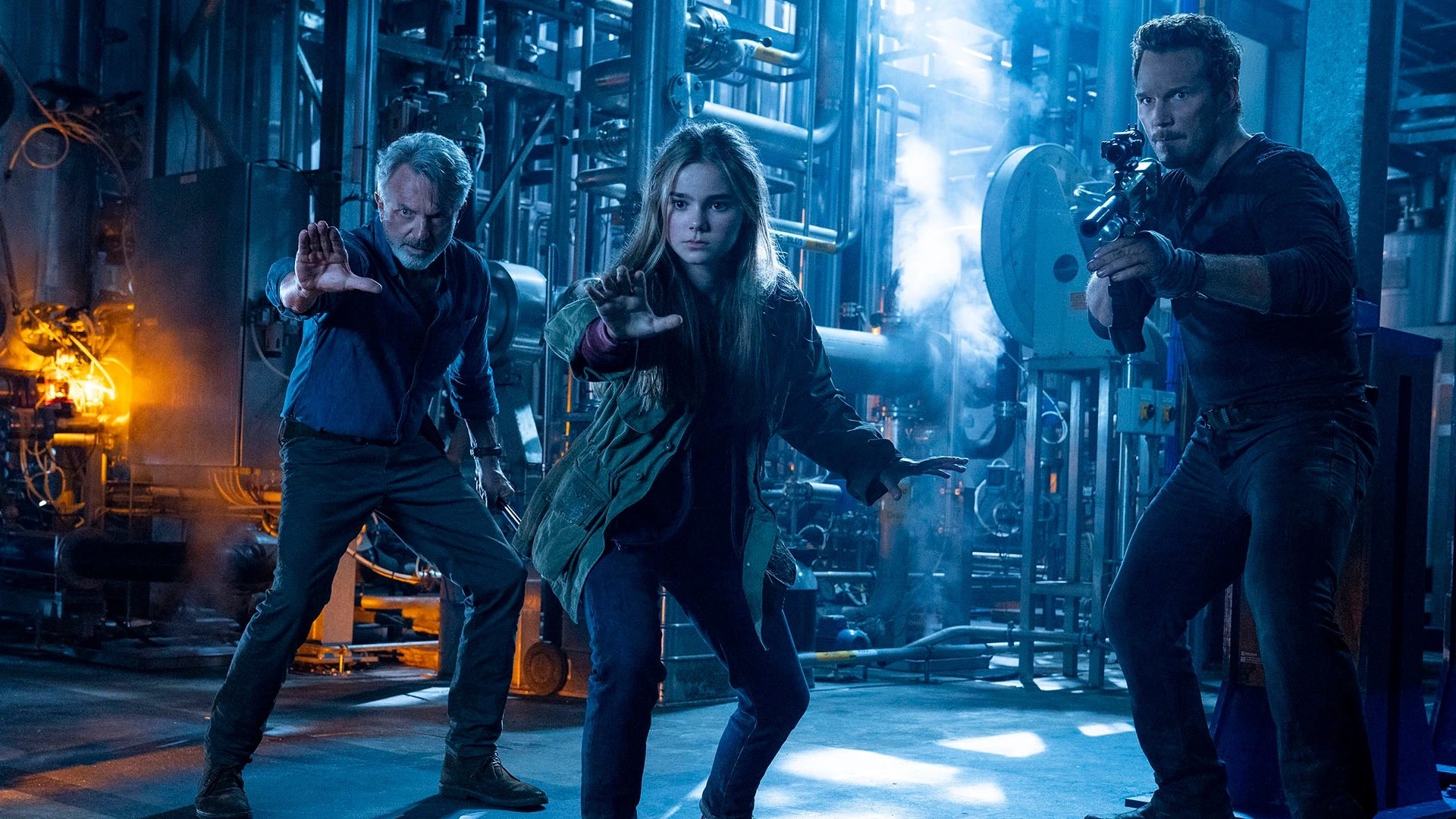
The movie may be bursting with references and exposition, but the series, under the guidance of writer-director Colin Trevorrow, has written itself into a tough spot where it has to get weighted down to move forward. Last time, 2018’s Fallen Kingdom, ended with dinosaurs finally fully escaped off the island and becoming the ultimate invasive species worldwide. Quite a cliffhanger. This one picks up by handwaving it a little, skipping over that potential awesome spectacle by saying, eh, we got used to it for the most part. The truly troublesome herds are shipped off to a remote mountain research facility in Italy. It’s here that a science company is fiddling with dino DNA, having secretly engineered a plague of locusts to take out competitors’ crops. This is what catches the eye of the original cast members (Laura Dern, Sam Neill, Jeff Goldblum) who are dragged back into this whole thing to investigate. It’s fun to see them, all in fine form, and quite a contrast to the other returning cast members, Chris Pratt and Bryce Dallas Howard from these last couple. They play a raptor trainer and a dinosaur right’s activist, respectively, and in three movies have accumulated roughly a tenth of the rooting interest that the older cast got in their first scenes thirty years ago. The movie keeps the two casts on separate tracks for most of the movie, as the younger players are chasing after their kidnapped adopted daughter (Isabella Sermon). You may recall that last time they saved a little girl who was an experimental clone of a dead scientist. See how this series has gotten so convoluted?
The wonder, then, is that the movie roars out from under this weight and delivers some actual pulp thrill in its outsized spectacles. The screenplay by Trevorrow and Emily Carmichael may clunk along connecting dots and communicating mostly in undigestible expository dialogue instead of finding ways to communicate ideas visually. But the ideas for action are pretty good, and decently assembled. These include: super-locusts swarming some farm kids; raptors chasing vehicles through the streets of Malta; a cool mercenary pilot (DeWanda Wise) facing off against these terrifying giant lizards by land, sea, and air; and our heroes sneaking through labs, tunnels, corridors, and finally, a forest fire, dodging dinos all the way. Trevorrow is a much better filmmaker now than he was when he made the first Jurassic World, a movie that was more hectic, crowded, and busy than it was well-judged from a visual sense. In Dominion, these action sequences have some momentum and legible direction, pushing along the characters from one plot point to the next with a high-energy rumble and tumble, crash and splash, that matches the needs of the moment. If you just want to see some familiar faces run around with big dinosaur spectacle, well, here they are.
I didn’t have a bad time for most of the time, as I enjoyed the enormous effects of it all. But in the back of my head I was suspecting that I didn’t care about these empty figures and oversized stakes as much as I did the far smaller, simpler, clearer, and more gripping ones back in ’93. (That’s why the clone girl, as weird a swing as it may be for the series, is a more interesting emotional hook than the end of the world. Go figure.) Thus, each sequence works pretty well, and it’s carried along by its size and speed, but cumulatively lands with a thud. It is, in other words, a proficient and enjoyable time in the moment. I was happy to have seen it, even as I found myself walking out, the full impact sinking in, feeling like the Talking Heads, asking myself: how did we get here? This sort of blockbuster should someday feel as dated as the bloated epics at the end of the studio system in the middle of the last century—loaded with technical prowess of high artifice, with good actors playing at phony, and talky, outlines of real ideas against a backdrop of excess. Feels like maybe this could be the end of the line to this sort of thing. Guess that makes it a dinosaur, too.
The movie may be bursting with references and exposition, but the series, under the guidance of writer-director Colin Trevorrow, has written itself into a tough spot where it has to get weighted down to move forward. Last time, 2018’s Fallen Kingdom, ended with dinosaurs finally fully escaped off the island and becoming the ultimate invasive species worldwide. Quite a cliffhanger. This one picks up by handwaving it a little, skipping over that potential awesome spectacle by saying, eh, we got used to it for the most part. The truly troublesome herds are shipped off to a remote mountain research facility in Italy. It’s here that a science company is fiddling with dino DNA, having secretly engineered a plague of locusts to take out competitors’ crops. This is what catches the eye of the original cast members (Laura Dern, Sam Neill, Jeff Goldblum) who are dragged back into this whole thing to investigate. It’s fun to see them, all in fine form, and quite a contrast to the other returning cast members, Chris Pratt and Bryce Dallas Howard from these last couple. They play a raptor trainer and a dinosaur right’s activist, respectively, and in three movies have accumulated roughly a tenth of the rooting interest that the older cast got in their first scenes thirty years ago. The movie keeps the two casts on separate tracks for most of the movie, as the younger players are chasing after their kidnapped adopted daughter (Isabella Sermon). You may recall that last time they saved a little girl who was an experimental clone of a dead scientist. See how this series has gotten so convoluted?
The wonder, then, is that the movie roars out from under this weight and delivers some actual pulp thrill in its outsized spectacles. The screenplay by Trevorrow and Emily Carmichael may clunk along connecting dots and communicating mostly in undigestible expository dialogue instead of finding ways to communicate ideas visually. But the ideas for action are pretty good, and decently assembled. These include: super-locusts swarming some farm kids; raptors chasing vehicles through the streets of Malta; a cool mercenary pilot (DeWanda Wise) facing off against these terrifying giant lizards by land, sea, and air; and our heroes sneaking through labs, tunnels, corridors, and finally, a forest fire, dodging dinos all the way. Trevorrow is a much better filmmaker now than he was when he made the first Jurassic World, a movie that was more hectic, crowded, and busy than it was well-judged from a visual sense. In Dominion, these action sequences have some momentum and legible direction, pushing along the characters from one plot point to the next with a high-energy rumble and tumble, crash and splash, that matches the needs of the moment. If you just want to see some familiar faces run around with big dinosaur spectacle, well, here they are.
I didn’t have a bad time for most of the time, as I enjoyed the enormous effects of it all. But in the back of my head I was suspecting that I didn’t care about these empty figures and oversized stakes as much as I did the far smaller, simpler, clearer, and more gripping ones back in ’93. (That’s why the clone girl, as weird a swing as it may be for the series, is a more interesting emotional hook than the end of the world. Go figure.) Thus, each sequence works pretty well, and it’s carried along by its size and speed, but cumulatively lands with a thud. It is, in other words, a proficient and enjoyable time in the moment. I was happy to have seen it, even as I found myself walking out, the full impact sinking in, feeling like the Talking Heads, asking myself: how did we get here? This sort of blockbuster should someday feel as dated as the bloated epics at the end of the studio system in the middle of the last century—loaded with technical prowess of high artifice, with good actors playing at phony, and talky, outlines of real ideas against a backdrop of excess. Feels like maybe this could be the end of the line to this sort of thing. Guess that makes it a dinosaur, too.
Subscribe to:
Posts (Atom)