Showing posts with label Alfred Molina. Show all posts

Sunday, December 19, 2021

Tangled: SPIDER-MAN: NO WAY HOME

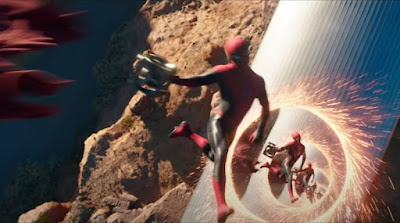
Here’s a Spider-Man movie about how much fun earlier Spider-Man movies were. Sure, it’s also about second chances (for Spider-Men) and learning from your (Spider-Man) mistakes and finding the people who truly love you for who you really are (Spider-Man). But I guess that makes it all the more a movie that begins and ends with nothing but Spider-Man and references to Spider-Man and cheap hits of nostalgia for Spider-Men we’ve loved and lost before. By the finale of Spider-Man: No Way Home, which brings together a cavalcade of cameos for web-swinging acrobatic action and pretends it built (or re-built) characters along the way, it made me, as someone who, I’ll admit, would call Spider-Man my favorite superhero, want the impossible: less Spider-Man.

This oddly flat and clunky project, the latest in the ongoing Marvel Cinematic Universe, opens up a live-action Spider-Verse to tromp around in. Peter Parker (Tom Holland) asks Dr. Strange (Benedict Cumberbatch) to help the world forget he’s the friendly neighborhood superhero. The spells goes wrong and results in characters from previous Spidey pictures stumbling in disoriented and wondering what to do with themselves. There’s Doc Ock (Alfred Molina) and Green Goblin (Willem Dafoe) and Sandman (Thomas Haden Church) from the Tobey Maguire movies and Electro (Jamie Foxx) and Lizard (Rhys Ifans) from the Andrew Garfield ones. The movie’s best idea is also what saps it of energy: these guys are way too confused to be much of a real threat. Instead, Strange and Spidey argue over how best to solve the problem. The wizard doctor wants to zip-zap them back from whence they came where they’ll meet their doom, while good ol’ Peter thinks he can save them. They’re scientists, after all, victims of one misfiring experiment or another. (This movie thinks their villainous natures can be subsumed under the audience’s affection for the characters and performers.) Practically, however, it’s a movie going around in circles, hoping to keep an audience’s interest by trotting out these cameos and lingering long enough for applause breaks before giving each returning face pretty much nothing to do.

And, for how befuddled they should be, and are at first, about getting ripped out of their universe and into another, these villains quickly get pretty casual and blasé about the situation. In typical MCU fashion, there are long scenes of actors standing around trading quips, smirking and giggling at the outsized sci-fi suspense whipping up around them. There’s nothing so heavy—not even the death of a major character—that can pause the deflating jokes for too long. And these have to be the cheapest and emptiest cracks, as Peter’s pals picked to help present possible solutions to this whole mess—MJ (Zendaya) and Ned (Jacob Batalon)—find themselves scoffing in disbelief at names and powers from these inter-dimensional interlopers. It want to both play off how much people love the earlier Spider-Man iterations and set itself up as the best one. (That they start calling Holland “Spidey 1” gets a little funny in that regard when he’s literally sharing the screen with people whose movies worked way better than this one.) No Way Home wobbles between these two modes: reverent celebration of what came before, and goofy puncturing of any possible seriousness. The entire multiverse is threatening to collapse on itself, and it feels about as monumental as channel surfing. That leaves vast swaths of the movie to clunk along in scenes that aren’t shaped so much as plugged into place, and moments of real high drama played off so abruptly and drearily—there are deaths and magical amnesia that’d hit harder with better track laid for it—that one forgets these are supposed to be real characters to care about and not just action figures clattering around.

Worst has to be the movie’s total lack of interesting style. Much has been made of the MCU’s bland house style, closer to network procedurals than cinema spectacle during downtimes between animated action. The style can be pushed here and there—one could parse the fine gradations between a Johnson, Gunn, or Waititi and a Russo bro—but often settles into a bland TV-style over-the-shoulder conversational tone mixed with quick-cut action in sets that trend to muddy grey. (That this year has found the theatrical and TV sides of the universe ever more immeshed makes this homogenized smallness ever more apparent.) This one’s pretty ugly most of the time: photographed with rarely more than three or four actors in frame together, and dialogue often in alternating tight medium or close up shots. Maybe it’s the fact the whole thing was shot last fall taking COVID precautions, but the look ends up cramped—few extras, smallish sets, and tons of flat blocking that has performers so separated from each other that they might’ve been green-screened in separately. When it comes to Big Names swanning in trying to steal scenes in this airless environment, it feels all the worse.

This ill-fitting sense of where to put people in the frame and how to track their behavior extends to the larger sense that nothing much matters herein. When any character can be whatever the plot needs and come flying in on magic sparkle dust from any other movie of which they want to remind you, it doesn’t much matter what happens to them. There’s something hollow at the core, and no amount of emoting can fill it. There’s a silly scene where characters from three different universes seriously compare iterations of advice from dead mentor figures, all tearing up and nodding sagely and talking about how meaningful the franchise’s triplicate pop psychology is. It goes for heavy meaning, but instead piles up comic cliche until it triple-underlines the silliness because the story’s only connection to anything real or human in its movements are to what it means for Spider-Man. And the collision between different visions of the character ends up highlighting how directors Sam Raimi and Marc Webb, for whatever missteps one might concede, were making real movies with their earlier versions, and Jon Watts, on his third go around, is stuck making a product. When characters from the earlier pictures arrive it’s from a different world entirely—one where these superhero movies weren’t only about themselves and pitched for a blandest possible homogeneous outcome. They interact awkwardly with the MCU world because they carry with them messy tendrils of style and substance that can’t entirely get polished away by the shallowness they’re asked to play.

Friday, September 23, 2011

Baby Bourne: ABDUCTION


Every movie is allowed a certain amount of implausibility, with the exact amount tied directly to the level of entertainment value. I suppose one could work out an exact formula that could determine the precise figures, but that’s beside the point. It’s all objective anyways. Everyone has his or her own internal meter to determine this sort of thing. The new teen-oriented action thriller Abduction broke my implausibility meter early and often. Just when it gears up for some big action sequence I found myself tripped up by the little details asking: Who? How? Why? Especially “why?”

The movie tries to make Taylor Lautner, the werewolf from the Twilight movies, into a star capable of taking center stage. He stars as Nathan, an average, if a bit on the wild side, teenager who discovers that a childhood picture of his is on a missing person website. Soon, two goons show up at his house and kill his parents (Jason Isaacs and Maria Bello, putting in little more than cameos) who, before they died, confirmed that they aren’t his real parents. Then one of the goons spits out a dying warning. “There’s a bomb in the oven.” Kaboom. The house blows up sending the fleeing Nathan and his study partner (Lily Collins) into the backyard swimming pool. They run to a nearby hospital where they call 911. “Are you okay?” the operator asks. “A little shaken up,” he replies. Talk about an understatement.

Somehow Lautner finds an unconvincing way to play rattled. He’s a pretty young man who, in his best moments of acting in the film, invites a similar amount of sympathy as a whining puppy. The plot thickens around him as the hospital fills up with dangerous people who want to attack him for some reason. Alfred Molina barks from a CIA control room while Michael Nyqvist stalks the halls with his vaguely villainous henchmen. Luckily Sigourney Weaver shows up to drive the teens to safety, claiming that she’s a friend of Nathan’s real parents. It’s all so very convoluted that she can hardly explain it to them, practically shouting that both men are up to no good but for separate and competing reasons, so trust no one. Then she makes them jump out of the moving vehicle.

Somehow the two teens stumble around and figure out how and why to show up on time for the competent scenes of action required of a potentially propulsive thriller. There are hundreds of bloodless gunshots fired throughout the film, a squeaky indifference to consequences. Sure, everything this kid believed has quite literally exploded out from under him but, hey, at least he still has his hot cheerleader study partner at his side and a sweet leather jacket on his back. He’s only a little shaken up. And he can more than take care of himself, possessing as he does a set of combat skills that seem at once learned and mysteriously second nature. He is like a baby Jason Bourne, so it’s only fitting that the girl says he looks like “Matt Damon meets…you.”

Director John Singleton, recently of Four Brothers and 2 Fast 2 Furious, keeps things zipping along painlessly enough, I guess. The screenplay by Shawn Christensen is a jumble of semi-nonsense. It’s the kind of movie where computers are magic boxes that can do anything required of the plot with just a few keystrokes, characters suddenly possess knowledge they couldn’t possibly have gained, and a bomb can mysteriously appear ready to blow up inside an oven and destroy an entire building. To say the movie has a few plot holes would be an understatement. Between the creak of cliché and the whiff of straight-faced, unintentional silliness, the best we can really hope for is watchable.

It’s almost there, but for the fact that the talent just isn’t into it. Singleton may be coasting on competence in the direction department, but it’s the cast that really assists the film in sinking to the level of its script. Lautner’s trying his hardest, at least I think he is, and Isaacs and Bello are fine in their brief moments on screen. It’s Molina who seems inert, Nyqvist who seems distracted, and Weaver who has a curiously flat affect. Or maybe they think they’re in a comedy? Abduction may have been intended to be a ludicrous teenybopper distraction and a potential star-maker, but in reality it’s just a nice paycheck for a bunch of folks who deserve better. Watching it is painless and useless in the same proportions.

Wednesday, March 23, 2011

The Good, The Bad, and the Lizard: RANGO

Rango is a computer-animated family film about a lizard with no name. He bounces out of the back of a truck and crash lands his terrarium on the side of a desert highway. Looking for signs of civilization he ends up in the pint-sized wild-west town of Dirt that’s populated by poor animals who are suffering from a terrible drought. They could also use a hero. So, this lizard says his name’s Rango, a rough, tough, capable gunslinger. Naturally, the townspeople make him sheriff. It’s not like they have a better option.

It’s a film that follows easily recognizable Western tropes, but it’s even more endearingly odd than you’d expect. This is a cockeyed postmodern western that’s a total delight in its energetic entertainment. It’s also a fantastically dark and fairly complicated look at the make up of identity. Rango himself puts on a new identity when stumbling into an animal Wild West town, playing his hero role as John Wayne by way of Don Knotts. He’s a thespian who builds his reality out of fiction, much like the film itself builds a glorious feat of originality out of gorgeous homage.

Directed by Gore Verbinski, he of The Ring and Pirates of the Caribbean fame, creates a world of starkly unexpected originality. From a script by John Logan, it’s one part kids’ film, one part Chinatown, and one part sophisticated revisionist Western. I never would have thought that was a combination that could be pulled off, let alone this well. Is Rango crowd-pleasing? I’d like to think so. This is a film that’s certainly, for lack of a better term, weird. But it’s also a rather safe kind of weird. It’s not at all alienating in its unexpected strangeness. There’s great energy in its visual wit, in the inventive and spectacularly staged set-pieces that riff on classic Westerns in enjoyable ways while still remaining faithful to the colorful, accessible milieu of its own that is created. This is hardly a film so burdened down with homage that it becomes inaccessible to all but the amateur film scholars in the audience. This is closer in spirit to Tarantino; the references are there if you catch them, but they’re still just a part of a larger entertaining picture.

There’s also great energy and skill to be found in the hugely entertaining chameleon-like voice performances. It’s a rare animated film that has its big-name voice cast disappear into the texture. Other than the marquee name of Johnny Depp (the film is, after all, being sold as “Johnny Depp is…Rango”), who remains recognizable through his excellent voice work, the cast so thoroughly inhabits their parts that the end credits were a delightful surprise to find out just who had a personality provided by the likes of Isla Fisher, Ned Beatty, Alfred Molina, Abigail Breslin, Stephen Root, Harry Dean Stanton, and Bill Nighy. These aren’t camouflaged star turns. These are specific characters, detailed and quirky in their own specific ways.

The characters are also remarkably ugly, vividly so. The animation, supplied by the special-effects studio Industrial Light and Magic in their first foray into feature length cartooning, is extraordinarily detailed. These are no rounded, soft, appealing prototypes for toys. These are realistically scarred and feathered creatures with ugly lumps and awkward gestures. They’re anthropomorphized, sure. But they’re much more grotesquely animal than we’re used to seeing in films of this type.

Which leads me back to Rango himself. His character is deeply, appealingly peculiar in his fluid identity and in his naked yearning for acceptance at any cost. It turns this enjoyable genre mashup into something a bit deeper, into a story about the power of constructed identity. It’s about, if I may be just a tad highfalutin here, the tension between who we are and what we say we are, a theme that crystallizes in a scene of chilly beauty as a distraught character contemplates committing suicide through a nighttime crossing of a dangerous road while long white-and-red streaks of taillights go soaring by. That’s rather deep stuff for what seems, at least on the surface, to be and is both a raucous Western and a rip-roarin’ animated family film. Indeed, I found the experience to be rather soulful amidst its jagged edges, western tropes, sand-scored scenery, and ugly folks. Much like last March’s How to Train Your Dragon, this is a film that builds its colorful entertainment from emotions instead of solely from flippant commercialism, proving that Pixar isn’t the only American animation company capable of high standards.

Wednesday, December 1, 2010

Catching Up on 2010: Epic Yawn Edition

There’s no good reason for Ridley Scott’s Robin Hood to be so dull, with the exception of copious development problems and the decision to make an overlong origin story that pushes all that is fun about the character past the end credits and out of the picture entirely. There’s also the thudding predictable epic-battle stylistic rut that Scott has found himself in (he’s basically recycling his own Gladiator) that cannot lift the tattered script. And, of course, there’s the fact that Russell Crowe, an actor with some nice range, is woefully miscast. On the scale of screen Robin Hoods, Crowe’s better than Kevin Costner, but he’s no Errol Flynn (or even Cary Elwes). This is a turgid epic that looks like little more than a high-priced game of dress-up as extras clop around muddy forests looking as grim and miserable as I was watching them. Not even the combined talents of Cate Blanchett, William Hurt, Danny Huston, Max von Sydow, Matthew Macfadyen, and Mark Strong (a “how could this go wrong?” kind of cast) can scrape up more than a little entertainment value. Don’t get me wrong, this is as slick and dumbly watchable as empty failed epics get. The money was well spent on the production values. Where the film is bankrupt is where it counts: story, emotion, character, and excitement.

Another failed summer epic at least has the dignity to go a little crazy. It’s not any better than Robin Hood, but Mike Newell’s video game adaptation Prince of Persia: The Sands of Time at least has Alfred Molina racing ostriches and Ben Kingsley as a man who knows all about procuring poisoned cloaks in between his mustache twirling. Oh, and a miscast Jake Gyllenhaal’s hanging around too, though despite his status as the lead of the film, he leaves very little impact. He’s the orphan-turned-prince who stumbles into possession of the Sands of Time that are conveniently held inside a goofy dagger. They turn back time, but they can only turn back as much time as there is sand in the dagger. (I think). So, for a convoluted set of reasons, the prince marches around the desert with the blank beauty love-interest Gemma Arterton while they figure out how to conquer the forces of evil and protect the world from the villainous forces that would use the sand to…I don’t know what exactly, but let’s assume it’s bad. Though, really, I spent about as long wishing they would use the sand to go back to a time before the movie started and try again. The film’s all red-blooded matinee fun, or at least it would be if it weren’t so frequently incomprehensible in the action scenes. Not only does CGI cloud any sense of physical space in the acrobatic flips and spins, but the magic is oddly rendered and decidedly hokey. The characters are bland, the plot is cardboard, and the filmmaking is just flat and affectless. I was bored or confused for most of the movie. It’s bland, but at least it’s not entirely without flavor.

Wednesday, July 14, 2010

Charm Offensive: THE SORCERER'S APPRENTICE

It’s not every day that you can see a big summer action-adventure based on a Goethe poem that was previously adapted into a short segment in the beloved Fantasia, but that’s exactly what you get with The Sorcerer’s Apprentice. It’s loud and expensive, much like other Jerry Bruckheimer productions including the dumb National Treasures which share, in Jon Turteltaub, the same director as this new feature. They also share the same star, Nicolas Cage, but Sorcerer’s Apprentice has the good sense to embrace the actor’s loopier side.

Looking through a mess of long hair and a floppy fedora, with a long trenchcoat flapping behind him, Nicolas Cage certainly looks the part of a more than one-thousand-year-old sorcerer now living in Manhattan, who trained under Merlin and has spent centuries searching for his master’s replacement. Cage hams it up, bugging out his crazy eyes and strutting through each scene with a magical confidence. He’s also hilarious. Early in the film, following a statement made by Cage, a character asks “how do you know that?” Cage spins and fixes a wild gaze on the character while shouting “because I can read minds!” Total commitment to a ridiculous role is the name of the game here, and the film is better for Cage’s participation.

It helps that Cage is facing off with a rival ancient sorcerer played by Alfred Molina, who brings an equal commitment to his suavely villainous cheeseball. He makes a grand entrance, forming out of a squirming mass of cockroaches. Out of all the actors in the world, perhaps only Molina could look so effortlessly nonchalant about a cockroach crawling up his nostril in his first big close-up. He’s having a ball, chewing on all his lines with clear satisfaction and infectious fun.

The two sorcerers are after a nesting doll that contains the trapped essences of various evil magicians from centuries past. Cage wishes to keep it out of the hands of Molina, who wants to free the evil in order to raise an army of the dead. To further complicate matters, this hunk of magical wood was inadvertently lost a decade earlier by college student Jay Baruchel, who may just be the one true heir to Merlin’s powers. Cage suspects as much, so he takes the lad under his wing to teach him the ways of using sorcery for good, not evil. And, of course, he’ll need his help to battle all the encroaching forces of darkness. What would a summer blockbuster be without encroaching forces of darkness?

This all sounds complicated, but the film wears its mythology lightly, preferring instead to go right for the big, splashy, effective set-pieces involving all kinds of kinetic magical danger and derring-do. Mixed in is a healthy dose of humor. This is a movie that is faintly aware of just how ridiculous it own story is. Cage and Molina aren’t the only ones having a ball. Baruchel is charming and funny as a geeky asocial guy who only cares about this girl (Teresa Palmer) that he’s loved since he was ten and with whom he just might be making a connection. She might even want to, you know, date him. And then all this crazy stuff about legends and curses and magic and good and evil? It’s almost more than he can take.

I went into the theater with very low expectations and, while I wasn’t blown away, I was pleasantly surprised. This is a mostly fast moving and enjoyable experience. The effects are convincing and are put to good use. It’s genuinely exciting and amusing. The Sorcerer’s Apprentice is not great, but it’s much better than the majority of this summer’s offerings from this genre, and it’s certainly just right for an uncomplicated couple of hours at the multiplex.

Tuesday, December 15, 2009

Quick Look: An Education (2009)

Carey Mulligan is almost unbelievably cute in the lead role of An Education, but that’s hardly the only good reason that so many critics and Oscar prognosticators have fallen in love with the film. On the one hand, it’s just a fairly routine coming-of-age story about a 16-year-old girl learning about life and love. On the other hand, it’s a very well done version of it. Mulligan, who I was surprised to learn is actually 24, plays the part with grace and charm and, in Jenny, she’s given a great character to play. She’s carefully poised with superficial depth and sophistication masking surprising emotional depth yet childishness. Mulligan’s also blessed with amazing support from an excellent cast that includes Peter Sarsgaard, Alfred Molina, Rosamund Pike, Dominic Cooper, Olivia Williams, and Emma Thompson, who all perform admirably. Sally Hawkins, so good in last year’s Happy-Go-Lucky, turns up for one scene that’s so emotionally involving, and well done, I wished she could have been given more to do. Director Lone Scherfig keeps the film moving at a brisk pace, hitting all the right notes with the help of frequently beautiful cinematography by John de Borman and a charming screenplay by Nick Hornby, capably adapted from Lynn Barber’s memoir. The early-60s time period is evoked with just-so production design which matches the matter-of fact charm that runs through the film. Likewise, the music is a mix of period songs and original songs that blend seamlessly with each other and with the nimble score. With all of this going for it, the movie should be really great, right? I wish. It’s almost there. In the end, the movie is a very enjoyable experience, light and fun with a handful of spiky dramatic moments, but it doesn’t stick. The movie’s impact seemed to be evaporating as I crossed the theater’s lobby, but, in the days since I have seen it, I’ve felt a growing desire to see it again. The movie’s impact might not be long-lasting, but it is still well worth feeling.