Showing posts with label Thomas Haden Church. Show all posts

Wednesday, November 26, 2025

Sinners: WAKE UP DEAD MAN

Rian Johnson’s third Benoit Blanc mystery, Wake Up Dead Man, is the least immediately appealing. Compared to the autumnal glow of Knives Out or the summery vibes of Glass Onion, with their pleasing puzzle-box structures to match, this new movie is darker, meaner, scarier, and heavier. It’s set largely in a rural Catholic Church in the middle of the woods during a muddy spring trending toward dark and stormy nights of weather and of the soul. That’ll also guarantee it’ll be the one that simpatico audience members will forever be saying, “you know which one’s actually the best?” I won’t be one of them, but I’ll know where they’re coming from. Here’s where the clever froth of the first two gets weightier, losing none of the sharp social satire while gaining a theological dimension. Its honest wrestling with faith and duty and denial of surface pleasures will resonate with people who tire of cozy mysteries and need that dark chocolate genre packaging of the Gothic. There’s a scene where Blanc asserts his doubts as the clouds blot out the sun, and as his innocent interlocutor loses himself in a spiritual rebuttal the sun returns full force through the stained-glass window behind him. Johnson’s playing in the light and dark more overtly here. The movie’s clearly got souls, not just lives, on the line in yet another expertly organized murder mystery plot. 

The small congregation’s charismatic right-wing Monsignor (Josh Brolin) has been murdered in a seemingly impossible way, and the new, more progressive, priest (Josh O’Connor) finds himself tagging along with Blanc (Daniel Craig) as he tries to untangle the suspects. We have a tense lawyer (Kerry Washington), a drunk doctor (Jeremy Renner), a wannabe influencer (Daryl McCormack), a wheelchair-bound cellist (Cailee Spaeny), a washed up sci-fi novelist (Andrew Scott), a recovering alcoholic groundskeeper (Thomas Haden Church) and a scarily strict devout old woman (Glenn Close). The sort of broken people drawn to such a cultish devotion to a cruel man of the cloth are all likely culprits. And the religiosity of the setting matching the apparent irreconcilable facts of the case lend toward much talk of potential supernatural solutions. The movie’s verging on horror at times, and even though it doesn’t tip over into total fantasy, this picture has the series’ gnarliest and creepiest sights. The ensemble of suspects aren’t as finely drawn, and get none of the snappy punchlines we’ve come to expect from this series. They’re all guilty as sin of something, though almost none are guilty of murder. And the intensity of their beliefs means they’re all sweating it out under the glare of their crooked faiths. The tangle of violence and betrayal is weightier than ever. Even Blanc is subdued in the face of it, though his honeyed southern accent remains a delight. Johnson’s clearly finding something dark and searching in our current cultural moment and gets to use the elements of such a dependable genre’s scaffolding to express them. 

Sunday, December 19, 2021

Tangled: SPIDER-MAN: NO WAY HOME

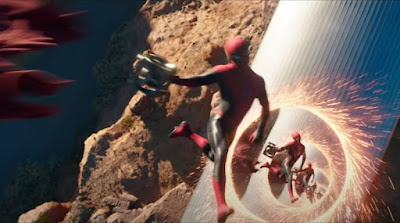
Here’s a Spider-Man movie about how much fun earlier Spider-Man movies were. Sure, it’s also about second chances (for Spider-Men) and learning from your (Spider-Man) mistakes and finding the people who truly love you for who you really are (Spider-Man). But I guess that makes it all the more a movie that begins and ends with nothing but Spider-Man and references to Spider-Man and cheap hits of nostalgia for Spider-Men we’ve loved and lost before. By the finale of Spider-Man: No Way Home, which brings together a cavalcade of cameos for web-swinging acrobatic action and pretends it built (or re-built) characters along the way, it made me, as someone who, I’ll admit, would call Spider-Man my favorite superhero, want the impossible: less Spider-Man.

This oddly flat and clunky project, the latest in the ongoing Marvel Cinematic Universe, opens up a live-action Spider-Verse to tromp around in. Peter Parker (Tom Holland) asks Dr. Strange (Benedict Cumberbatch) to help the world forget he’s the friendly neighborhood superhero. The spells goes wrong and results in characters from previous Spidey pictures stumbling in disoriented and wondering what to do with themselves. There’s Doc Ock (Alfred Molina) and Green Goblin (Willem Dafoe) and Sandman (Thomas Haden Church) from the Tobey Maguire movies and Electro (Jamie Foxx) and Lizard (Rhys Ifans) from the Andrew Garfield ones. The movie’s best idea is also what saps it of energy: these guys are way too confused to be much of a real threat. Instead, Strange and Spidey argue over how best to solve the problem. The wizard doctor wants to zip-zap them back from whence they came where they’ll meet their doom, while good ol’ Peter thinks he can save them. They’re scientists, after all, victims of one misfiring experiment or another. (This movie thinks their villainous natures can be subsumed under the audience’s affection for the characters and performers.) Practically, however, it’s a movie going around in circles, hoping to keep an audience’s interest by trotting out these cameos and lingering long enough for applause breaks before giving each returning face pretty much nothing to do.

And, for how befuddled they should be, and are at first, about getting ripped out of their universe and into another, these villains quickly get pretty casual and blasé about the situation. In typical MCU fashion, there are long scenes of actors standing around trading quips, smirking and giggling at the outsized sci-fi suspense whipping up around them. There’s nothing so heavy—not even the death of a major character—that can pause the deflating jokes for too long. And these have to be the cheapest and emptiest cracks, as Peter’s pals picked to help present possible solutions to this whole mess—MJ (Zendaya) and Ned (Jacob Batalon)—find themselves scoffing in disbelief at names and powers from these inter-dimensional interlopers. It want to both play off how much people love the earlier Spider-Man iterations and set itself up as the best one. (That they start calling Holland “Spidey 1” gets a little funny in that regard when he’s literally sharing the screen with people whose movies worked way better than this one.) No Way Home wobbles between these two modes: reverent celebration of what came before, and goofy puncturing of any possible seriousness. The entire multiverse is threatening to collapse on itself, and it feels about as monumental as channel surfing. That leaves vast swaths of the movie to clunk along in scenes that aren’t shaped so much as plugged into place, and moments of real high drama played off so abruptly and drearily—there are deaths and magical amnesia that’d hit harder with better track laid for it—that one forgets these are supposed to be real characters to care about and not just action figures clattering around.

Worst has to be the movie’s total lack of interesting style. Much has been made of the MCU’s bland house style, closer to network procedurals than cinema spectacle during downtimes between animated action. The style can be pushed here and there—one could parse the fine gradations between a Johnson, Gunn, or Waititi and a Russo bro—but often settles into a bland TV-style over-the-shoulder conversational tone mixed with quick-cut action in sets that trend to muddy grey. (That this year has found the theatrical and TV sides of the universe ever more immeshed makes this homogenized smallness ever more apparent.) This one’s pretty ugly most of the time: photographed with rarely more than three or four actors in frame together, and dialogue often in alternating tight medium or close up shots. Maybe it’s the fact the whole thing was shot last fall taking COVID precautions, but the look ends up cramped—few extras, smallish sets, and tons of flat blocking that has performers so separated from each other that they might’ve been green-screened in separately. When it comes to Big Names swanning in trying to steal scenes in this airless environment, it feels all the worse.

This ill-fitting sense of where to put people in the frame and how to track their behavior extends to the larger sense that nothing much matters herein. When any character can be whatever the plot needs and come flying in on magic sparkle dust from any other movie of which they want to remind you, it doesn’t much matter what happens to them. There’s something hollow at the core, and no amount of emoting can fill it. There’s a silly scene where characters from three different universes seriously compare iterations of advice from dead mentor figures, all tearing up and nodding sagely and talking about how meaningful the franchise’s triplicate pop psychology is. It goes for heavy meaning, but instead piles up comic cliche until it triple-underlines the silliness because the story’s only connection to anything real or human in its movements are to what it means for Spider-Man. And the collision between different visions of the character ends up highlighting how directors Sam Raimi and Marc Webb, for whatever missteps one might concede, were making real movies with their earlier versions, and Jon Watts, on his third go around, is stuck making a product. When characters from the earlier pictures arrive it’s from a different world entirely—one where these superhero movies weren’t only about themselves and pitched for a blandest possible homogeneous outcome. They interact awkwardly with the MCU world because they carry with them messy tendrils of style and substance that can’t entirely get polished away by the shallowness they’re asked to play.

Saturday, June 27, 2015

Furry Road: MAX


Who’s a good dog? Max is a good dog. He can sit, stay, beg, bark, obey orders, follow his leader, search for contraband, find missing persons, track suspects, sniff out bombs, serve in the military, escape bad guys, fight off meaner dogs, take down an international smuggling conspiracy, save hostages, and bring a grieving family closer together by loving them as only man’s best friend can. Sounds like a good dog to me. The movie in which he stars, played by a handsome Belgian Malinois named Carlos, is a slice of schmaltzy Americana, flag-waving, manipulative and corny as all get out. It’s a movie intent on pushing buttons with sentimentality, easy suspense, and simple uplift. But at least Max proves himself one of the most uncomplicatedly likable heroes you’ll see at the movies this summer. Who couldn’t like a dog this sweet and tough?

We meet Max in Afghanistan, on patrol with his until. There his handler (Robbie Amell) is killed. The dog is returned stateside where he’s diagnosed with a bad case of canine post-traumatic stress disorder. By this point we’ve already met the family of the fallen soldier, seen the funeral where the dog sits in front of the coffin and refuses to leave. You’d have to be made of stone not to feel the tug of heartstrings, since the movie’s working so hard to yank them there. So, since Max has been declared no longer fit for duty, the family adopts him. They’re mourning the same man. Through the presence of the pooch, the family – a gruff dad (Thomas Haden Church), sweet sad mom (Lauren Graham) and sullen teenage boy (Josh Wiggins) – slowly works through grief while learning to live with this new companion.

That’s surprisingly heavy stuff for a kids’ animal adventure. This glossy, earnest look at a mourning family has some sincere intent to focus on the plight of soldiers and their families’ through a dog’s-eye view. I liked this aspect of the movie, as the boy and dog learn to trust each other and the family starts to work through emotional trauma, the boy’s father growing distant, his mother quick to cry, his friends (comic relief Dejon LaQuake and love interest Mia Xitlali) the only ones ready to help him train the dog. Soft, bright cinematography keeps things feeling safe and comfortable even when dealing with pain. There’s always a feeling things will work out just fine. I mean just look at that dog, good at growling, panting away, chuffed to be sniffing and barking and going for walks and chewing on his toys. Maybe one day they’ll let him in the house.

But right when the movie seems to be narrowing in on the sensitive emotional terrain of the family, it becomes another movie. Writer-director Boaz Yakin (Remember the Titans) and co-writer Sheldon Lettich (of Stallone and Van Damme pictures) really want to underline this dog’s heroism as a salute to military dogs everywhere. They get Max and his boy involved in a crime thriller about a crooked soldier smuggling arms to drug cartels south of the border. The dog recognizes one of the culprits and ends up leading his new family down a dangerous path ending in a red-meat satisfying boom-pow conclusion pushing the edge of the PG rating with fights and stunts out of proportion with the smaller, sweeter, sadder story pushed to the margins. There are some nice twists, and its reasonably involving on a dumb level. But I wondered why it was there.

Maybe it’s best to think of Max not as a socially conscious boy-and-his-dog picture, but as a canine version of The Rock's Walking Tall. It’s a story of a veteran who returns home psychologically wounded by war, then needs to clean up his small town’s crime problem. The veteran here just happens to be a dog. Over the end credits, we’re told military pooches have a proud tradition. We see photos of various dogs in various wars, and are shown statistics as to how many have died for our country. It’s a nice sentiment, and the movie, all apple-pie, bike rides, Fourth of July, and fireworks, looks at an interesting subset of military service. And yet, I couldn’t shake dissatisfaction as a great dog – and some great dog acting, with perfect reaction shots, fun stunts, and reasonably believable action – was pressed into clunky formula. Wouldn’t the family-friendly canine remake of Best Years of Our Lives or Coming Home it occasionally is be more interesting?

Saturday, March 10, 2012

The Man Who Fell to Barsoom: JOHN CARTER

John Carter begins three times. First, there’s a sequence that begins with a splash of expository narration before joining a conflict in media res with solar-powered flying vessels clashing in the skies above the planet Barsoom. Next, a young man (Daryl Sabara) arrives at the home of his recently departed uncle and, as a condition of the man’s will, is given a journal to read. Now, through his own words, we are properly introduced to that uncle, John Carter (Taylor Kitsch), a Civil War veteran looking for gold out west while trying to avoid capture. And then, he’s mysteriously, accidentally transported to Barsoom. These three beginnings do more than place the narrative in framing devices like so many nesting dolls. It’s a narrative technique that emphasizes the protagonist’s status as a man out of time and space.

So too is the film’s source material. John Carter first appeared in print from the author Edgar Rice Burroughs, he of Tarzan fame, in the year 1912, exactly 100 years ago. Consequently, bits and pieces of the story can be traced through much of the previous century’s popular science fiction from Flash Gordon and Robinson Crusoe on Mars to Star Wars, Star Trek, Stargate, and Avatar. The trick of adapting John Carter after all these years is to make new what is old, to make fresh what has already been thoroughly chewed, to reconstitute a story, the DNA of which has permeated the genre in ways big and small these many years.

Up to the task is director Andrew Stanton, whose animation work for Pixar includes WALL-E, a favorite of mine and one of the very best sci-fi films of recent years. He makes his live action debut with John Carter and, much like his colleague Brad Bird proved with Mission: Impossible – Ghost Protocol, there’s definitely something to be said for the animator’s eye applied to live action. Here is a film so wonderfully composed, so imbued with visual energy of a sturdy, meticulous kind that this becomes no mere studio programmer and rarely feels old-fashioned or stuffy in any way. No, this is a film that slides into its timeless qualities in a grand Hollywood style, with spectacle and pageantry so lush, so vivid and sweeping, that oftentimes it feels like what Cecil B. DeMille or David Lean would have done with space opera.

The film finds John Carter unexpectedly displaced to Barsoom, a dusty rust-tinged desert planet with regal red humanoids clashing for control of the planet while the tall, green, four-armed tribe of Tharks remains neutral and isolated in the barren wilderness. Barsoom, Carter soon learns, is what he knows as Mars. Its atmosphere and gravity give him extraordinary powers of strength and speed; he can cross vast distances in a single leap, kill a Thark with a single blow. This impresses the leader of the Tharks, the first beings of Barsoom to stumble upon this strange creature they first refer to as a “white worm” before finding ways to communicate with him, though they mistake “Virginia” as his species name rather than his homeland.

The Tharks clash over what to do with the man. One grumbling tribal leader (Thomas Haden Church) believes Carter should be put to the test against fearsome beasts in their punishing arena. But the Tharks’ leader (Willem Dafoe) is inquisitive and hopeful. He believes they’ve found a super-powered champion for their people. This is also the belief of the beautiful and tough princess Dejah (Lynn Collins), who crash-lands while fleeing a marriage to her nemesis (Dominic West) that was arranged by her father (Ciarán Hinds) as a peace treaty. For his part, Carter just wants to go home, but his curiosity and his desire to somehow help these strange people compels him to learn more about these warring tribes. After all, to return to Earth he will need all the help he can get learning about mysterious alien shape-shifters who were involved in getting him into this predicament and whose leader (Mark Strong), unbeknownst to Carter, is the true catalyst for the war on Barsoom.

This is a richly imagined world brought to life with strong filmmaking that, wonder of wonders, trusts an audience to understand aspects of plot without too much of a fuss. Powerful moments, like when an alien battle is crosscut with an Earth-bound burial flashback, sketch in backstory and juxtapose it with an exciting forward pace to draw a fuller picture of Carter’s mental state with incredible ease. The script by Stanton with Mark Andrews and the great novelist Michael Chabon has a wonderful flow, slipping through its narrative loops with a minimum of fuss and delivering big action setpieces without seeming to strain over much towards preordained plot points. The dialogue, so often a sticking point in these earnest throwback blockbusters, is nicely polished. The regal dialogue of the royal Barsoomian people comes off not as stiff fantasy gobbledygook, but vivid pseudo-historical regality whereas the Tharks have a nice tribal feeling and Carter himself has a nice rascally Southern drawl. The actors seem grateful for the chance to do more than pose for effects; they have a world to inhabit and characters to play.

Stanton exhibits a helpful curiosity in the workings of this fantasy world that match the bewildered Carter. The long middle section of the film in which we are introduced to various technologies, traditions, legends, villages, cities, vehicles, heroes, villains, and creatures (including Woola, a squishy, speedy monster-dog who I found more adorable than the dogs in The Artist, Beginners, and Hugo combined) is simply wonderful filmmaking. The effects are wonderful, but Stanton grounds them and makes them work as a cohesive whole. They’re neither confusing, nor overly explained. The costumes, all loose, flowing, ancient-alien chic, and the sets, from humble huts to towering castles, are just as lovingly designed and executed. It all just simply works together as a terrific example of world building while still telling a compelling, exciting, and, yes, even moving story.

It’s by nature a somewhat predictable story, seeing as it has arrived pre-recycled by its genre peers over so many decades, and the film is not without its rough patches, to be sure. But it’s a film told with such energy and a high entertainment factor that I found it especially irresistible. Like the best films of its genre, John Carter is a film that draws upon archetypes – here it’s a crypto-western that shakes off the “crypto” by more or less starting as one – and extrapolates, reinterpreting visceral, primeval stories into a form that expands the imagination. Here’s a satisfying film that, with a flourish of its sweeping Michael Giacchino score, opens up a new world before your very eyes and, whatever its influences, whatever its source material has influenced, manages to become something entirely its own.

Monday, December 26, 2011

Lions, Tigers, and Bears: WE BOUGHT A ZOO


Cameron Crowe is the kind of writer-director who can manufacture moments so broad and sentimental, then deploy them with such total earnestness (accompanied with a tasteful mix-tape of a soundtrack) that they work wonders. Remember John Cusack holding the boombox under Ione Skye’s window in Say Anything? Tom Cruise telling Renée Zellweger that she “had him from hello” in Jerry Maguire? A group of rockers and their teenage embedded reporter having an impromptu Elton John sing-along on the tour bus in Almost Famous? These are moments of great magic that could have gone wrong in lesser hands, but when Crowe’s films sing, they really sing. There’s so much heart and humanity coursing through the films that they create comfortable places to settle into. Even when characters are running into problems, there’s a sense of a warm, gentle humanist spirit that will take care of them.

I should have remembered all of that when I went into Crowe’s first film in six years, We Got a Zoo. Instead, I had low expectations. It’s a comedy/drama based on a true story and featuring cute kids and lots of animals. I was worried the film would be too schmaltzy, too gooey sweet, too simple and formulaic. And it is, to a certain extent. But what surprised me was how caught up in it all I found myself. It’s hardly a subtle film, but it’s a comforting one all the same. It’s a movie with heavy material handled with the lightest of touches. It’s such a calm, warm, sunny film that it’s a pleasure to simply bask in it for two hours.

The film is about Benjamin Mee (Matt Damon) a new widower with two kids, a young teen son (Colin Ford) and a seven-year-old daughter (Maggie Elizabeth Jones). Crowe makes a film about grief and mourning that isn’t all that concerned with the immediate aftermath of a death. Instead, this is a film that recognizes that life moves on whether you’re ready for it or not. They’re not. They’re still very much grieving, floundering under the demands of day-to-day life. Benjamin has quit his job. The son is moody and misbehaving; for this he has been expelled. The daughter, sweet as she can be, is nonetheless troubled in her own way. Hearing the sounds of a late night party next door she finds her dad and tells him “their happy is too loud.” The Mees need a change of pace.

Out house hunting, the realtor (J.B. Smoove) shows them a nice property that he warns has complications. They fall in love with the house and its vast expanse of fields. The complications? It’s a zoo shut down by state regulators. If there’s no buyer willing to fund and run the zoo, the animals will be sent away in a permanent fashion. Summoning up his courage – and his pocketbook – and against the advice of his brother (Thomas Haden Church), Mr. Mee buys the house and the zoo right along with it. His daughter is thrilled. His son is very much less so. Suddenly, they’re the owners of a lion, tigers, and a bear (and, oh my, zebras, peacocks, snakes, monkeys, and more). The workers that come with the zoo, including the young, passionate zookeeper (Scarlett Johansson), are just glad the place will open back up and the animals will remain under their care.

This is a film about rebuilding a zoo and rebuilding a family. The zoo’s employees become a kind of second family for the Mees as they try to rebuild their lives in a new place without their wife and mother. I would have liked to learn a little more about the actual process of running the zoo, which would have given more screen time to other zoo employees like Patrick Fugit and Angus Macfadyen. But that’s a minor quibble in a film that’s only interested in what owning the zoo means for the characters. It’s sprinkled with lovely little bits of acting and wonderful moments of soft cinematic delight. Its approach to mourning is a small wonder in a moment when a photo comes to life with a full memory or when a simple story can bring back the lost loved one, if only for an instant. Damon and the rather wonderful child actors sell these moments, yes, but they achieve a kind of visual power as well. Without a single proper flashback, the extent of their loss is felt.

As these characters try to move forward – Damon throws himself into the zoo and is a little startled by his hesitant feelings towards Johansson, his son develops a crush on the zoo volunteer next door (Elle Fanning), his daughter falls in love with the animals – there’s naturally some tension to be felt and life lessons to be learned. But what makes this film so satisfying is the way Crowe sets up an interesting situation in which the characters are all likable. (Well, except for the token jerk zoo inspector who exists solely to give the film some small semblance of deadline-based conflict). Little aspects of character work ring so true (I was particularly taken with Johansson’s halting, rushed pronunciation of Mr. Mee’s name, “Ben-jamin,”as she remembers his preference). I genuinely wanted to see things turn out well for each and every one of them. This is essentially a warm, broad, sweet embrace of a movie. I felt myself settling in to enjoy it as if it were cinematic comfort food.