Showing posts with label Ariana Greenblatt. Show all posts

Thursday, July 27, 2023

Dolled Up: BARBIE

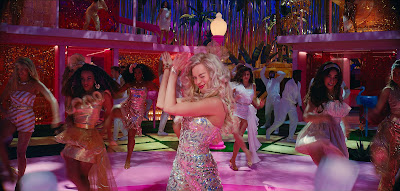
Greta Gerwig’s Barbie is a live-action cartoon philosophizing specifically about Barbie’s place in our culture, and gender performativity more broadly. In gleaming pink dollhouse sets against a painted sky, it is artifice in search of a truth. (Squint and you could call it Wes Anderson’s LEGO Movie.) It works, blending bright, sparkling silliness with clever ideas and even some moving earnest heart. That it manages to pull it off well is a post-modern two-step, setting up a dialectic—Barbie is a force for girlish fun and breezy empowerment versus Barbie as pernicious faux-feminist message in a materialistic patriarchal image—that’s somehow simultaneously criticism and advertisement. I’d like to hear how Barbie’s corporate owners let that happen. It’s both an obvious celebration of Barbie-land, and an overt problematization, a rich text that won’t stop explaining itself. The movie has characters flat out speak its ideas and debate their meaning, but it’s so nonstop funny and visually appealing that it rarely feels forced. We’re in a fizzy existential crisis for a movie that’s poppy and peppy and almost profound.

Gerwig opens the movie with gleaming fakery. After a 2001-style origin montage, which winkingly asserts the arrival of Barbie solved every girls’ real-world problems, we meet Stereotypical Barbie (Margot Robbie) living her Dream Life in her own little world. It’s a land full of Barbies—President Barbie, Doctor Barbie, and so on—who rule every profession, and their doting Kens who stand around and smile. (The well-cast world is populated with charmers putting on their best plastic grins.) Every day is a beach paradise, and every night is a dance party. But one night, during a bopping choreographed number to an original Dua Lipa song, she’s suddenly aware of her mortality. As her worry only escalates the next day, she’s informed by Weird Barbie (Kate McKinnon) that she should go to the Real World and find her owner to fix this. The resulting story makes the boundary between her world and ours porous, as her new understandings earned through fish-out-of-water interactions also get into the heads of her fellow Barbies and Kens. Ryan Gosling’s Ken is a particularly amusing vector of this confusion, as he gets hyped up on harmful real-world masculine stereotypes and turns from a purposeless accessory to an amped up parody of maleness. Other Barbie associates always seemed aware of their vestigial status, like real discontinued Ken friend Alan (Michael Cera), and the world-building is so loose and light that the very emptiness of these figures is the point.

While our world’s gender politics intrude on the oblivious Barbie’s consciousness, the movie introduces a real woman (America Ferrera) and her teenage daughter (Ariana Greenblatt) who alternately reject and entertain the fantasy Barbie offers. Here’s that dialectic, as Gerwig’s broad screenplay pushes and pulls at the delights and the dangers of the Barbie society, and our own. The CEO of Mattel (Will Ferrell) wants her back in the box, so to speak, but she’s starting to think she doesn’t like it there. The movie gives Robbie a deceptively complicated part to play—the perfect doll, then the plucky doubter, all while teasing out the slow crumbling of her facade. It’s strangely moving to see. We project so much, for good and ill, on this toy. To see Robbie bring a sense of interiority to the plastic ad-spread design is to see fifty years of feminism collapsing in on her. But there’s a bubblegum snap to the writing, co-scripted by Noah Baumbach, that never lets us forget the silliness of its construction. And there’s inventive filmmaking that continually reveals surprises in cartoony tableau and theatrical flourishes (even a climactic dream ballet), a sparkling, knowing campiness that melts into something genuine about purpose and connection and mothers and daughters and growing older. Gerwig, with Lady Bird and Little Women, made movies that glow with inner life, and here she finds that spark in plastic hearts. Or, to put it even more accurately, the spark is how those plastic people reflect and refract our own self-images. After all, who wants to be boxed in by other’s expectations?

Saturday, March 11, 2023

Jurassic World: 65

It may be a slow slog through a prehistoric jungle, but at least Adam Driver is there. The premise behind 65, named after how many millions of years in the past it’s set, finds a spaceship pilot crashing on Earth on the last day of the dinosaurs. He’s all set to off himself in despair until he realizes there’s one other survivor: a little girl (Ariana Greenblatt). Together they have to trudge across the wilderness, dodge a few dinosaurs, and get to the escape pod before the asteroid hits. Not a bad idea. In practice, the movie is sluggish and sparse, with a meager number of dino-related suspense moments and lots of slow-boil, largely dialogue-free, character interactions as the glum Driver and the girl—who don’t speak the same language—inevitably learn an ad hoc way to communicate and, wouldn’t you know it, care about each other. Driver is one of our finest actors, and though the movie gives him little to work with verbally or contextually, he’s able to use an expressive physicality that allows him to glower and smolder and sink into grief far more believable than what’s on the page. Imagine, say, a Tom Holland in the role, and I don’t know if it works as well. No offense to him.

It’s through Driver's performance—moving in a slow-motion, underwater sadness—that it becomes clear the movie is yet another modern genre effort that’s an extended metaphor for depression. His character is in a state of mourning for his home life—filled in with flashbacks—and in despair over his crashed fate. Only the glimmer of duty in protecting and caring for another person keeps him barely invested in staying alive and moving forward. No coincidence, then, that writer-directors Scott Beck and Bryan Woods (cashing in on their big hit Quiet Place screenplay) have set the stage at the end of one era in our planet’s history and beginning of the next. By the time the movie arrives at its fiery conclusion, with asteroid pieces raining hellfire down on the prehistoric landscape as our characters make their last-minute attempt at escape, there’s something potent about the idea of a desperate climb out of one’s sadness—it’s either the end, or a new start. I just wished, for a movie about a spaceman trapped in dinosaur times, there were more use of that tension throughout. There are a few fleeting moments of effective creature feature skill—a tyrannosaurus rex ominously illuminated in the night by a lightening strike, a few jump scares with snarling teeth and looming claws—but the movie strangely underplays its own high concept. All the more accurate for its aims to make us feel Driver’s disappointment, I suppose.