Showing posts with label Kate McKinnon. Show all posts

Thursday, July 27, 2023

Dolled Up: BARBIE

Greta Gerwig’s Barbie is a live-action cartoon philosophizing specifically about Barbie’s place in our culture, and gender performativity more broadly. In gleaming pink dollhouse sets against a painted sky, it is artifice in search of a truth. (Squint and you could call it Wes Anderson’s LEGO Movie.) It works, blending bright, sparkling silliness with clever ideas and even some moving earnest heart. That it manages to pull it off well is a post-modern two-step, setting up a dialectic—Barbie is a force for girlish fun and breezy empowerment versus Barbie as pernicious faux-feminist message in a materialistic patriarchal image—that’s somehow simultaneously criticism and advertisement. I’d like to hear how Barbie’s corporate owners let that happen. It’s both an obvious celebration of Barbie-land, and an overt problematization, a rich text that won’t stop explaining itself. The movie has characters flat out speak its ideas and debate their meaning, but it’s so nonstop funny and visually appealing that it rarely feels forced. We’re in a fizzy existential crisis for a movie that’s poppy and peppy and almost profound.

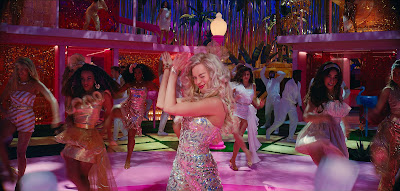
Gerwig opens the movie with gleaming fakery. After a 2001-style origin montage, which winkingly asserts the arrival of Barbie solved every girls’ real-world problems, we meet Stereotypical Barbie (Margot Robbie) living her Dream Life in her own little world. It’s a land full of Barbies—President Barbie, Doctor Barbie, and so on—who rule every profession, and their doting Kens who stand around and smile. (The well-cast world is populated with charmers putting on their best plastic grins.) Every day is a beach paradise, and every night is a dance party. But one night, during a bopping choreographed number to an original Dua Lipa song, she’s suddenly aware of her mortality. As her worry only escalates the next day, she’s informed by Weird Barbie (Kate McKinnon) that she should go to the Real World and find her owner to fix this. The resulting story makes the boundary between her world and ours porous, as her new understandings earned through fish-out-of-water interactions also get into the heads of her fellow Barbies and Kens. Ryan Gosling’s Ken is a particularly amusing vector of this confusion, as he gets hyped up on harmful real-world masculine stereotypes and turns from a purposeless accessory to an amped up parody of maleness. Other Barbie associates always seemed aware of their vestigial status, like real discontinued Ken friend Alan (Michael Cera), and the world-building is so loose and light that the very emptiness of these figures is the point.

While our world’s gender politics intrude on the oblivious Barbie’s consciousness, the movie introduces a real woman (America Ferrera) and her teenage daughter (Ariana Greenblatt) who alternately reject and entertain the fantasy Barbie offers. Here’s that dialectic, as Gerwig’s broad screenplay pushes and pulls at the delights and the dangers of the Barbie society, and our own. The CEO of Mattel (Will Ferrell) wants her back in the box, so to speak, but she’s starting to think she doesn’t like it there. The movie gives Robbie a deceptively complicated part to play—the perfect doll, then the plucky doubter, all while teasing out the slow crumbling of her facade. It’s strangely moving to see. We project so much, for good and ill, on this toy. To see Robbie bring a sense of interiority to the plastic ad-spread design is to see fifty years of feminism collapsing in on her. But there’s a bubblegum snap to the writing, co-scripted by Noah Baumbach, that never lets us forget the silliness of its construction. And there’s inventive filmmaking that continually reveals surprises in cartoony tableau and theatrical flourishes (even a climactic dream ballet), a sparkling, knowing campiness that melts into something genuine about purpose and connection and mothers and daughters and growing older. Gerwig, with Lady Bird and Little Women, made movies that glow with inner life, and here she finds that spark in plastic hearts. Or, to put it even more accurately, the spark is how those plastic people reflect and refract our own self-images. After all, who wants to be boxed in by other’s expectations?

Sunday, December 11, 2016

After Hours: OFFICE CHRISTMAS PARTY


Through how many tableaux of bad behavior have we suffered over the last several years? And I’m talking of only the party movie kind. The slow-mo drinking and dancing. The messy floors. The pounding dance music. The people making out or throwing up or swinging punches. The appliances hurled out windows. The drugs splayed out on tables, smoked up in clouds, or dusted over crowds. The bottles broken, syrup spilled, clothes flung, cars crashed, and animals wandering. We’ve seen this in basically every other R-rated comedy of the past decade or so. It no longer has much in the way of shock value, and is only a fun party by proxy if the mix of naughty to nice is exactly right. (Think more Sisters than Project X.) By now it’s a predictable and hyperbolic version of the lampshades on heads or pizzas on turntables of yesteryear. Now here’s Office Christmas Party, the latest excuse to stage the same wild party behavior.

Proficiently and competently directed by Josh Gordon and Will Speck (of similarly sturdy slight comedies Blades of Glory and The Switch) the whole thing contrives a reason to get rowdy. Set almost exclusively on a couple floors in a Chicago skyscraper, where a tech company (an old-school kind, more Dell than Uber) has its annual Christmas party cancelled. The CEO (Jennifer Aniston) threatens cuts, but her brother (T.J. Miller), as head of this branch, goes behind her back to throw the biggest bash yet. It’s a last ditch effort to pitch an older businessman (Courtney B. Vance) on signing a new contract, the only thing that’ll keep layoffs out of the picture for the next quarter. This leaves decent middle managers (like Jason Bateman and Olivia Munn) scrambling to make sure the wild night saves everyone’s jobs. The stage is set for a commentary on good people trapped in a debased culture – between ruthless profiteering on the one hand, total anarchic largess on the other. But the movie mostly throws that overboard in hopes we’ll root for the corporation.

There are some funny ideas here: a huge company run like a family squabble, markets driven by a rapacious need for constant growth, employees listless and only motivated by fear of firings, society a mindless rabble willing to throw off bounds of decorum at the first opportunity. There’s something perceptive under the surface. Tip the whole thing five or ten degrees in perspective and tone and you’d have a vicious satire of modern America. Alas, it’s just another glossy spread of dumb sitcom excess and juvenile antics dressed up as cutting loose and living it up with no connection to any reality. Watch Miller’s rich dope spend money on a living nativity, huge Christmas trees, a DJ, endless booze, profane ice sculptures, and let the vibrantly devolving bacchanal begin. It’s like Wolf of Wall Street without the bite or wit. Instead we’re just supposed to find it amusing, as wish fulfillment or vicarious thrill. How sad if this is any fantasy earnestly harbored. Worse still the implications in letting quiet, dull, dutiful good-behaving office parties be the enemy. What’s wrong with a simple cheese plate and a non-alcoholic beverage between polite work acquaintances and assorted colleagues?

In some ways, it makes more sense as a disaster movie. Like The Towering Inferno it gathers a lot of characters in a tower and introduces them all with an emotional or professional loose end that’ll be tidily resolved in chaos to come. But that movie had the good decency not to ask us to be primarily invested in whether or not the company that built the structure would be able to make money off the madness. Office Christmas Party is smartly cast down to the smallest role with fun scene-stealers – Kate McKinnon, Jillian Bell, Rob Corddry, Vanessa Bayer, Randall Park, Sam Richardson, Karan Soni, Jamie Chung, Abbey Lee, Andrew Leeds, Matt Walsh, and many more recognizable to anyone who has seen a comedy or two lately. They’re just given routine sitcom plots to enact through the party – a guy who tries to hire an escort to act like his fake girlfriend; a guy who doesn’t tell his boss he has a better job offer; a woman trying to avoid a co-worker after learning something embarrassing about him. They wring some pleasant entertainment, personalities and a brisk pace papering over the fundamental emptiness at its core: a bland celebration of a vulgar holiday spirit, with capitalism and commercialism for all.

Sunday, October 2, 2016

The Heist Guys: MASTERMINDS


Inevitably, the best part of any Jared Hess movie is whatever The New Yorker’s Richard Brody writes about it. Brody is the film critic most on Hess’s wavelength, able to enjoy his films’ fussy eccentricity, aloof absurdism, and reliance on characters who are stumbling stupid dopes. I look forward to reading Brody’s takes because, aside from the fact he’s a terrific writer worth reading even if you disagree with his position, I wish these movies worked on me like they do him. From the outside, they seem fun, with goofy premises and promising casts of talented performers. There’s his 2004 Napoleon Dynamite, the surprise hit about a gawky high school nerd, and Nacho Libre, with Jack Black as a monk moonlighting as a luchador. His best, though still uneven and hard to hang with for their entirety, are Gentlemen Broncos, in which Jemaine Clement plays a pompous sci-fi author, and Don Verdean, starring Sam Rockwell as a fraud Christian archeologist. These all sound like fun movies, but I always watch them slightly perplexed, delighting anytime a rare laugh surfaces. In Hess’s style the humor is often hermetically sealed in a signal my brain can only intermittently pick up.

Hess’s latest is Masterminds, a movie about a group of dim schemers who attempt to pull off a massive heist and then flail around in its aftermath. It’s based on a true story, loosely I hope. If you ever in your life find yourself in a situation so bad you look around and think to yourself, “this could be a Jared Hess movie,” something has gone terribly wrong for you. The characters here are all sad members of the working poor, and the movie’s perspective is aggressively condescending and dismissive. They work minimum wage jobs, live in trailers, and shop at big box discount chains, and Hess shoots every scene to emphasize the grotesque, the tacky, the pitiable. There’s not an ounce of empathy or sympathy in the film’s mocking construction or approach, desperate people willing to do dire things for dumb reasons squirming under pressure for our amusement. Of course a movie could theoretically get away with being cruel or mercilessly satirical, but not one so purposeless as this. It’s only out to deride and denigrate, looking down its nose in heartless smirking scorn.

At least the talented performers are bright enough to sneak in some endearing, even amusing, touches now and then. They try, anyway. Zach Galifianakis is an awkward armored car driver head over heels for his shift partner (Kristen Wiig). When her dumb friend (Owen Wilson) asks her to seduce the sap into stealing $17 million in cash from the warehouse after hours, she’s willing to go along with it. The driver doesn’t know he’s being duped, and that the woman he thinks he’s colluding with in heist and in love is never going to go on the run with him. He’d be better off staying home, following the law, and marrying his creepy fiancĂ© (Kate McKinnon). Alas, the heist goes off and goes wrong, drawing the dogged pursuit of a weary FBI agent (Leslie Jones) and a wacky hit man (Jason Sudeikis). The plot is rigged against them all – and there’s something extra squirm-worthy to consider the real people in the real story seeing themselves presented in such a funhouse-mirror farce – but the actors involved scrape out enough eccentric line readings to make it seem like a comedy.

Remarkably low-energy and scattershot, the movie slowly grinds to its conclusion through increasingly broad and mind-numbingly exaggerated silliness involving kidnappings, death threats, disguises, stupid mistakes, lazy coincidences, and strained stakes. Hess doesn’t take advantage of the inherent comedy of his cast or concept. Instead it drains into gross out gags – a gooey bit about biting into a tarantula is so puss-filled it made me gag – and preposterous developments – like a hit man easily tricked into thinking a man with his stolen birth certificate is, in fact, a long-lost crib mate. It’s not heightened so much as artificial, with shallow, static framing always straining for oddball intent with claustrophobic fussiness and flat affect instead of coming by its weirdness naturally. Maybe there’s some way to understand the movie’s creative spark or unusual perspective, but I can’t find it. Aside from a few promising flickers here and there, the whole thing plays out like dead air to me. I left scratching my head, completely unaffected, a little repulsed, more than a little annoyed, and eager to see what Richard Brody had to say about all this.

Saturday, July 16, 2016

Boo Who? GHOSTBUSTERS


Like the 1984 supernatural comedy Ghostbusters, the 2016 remake is a plodding effects-heavy silly spectacle strung along a rickety thin plot. The jokes aren’t particularly funny. The ghosts aren’t particularly scary. And the story isn’t compelling. The whole enterprise rests entirely on the charms of its comedian cast. In both cases, this allows for a certain eccentric personality that keeps it from being a total waste. The original had its sarcastic Bill Murray, technical Harold Ramis, eager Dan Aykroyd, and helpful Ernie Hudson banding together to start a small business as ghost catchers. Now there’s a reluctant Kristen Wiig, earnest Melissa McCarthy, loopy Kate McKinnon, and capable Leslie Jones putting together a ghost busting team. They want to prove their research isn’t bunk, and that they can do some good removing New York City’s pesky hauntings. Because the cast is likable and game, throwing themselves into the swirling effects work with some sense of commitment and chemistry, it’s not too bad.

The run up to the movie’s release was marred by sight-unseen sexist anger from guys who objected to women in the ghostbusting business, followed by an opposing contingent who felt the best way to combat that nonsensical rage was to claim seeing the movie to be a sort of feminist duty. (Hopefully all right-thinking people know women can be ghostbusters; and you don’t need to buy this particular movie ticket to prove you believe in gender equality, despite its undeniably productive symbolic value.) In retrospect, the movie itself is hardly worth the foofaraw. Watching it I was neither entertained nor annoyed. I was, in fact, the closest to no thoughts at all as possible. Technically a movie, a great deal of obvious cost and effort went into making it a shiny, amiable, blockbuster bauble. It’s not a good movie, but it’s certainly no worse than the original, sparks of inspiration duly served up in a bland container. There are good intentions and good will on the part of director Paul Feig, co-writing with his The Heat screenwriter Kate Dippold, beholden to the idea of what a Ghostbusters should be. It hits the same beats, invites in many of the same spirits, and plays it safe. There’s an overwhelming feeling of been there, done that, despite the refreshed surface details.

Tasked with reviving a long-dormant property important to Sony’s bottom line, Feig, who has steadily been accruing a good run of big screen comedy, is beholden to the dictates of big, bland studio product. He doesn’t have the freedom to be as loose and observationally character driven as his Bridesmaids or as sharply pointed a gender studies genre critique as his Spy. So it feels emptier than we know he was, at least in theory, capable of making it, like it’s a fresh take sloppily shoved into stale packaging. But at least he is allowed to give his cast enough room to make it their own. Wiig and McCarthy nicely underplay sweet old friends who reconnect over their love of the supernatural. McKinnon is a continual delight as a loose-limbed weirdo fawning over the ghostly happenings and her oddball tech. (Whether she’s dancing to DeBarge or licking her weapons, every cutaway to her is worth a smile.) And Jones makes the most out of an NYC history buff, good for pointing out a subway spirit is of one the earliest criminals to be electrocuted in the city. (“It took so much electricity they said, forget it, just shoot him.”) They wring some small laughs out of the dead air.

To the extent this Ghostbusters is a pleasure to watch it’s thanks to these four women, plus Chris Hemsworth as their incredibly dim hunky secretary so dumb he plugs his eyes when he hears a loud noise. (That’s the movie’s one smart commentary on gender roles in these kinds of movies, giving women the center stage while the token man is there to be stupid and objectified.) Otherwise the movie’s a slog through repetitive and flatly deployed hauntings at which the women show up, take care of business, and then leave deflated when the mayor’s office routinely decries them as fakes. Then there’s an endless CG climax with swirling ectoplasm and a snarling underwritten villain. It’s business as usual. Every scene is too short – no good build to the comic rhythms or scares’ staging, with the hammering editing stepping on most punchlines – and yet the whole movie is too long. There’s a push-pull between the new and old (several cameos from original cast members stop the action cold), the comedy and horror, the grinding predictable plot and the thwarted desire to turn into a loose hangout with funny people. It never resolves these tensions, leaving the movie off-balance and never wholly satisfying. The women are great. The movie is not. A more radical reimagining was in order.

Monday, May 23, 2016

Foul: THE ANGRY BIRDS MOVIE

Remember Angry Birds? It was that game you might've played on your phone for a couple months six years ago? Well, now there’s a CGI animated movie from Sony to answer the not-so-pressing questions of who are those birds and why are they so angry? If you recall the game involved flinging bird projectiles from a giant slingshot to smash into pigs who stole their eggs, I think you can piece the answers together. The filmmakers behind such a crass commercial project as The Angry Birds Movie haven’t done much to elaborate on the game’s basic premise. They’re content to just graft on plot points we’ve seen in lots of other cartoons. There’s an outcast who needs to double down on being himself to save the day and win his community’s acceptance. A hero appears to die in the final explosion, but grief is interrupted by the reveal that – surprise! – he survived. Endless colloquial patter and second-hand cultural references from celebrity voices load up the dialogue. And then it all ends in a dance party. But, you know, name recognition counts for a lot, I suppose.

The movie is about Red (Jason Sudeikis), a mean, grumpy, misanthropic jerk of a bird, a walking bad mood who grumbles about everything and makes fun of everyone. He has no patience either, and is quick to take offense. He’s an Internet comment, or maybe a Twitter egg. He’s one angry bird on a peaceful island of stubby flightless feathery lumps you’ll recognize from the game. They don’t like him, so the feeling’s mutual. They want to send him to anger management courses, but of course that doesn’t work because Red needs to be able to channel his negative emotions into teaching the birds to fight back after they’ve been tricked by a bunch of pigs (led by Bill Hader) into welcoming porcine strangers into their homes and end up having their eggs stolen. The meek flock, full of distinctive comedians’ voices there to distract the parents (Danny McBride, Josh Gad, Maya Rudolph, Keegan-Michael Key, Kate McKinnon, Tony Hale, Hannibal Buress, and others), needs to become Angry Birds of a feather.

Writer Jon Vitti, who apparently brings none of his smarter comedy experience working on Saturday Night Live, The Larry Sanders Show, The Office, and more to his family friendly scripts (like this, and The Squeakquel), spends an awful lot of time getting to this point, most of the runtime in fact. Why a movie based on a game everyone knows would feel the need to lay so much track for its preposterously simple concept is beyond me. Is there any viewer who won’t know what’s about to happen? Eventually, the birds fling themselves into Pig Land and destroy everything in sight with the help of an uncouth, lazy bald eagle. So it’s just your average everyday colorfully dumb kids’ movie about righteous anger as an asset, territorial xenophobia as the only alternative to gullibility, and the need for a red-faced strongman to lead our heroes in excusable genocide. You know, the old someone-does-wrong-to-you-so-burn-your-enemies-to-the-ground family film moral. Yikes.

Only coming alive in spurts in the climax, when the movie manages to make a direct translation of gameplay into something like action and movement, the whole thing is otherwise agonizingly static and manic, birds standing around trading bad quips and engaging in tame, unimaginative animated antics. It’s also the dirtiest kids’ movie in ages, with wiggling cartoon butts, jokes about poop and pee, and all sorts of barely veiled entendres like a disgruntled bird chirping, “pluck my life,” a bird with a large brood asked if she’s ever heard of “using bird control,” and a pig’s bookcase with “Fifty Shades of Green” open. All that and more too isn’t funny, and rarely works on a child’s level. And what would a 7-year-old make of a Shining reference? Or a pig named Jon Hamm? These are moments for literally no one.

It’s just dire garbage, empty-headed and utterly worthless. There’s not a single spark of imagination to be found in the soulless, vacant frames, putting who knows how many man-hours of talented animation work to waste. Not a story so much as feature length product integration – not just to move apps, but also a Blake Shelton single (played twice), and whatever toys you can find in your local shops and Happy Meals – it can’t even be bothered to think up memorable characters, noteworthy slapstick, or even one good catchphrase. (Have we fallen so far that a movie as dumb and pointless as this can’t even choke up one annoying line for kids to repeat on the way out of the theater?) I found the movie agonizingly slow and tediously uninspired, somehow not only less fun and entertaining, but also significantly less smart than the simplistic game. Mind-numbingly predictable and carelessly cruel, the whole thing is so thoughtless and witless the world feels like a worse place for having it.