Is this just what movies are going to be now? I sank in my seat as I asked myself that question while the deadening Argylle played out on screen. I dreaded the answer as my pessimism grew. The image was bright. The sound was loud. And I was entirely bored. The thing is just so phony I could hardly believe it as it grew worse by the second. The picture opens with an exaggerated goof on spy movie tropes as Agent Argylle (Henry Cavill) chases a bombshell villainess (Dua Lipa) down twisty Grecian streets while his partners in espionage (John Cena and Ariana DeBose) press buttons and sip coffee. Dua Lipa is on a motorcycle doing tight turns and Cavill is sailing over rooftops in a jeep. There’s not a single shot that doesn’t look sloppily green-screened or like the actor’s face hasn’t been plastered on a stunt person or the digital recreation thereof. The dialogue is all tinny and the scenario entirely prefab. At least when it cuts to Bryce Dallas Howard playing the author of junky spy novels, revealing this prologue was a scene from her latest book, one can briefly entertain the notion that the exaggerated falseness was the point. But then scenes of Howard’s quote-unquote normal life proceed with the same blatantly chintzy computerized backdrops and, as the movie progresses, not a single location appears real in any meaningful sense. Every sequence—dialogue and action alike—is shot with the same bland sloppiness as the opening. It gets less forgivable every time it shows a glitchy face-replacement or cartoon cat effect. When you can’t even get a real cat on set, or at least make a convincing digital double, something’s gone awry.
The movie ramps up into more silliness—dragging through 140-some minutes of plot structured as nesting dolls of stupid twists—as the author is entangled in real espionage as warring spies want her to write the next chapter of a real case. The supporting cast—Sam Rockwell, Samuel L. Jackson, Catherine O’Hara, Bryan Cranston—gamely props up the silliness by snarling and chewing on every scrap of interest the dialogue manages to provide. (Not much; this is a movie that’s constantly, loudly grinning and nodding at its own misplaced sense of cleverness.) But with all this talent and potential, the movie is totally dead on arrival for its aesthetic sins. It’s a part of a mind-numbing trend of visual despair that finds the complete erasure of real things in head-scratching preference for the ugly fakery of pure digital mush. Real and talented performers are stranded with not only a nonsense plot pushed along by scenes of mindless exposition, but in entire worlds of falsehood. I’m sure it doesn’t help that every shot, every line, every concept, every twist is so totally overplayed and thoroughly cliched. It’s cluttered with noisy snark and pounding pseudo-ironic needle-drops and misfiring comedy and redirecting twists that all collide to undermine each other. In the end, Samuel L. Jackson spends half of the climax watching a Lakers game, and the other half watching a slow download’s progress bar, and that’s the fun part. Who cares about a floating CGI fortress blowing up in animated flames while our flimsy heroes speed off in a fake getaway boat into an unreal sunset? It’s witless fakery all the way down.
Used to be you could suspend your disbelief in a high-concept adventure movie because at least the cars and boats and landscapes and animals were real. And real things blew up in beautiful fireballs. And the effects served the story instead of feeling like a rich frosting that’s totally replaced the cake. Now we have this nadir of current trends, with a 200 million dollar movie from deep-pocketed studios, a name director, and a cast that’s cumulatively EGOTed, and it barely looks like a movie at all. It’s over lit, overwrought, computerized nothing. Not even scenes of people in a field or on a roof escape a completely disconnected physical space in front of computer-generated backdrops that make old-fashioned studio rear-projection look believable. Director Matthew Vaughn’s earlier works, like vulgar alt-superhero comedy Kick-Ass and the super-violent double-oh riffing Kingsman movies, are also hyperbolic and over-cranked works of excessive style in action and violence. But at least those have a kind of swirling CG coherence grounded in something pulpy and filmic. With Argylle it’s all frictionless digital blandness. For a big-budget spy movie, it doesn’t look expensive, or glamorous, and the action isn’t clever or exciting. It simply goes on and on, completely and totally alienated from reality and cinema alike. Of course it makes its main characters’ favorite song the new zombie Beatles track—they swirl down the same cultural gutter, amalgamated simulacrum of culture we used to enjoy. We’re in a time where cultural products can be all artificial, no intelligence.
Showing posts with label Dua Lipa. Show all posts
Saturday, February 3, 2024
Thursday, July 27, 2023
Dolled Up: BARBIE
Greta Gerwig’s Barbie is a live-action cartoon philosophizing specifically about Barbie’s place in our culture, and gender performativity more broadly. In gleaming pink dollhouse sets against a painted sky, it is artifice in search of a truth. (Squint and you could call it Wes Anderson’s LEGO Movie.) It works, blending bright, sparkling silliness with clever ideas and even some moving earnest heart. That it manages to pull it off well is a post-modern two-step, setting up a dialectic—Barbie is a force for girlish fun and breezy empowerment versus Barbie as pernicious faux-feminist message in a materialistic patriarchal image—that’s somehow simultaneously criticism and advertisement. I’d like to hear how Barbie’s corporate owners let that happen. It’s both an obvious celebration of Barbie-land, and an overt problematization, a rich text that won’t stop explaining itself. The movie has characters flat out speak its ideas and debate their meaning, but it’s so nonstop funny and visually appealing that it rarely feels forced. We’re in a fizzy existential crisis for a movie that’s poppy and peppy and almost profound.
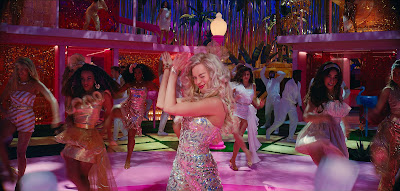
Gerwig opens the movie with gleaming fakery. After a 2001-style origin montage, which winkingly asserts the arrival of Barbie solved every girls’ real-world problems, we meet Stereotypical Barbie (Margot Robbie) living her Dream Life in her own little world. It’s a land full of Barbies—President Barbie, Doctor Barbie, and so on—who rule every profession, and their doting Kens who stand around and smile. (The well-cast world is populated with charmers putting on their best plastic grins.) Every day is a beach paradise, and every night is a dance party. But one night, during a bopping choreographed number to an original Dua Lipa song, she’s suddenly aware of her mortality. As her worry only escalates the next day, she’s informed by Weird Barbie (Kate McKinnon) that she should go to the Real World and find her owner to fix this. The resulting story makes the boundary between her world and ours porous, as her new understandings earned through fish-out-of-water interactions also get into the heads of her fellow Barbies and Kens. Ryan Gosling’s Ken is a particularly amusing vector of this confusion, as he gets hyped up on harmful real-world masculine stereotypes and turns from a purposeless accessory to an amped up parody of maleness. Other Barbie associates always seemed aware of their vestigial status, like real discontinued Ken friend Alan (Michael Cera), and the world-building is so loose and light that the very emptiness of these figures is the point.
While our world’s gender politics intrude on the oblivious Barbie’s consciousness, the movie introduces a real woman (America Ferrera) and her teenage daughter (Ariana Greenblatt) who alternately reject and entertain the fantasy Barbie offers. Here’s that dialectic, as Gerwig’s broad screenplay pushes and pulls at the delights and the dangers of the Barbie society, and our own. The CEO of Mattel (Will Ferrell) wants her back in the box, so to speak, but she’s starting to think she doesn’t like it there. The movie gives Robbie a deceptively complicated part to play—the perfect doll, then the plucky doubter, all while teasing out the slow crumbling of her facade. It’s strangely moving to see. We project so much, for good and ill, on this toy. To see Robbie bring a sense of interiority to the plastic ad-spread design is to see fifty years of feminism collapsing in on her. But there’s a bubblegum snap to the writing, co-scripted by Noah Baumbach, that never lets us forget the silliness of its construction. And there’s inventive filmmaking that continually reveals surprises in cartoony tableau and theatrical flourishes (even a climactic dream ballet), a sparkling, knowing campiness that melts into something genuine about purpose and connection and mothers and daughters and growing older. Gerwig, with Lady Bird and Little Women, made movies that glow with inner life, and here she finds that spark in plastic hearts. Or, to put it even more accurately, the spark is how those plastic people reflect and refract our own self-images. After all, who wants to be boxed in by other’s expectations?
Gerwig opens the movie with gleaming fakery. After a 2001-style origin montage, which winkingly asserts the arrival of Barbie solved every girls’ real-world problems, we meet Stereotypical Barbie (Margot Robbie) living her Dream Life in her own little world. It’s a land full of Barbies—President Barbie, Doctor Barbie, and so on—who rule every profession, and their doting Kens who stand around and smile. (The well-cast world is populated with charmers putting on their best plastic grins.) Every day is a beach paradise, and every night is a dance party. But one night, during a bopping choreographed number to an original Dua Lipa song, she’s suddenly aware of her mortality. As her worry only escalates the next day, she’s informed by Weird Barbie (Kate McKinnon) that she should go to the Real World and find her owner to fix this. The resulting story makes the boundary between her world and ours porous, as her new understandings earned through fish-out-of-water interactions also get into the heads of her fellow Barbies and Kens. Ryan Gosling’s Ken is a particularly amusing vector of this confusion, as he gets hyped up on harmful real-world masculine stereotypes and turns from a purposeless accessory to an amped up parody of maleness. Other Barbie associates always seemed aware of their vestigial status, like real discontinued Ken friend Alan (Michael Cera), and the world-building is so loose and light that the very emptiness of these figures is the point.
While our world’s gender politics intrude on the oblivious Barbie’s consciousness, the movie introduces a real woman (America Ferrera) and her teenage daughter (Ariana Greenblatt) who alternately reject and entertain the fantasy Barbie offers. Here’s that dialectic, as Gerwig’s broad screenplay pushes and pulls at the delights and the dangers of the Barbie society, and our own. The CEO of Mattel (Will Ferrell) wants her back in the box, so to speak, but she’s starting to think she doesn’t like it there. The movie gives Robbie a deceptively complicated part to play—the perfect doll, then the plucky doubter, all while teasing out the slow crumbling of her facade. It’s strangely moving to see. We project so much, for good and ill, on this toy. To see Robbie bring a sense of interiority to the plastic ad-spread design is to see fifty years of feminism collapsing in on her. But there’s a bubblegum snap to the writing, co-scripted by Noah Baumbach, that never lets us forget the silliness of its construction. And there’s inventive filmmaking that continually reveals surprises in cartoony tableau and theatrical flourishes (even a climactic dream ballet), a sparkling, knowing campiness that melts into something genuine about purpose and connection and mothers and daughters and growing older. Gerwig, with Lady Bird and Little Women, made movies that glow with inner life, and here she finds that spark in plastic hearts. Or, to put it even more accurately, the spark is how those plastic people reflect and refract our own self-images. After all, who wants to be boxed in by other’s expectations?
Subscribe to:
Posts (Atom)