Greta Gerwig’s Barbie is a live-action cartoon philosophizing specifically about Barbie’s place in our culture, and gender performativity more broadly. In gleaming pink dollhouse sets against a painted sky, it is artifice in search of a truth. (Squint and you could call it Wes Anderson’s LEGO Movie.) It works, blending bright, sparkling silliness with clever ideas and even some moving earnest heart. That it manages to pull it off well is a post-modern two-step, setting up a dialectic—Barbie is a force for girlish fun and breezy empowerment versus Barbie as pernicious faux-feminist message in a materialistic patriarchal image—that’s somehow simultaneously criticism and advertisement. I’d like to hear how Barbie’s corporate owners let that happen. It’s both an obvious celebration of Barbie-land, and an overt problematization, a rich text that won’t stop explaining itself. The movie has characters flat out speak its ideas and debate their meaning, but it’s so nonstop funny and visually appealing that it rarely feels forced. We’re in a fizzy existential crisis for a movie that’s poppy and peppy and almost profound.
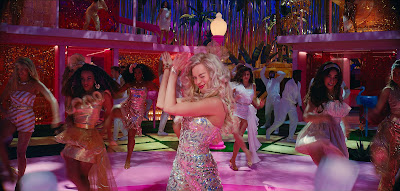
Gerwig opens the movie with gleaming fakery. After a 2001-style origin montage, which winkingly asserts the arrival of Barbie solved every girls’ real-world problems, we meet Stereotypical Barbie (Margot Robbie) living her Dream Life in her own little world. It’s a land full of Barbies—President Barbie, Doctor Barbie, and so on—who rule every profession, and their doting Kens who stand around and smile. (The well-cast world is populated with charmers putting on their best plastic grins.) Every day is a beach paradise, and every night is a dance party. But one night, during a bopping choreographed number to an original Dua Lipa song, she’s suddenly aware of her mortality. As her worry only escalates the next day, she’s informed by Weird Barbie (Kate McKinnon) that she should go to the Real World and find her owner to fix this. The resulting story makes the boundary between her world and ours porous, as her new understandings earned through fish-out-of-water interactions also get into the heads of her fellow Barbies and Kens. Ryan Gosling’s Ken is a particularly amusing vector of this confusion, as he gets hyped up on harmful real-world masculine stereotypes and turns from a purposeless accessory to an amped up parody of maleness. Other Barbie associates always seemed aware of their vestigial status, like real discontinued Ken friend Alan (Michael Cera), and the world-building is so loose and light that the very emptiness of these figures is the point.
While our world’s gender politics intrude on the oblivious Barbie’s consciousness, the movie introduces a real woman (America Ferrera) and her teenage daughter (Ariana Greenblatt) who alternately reject and entertain the fantasy Barbie offers. Here’s that dialectic, as Gerwig’s broad screenplay pushes and pulls at the delights and the dangers of the Barbie society, and our own. The CEO of Mattel (Will Ferrell) wants her back in the box, so to speak, but she’s starting to think she doesn’t like it there. The movie gives Robbie a deceptively complicated part to play—the perfect doll, then the plucky doubter, all while teasing out the slow crumbling of her facade. It’s strangely moving to see. We project so much, for good and ill, on this toy. To see Robbie bring a sense of interiority to the plastic ad-spread design is to see fifty years of feminism collapsing in on her. But there’s a bubblegum snap to the writing, co-scripted by Noah Baumbach, that never lets us forget the silliness of its construction. And there’s inventive filmmaking that continually reveals surprises in cartoony tableau and theatrical flourishes (even a climactic dream ballet), a sparkling, knowing campiness that melts into something genuine about purpose and connection and mothers and daughters and growing older. Gerwig, with Lady Bird and Little Women, made movies that glow with inner life, and here she finds that spark in plastic hearts. Or, to put it even more accurately, the spark is how those plastic people reflect and refract our own self-images. After all, who wants to be boxed in by other’s expectations?
Showing posts with label Noah Baumbach. Show all posts
Thursday, July 27, 2023
Saturday, December 3, 2022
Same As It Ever Was: WHITE NOISE
You can always tell when a filmmaker enjoys reading great literature. There’s the extra understanding of the importance of the shape of a story, an added attention to weaving incident and images with thematic motifs, a patience for constructing dialogue with an ear for layers of meaning and revealing detail. There’s the confidence for letting a story feel like it’s sprawling, even as the pile-up of moments and impressions builds to somewhere intentional. Watching a movie from such a filmmaker—even a partially-successful one—can sometimes activate the English class seminar in me, filling the brain with the pleasing close-reading feeling of getting absorbed in a fascinating narrative and pinging off each noteworthy detail as you build a grand theory of the text.
Noah Baumbach’s always been a clever, verbose screenwriter, with his early efforts like Kicking and Screaming and Mr. Jealousy of a piece with that 90’s wave of East Coast indie wordsmiths, like Whit Stillman and Hal Hartley, who made their bones on dialogue patter with a fine-tuned ear for idiosyncratic character. Lately, though, he’s risen to greater heights, and ever more literate efforts. His Marriage Story is a precise dance of perspective as both partners in a divorce have their foibles and complaints balanced on the fulcrum of what’s best for their child. In its focused generosity of character and anecdote, it has the vibes of a densely imagined ensemble adult drama of the Terms of Endearment or Ordinary People adaptations kind, albeit with more quotidian conflicts instead of tear-jerking tragedy. Fizzy comedies like Mistress America and Frances Ha are shaggy, observational, and quippy like a slim, charming, surprisingly soulful character study. Greenberg has its cranky epistolary hook. Best is his The Meyerowitz Stories (New and Selected), which, from the title on down, plays like the best collections of linked short stories. This one has insight into three generations, interest in art and legacies, empathy for revealing eccentricities and tender connections, and smart repetitions of key lines. That gives it the intimate interior scope of the finest-tuned concision.
His latest is a further expression of his literary tastes: White Noise, an ambitious adaptation of Don DeLillo’s 1985 novel. That classic was a timely satire of middle-class ennui, academia’s tunnel vision, and consumer culture’s mass homogenizing media noise. It’s the story of a small-town college professor (Adam Driver) and his family. He’s an expert in Hitler Studies. His wife (Greta Gerwig) is a frizzy-haired wellness coach and secret addict of experimental pills. They have a Brady Bunch of children from their previous marriages. The first part of the story is a swirling, arch take on campus politics—especially as the professor talks with colleagues, including a new friend (Don Cheadle) who teaches a class on cinematic car crashes and dreams of being the expert in Elvis Studies—and a cozy, overlapping ensemble family dramedy. The second, best, part takes a swerve for the apocalyptic, as a train derailment sparks what’s known euphemistically as an Airborne Toxic Event. The town has to evacuate, cutting short the brewing plot lines and tossing the characters dynamics into a tumbler. These sequences are shot with wide lens complexity and dazzling real-world spectacle—like Altman’s Nashville traffic jam meets the UFO gawkers from Spielberg’s Close Encounters. The final stretch, an extended denouement, returns to resolve some of the threads from before, but the traumas of the middle stretch contaminate. The new dark cloud of mortality that hangs over all.
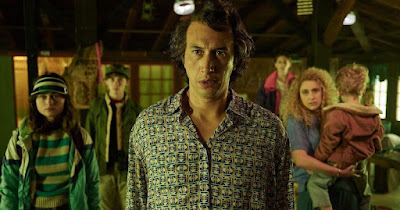
Appearing on our screens now in 2022, the adaptation is somehow even more timely in the midst of a pandemic, and an opioid crisis, and an ongoing erosion of confidence in systems big and small. But to reduce it to the oblique commentary on its 80s times, or ours, is shortchanging it as a work of ideas. It buys into the humanity of its characters and their predicaments, even as the movie operates at a heightened pitch. It swings from quiet, tightly-framed, naturalistic dialogues to loud, highly choreographed, widescreen sequences saturated with colors and lights. In grocery stores and campus cafeterias, the fluorescents practically radiate with an intensity. In the home, crowded with kids and books and nooks and crannies, there’s a cozy hustle and bustle to the more naturalistic textures. In the wilderness, an endless highway and crowded campground, there’s wide open possibility that’s somehow closing in. Here’s a story at least in part about life as a jumble of sensations guided by circumstance and environment that don’t care for you or your systems. And it’s about the meanings we make with, and for, each other to make sense of it in spite of the bombardments of stimulus. “Family,” goes a repeated professorial axiom herein, “is the cradle of misinformation. We’re fragile creatures, and the society we’ve built to obscure that fact is easily strained. A key image has to be an evacuated man angry that their fear hasn’t made the news, and thus isn’t validated, or that that feels the same as not existing at all.
Baumbach stretches his style here with impressive dexterity and scope. He shoots his adaption like a 90s ironic version of a 70s suburban drama—all overlapping dialogue and roaming camera and self-consciously elaborate tableau. Lol Crawley’s cinematography is slick and insistent, not unlike what Conrad Hall brought to American Beauty or how Alan Rudolph half-successfully adapted Vonnegut’s Breakfast of Champions. It’s at once flatly naturalistic and cocked at a half-joking expressionism. Turns out, you tip an 80s consumerist playground or small-town aesthetic just slightly to the left or right and you get a rumbling, believable self-satirizing setting. There’s a high-toned seriousness played for woozy, breezy, frazzled choking smirks. Danny Elfman’s score has pounding carnival horns and soaring theremins and dark, noodling madness—a perfect amalgamation of his collaborations with Tim Burton and Sam Raimi. Together the sound and image create a tension, a lightness, and an inner motor for a movie that bursts with inner life—the suggestion of intellects spiraling. And in the middle is a rather believable family relationship, as Driver and Gerwig and the younger performers make a unit that’s lovably eccentric and unbelievably tossed about by the upsetting events that threaten to tear them apart. There’s something emotive there to hang onto as the movie takes its spins through incidents amusing, frightening, chaotic or cringing. It looks at a world with fears, and denials, and ominous signs of contamination and infection and distraction and despair and says, well, fair enough. But you gotta have hope, too.
The movie, like the book, albeit without slavishly chasing its every rabbit hole, feels caught, and overwhelmed, in a time of transition. DeLillo’s work was in the mode of fascinating 80’s boomer novels—far enough from the incomplete progress of 60’s radicals to feel the failures, and taking the temperature of the very waters that’ll brew the Gen X disaffected distancing. Inspired by this source, Baumbach has copied over its frazzled stream of ideas, a sure-footed confusion, a world bombarded with messages and television and radio dispatches and camcorders and corded telephones. He captures a sense of disruption, and places at its center earnest performances invested in the characters emotions. It’s a neat trick making the people real and their world hyperreal, piling on details verging on surreal—The Event, vivid nightmares, a drop into potential climactic violence—while the characters maintain their sense of self. The film strains to capture these extremes at times, tipping fleetingly into too-clever artifice while trying to play it flat. And without the inner monologue there’s some vagueness around some less convincing plot turns. (What works on the page is sometimes harder to transition on screen, especially the swerves in the final third.) And yet, Baumbach directs like a smart reader, drawing our attention like a tour guide to the ideas and images and people on display. He takes us through a book’s notable ideas, dramatized and stood up on a stage for us to see. Not unlike when Gerwig herself adapted Little Women (easily my favorite classic-book-to-film in many years), the form itself is an argument to return to the text. It may not be a great movie, but, at its best, it can light up one’s brain like one.
Noah Baumbach’s always been a clever, verbose screenwriter, with his early efforts like Kicking and Screaming and Mr. Jealousy of a piece with that 90’s wave of East Coast indie wordsmiths, like Whit Stillman and Hal Hartley, who made their bones on dialogue patter with a fine-tuned ear for idiosyncratic character. Lately, though, he’s risen to greater heights, and ever more literate efforts. His Marriage Story is a precise dance of perspective as both partners in a divorce have their foibles and complaints balanced on the fulcrum of what’s best for their child. In its focused generosity of character and anecdote, it has the vibes of a densely imagined ensemble adult drama of the Terms of Endearment or Ordinary People adaptations kind, albeit with more quotidian conflicts instead of tear-jerking tragedy. Fizzy comedies like Mistress America and Frances Ha are shaggy, observational, and quippy like a slim, charming, surprisingly soulful character study. Greenberg has its cranky epistolary hook. Best is his The Meyerowitz Stories (New and Selected), which, from the title on down, plays like the best collections of linked short stories. This one has insight into three generations, interest in art and legacies, empathy for revealing eccentricities and tender connections, and smart repetitions of key lines. That gives it the intimate interior scope of the finest-tuned concision.
His latest is a further expression of his literary tastes: White Noise, an ambitious adaptation of Don DeLillo’s 1985 novel. That classic was a timely satire of middle-class ennui, academia’s tunnel vision, and consumer culture’s mass homogenizing media noise. It’s the story of a small-town college professor (Adam Driver) and his family. He’s an expert in Hitler Studies. His wife (Greta Gerwig) is a frizzy-haired wellness coach and secret addict of experimental pills. They have a Brady Bunch of children from their previous marriages. The first part of the story is a swirling, arch take on campus politics—especially as the professor talks with colleagues, including a new friend (Don Cheadle) who teaches a class on cinematic car crashes and dreams of being the expert in Elvis Studies—and a cozy, overlapping ensemble family dramedy. The second, best, part takes a swerve for the apocalyptic, as a train derailment sparks what’s known euphemistically as an Airborne Toxic Event. The town has to evacuate, cutting short the brewing plot lines and tossing the characters dynamics into a tumbler. These sequences are shot with wide lens complexity and dazzling real-world spectacle—like Altman’s Nashville traffic jam meets the UFO gawkers from Spielberg’s Close Encounters. The final stretch, an extended denouement, returns to resolve some of the threads from before, but the traumas of the middle stretch contaminate. The new dark cloud of mortality that hangs over all.
Appearing on our screens now in 2022, the adaptation is somehow even more timely in the midst of a pandemic, and an opioid crisis, and an ongoing erosion of confidence in systems big and small. But to reduce it to the oblique commentary on its 80s times, or ours, is shortchanging it as a work of ideas. It buys into the humanity of its characters and their predicaments, even as the movie operates at a heightened pitch. It swings from quiet, tightly-framed, naturalistic dialogues to loud, highly choreographed, widescreen sequences saturated with colors and lights. In grocery stores and campus cafeterias, the fluorescents practically radiate with an intensity. In the home, crowded with kids and books and nooks and crannies, there’s a cozy hustle and bustle to the more naturalistic textures. In the wilderness, an endless highway and crowded campground, there’s wide open possibility that’s somehow closing in. Here’s a story at least in part about life as a jumble of sensations guided by circumstance and environment that don’t care for you or your systems. And it’s about the meanings we make with, and for, each other to make sense of it in spite of the bombardments of stimulus. “Family,” goes a repeated professorial axiom herein, “is the cradle of misinformation. We’re fragile creatures, and the society we’ve built to obscure that fact is easily strained. A key image has to be an evacuated man angry that their fear hasn’t made the news, and thus isn’t validated, or that that feels the same as not existing at all.
Baumbach stretches his style here with impressive dexterity and scope. He shoots his adaption like a 90s ironic version of a 70s suburban drama—all overlapping dialogue and roaming camera and self-consciously elaborate tableau. Lol Crawley’s cinematography is slick and insistent, not unlike what Conrad Hall brought to American Beauty or how Alan Rudolph half-successfully adapted Vonnegut’s Breakfast of Champions. It’s at once flatly naturalistic and cocked at a half-joking expressionism. Turns out, you tip an 80s consumerist playground or small-town aesthetic just slightly to the left or right and you get a rumbling, believable self-satirizing setting. There’s a high-toned seriousness played for woozy, breezy, frazzled choking smirks. Danny Elfman’s score has pounding carnival horns and soaring theremins and dark, noodling madness—a perfect amalgamation of his collaborations with Tim Burton and Sam Raimi. Together the sound and image create a tension, a lightness, and an inner motor for a movie that bursts with inner life—the suggestion of intellects spiraling. And in the middle is a rather believable family relationship, as Driver and Gerwig and the younger performers make a unit that’s lovably eccentric and unbelievably tossed about by the upsetting events that threaten to tear them apart. There’s something emotive there to hang onto as the movie takes its spins through incidents amusing, frightening, chaotic or cringing. It looks at a world with fears, and denials, and ominous signs of contamination and infection and distraction and despair and says, well, fair enough. But you gotta have hope, too.
The movie, like the book, albeit without slavishly chasing its every rabbit hole, feels caught, and overwhelmed, in a time of transition. DeLillo’s work was in the mode of fascinating 80’s boomer novels—far enough from the incomplete progress of 60’s radicals to feel the failures, and taking the temperature of the very waters that’ll brew the Gen X disaffected distancing. Inspired by this source, Baumbach has copied over its frazzled stream of ideas, a sure-footed confusion, a world bombarded with messages and television and radio dispatches and camcorders and corded telephones. He captures a sense of disruption, and places at its center earnest performances invested in the characters emotions. It’s a neat trick making the people real and their world hyperreal, piling on details verging on surreal—The Event, vivid nightmares, a drop into potential climactic violence—while the characters maintain their sense of self. The film strains to capture these extremes at times, tipping fleetingly into too-clever artifice while trying to play it flat. And without the inner monologue there’s some vagueness around some less convincing plot turns. (What works on the page is sometimes harder to transition on screen, especially the swerves in the final third.) And yet, Baumbach directs like a smart reader, drawing our attention like a tour guide to the ideas and images and people on display. He takes us through a book’s notable ideas, dramatized and stood up on a stage for us to see. Not unlike when Gerwig herself adapted Little Women (easily my favorite classic-book-to-film in many years), the form itself is an argument to return to the text. It may not be a great movie, but, at its best, it can light up one’s brain like one.
Labels:
Adam Driver,
Greta Gerwig,
Noah Baumbach
No comments:
Wednesday, September 9, 2015
Everybody Here Wanted Something More:
MISTRESS AMERICA
“Welcome to the Great White Way!” Brooke declares from the
middle of the glowing staircase in Times Square, arms outstretched in a
glamorous convivial gesture. She wants to make a good impression, since she’s
meeting her soon-to-be stepsister for the first time. It’s just too bad that
she shouted her greeting too early, and so gingerly makes her way down the
steps while awkwardly holding her pose, flashes of panic on her face as she
tries not to trip. This early scene in Mistress
America, Noah Baumbach’s new comedy, is a snapshot of the relationship at
its core, one woman looking up to, and yet aware of the flaws of, another. The
difference between the spectacular moments in their minds and the sad realities
bringing them down, between grand intentions and wobbly reality, is mined for
hilarity, but also for great empathy.
These are two women trying to forge their identities in the
crucible of New York City, bound together by nothing more than the impending
marriage of one’s father to the other’s mother. What they make of this new connection
is as funny as it is revealing. The bouncy score (by Luna’s Britta Phillips and
Dean Wareham) motors a comedy of complicated characters, a nicely drawn charmer
gaining sharp insight and quick laughs by creating characters specifically
drawn and deeply felt. Brooke, a sunny 30-year-old, has been living in the city
for several years. The younger is Tracy, a fresh-faced 18, just moved in from
the suburbs to attend college. Tracy is pulled immediately into Brooke’s
magnetic orbit, instantly enamored with a new big sister who personifies
everything she thought life as a young adult in New York should be:
interesting, funny, ambitious, connected, with sharp fashion sense and the
charm to be the life of every party.
Lola Kirke plays Tracy with a look of shy awe, feeling lucky
to have found such a perfect mentor to guide her into a glamorous and
productive adulthood. Taken under the wing of this new friend, she’s led out to
bars, clubs, concerts, and hipster hangouts, even allowed to crash on the couch
in a homey studio apartment hidden illegally in a commercially zoned building.
Creative juices flowing, she begins to write a short story inspired by Brooke,
lovely precocious freshman prose that becomes warm narration throughout. There
we discover the sharp observations Tracy has, the kind Brooke would never stop
to consider about herself. And what a character Brooke is! Played by Greta
Gerwig, who also co-wrote with her Frances
Ha partner Baumbach, she's a bubbly extrovert charging through every
scenario convinced she’s the master of the universe.
She shows up at all the best places, possesses a tremendous
clarity about her goals (she wants to start a restaurant where people can also
shop, and get their haircut, and more), and is eager to invite a younger friend
into her life as a prop (to show off, and to use as support). Is it a real
friendship the women create? Who’s to say? Brooke’s one of those people who
seems to know everyone and be close friends with most of them. Still, the
genius in Gerwig’s performance of boundless energy and daffy quotability (“I don’t
know if you’re a zen master or a sociopath,” she tells a deadpan friend) is her
ability to casually pick holes in Brooke’s façade. She’s desperate to be
considered a success, fills every silence with hollow patter, and mercilessly
observes everyone’s flaws but her own. Her constant movement and talk serves as
a way to throw doubt and insecurities away from herself and on to others.
What Baumbach and Gerwig create is a portrait of a woman who
is a dazzling frazzled idea machine, creative but without good
follow-through. She’s totally lovable, but spiked with off-putting
self-involvement. At one point, she encounters an old high school classmate who
confesses memories of her as a hurtful bully. Brooke nonchalantly confesses she
can’t feel sorry since she doesn’t remember. It’s ice cold, and seemingly
doesn’t impact the rest of her chipper conversation to which she immediately
returns. We follow Brooke and Tracy through a collection of beautifully executed
comic scenarios populated with broad types who quickly become fully fleshed
people whose loves and lives and dreams really matter. The scene with the old
classmate has such an impact because of the instant humanity it observes. We
see how difficult it is to have your self-image interrupted by a view from
outside your head, and how much easier it would be to not let such perspective
cloud your good time.
An endlessly witty confection worth savoring on a
line-by-line basis, the film forges a real and tangible connection to its
characters while sharply observing modern social dynamics. We meet some self-serious college kids (Matthew Shear and Jasmine
Cephas Jones) and bunch of wealthy Connecticut suburbanites (including Michael
Chernus and Heather Lind, who Brooke considers her “nemesis”) as the movie
builds to a lengthy farcical climax. It teases out its casual ideas about
gender politics and income inequality as punchlines roll in rapid waves. But
what’s most satisfying is the patient and casually moving moments that follow,
bringing its unsettled threads together as characters finally must reckon with
the impact of their actions and relationships.
It’s probably Baumbach’s most sweetly affectionate film,
certainly less openly acidic than something like The Squid and the Whale or Greenberg,
though just as cynical in its softer way. The movie allows its characters to be
figures of fun and yet nonjudgmentally free to be who they are. It gets what
it’s like to enjoy someone’s presence, without really buying into the persona
they’re selling, just as surely as it knows the hustle it takes to make a life
for yourself outside the homogenous norm. The movie respects its characters' flaws while allowing them room for potential and growth, and it is all the
sunnier for it. Call it the Gerwig effect. She brings out the best in Baumbach.
With casually beautiful framing and perfectly timed editing (from Sam Levy and
Jennifer Lame, respectively, who were also key Frances Ha collaborators), Baumbach makes Mistress America a light and energetic comedy of dialogue and
manners that manages to draw real and modern emotional truths in the process.
Friday, April 24, 2015
Old's Story: WHILE WE'RE YOUNG
There’s a scene in Noah Baumbach’s bracing character study Greenberg where the eponymous middle-aged
curmudgeon played by Ben Stiller finds himself in the middle of a young
person’s party. He sits on the couch talking to energetic teens, is intimidated
by their confidence, and concludes, “I’m freaked out by you kids.” That’s just
one scene in the movie, the broad strokes with which the youngsters are drawn
excusable as a concept to push Stiller’s character out of his comfort zone.
Baumbach’s new low-key comedy While We’re
Young essentially stretches Greenberg’s
party scene to feature length, finding a contentedly neurotic fortyish married
couple (Stiller and Naomi Watts) drawn into a relationship with easygoing hipsters
(Adam Driver and Amanda Seyfried) who alternately attract and repel them.
The film sets up an interesting dynamic, with Stiller and
Watts feeling displaced by their generational cohort’s baby-having ways. Friends
(like Maria Dizzia and Adam Horovitz) are disappearing into this different
middle-aged demographic, so Stiller and Watts try to fit in with Driver and
Seyfried’s crowd despite obvious confusion and discomfort over a lifestyle of twee
handcrafted locavore retro-kitsch irony. The older couple still feels young,
like they’re only pretending to be grown-ups. But confronting the alluring and
confusing ways of the young folks forces them to choose between regressing in a
return trip to extended adolescence or embracing the comforting steady grind of
adulthood. They try out a new routine and see how it fits, a form of generation
gap tourism.
A soft and comfortable film, the result lacks precision.
Where’s the well-observed bitterness of Greenberg,
or the sweet youthful energy of his previous film, the charming twentysomethings’
comedy Frances Ha? Baumbach has seen
the age gap from both sides in better films, so it’s harder to accept the mushy
generalizations and broad caricaturing at work here. It's still, in the typical Baumbach approach, full of
characters who think they’re one clarifying conversation away from a better,
more fulfilling life, and yet keep talking themselves back into corners of
their own making. They leave each scene feeling worse than they were before. On some level it works. But here the lines are fuzzy more than
sharp. Stiller and Watts make the most of their pleasant banter, able to slide
easily into prickly married-life arguments. But Driver and Seyfried float through
on a cloud of pixie dust as magical bewitching younger people, contrasts and
sometimes foils, but never fully alive.
The young couple is a collection of stereotypes, a jumble of
traits meant to make them specific and yet only serves to make them unknowable.
He wants to be a documentarian, loves vinyl and VHS, hates social media, raises
chickens, and encourages his partner’s burgeoning homemade ice cream business.
You can tell on a surface level why that’d be exciting for a couple who otherwise
spends their time avoiding pals’ children, chatting about arthritis, academia, and
business meetings, and then going to bed early. But there’s no sense of who Stiller
and Watts were as younger people, or what they’re trying to reclaim by hanging
around these willowy strawmen who drag them to block parties and New Age shaman
cleanses. Eventually, as the younger people prove more calculating than they
first appear, the plot returns our middle-aged protagonists to the comfort of
their generation, suspicious of young people all the more.
The final shots of the film confirm this fear of youth as we
watch a baby expertly manipulate an iPhone, then cut back to Stiller and Watts
pulling horrified faces. What is this world coming to? How can people of such
different worlds coexist? While We’re
Young’s not so sure they can, or should. The writing is full of prickly
barbs, one part sublimated Borscht Belt and one part relaxed New Hollywood
indie, the bright and sprightly Woody Allen-style New York City imagery hopping
along bridging the gap. The cast (including a welcome, but small, role for the
great Charles Grodin) spits the lines with great aplomb and winning chemistry.
But Baumbach’s usual emotional specificity is stale, even strained, here. I saw
where he was going, poking fun at youthful affectations and aging insecurities
alike, but it never rose past the level of thinly imagined sketch.
Tuesday, June 4, 2013
To Live Her Life: FRANCES HA
Frances Ha is a
trifle – loose, casual, light – but a rich one, full of unexpected layers of
sweetness and surprise complexity. Writer-director Noah Baumbach, he of more
emotionally unpleasant, though no less thrilling, character pieces like The Squid and the Whale and Greenberg, brings his rawness to a
character who is so charming and resilient that it’s hard not to like her. The
film follows Frances (Greta Gerwig), a 27-year-old underemployed New Yorker who
bounces around small apartments, hangs out with her best friend (Mickey Sumner),
goes to parties, makes some money at a rapidly dead-ending job, and circles
endlessly for a good way to improve her position in life. She, as one character
matter-of-factly lets her know, is old without being grown-up.
Shot in appealing black and white photography and set to a
jazzy soundtrack that draws upon French New Wave composers Georges Delerue and
Jean Constantin as well as great uses of pop like David Bowie’s “Modern Love” and
Hot Chocolate’s “Every1’s a Winner,” the film pulses with an energy that has to
skip along to keep up with Frances and her aimless restlessness. She’s
continually pushing towards her goals of self-sufficient adulthood, a drive she
will usually undercut through some combination of shortsighted thinking and
self-doubt. This gives every scene, so carefully observed and precisely
performed despite a loose tone, a near-imperceptible anxiety, even when she’s
making moves towards some degree of comfort, rooming with a friend or becoming
buddies with two sometimes-charming wannabe artists (Adam Driver and Michael
Zegen) with lifestyles bankrolled reluctantly, they claim, by generous family.
Often very funny, the film gets big laughs not necessarily out
of jokes, but out of situations and interpersonal dynamics so sharply drawn
that recognition and empathy spark chuckles. A scene in which Frances finds
herself at a dinner party with more accomplished peers plays humorously off of
the ways in which she stretches to ingratiate herself as an intellectual –
not-so-casually referencing how much she reads – and failing when defaulting to
post-collegiate gossip and introspection so haphazardly philosophical she starts
to fear she sounds stoned and says as much. The movie’s setting amid those
privileged to live lives of such purposeful searching touches upon issues of
class and economic conditions, but Baumbach neither cheapens them nor lets them
overwhelm the film’s modest character sketch goals and good humor. When Frances
hesitates at the ATM when confronted with the fee to be charged, it’s resonant
without being heavy-handed. And that’s the way Baumbach and his cast operates
here, with a film so light and enjoyable that the resonances and comedy appear
casually, naturally.
This is the kind of film that’s a great delight mainly
(though not only) for the way it introduces us to an interesting, appealing
character. As played by Gerwig, who is also the co-writer, Frances is a person we
like spending time with and want to see succeed. Throughout the film’s
episodes, she seems to drift away from her goals, finding her way forward through
trial and error, but Gerwig deploys winning misdirection in her encounters. Frances may be desperate, even depressed at times, but she diverts her acquaintances’
and colleagues’ attention with affected optimism that’s maybe truer than even
she believes. Gerwig has a great physicality here, matching her winning line
readings and occasional monologues, beautifully precise and unfussy turns of
phrase, with a sense of movement and nonverbal reaction that finds exactly the
right emotion to communicate. Gerwig’s performance is the kind that pulls focus
without distracting: a real star turn.
It’s refreshing to see a film that takes women seriously by
treating female friendship as real nuanced relationships instead of secondary
concerns to romantic relationships with men. Frances interacts with her friends
with a mixture of love and antagonism, competition and compassion, a mixture
that shifts, grows, and evolves. Perhaps not since Whit Stillman’s The Last Days of Disco has there been a
film so truthful about this. Frances Ha
is a film about a young woman striving towards a better life without once
feeling the need to make her future contingent upon her romantic prospects.
Instead, she simply exists amongst a group of people in a film that provides
each and every character with a generous sense of a life lived. Some gentle fun
may be poked at broad generalizations – yuppies, parents, hipsters – but each
character comes into the picture with a past unspoken and leaves with a sense
that their life continues beyond the frame. It’s a sharply written comedy with
a light touch, but one that rings with truth.
Sunday, June 10, 2012
Three-Ring Boredom: MADAGASCAR 3: EUROPE'S MOST WANTED
What is there to say about Madagascar 3: Europe’s Most Wanted? At this point you already know
if you like this sort of thing. It’s the latest in Dreamworks Animation’s
series about animals that, in the original film, went from a zoo in New York City to the wilds of Madagascar, then into deepest Africa in the sequel. Now,
the group of wacky creatures (blandly voiced by Ben Stiller, Chris Rock, David
Schwimmer, and Jada Pinkett Smith) is on the move again. Has there been a
series of kids’ movies with a more aggressively uncharismatic ensemble of
characters? I’ve never once cared about the lion, zebra, giraffe, and hippo
that bumble around so dully in the protagonist roles. I couldn’t even tell you
the first thing about their personalities. The lion’s vain, I guess? The
giraffe’s kind of nervous quite a bit? That sounds about right. The point is,
my affection for the series is awfully low. I walk in to the theater, the movie
happens, and then I walk out. I don’t love them or hate them. They just are and
they’re not for me. I can’t care about such generic cartoon critters.
No, all the fun characters – what few there are, that is –
can be found around the margins. I like the reasonably silly penguins (funny
enough to get their own spin-off cartoon series that ditches the dead weight of
those lame leads) and an agreeably wacky vocal performance from Sacha Baron
Cohen as a deluded lemur king. It’s with these characters that the movies
threaten to break off into something altogether more enjoyable. In this movie the whole group is trying
to get back to America, but have somehow ended up in Europe. They’re forced to
join the circus to hide from a competently villainous new character, a
seemingly indestructible French animal-control meanie, Captain DuBois (Frances
McDormand in a thick, thick accent). It’s a good thing that the story clutters
up with partially amusing distractions like DuBois, as well as a train full of
circus critters like a gruff tiger (Bryan Cranston), a silly sea lion (Martin
Short), and a nice leopard (Jessica Chastain). They’re not all that fleshed
out, either, but at least the ensemble swells to take your mind off of the real
leads.
The story here (cobbled together by series regular Eric
Darnell and Noah Baumbach, of all people) is awfully dull and predictable,
adhering to an undisguised and uncomplicated three-act structure that plods
along like most low-functioning family films. It’s essentially a creaky tumble
of colorful animation and wacky voices mixed in with grating pop culture
references and obvious music cues. What helps it not be completely terrible is
the way directors Eric Darnell, Tom McGrath, and Conrad Vernon seem to push
against the plot and just make things tumble over in free-form silliness from
time to time. The actual jokes fall flatter than flat, but some sequences have meager
visual whimsy. All of the best scenes, and there are some good ones, could be
nice, wacky shorts in a Looney Tunes style.
I liked when the lemur falls in love with a bear and together they ride the
bear’s tricycle through Vatican City in a romantic montage set to “Con Te
Partirò.” And it’s worth a chuckle when DuBois escapes from a grimy Italian
prison by hiding inside a mattress. That’s not to mention the big opening
sequence in which the animals are chased around Monte Carlo in a brisk and
funny slapstick chase. And there are a couple of big circus setpieces that are
pleasing neon 3D swirls. But, like usual, all of these highlights are mostly
secondary to the unremarkable stories of the main characters.
I suppose people like these movies or else they wouldn’t be
so profitable. I’m just not one of those people. This is a series that has
always felt tired to me, right from the beginning. I went to this third
installment not expecting much and got a little more than I expected anyways.
There are fleeting moments of smile-worthy goofiness and plenty of objects
thrust out through the fourth wall to take advantage of the 3D. I guess I liked
this the best out of the Madagascars,
even though that’s not saying much. I still don’t care much for these
characters and the movie doesn’t even try to get the unconverted there. I
couldn’t care less if they made it back to New York, but as long as the movie
crashed through common sense and indulged it’s silliest side-characters’
antics, I could be distracted just enough not to care that I didn’t care. The
instant the credits rolled, the movie began to leave my mind. There’s nothing
wrong with these Madagascar movies
that better jokes, better stories, and more memorable main characters couldn’t
fix.
Subscribe to:
Posts (Atom)


