Showing posts with label Wachowskis. Show all posts

Thursday, December 23, 2021

Version Control: THE MATRIX RESURRECTIONS

There’s something romantic amid The Matrix Resurrections’ bafflements—a grasping, yearning, swooning desire for connection—that might surprise those who remember the original trilogy mostly for its trench coats, machine guns, mind-bending reveals, and nu-metal soundtrack. But wasn’t this always a series about learning to reconcile the parts of oneself, and one’s world, and to hold close those whose love holds the key to The Truth? Like so many franchise pictures these days, Resurrections is a reboot about reboots, a movie about itself. But unlike other properties doomed to grow ever-more airless and walled off from real emotion, here’s one that explodes out the emotional world of its predecessors in big, bold, busy ways, growing more overtly expressionistic and sentimental. Writer-director Lana Wachowski lovingly, yet not uncritically, returns solo to the world she and her sister Lilly created over twenty years ago and finds that it’s changed in passionate, provocative, and confusing ways.

She, co-writing with screenwriter Aleksandar Hemon and novelist David Mitchell, decided that Neo (Keanu Reeves), the self-sacrificing hero of the super cool, genre-busting, paradigm-shifting originals has found himself, post-death, recreated and plugged back into The Matrix. He doesn’t remember the events of those movies, or rather remembers them incorrectly, or rather thinks of them in the wrong category entirely. Almost. That’s when it’s clear Wachowski is making no mere remake or legacy sequel only drifting off nostalgia, although it is. Even more it’s a recreation and refutation, a continuation and complication. Once again characters are separated from their true selves, and true loves, and true worlds. Machines strain against their coding and people struggle to reconcile the paradoxes of a buggy program called life. Thus the movie’s thrillingly dense and bafflingly never quite what you think it’ll be, steering hard into philosophical and psychological dilemmas that always formed the structure of this series’ sensational action spectacle. It makes for a heady trip.

You see, instead of Neo once again learning that what we think is reality is, in fact, a digital construct fed to us by a ruling class of advanced robots to keep humans captive in pods of goo that are their energy source, he’s a coder for a tech company who thinks that story is the plot of their most famous games. A trilogy of them. What better way to make a people forget that they’re in that simulation than make them think The Truth is mere fiction? When Neo’s boss  (Jonathan Groff) calls him in to say the moneymen want to exploit the I.P. again he’s told “Warner Brothers is making Matrix 4 with or without” them. Here’s a sequel spinning games within games, in which a focus group is called in to stand in for Matrix fans discussing theories about what it was all about, man. It’s about trans self-actualization; or it’s about simulation theory; maybe it’s all about the bullet time. All of the above, Wachowski says. And wait’ll you see where it goes from there. Neo’s therapist (Neil Patrick Harris) is concerned that his patient’s reality is blurring—we see flashes of the earlier movies, echoes of sequences past that rattle around in moments of tingling deja vu. There’s something real and unreal at the same time, ripples from conflicts and debates in the so-called real world shaking the foundations of the green lines of code.
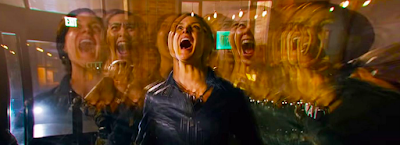
Neo is more lost than ever, imbued with the knowledge he needs yet all the more resistant to the truth for having buried it in plain sight. Trinity (Carrie-Anne Moss), his soul mate in kung-fu, and love, is also resurrected in the Matrix. But she’s been pushed even deeper into the computer’s fiction. As they find themselves drawn by destiny, by programming, by happenstance, by fate to reconnect with each other and themselves, a host of returning characters and new faces (coolest has to be the blue-haired Jessica Henwick as rogue freedom-fighter Bugs—“like Bunny,” she quips) and some returning characters in new faces (Yahya Abdul-Mateen II, making a habit of that sort of thing) line up along scrambled battle-lines leftover from the old revolution. The proceedings get ever more complicated. But even in the long stretches where I wasn’t quite sure what was happening or what outcome to root for, there’s that central yearning. That’s what makes it romantic—that strong surge of emotion, that plaintive push toward greater understanding of oneself and one’s loved ones. Reeves and Moss haven’t missed a step from their earlier performances, slipping easily into the human avatars of the fake world and the broken real humanity beneath—synthesized in the eventual uneasy steps back toward digital superheroes. It’s still a world of point-and-click prophecy and computerized spirituality, of shifting perspectives and cyclical conflicts. And Wachowski clearly loves her characters—and wants to see them reawaken to their full potential as much as we do.

The result is just as much a knotty puzzle of a head-fake, mind-bender as the originals—but woolier and more static, with a meandering central drive that’s sometimes as lost as its characters. In its long scenes of exposition spoken intently by the large cast, it pays off the intense, long-lived conversations from those who undertook the amateur field of Matrix studies seriously those decades ago. (Remember the philosophers’ commentaries from the DVDs? I hope that roundtable is reconvened for this one.) The movie can be playfully meta-textual, and even knowingly self-parodic, as it relentlessly plays with expectations. I didn’t always find it as immediately gripping or legible as the originals. It’s less self-consciously cool and stingier in action, but it’s still rich in ideas and has swelling heartfelt expressions of human (and inter-human) connection, and shot with a warm energy in sumptuous light and slick effects. And some stuff blows up. When in motion, the movie’s a shock of recognition but, successfully and unsuccessfully, chopped up, remixed, edited to ribbons, and smoothed out in new and bewildering ways. It may not always be legible, and lacks the immediacy and palpable visual pleasures of its progenitors, but its heart is in the right place.

This is the distinctive work of a filmmaker who has stylishly, entertainingly drawn out these ideas—of humans caught in a system built to grind them down, and who assert their passions and humanity against all odds—with her usual co-writer/director sister through Speed Racer’s masterpiece of hyperactive anime homage, Cloud Atlas’s six-fold cross-cut reincarnated melodramas, and Sense8’s dazzlingly sensual sci-fi poly-psychic mind-blender series. So it should be no surprise to find her returning to The Matrix with a totally earnest extension of the originals’ cyberpunk Plato’s cave. It meets our moment of accelerated techno-dystopian alienation and confusion with its own, and lets some love shine through the cracks. How romantic.

Friday, February 6, 2015

Spaced Out: JUPITER ASCENDING


Jupiter Ascending is an all-you-can-eat sci-fi smorgasbord. Writer-directors Andy and Lana Wachowski provide a generous spread filled with way more than one person, or, as it turns out, one film could possible devour in one sitting. It’s a big goofy space opera serving non-stop silly names, strange creatures, intergalactic scheming, gobbledygook jargon, majestic CGI vistas, swooshing spaceships, and laser guns that go pew-pew-kaZAAp, all wrapped up in an impenetrably convoluted mythos. Unlike the Wachowski’s Matrix trilogy, which invited a casual view deeper and deeper down a nutso rabbit hole, this offering is crazy from the jump. They’ve gotten so far into their worldbuilding they’ve forgotten to leave an entry point for the rest of us. I don’t mean to give off the impression that I hated it. On the contrary, I admired its idiosyncrasies, but only to a point. I felt perpetually on the outside looking in.

At least the view’s nice. It has spectacular production design, from spaceships that look like sea-creatures with throne-room interiors, to massive steam-punk factories nestled in gas giants, whirring robots, ornate gowns, glowing gewgaws and weird alien thingamabobs from gravity boots to memory wipes and high-tech paperwork. It has a sweeping Michael Giacchino score in full pa-rum-pa-pum-pum epic swelling mode, immersive bleeping and rumbling soundscapes, and a bevy of hilarious camp voices. So it looks and sounds like a great pulp space adventure. But for all its whiz-bang flash and sizzle, as clean and shiny as anything the Wachowski’s have made, it’s chintzy on a human scale, with ridiculous characters, hazy motivations, and an overcomplicated story that’s at once too much and too little. It’s both overstuffed and thinly repetitive.

What, exactly, is supposed to be happening amidst the shimmery sci-fi frippery on display? Well, you see, there’s this cleaning lady (Mila Kunis) who, after the movie's weirdly scattered and confused false starts, agrees to sell her eggs to help her illegal immigrant family. Strange place to start, but the movie doesn't seem to care. It’s just a place where she can be attacked by evil alien bounty hunters and saved at the last minute by a dashing space guy, Channing Tatum with elvish ears and a wolfish grin. He eventually takes her to space, where three wealthy warring alien siblings (Eddie Redmayne, Tuppence Middleton, and Douglas Booth) each want her captured for their individual purposes. Turns out she’s a reincarnation of their mother, a matriarch in a race of practically ageless aliens who seeded the Earth with human DNA millennia ago and are ready to collect their harvest.

They want to trick Kunis into giving up the rights to Earth, since their mother left her eventual reincarnation that very planet in her will. Make sense? It takes more than an hour to introduce all these stakes, as we head to each evil sibling one at a time in episodic encounters, each more dangerous than the last. Allegiances shift, strange creatures and rituals appear, and elaborate background is filled in, like learning Tatum is an animal-human hybrid – part dog, part man – with a complicated sketchy past. Elsewhere we see a part-bee man named Stinger (Sean Bean), armies of winged dinosaur things in trench coats, and a man-sized pilot with the face of an elephant. (When given an order, he trumpets with determination.) It’s fun, but exhausting keeping up with the free-floating oddities that never seem to connect with any real purpose. They’re laid out in earnestly campy detail, so at least some of the giggles these concepts provoke are intentional delight.

It should be a simple story of empowerment, with Kunis as a special person who discovers her alien gifts and ascends to a place of power in the galaxy while interacting with weird beasties and strange beings. Instead, she flails and falls through busy CGI spectacle, bounced helplessly from one elaborate plot point to the next. Those who erroneously claim the Star Wars prequels are only about trade routes won’t be happy to find that Jupiter Ascending is literally only a fight over the deed to Earth. Now, granted, it has energetic action, vials of youth serum, warring factions of creature-people, and nods towards usual Wachowski themes of destiny, reincarnation, conspiracies, redemption, consumption, and rampaging capitalism. And the actors are up for the mood of the thing, with Kunis and Tatum going totally sincere, and others like Redmayne going batty with affected whispery high-pitch mumbling and stiff movements.

But with only the barest rooting interest in any character’s plight, it’s hard to care about the serious craziness on screen. It’s a film of incredible sights put to use muddling through the political machinations of a galactic oligarchy, half-hearted self-actualization, and a totally unbelievable romantic subplot. Throughout, obvious apocalyptic stakes are weirdly downplayed, the main narrative and emotional thrusts drifting away. I appreciated the Wachowskis’ commitment to loony concepts. Keep in mind I think Speed Racer is their best work. But they didn’t crack this narrative open in any compelling way. There’s a fun movie hidden somewhere in Jupiter Ascending's confusion of dropped plot lines and ridiculous implications, but they didn’t quite find it. Perhaps it’s no surprise to find buried with this mess a cameo from Terry Gilliam, the patron saint auteur of fantasy follies. This movie may not work, but it’s the kind of distinctive, eccentric, personal failure I find hard to dismiss entirely.

Monday, October 29, 2012

What is Any Ocean but a Multitude of Drops? CLOUD ATLAS


Starting with nothing less than a Homeric incantation in which a white-haired old man stares into a crackling fire and seems to summon the fiction into being, Cloud Atlas, an ambitious adaptation of David Mitchell’s tricky novel, is the kind of movie that’s easy to recommend and admire, if for no other reason than that nothing quite like it has ever existed and is unlikely to come around again any time soon. It wobbles at times, but luckily it’s ultimately better than the sum of its gimmicks. This is a complicated film about simple truths: love, ambition, knowledge, power. A major motif is a musical composition that one of the characters writes called “The Cloud Atlas Sextet.” It’s a lush, haunting piece of music that winds its way through the soundtrack and, by its very nature, echoes the major structural conceit of the film. A sextet is a piece of music to be played by six musicians. This film – like the novel before it – contains six stories, any one of which could easily expand into its own film, but together combine into one gorgeous whole.

Spanning centuries and genres, the film breaks apart the book’s chronological and mirrored presentation and instead places the six stories parallel to each other, cutting between the stories with a gleeful, witty, dexterous montage that recalls D.W. Griffith’s 1916 feature Intolerance in the way it so skillfully weaves in and out of varying plotlines. A massive undertaking, three directors, Tom Tykwer (of Run Lola Run and Perfume: The Story of a Murderer) and Lana and Andy Wachowski (of The Matrix films and Speed Racer) split the six sections among them, adapting and directing separately but from a shared common vision so that the story flows both stylistically and emotionally. Like some strange geometric object with many sides and layers, the film grows all the more epic by expanding outwards through time and space.

It takes us to the Pacific Ocean in the nineteenth century aboard a ship sailing towards America. Then, we’re in Europe in the 1930s, following a disinherited, but ambitious and talented, music student to the home of an elderly composer. Next, we’re in 1970s America, following an intrepid reporter into a conspiracy at a new nuclear power plant. On to the present, where we find a publisher who is the victim of a mean brotherly prank and stuck in an unexpected place. Then we’re to the future, where a clone slave describes her story of finding awareness of the consumerist dystopia she lives in. Finally, to the far future, where we find a post-apocalyptic world that has returned to clannish living in the wilderness, where the peaceful people are terrorized by a tribe of aggressive cannibals. Tykwer and the Wachowskis present each setting with handsomely realized production design and detailed special effects. Moving between them is anything but disorienting; it’s, more often than not, invigorating.

Almost too much to handle in one sitting, this film is a rush of character and incident, themes and patterns, echoes upon echoes, all distinctive melodies that fade and reoccur time and again. Some sequences play more successfully than others, but the film is largely fascinating and generally gripping as it becomes a symphony of imagery and genre, returning again and again to mistakes humankind makes, the benefits and constraints of orderly society, and the way underdogs try to find the right thing to do against all odds. The themes play out repeatedly in a flurry of glancingly interconnected genre variations. What appears as drama later plays as comedy, as action, as mystery, as tragedy. Tykwer and the Wachowskis have put the film together in such a way that the editing escalates with the intensity of each plotline, bouncing in an echoing flurry during rhyming plot points (escapes, reversals of fortune, setbacks, reunions) and settling down for more languid idylls when the plots simply simmer along. By turns thrilling, romantic, disturbing, suspenseful, and sexy, there’s a fluidity here that makes this a breathless three-hour experience. The film moves smoothly and sharply between six richly imagined stories that connect more spiritually and metaphysically than they do literally, and yet artifacts of one story may appear in another, sets may be redressed for maximum déjà vu, characters in one story may dream glimpses of another. This isn’t a puzzle to be solved, but rather a stylish assertion that people are inescapably connected to their circumstances and to those who lived before and will live after.

In order to underline its insistence upon the connectedness of mankind then, now, and always, the film features the same cast in each story, making it possible to get a sense of the progression of a soul through time, each reincarnation living up (or down) to the example of earlier experiences and choices. Through mostly convincing makeup, actors cross all manner of conventions, playing not just against type, but crossing race, gender, age, and sexual orientation in unexpected ways. (Some of the biggest pleasant surprises in the film are in the end credits, so I’ll attempt to preserve them.) For example, Tom Hanks appears as a crackpot doctor, then again as a thuggish wannabe writer, then again as a haunted future tribesman, among other roles. This is a large, talented and eclectic cast with Halle Berry, Jim Broadbent, Hugo Weaving, Keith David, Doona Bae, Jim Sturgess, Ben Whishaw, James D’Arcy, David Gyasi, Susan Sarandon and Hugh Grant delivering strong performances, appearing over and over, sometimes obviously, sometimes unrecognizably or for only a moment. This allows the filmmakers to dovetail the storylines even further, for what is denied in one (lovers torn apart, say) may be given back in the space of an edit (lovers, not the same people, but played by the same performers, reunited).

Though some will undoubtedly be turned away by its earnest (if vague) spirituality and messy philosophical bombast, this is the kind of film that, if you let it, opens up an endless spiral of deep thoughts. You could think it over and spin theories about what it all means for hours. To me, that’s part of the fun. It’s a historical drama, a romance, a mystery, a sci-fi epic, a comedy, and a post-apocalyptic fantasy all at once. In placing them all in the same film and running them concurrently Tykwer and the Wachowskis have created a moving and exciting epic that seems to circle human nature as each iteration finds characters struggling against societal conventions to do the right thing. The powerful scheme and rationalize ways to stay on top; those below them yearn for greater freedom and greater meaning. There’s much talk about connection and kindred spirits; at one point a character idly wonders why “we keep making the same mistakes…” It accumulates more than it coheres, and yet that’s the bold, beautiful mystery of Cloud Atlas, that it invites a viewer into a swirl of imagery, genre, and character, to be dazzled by virtuosic acting and effective filmmaking, to get lost amongst the connections and coincidences, to enjoy and perhaps be moved by the shapes and patterns formed by souls drifting through time and space.

Wednesday, June 3, 2009

Go Wachowskis, Go!

A year ago, the film community had almost forgotten about Speed Racer, caring only about its box office failure and the horrible critical consensus. I, on the other hand, loved it and took comfort in finding that Dennis Cozzalio, Richard Corliss, and Rob Humanick shared my enthusiasm. The film ended up on all four of our lists of favorite movies for 2008 (Cozzalio: #1, Corliss: #9, Humanick: #2) but it will take some time for the cult of Speed Racer to grow. Allow me to add another voice to the choir singing the praises of this film that was so unfairly beaten up and left for dead. This is a future cult classic.

Like most little boys, I loved Saturday morning cartoons, the louder, the flashier, the more action-packed the better. Sure, the quieter, funnier ones were great but they failed to occupy the same fever-dream intensity in the imagination that boiled them out onto the playground. The genius of the Wachowski Brothers’ film adaptation of the early pre-anime series Speed Racer is in its effortless capturing of those feelings. The film is a big, over-the-top, live-action cartoon, and unapologetically so. The film is a wide-eyed digital creation, a film of non-stop action and intense gumball colors that pop and blur and burn their ways across the screen.

It’s every boy’s cartoon-fueled fantasy filmed and thrown onto the screen. It’s fitting that the film opens with a young Speed Racer sitting in class daydreaming about being a racecar driver. The classroom melts away into a childish doodle of a race that soon slides into the most remarkably dense and layered opening sequence of any film this year with three flashbacks simultaneously unfolding. It’s smart of the Wachowskis to throw us right into a race-sequence (two of the flashbacks are races). As fun as the film is, when the cars take off down the track the movie becomes a flashing, spinning, kaleidoscopic, neon pinball machine. These exciting races are not only inspired by the original show’s early-anime aesthetic but seem equally inspired by Hot Wheels, “Mario Kart,” and “Wacky Races” while still seeming radically original in execution and style. The look is, in influences, part futuristic, part retro, but all cartoon.

The races take up a good portion of the film but the plot itself is a topsy-turvy speed through all kinds of cartoon clichés which are invigorated by the pitch-perfect cartoonish performances by all involved. All of the performers know exactly the kind of movie they are in and acts accordingly. Emile Hirsch hits just the right notes of earnest naiveté as Speed Racer who races in the shadow of his older brother who was killed racing years before. His father (a perfectly paternal John Goodman) and mother (Susan Sarandon bringing just enough maternal warmth) support him, as does his younger brother (Paulie Litt, the right amount of annoying). They’re a family right out of the 1950’s but the villains are right out of a mid-80’s cartoon: a nefarious head of a corporation (Roger Allam) with a troupe of slimy henchmen out to fix the race. While on the subject of performances and casting, why don’t we pause to marvel at Christina Ricci (playing Trixi, Speed’s girlfriend), who, through a combination of costuming, hairstyling, makeup and genetics has the perfect look of a cartoon heroine with her big, wide eyes.

This is an overstuffed and over-the-top film with moneys, ninjas, piranhas, cars, trucks, booby traps, throwing stars, and machine guns but the Wachowskis never seem to be operating with a checklist of cartoon staples and stereotypes. Even moments as bizarre as a monkey, drunk on candy, driving a vehicle and rocking out to Lynyrd Skynyrd almost, no, definitely, make sense in context. All sorts of puns and slapstick that, in any other setting, would have no reason to be funny work surprisingly well. I had to laugh with glee when, in the middle of the race, while still in their cars, one racer punches another in the face. As with anything radically original, there will be those resistant to its charms. Don’t listen to them. This is truly a film that has to be seen to be believed.

A decade ago, Andy and Larry Wachowski made the genre-busting, envelope pushing special-effects picture The Matrix, a film the ramifications of which are still being felt in the genre. Blockbusters still ape the color palate and every action film slightly out of the ordinary can count on finding someone to call it “the next Matrix.” Now, with Speed Racer, the Wachowskis, dare I say it, have bested themselves. They have created a heart-pounding action-adventure family film that’s such a radical and successful fusion of style and content that it’s nearly impossible to copy. This is uniquely exhilarating, startlingly vivid filmmaking that creates a delirious candy-coated kaleidoscope of colors that swirl and mix to make up this live-action cartoon that is a persistent and immersive world that exists only in the realm of the imagination.

The fluid, dynamic and expressive score from Michael Giacchino, in concert with the sensational sound editing, work overtime to keep the ears as dazzled as the eyes; the technicians are more than successful. Yes, the film can at times be overwhelming, threatening sensory overload, but it’s the same effect cartoons can have on kids. This is terrific entertainment, not just for its technical achievement but because it had me stumble exhilarated from the theater pulse-pounding, blinking the colors from my eyes, and with a smile so wide it hurt my face.